 You know those Facebook quizzes…the ones that ask a bunch of questions and then deliver what is supposed to be some insightful truth about you, which you’re then supposed to post for all the world to see? I hate those. If you invite me to take one (or to play Candy Crush) I will unfriend you.
That’s why I was surprised at how deeply I responded to a series of philosophical questions posed by the folks at Triyoga in London, where I’ll be teaching at the end of June. As it happens, the key question they asked me was “What is your favourite quote?” I instantly knew the answer.
Even before I was attracted to yoga in my late teens, I had been very curious about fundamental world views. My readings at the time tended toward the mystical as well as the philosophical. As part of my yoga training with the Sivananda organization, I got a big dose of Vedanta and Yoga philosophy, which I continued to study for many years. In spite of the fact that I ended up teaching the basic tenets of Yoga/Vedanta, I developed deep misgivings about what I saw as the disembodied nature of the teachings. Years later, I stumbled on a quote in the book Philosophy: Who Needs It, by Ayn Rand:
“Humans are beings of self-made soul.”
That one devastating statement shattered any remnants of the mystical thinking I had inherited from my days at the ashram. It awakened me to the fact that the fundamental essence of my being is my own creation, and it belongs to me, and no one else. In other words, my soul is not on temporary loan from god or some great undifferentiated cloud of consciousness. Through the accumulation of the countless free-will choices I’ve made ever since I’ve existed, I have created the kind of person I have become.
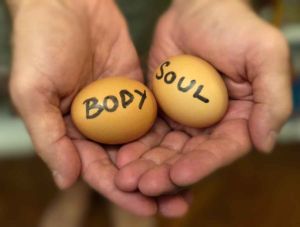
I came to realize that mystical teachings get it backwards when they insist that existence emerges from consciousness. Rather, consciousness can only exist as an emergent attribute of a physical entity. This is a fundamental point of divergence between my view and that of most other yoga teachers. The issue has been called the primacy of existence vs. the primacy of consciousness. The primacy of consciousness view allows for the separability of body and soul. My yoga is grounded in the indivisibility of body and soul – the primacy of existence.
The dualistic roots of yoga philosophy can easily reinforce disembodied thinking by reducing a person to two fundamentally incompatible elements: Purusha (consciousness) and Prakriti (physical nature). This is reminiscent of another Ayn Rand quote from her book Atlas Shrugged when she wrote that proponents of the soul-body dichotomy “…have taught man that he is a hopeless misfit made of two elements, both symbols of death. A body without a soul is a corpse, a soul without a body is a ghost.” Similarly, Samkhya (the darshanic partner of Yoga) famously describes a human as a lame man who can see (Purusha) being carried around by a blind man who can walk (Prakriti). By asserting the indivisibility of body and soul, I reject both models. Humans are not the ghost of a consciousness somehow being carried around by a dead lump of matter.
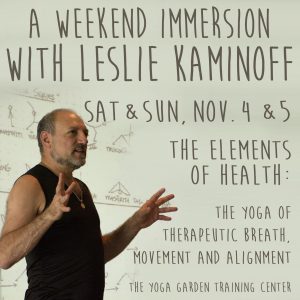
I’m grateful that the questions sent me by Triyoga for their blog post created an opportunity to consider these and other issues. I’ll be offering a special 90 minute donation-based program while in London: Free Will and The Nature of the Soul: A Philosophical Inquiry with Leslie Kaminoff with all profits going to a favorite charity of mine, The Africa Yoga Project. This will be on Facebook Live too, so we hope to see you there!
 Just finishing a month of teaching in Australia, I’ve had innumerable opportunities to practice a principle my teacher T.K.V. Desikachar often emphasized: “Yoga is relationship.” One of our Brisbane hosts is the witty and fierce president of
 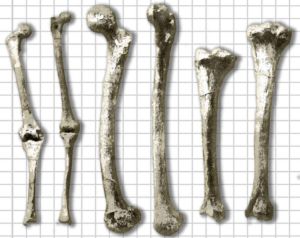 For the last several years I’ve been pondering the derivation and evolution of the term “alignment” as it relates to yoga asana. My interest correlates directly to the increasing number of repetitive strain injuries my private clients, many of them long-term practitioners, have been presenting with. It is no longer a secret how many
  In this photo, I am posing for an AP photographer with Evelyn Ashford, who at the time was the world’s fastest woman. Evelyn had sustained a hamstring injury in an early heat of the 100 meter dash, and I was treating her with the equipment. She recovered well enough to make the U.S. team and win a gold medal the 1984 L.A. Olympics in spite of a slight re-injury at the team trials (for which I also treated her). As part the promotion for the Sydney event, I was invited to a T.V. interview on “Good Morning Australia.
 This photo shows me on set preparing the equipment for my segment. I am wearing my best (and only) suit for the occasion. I was apparently still wearing that outfit when we visited a game preserve outside Sydney. There, I met kangaroos for the first time. Once the film was developed back in L.A. , I also noticed for the very first time that I was – at the tender age of 25 – going bald on the top of my head. I was shocked and devastated, but I’ve gotten over it.
 The rest of our trip was terrific. We traveled to Canberra to tour the brand new Australian Institute of Sport, and the headed up the Gold Coast to visit with some friends in Nambour before continuing up to check out the facilities at the University of Queensland in Brisbane. Finally, we went all the way north to Cairns, where we had a memorable scuba dive off the Barrier Reef. Lynda and I actually returned to Sydney in 1984 for a return visit that was more of a pleasure trip.
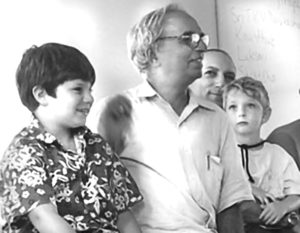 I was remembering how, in the summer of 2003, my teacher Desikachar’s family joined my family, friends and colleagues for a small ceremony to help inaugurate our new studio. Taken on that day, this photo shows me and my teacher and my middle and youngest sons, Jai (8) and Sasha (3). Afterwards at