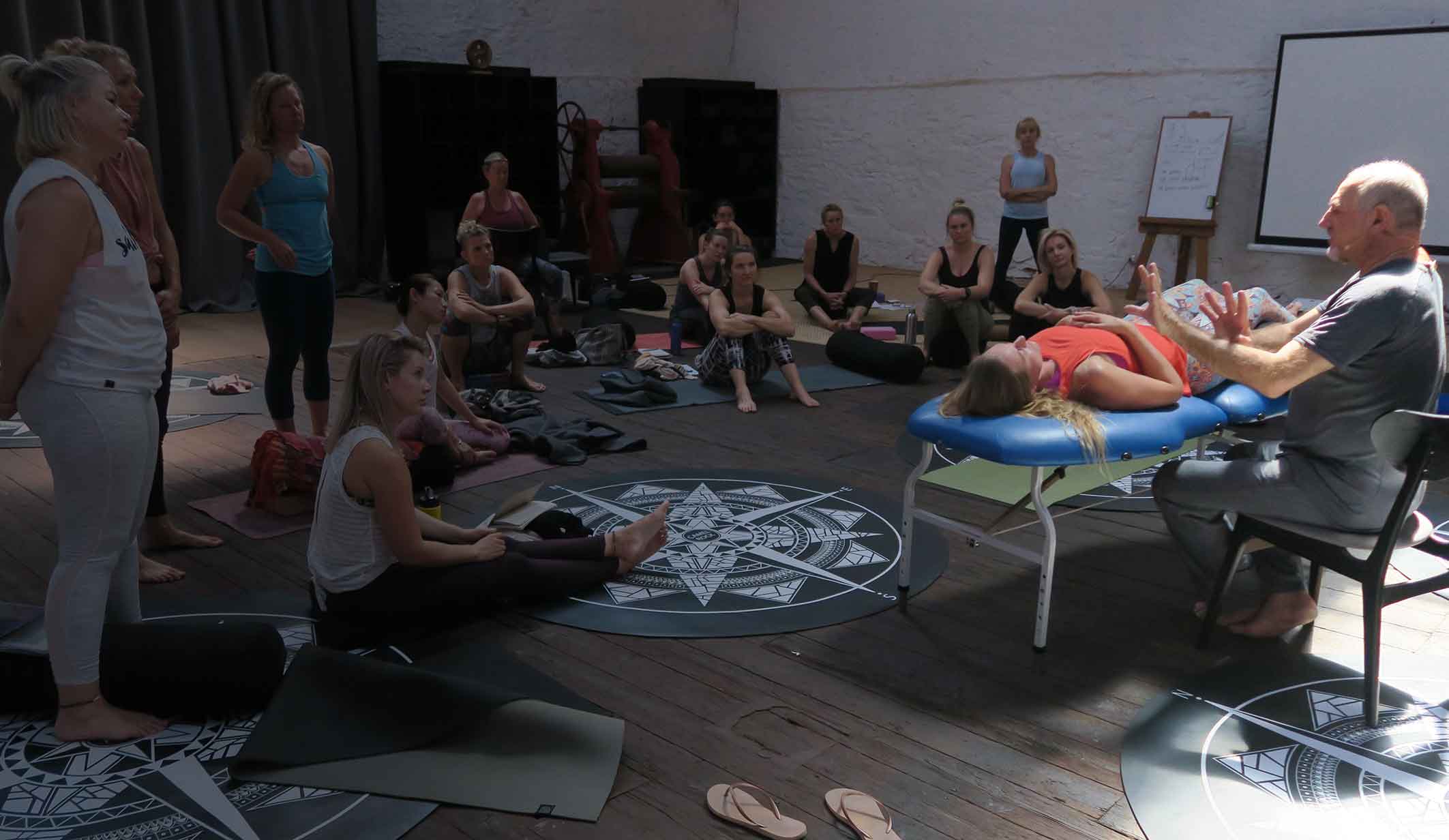


Leslie seated at a massage table demonstrating a technique for a roomful of students

Leslie Kaminoff is a best-selling author and yoga educator.

Blog

  • A Re-Declaration of Independence from a Yoga Educator

    A Re-Declaration of Independence from a Yoga Educator

    Orleans, MA

    July 4th, 2019

    Happy Independence Day!

    As I send this, the sound of Cape Cod fireworks is being carried through the window of my room by a warm summer breeze.

    I’m thinking of two anniversaries today. The first is July 4, 1979: Exactly 40 years ago today, at the age of 21, I left the USA for the first time in my life to travel to the Laurentian Mountains of Quebec, Canada. My destination was the headquarters of the Sivananda Yoga Organization to attend a month-long yoga teacher training course. I left the United States with one goal: to spend a nice month in the country sleeping in a tent, doing twice daily yoga and meditation, learning about Eastern philosophy and eating healthy food.  I had absolutely no inkling that I was embarking on a lifelong exploration of what it means to be a student and teacher of yoga.

    Since that summer in 1979, I’ve never looked back nor had another career.  It has been all yoga for me – first as a full-time staff member of the Sivananda organization, then as an independent teacher, bodyworker and studio owner. 

    From the very beginning, I was involved with the planning and execution of yoga related events, which is what I eventually did for a group called Unity in Yoga. From the mid 80s to the mid 90s, UIY brought together representatives of every tradition at international yoga conferences. It was at these events that the first discussions of national standards for the training of yoga teachers took place. I was, in fact, the author of the official 1993 statement from the Unity in Yoga Executive Board that endorsed the first-ever standards initiative:

    “We enthusiastically support the ongoing dialogue addressing higher personal, professional, and ethical standards for Yoga teachers and therapists.” 

    “We are in support of a process that results in the establishment of Yoga as a respected personal and academic pursuit, and any certification or accreditation that may result.”

    Those two sentences were released to the public.  There was a third sentence that the board voted to delete over my strong objections. I considered it critical to establish a principle upon which these standards could be built, and without this sentence that opportunity was lost:

    “We are, however, opposed to the establishment of any entity that assumes the authority to license or regulate Yoga teachers as professional practitioners and to enforce its standards on the Yoga community.”

    I have been arguing for the principle expressed in that sentence ever since.

    After resigning from Unity in Yoga in 1993, I agreed to be a member of the 1997 Ad Hoc Committee on teacher training standards.  We recommended the hours and subjects which became the 200 and 500 hour standards adopted by the Yoga Alliance, which came into official existence when it inherited Unity in Yoga’s non-profit status in January of 1999.1 

    By the time the Ad Hoc Committee became the Yoga Alliance, I had resigned.  For the next 15 years, I was a vocal and consistent critic of the Alliance.  I started one of the earliest online yoga forums (eSutra) for the express purpose of circulating these views, and fostering challenging dialogue with the emerging leadership of the Alliance.2

    Which brings me to the second anniversary I’m thinking of today, July 4, 2009: Ten years ago today, I hit “publish” on a rather lengthy and passionate blog post titled, “A Declaration of Independence for Yoga Educators.” 

    Anyone who has been following the 20-year saga of national educational standards for yoga would probably tell you that 2009 was arguably Yoga Alliance’s lowest point.  YA’s custodianship of the standards was widely viewed as a running joke and their infrastructure was in shambles. To make matters worse, several states were actively seeking to forcibly regulate yoga teacher training programs under vocational licensing statutes. 

    The Alliance had no policy against regulation ten years ago. Even if they had, they were prevented by the rules of their 501(c)(3) non-profit status3 from lobbying for or against anything. All YA could do was issue impotent, empty platitudes while at the same time making it easier for the regulators to come after teacher training programs by maintaining an online list of targets. In my blog post I was particularly hard on the president of the Alliance, Mark Davis, because in my judgment he did nothing to protect or inform his member schools about the dire consequences many of them were facing.

    I won’t repeat here my impassioned 2009 arguments against both regulation and the Yoga Alliance, but encourage readers to follow the link to my “Declaration” to get a sense of how desperate I found the situation back then.

    These two quotes from the “Declaration” make clear how much has changed in the intervening years:

    “…I’ve been telling people not to expect any support from the Alliance on this issue – ever. Even if its board members were willing to agree on a stand for or against licensing (which, as of this writing, they have not) the mere existence of YA and its online database have made it vastly easier for the state regulators to do their jobs…”

    “…Unlike the Yoga Alliance, IAYT (International Association of Yoga Therapists) has never sought to establish industry-wide standards for Yoga Therapy trainings – preferring to facilitate dialogue about standards among established and emerging schools…However circumspect IAYT remains about becoming an accrediting organization, without taking a strong stand against licensing, it has little hope of providing leadership as a strong defender of the freedom of its members…”

    And now, here we are on July 4, 2019: What a difference a decade makes!  From the ashes of 2009, the Yoga Alliance revitalized its executive board, hired new leadership (a number of times4), instituted an anti-regulation policy and restructured its non-profit status by adding a 501(c)(6)5 that is legally permitted to lobby against state control.  This is an essential shift considering the scope of the ever-expanding yoga industry. YA’s advocacy efforts have challenged and defeated every state effort to regulate yoga teacher training programs.  Beyond that, YA’s legal team has even argued successfully in favor of legislation protecting the rights of YTT’s to operate free of governmental interference.

    In addition, the Yoga Alliance has also joined the PHIT Act Coalition, a group of organizations that includes leaders in the fitness, sports, medical, and youth wellness communities who are lobbying for federal legislation that would allow individual taxpayers to place up to $1,000 annually in pre-tax medical accounts. These funds could be used to pay for physical activity expenses, including yoga.

    Meanwhile, in 2013 IAYT went from facilitating dialogue about standards to launching an application process for the accreditation of yoga therapy training programs, the first twelve of which were approved the following year. In 2016, they credentialed 500 of their members as “Certified Yoga Therapists” (C-IAYT).  As of this writing, IAYT leadership has still not articulated whether they are for or against the state regulation of yoga therapy training programs or practitioners. As a result, I have not attended an IAYT event since 2013.

    When I learned of the establishment of Yoga Alliance’s anti-regulation policy I began seeing them as a potentially positive force in the yoga industry.  In addition, when Richard Karpel took over as YA president in 2012 he went out of his way to find the strongest, loudest critics of the Alliance so he could reach out to them personally. Along with a handful of others, I was pleased to be the recipient of one of those calls, and we had a candid three hour conversation in which he admitted, without appearing defensive, to many of the failings for which I had publicly criticized the Alliance.

    Following this welcome and generous gesture, I re-engaged with the Yoga Alliance, very pleased to find there were other pro-freedom, free-market thinkers on the board and staff who were willing to discuss the principles behind an anti-regulation policy. In particular, I want to acknowledge Brandon Hartsell, the former chair of the executive board, and Andrew Tanner, former executive board member and long-time chief ambassador for YA. Both proved to be up to the task of hard thinking and confronting challenging tasks.

    Though I was sorry to see Richard Karpel leave the YA presidency, the new hire in 2017, David Lipsius, had the appropriate skill set and personality to lead the Yoga Alliance into the #metoo era, just as issues of injury and power abuse were heating up in the the yoga world. He brought a strong group of experienced staff on board and initiated the lengthy and daunting Standards Review Process (SRP) that culminated in last week’s announcement of the revised Yoga Alliance standards.

    I participated in the SRP last year on a panel that evaluated a proposed scope of practice for yoga teachers.  Since the context of my original 1993 protest to Unity in Yoga was about the lack of principled decision-making, my recommendations went beyond scope of practice to address the most important principles upon which all policy decisions must rest.

    Since last week’s release of YA’s updated standards, I’ve been asked by a wide range of yoga professionals and practitioners to offer my opinion. Now that I am no longer bound by the non-disclosure agreement all SRP advisors signed, I am free to fully share those thoughts with the world outside of Yoga Alliance leadership.

    This is the opening remark in the review I submitted: 

    YA should completely avoid any reference to “defining yoga.” It is not the job of the Alliance to do that, and any attempt at it would invite dissent, not unity of purpose. YA should function as a clearinghouse for ideas and debate that would help to educate the general public and teaching profession.

    Regarding YA’s overall mission related to fighting regulation, I said:

    The Alliance is walking a razor’s edge: on one side is the invaluable advocacy work being done to keep the government regulators out of our field; on the other is the need to avoid becoming the “yoga police,” along with everything that implies.

    All the discussions I’ve had with the current YA leadership leads me to believe that they understand my first point very well.  In fact, in response to the very first question asked in a podcast interview released just today, Shannon Roche, YA’s CEO and President explicitly stated that it is not the job of the Alliance to offer a single definition of yoga.

    Two nights ago, I had a long conference call with Shannon, Christa Kuberry, the V.P. of Standards and Erin Logan, YA’s Chief Operating Officer.  I told them of my intention to publish this article and requested their comments.  Shannon sent the following:

     “We know that there has long been a concern about Yoga Alliance stepping too far into the role of a regulatory body.  We worked purposefully throughout the Standards Review Project (SRP) not to overstep here and rather to best position ourselves to continue a central tenet of our work – that of fighting overburdensome regulation.”

    This is a strong statement with which I have only one issue. I would remove the word “overburdensome,” which implies that some regulation would be tolerated if it were judged to be “unburdensome.”  A more consistent stand would be to fight all regulation as a matter of principle. If you concede that the state has the right to regulate you at all, you have surrendered your freedom.  To paraphrase what I said in 2009:

    “…[Regulatory] enforcement [by the government] and Yoga cannot co-exist. Yoga is about freedom and Yoga is about relationship, and force destroys both. If we do not protect our right to conduct our relationships free of interference by third parties, there can be no yoga…”

    Shannon’s email continued:

    “We also know that many around the world who employ yoga teachers have chosen to make our [voluntary] credentials a requirement for employment, looking to them as an indicator of high-quality teaching and safe instruction.  We do not take this lightly but rather see it as a deeply meaningful responsibility.  At the same time, we learned from all of the feedback shared by the yoga community through the SRP that there were concerns about whether this actually is an accurate interpretation of our credentials.  We do not take the need to fix this disconnect lightly, either, as we want both employers and holders of our credentials to feel the same pride and confidence in these markers of quality and safety in yoga.  The significant enhancements we just announced to our standards and the increase in our application and review process are examples of these corrections we are taking.”

    Apparently, the Yoga Alliance has always considered their RYT designations to be credentials, but is now acknowledging that they have historically failed to act in such a way as to lend them much credence in the public’s perception. The upgraded standards are meant to specifically address that issue, which Shannon characterizes as a “disconnect.”

    I still maintain there is a big difference between the administrative function of managing a registry and claiming that registering a teacher is the equivalent of issuing them a valid credential.  I believe the only valid credential a yoga teacher could hold would be issued by the school or teacher that trained them, and would be a certificate.  Perhaps it is just semantics, but the underlying principle is what matters, and the principle is relationship. An organization issuing a credential to someone with whom they have had no personal relationship is a problem, one which Shannon apparently recognizes as well:

    “This does not mean that we are trying to replace or be a substitute for the appropriate relationship among schools, teachers, students, and mentors which, ideally, is the best place for many issues of concern to be worked out. What it does mean is that we accept our responsibility and intend to do so with integrity – such as ensuring that 200 hours equals a complete 200 hours, or that all Registered Yoga Schools operate with, for example, whistleblower policies in place. It would be irresponsible of us walk away from this responsibility, and we don’t intend to – it’s too important.”

    The “many issues of concern” to which Shannon refers go beyond training and certification. Some relate to problematic classroom behavior of teachers.  I’ve always maintained that if the first court of appeal for addressing ethical breaches is seen to be the Yoga Alliance, that indicates two things: YA is overstepping its proper function, and something has seriously broken down on the level of community, communication and mentorship.

    Some practical considerations I also voiced related to the expansive new operational responsibilities and activities YA is taking on by upgrading their standards. Application reviews, educational requirements, ongoing compliance, etc. would have profound financial, organizational and infrastructure implications for the Yoga Alliance. How does an organization which has historically had trouble responding to simple email requests for information become a more efficient operation capable of implementing the sweeping changes and increased vigilance to which they’ve committed themselves by February 2022?

    I also expressed concern that the burden of administering these new standards would shift focus and resources away from the vital and highly successful advocacy work against governmental interference with our industry.

    I was assured they are taking steps to address the administrative issues, and that their commitment to the advocacy work remains a core value for YA.  I was glad to hear that, but would be more convinced if the Alliance could explain not just that their anti-regulation policy is a correct and practical one but why it is a correct stand, on defensible ethical grounds.

    Without a strong ethical foundation in place, all that’s left is decision-by-committee or opinion poll. Majority opinion does not constitute a principled stand, no matter how many “elders, experts and wisdom holders” may have contributed. Opinions change, frequently and rapidly. The past few years of YA’s history eloquently attest to that.

    The Yoga Alliance has claimed that the foundation of their ethical principles is Yama and Niyama. Based on my understanding of those terms, this sounds good, but what does it mean to the Yoga Alliance, and its members?  

    The yogic teaching concerning what we should avoid (Yama) is presented before we are told what we should pursue (Niyama). This is a significant distinction, because it’s easy for YA, survey respondents, and panels of experts to say that they are in favor of setting the bar higher for the training of teachers and the registering of schools.  In my experience, it is a far more difficult task to consistently and defensibly identify a principle behind what you are not supporting.  As evidence, consider how the original standards dialogue started in 1997 with people readily agreeing on the need for setting the bar higher6, compared to how long it took the Alliance to formulate a policy against regulation 14 years later.  

    As mentioned earlier, IAYT – founded in 1989 – has still not taken a stand on regulation, and because they aspire to have a seat at the table of healthcare delivery, they need such a policy even more urgently than YA.  I often characterize the organizational distinction between the “easy yes” and the “hard no” as the difference between cheerleading and leadership.

    Here’s my case for a what is literally a first ethical principle from a yogic perspective. The very first Yama is Ahimsa – the avoidance of doing harm. In the context of YA’s mission, what exactly is it they must avoid harming? The process of teaching yoga.  What is the vehicle for the process of teaching yoga? The student-teacher relationship.

    In support of this principle the leadership of the Yoga Alliance should establish what I refer to as their “prime directive”7:

    “The Yoga Alliance must never insert itself into the student-teacher relationship, and must work to prevent anyone else from doing so.”

    The Yoga Alliance must function as a system of voluntary self-regulation in the field of yoga teaching. The training of teachers must be done by certifying schools and/or teachers, and the competency of those trainees can only be judged from within a teaching relationship.

    It cannot be emphasized strongly enough that membership in the Yoga Alliance is strictly voluntary.  When the state of Wisconsin tried to make YA membership mandatory as part of their regulation efforts, Alliance leadership was justifiably outraged, and threw their legal muscle behind defeating that initiative. 

    I am not now, nor have I ever been, a member of YA and that has not hampered me in the yoga marketplace – so far. Whether that continues to be the case depends primarily on my status (or non-status) as a provider of CEU contact hours recognized by YA.  Ironically, I’ve been assured that the online courses I’ve developed at yogaanatomy.net will not require some sort of YA “stamp of approval” in order be accepted for the 30 anatomy hours in the upgraded RYT200 standard.  BUT the CEU status of the live contact hours I provide in my in-person workshops seems to be in limbo due to my non-membership in the Alliance.

    Clearly, there are a few kinks like this to still be worked out.  Stay tuned.

    As always, your feedback is welcome.

    Leslie

    As always, my deepest gratitude goes to Lydia Mann for her unwavering support and expert editorial assistance.

    Footnotes:

    1As of July 4, 2019, the Yoga Alliance Registry’s underlying corporate identity was registered under the laws of Washington State – the former home base of Unity in Yoga’s late founder, Rama Jyoti Vernon. It has since been “adopted, as amended, September 28, 2024” to the state of Virginia.

    2 This excerpt from an e-Sutra post I wrote sums up my 1999 attitude toward the Alliance pretty succinctly: 

    I respectfully suggest that the Alliance do the following:

    • Complete its task of creating standards for instructors.
    • Make it clear that training programs and individual teachers will comply with the standards on a completely voluntary, honorary basis…No enforcement or verification. It will be up to the students to determine the honesty of their teachers (it always has been, anyway).
    • Thoroughly publicize the standards and the terms of compliance to the entire world.
    • Disband.

    3 501(c)(3)s are organized and operated primarily for religious, charitable, scientific, educational, and certain other purposes. They are what most people think of when referring to nonprofit organizations.   A 501(c)(3) is strictly prohibited from engaging in any political activity and is very limited as to the amount of lobbying they are permitted. The primary beneficiary of their actions is the general public, NOT their membership.

    4 Davis was gone by March of 2010, to be replaced by John Matthews, who would last about one year, followed by the 2-year tenure of Richard Karpel, which, after a gap, led to the 18-month reign of David Lipsius.  YA’s current President and CEO is Shannon Roche.

    5 A 501(c)(6) is business league or trade association that is organized and operated primarily to lobby on behalf of the common business interests of its members. 

    6 That was a very easy call back in 1997, when there were aerobics instructors being taught to lead yoga classes in a single weekend of training.

    7  The “Prime Directive” is a Star Trek reference. Early in the series “Enterprise” (a prequel to the Original Series) the first captain of the Enterprise Jonathan Archer sensed the need for a Prime Directive, and stated: “Some day my people are going to come up with some sort of a doctrine, something that tells us what we can and can’t do out here; should and shouldn’t do. But until somebody tells me that they’ve drafted that…directive… I’m going to have to remind myself every day that we didn’t come out here to play God.”


  • Upcoming travel to fabulous places!

    Upcoming travel to fabulous places!

    Rafael Corrochano from Radiantly AliveIn one month, Lydia and I will be heading to the other side of the world to teach for Rafael Corrochano and Jasmine Dañino, owners of Radiantly Alive in Ubud, Bali on June 1 & 2. This is a beautiful space amidst the treetops we visited last year during a 2-day holiday. During that too-short stay, Ubud became one of my favorite places and this will be my first time teaching in that yoga-haven. I hope to attract all those yoga retreatists for some breath, bandhas and om-ing between their massages and cocktails so please send all your vacationing friends and colleagues my way!

    Shivom Yoga & Dance logoAfter Bali, we will teach a weekend workshop June 8 & 9 at Shivom Yoga & Dance in Hanoi, Vietnam. Lydia and I have dreamed about visiting this beautiful country for years and look forward to exploring both before and after teaching. We welcome your recommendations for affordable and restful places to visit.

    Our yearly summer retreat in Cape Cod will be extra special this year, because we have added a Friday/Saturday workshop at the fabulous Orleans Yoga July 12 & 13. Studio owner Petra Ledkovsky was excited to learn that we’d be neighbors, so we put together an exciting program for this popular summer destination. It’s selling quickly, so book soon if you’d like to join us.

    Rounding out the summer will be our first ever trip to The Yoga Think Tank in New Harmony, Indiana. My August 17 & 18 workshop will be held at the beautiful New Harmony Inn Resort. This event is being hosted by our good friends Shanda Packard and Karen Sahetya, and we are anticipating a weekend filled with inspiration, transformation, and fun. There are just 25 spots open for early registration, so if you or anyone you know is in that area sign up now!

  • The Flying Swami: Vishnudevananda

    2018 was the 40th anniversary of my first yoga class at the Sivananda Yoga Vedanta Center here in New York City – still in its original location at 243 West 24th Street.  2019 will mark my 40th year as a yoga teacher.  Yoga took such a hold of me when I was 20 years old that it was less than a year between my first yoga class and my first trip out of the USA to live for month in a tent on a ski hill at the Sivananda Yoga Camp in Val Morin, Quebec, Canada.  There, I was trained as a Sivananda yoga teacher by the senior students of Swami Vishnudevananda, and by Swami Vishnu himself, who came out of seclusion halfway through our training to deliver daily lectures and lessons.

    A flood of memories of the extraordinary Swami Vishnu came rushing back to me the other day, when I saw that my old friend Srinivasan Ashley had posted to Facebook a BBC video commemorating Swamiji’s flight over Northern Ireland with Peter Sellers at the height of the troubles.

    I could go on endlessly with stories from my time with the Sivananda organization, but for now, I’ll let the footage speak for itself.  If you are at all interested in the history of yoga over the last 50 years, you owe it to yourself to take some time to get to know the man responsible for opening the oldest continually operating yoga center (Montreal since 1959), creating the largest yoga organization in the world (30 centers, 10 ashrams), and training the most yoga teachers (over 30,000 to date).  In a story for another time, I’ll write about how the month-long Sivananda teacher training served as the original template for what became the Yoga Aliiance’s 200 minimum standard.

    I highly recommend viewing the attached 2-part mini-documentary about Swami Vishnu’s lifelong mission for worldwide peace.  His vision may seem utopian naivety by today’s cynical standards, but the bravery he exhibited by flying his aircraft over the most troubled borders in the world (Suez, Northern Ireland, Berlin Wall) without a flight plan, passport or visa was unquestionable.  If he were alive today, I have no doubt he’d be flying over the Middle East, Burma or Pakistan challenging the authorities to shoot him down.

    Swami Vishnu’s legacy – as someone who stuck to his principles, and fearlessly defied authority – deserves to be remembered. As I type those words, I realize how much he has been a role model for me since the very beginning my yoga journey.

  • A tasty return to CAMYoga (and Stem + Glory)

    Delicious vegan (!) food from Stem + GloryWe’re thrilled to be returning to CAMYoga in November for one of my favorite topics geared specifically to yoga educators, Teaching Methodology For Breath-Centered, Individualized Yoga, as well as a weekend workshop for all yoga practitioners.

    Our host, Louise Palmer-Masterton wrote to say: “Leslie’s annual visits to CAMYOGA are the highlight of our academic year. He has had a huge influence on our diploma courses, and we are really excited to experience this year’s all new content especially for teachers, alongside two days for non-teachers. Leslie’s work really is inspiring for everyone, and is an absolute must for anyone interested in the subject of yoga.”

    We’ll be there over American Thanksgiving (a feast of gorging, for those of you unfamiliar with the holiday) which we may miss a bit, but we’re looking forward to delicious daily lunches at Stem + Glory, one of CAMYoga’s restaurants onsite at the Mitcham’s Corner studio. I don’t often find myself singing the praises of vegan food, but we loved each of our meals there.

    There are still a few seats left for each of my workshops but seating is limited so don’t delay (or send your friends if they’re in the vicinity!). And if you’re in Cambridge or London, make sure to stop by one of the Stem + Glory restaurants and tell them Leslie sent you.

  • The Art of the Answer-Sutra (+ commentary), part 3

    Here’s another exchange from my Instagram Stories Q&A, plus a bit more exposition:

    Q: Would you instruct to use the breath to lengthen the spine?  Is this possible?

    A: I generally do not give this cue unless the nature of the pose specifically calls for axial extension, which reduces all three of the major curves of the spine. And yes, any spinal action involves many of the major respiratory muscles.

    “Lengthen the spine” is a very common cue given in yoga class that is strongly associated with safety and proper alignment. I believe that – for the most part – when a yoga teacher gives that cue, their intent is to keep the spine in neutral meaning: “don’t collapse into flexion or over-arch into extension.”  In fact, a neutral spine can be relaxed without being collapsed, and is a component of many asanas, including: Sirsasana, Chaturanga Dandasana, Adho Mukha Svanasana.

    Anatomically it is not possible to lengthen your spine. The action of axial extension, in which all three curves of the spine are flattened and stabilized, can make you a bit taller – temporarily.  It is not a state you can live in forever, and you wouldn’t want to. It would be exhausting, and likely adversely effect digestion (acid reflux, anyone?).

    Axial extension is present to various degrees in a number of asanas such as Tadasana, Virabhadrasana III, Dandasana, Malasana/Upavasasana and Mahamudra, as well as any pranayama in which strong bandhas are engaged. In fact, the muscular action that creates axial extension is, by definition, the action of the bandhas:

    • Mula Bandha flattens the lumbar curve;
    • Uddiyana Bandha flattens the thoracic curve; and,
    • Jalandhara Bandha flattens the cervical curve.

    All these actions both reduce the ability of the spine to articulate and reduce the freedom of respiratory shape-change. In other words, the result is spinal and breath stability (sthira). As I said before, this is not something you want to hold all the time.

    Bottom line: unless I’m teaching one of the practices in which axial extension is specifically called for I do not refer to “lengthening the spine.”  You can find more detailed information about spinal actions in many of the major asanas in our book Yoga Anatomy.

  • The Art of the Answer-Sutra (+ commentary), part 2

    How do you know when your body is anatomically not built for a certain pose (and when to accept this)?Here’s another from my Instagram Stories Q&A, plus a bit more exposition:

    Q: How do you know when you’re (sic) body is anatomically not built for a certain pose (and when to accept this)?
    A: This is a key question that involves a deep practice of swadhyaya (self-inquiry), and it never has any final solution, because as our body ages, the answers will constantly change.

    My expanded commentary: Some questions cut right to the heart of yoga, and this is one of them. The second chapter (Sadhana Pada) of Patanjali’s Yoga Sutra offers a brilliant, succinct three-part definition of yoga practice (Kriya Yoga). Two of those parts (tapas and isvara pranidhana) are referenced in this question and the third (swadhyaya) is in my answer.

    The practice of poses (asana) can be seen as a kind of tapas. Although the term tapas is usually translated as “austerity,” a more useful view derives from its primary meaning of “warmth” or “heat.” My teacher T.K.V. Desikachar described the heat of tapas as a fire which removes impurities. Asana practice accomplishes this by working our physical body and breath against the grain of our embedded habits (samskaras). The assumption behind this idea is that we are working with something that actually is changeable – like how we breathe or hold tension in certain muscles – and this is how our bodies adapt to the practice. By contrast, we sometimes discover that some poses are made difficult (if not impossible) by some aspect of our body that is not going to change – like the proportional relationship of our arm-to-torso length, or the orientation of our hip joints – and this is when we must adapt the practice to our bodies.

    Through practice and self-reflection (swadhyaya) we can discover some things about ourselves that are not subject to change – that’s when acceptance of that reality needs to become our focus. This is isvara pranidhana, a surrender to that which is not changeable or within our control.  Or, as Desikachar put it: “…in the final analysis, we are not the masters of everything we do.” (from Heart of Yoga)

    To re-state what I said in my original answer, everything about our embodied existence is subject to some kind of change, so we must always maintain a self-reflective attitude that allows us to constantly re-evaluate what we are working to change, and what we need to stop trying to change.  Surrender is itself an act of will.

    Another well-known formulation of this principle is Reinhold Niebuhr’s Serenity Prayer which seeks to find “the strength to change the things we can, the serenity to accept the things we cannot change, and the wisdom to know the difference.”

    Stay tuned for more Q&A sutras with commentary, and if you have yoga anatomy questions please ask them on Instagram, or email me.

  • The Art of the Answer-Sutra (+ commentary), part 1

    Q: Is there any way to teach people not just do the pose but feel the pose?Some of you reading this may have been on my e-Sutra email-based discussion list since 1997, when it was run through my AOL account (an inelegant solution, but all there was at the time). Those early long-form threads tackled important issues at a critical time in the yoga community, but the reach was inherently limited.
    By far the vast majority of you are more recent members of my online community via web blog, Facebook, Twitter, or Instagram and may never have had exposure to long-form online writing. That type of inquiry-based exchange remains my comfort zone – evident to all who take workshops with me, as I insist on interaction and will ask questions of my students if they don’t speak up themselves!

    Newer social media opportunities, such as Instagram Stories, have simultaneously opened up a much broader reach while requiring ever-briefer sutra-like* answers. I am constantly trying to improve my ability to deliver meaningful information is as few words as possible, but often know there’s more I’d like to say. By way of illustration, here’s a question from Iness Lagios (_yoginess__) from a recent Instagram Story, and my brief answer, plus some commentary:

    Q: Is there a way to teach people not just to do the pose, but to feel the pose?
    A: Yes. It involves engaging students in an inquiry – but first, we have to stop telling them what they should be feeling, and inviting them to see what they notice.

    My expanded commentary: Iness’ excellent question touches on what is essential for anyone practicing or teaching yoga. The key to safety and effectiveness in asana practice depends on an ability to tune into your inner experience of the pose – not just mimicking a teacher, other students, or an idealized image of what the pose looks like, or what you’ve been told it should feel like.

    My current thinking on this is encapsulated by the following teaching methodology: “Try this, now try that…now, see what you notice.” I propose that teachers should always have at least two different ways of teaching a single practice. By offering options in close succession students are encouraged to notice what difference they feel, if any, putting focus on their own embodied experience.

    Invariably, some students will have trouble noticing any difference between the options, and it’s easy for them to feel left out or to assume they “did it wrong.” That’s why I always leave a lot of space in my classroom for not knowing. In fact, I honor confusion as a necessary starting point for any meaningful inquiry, as long as it is recognized. I’m pretty certain that for at least the last decade of workshops I’ve always quoted my teacher T.K.V. Desikachar on this point: “The recognition of confusion is itself a form of clarity.” This is the point from which an asana practice can become yoga, not just physical exercise.

    Stay tuned for more Q&A sutras with commentary, and if you have yoga anatomy questions please ask them on Instagram, or email me.

    * My teacher T.K.V. Desikachar’s father, T. Krishnamacharya, described a sutra as being inspiration for the teacher rather than instruction for the student. When I refer to something as “sutra-like” I mean to offer some direction with room for exploration and development, not a hard-and-fast rule.

  • My Friend Ti.

    I want you to know about a friend of mine. Her full name is Terecita Mahoney Blair, but everyone calls her Ti (sounds like “Tee”).  August 8 is her birthday and I sincerely hope it marks the start of a wonderful next year.

    Ti is one of my (s)heroes. Life has dealt her some pretty tough cards yet she consistently inspires with dedication, determination and a relentlessly positive, honest outlook.

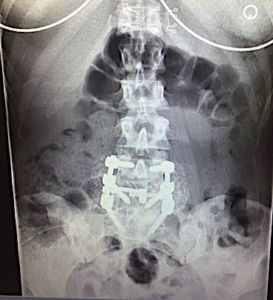
    I don’t know too much about her early life, but in 2009 Ti got hit by a bus. Her spine was badly broken, and she needed 5 surgeries in the years that followed. Turns out, the hardware that was implanted did not do what it was supposed to and she has been struggling with a host of bizarre and awful symptoms, often being dismissed by orthopedists and other medical professionals. It’s a wonder she was vertical at all, once she learned that nothing more than scar tissue and muscle spasms were keeping her vertebra together (photos below of the faulty and replacement hardware).

    photo of spinal hardware
    Bad spinal hardware, that never should have been put into anyone’s body, and never permitted spinal fusion to take place.

    Ti wrote about her new spinal hardware: “Bottom screws into sacrum, L5 and L4. You can’t see them, but new Titanium plated cages were inserted. Bone should grow within the vertebrae and on the outsides of all the hardware, making for a solid fusion.”

    I met Ti five years ago this month in Los Angeles, when I taught a workshop at Black Dog Yoga, where she was working as their Teacher Training Administrator. Ti was familiar with me through my online courses, which Black Dog had been using as part of their teacher training. You never know who’s going to walk into one of your classes. All educators need to remember that. Ti was just four years post-surgical, and I could have asked a million questions of her, but if I thought I could keep her *safe* during my workshop, I would have been sorely mistaken. All we can do is set up reasonable experiments for our students to try on their “rectangular laboratories” (aka yoga mats), and encourage them to notice what they are experiencing.

    Ti at her temporary work station (laptop on her bright pink walker) answering questions from students in my online Yoga Anatomy course.

    Ti was a careful and wise student, applying the anatomy and asana practice I was presenting, and referencing what she found in her own body. As she wrote in a recent Facebook post: “Leslie Kaminoff’s Yoga Anatomy (is) the foundation of how I teach and understand pain, relationship and balance.” As an educator, I couldn’t possibly hope for a better student.

    When Ti and her husband moved to Denver, it was a natural fit for her to connect with the creator of our online courses Kelsey Kaufman, who lives in Fort Collins, CO. Ti eventually became our anatomy homework coach for the online courses. I am touched and honored to know that her work with us has been a lifeline when she’s been so laid up with physical pain, she’s had to take a break from pretty much everything else.

    I travel around the world teaching yoga for a living – mostly to other yoga teachers, and I feel privileged when I meet people like Ti, whose primary focus is on doing whatever good they can for populations they care most about.  For Ti it’s seniors and first responders, two groups that often get lost in the cracks of our society.  For others, it’s trauma survivors, prison populations, people in recovery, teens at risk…the list is endless. This commitment to using the tools of Yoga to better the world is a never-ending source of inspiration.

    video link Last year, we were thrilled when she was voted the 2017 Silver Sneakers 2017 Instructor of the Year. Please watch this video celebrating Ti’s award and bear in mind that – unbeknownst to her – her spine was being inadequately held together by ill-conceived hardware all the time she was jumping around and leading these classes! Ti’s commitment to frequently invisible populations, in this case older folks needing to get or stay moving, catapulted her along and her life-experience made her a sympathetic example for these elders experiencing their own physical challenges.

    What really makes Ti a hero to me is that through all the pain of recovery as well as her internal demons, she not only maintains a positive attitude but keeps focus on what really matters to her: other people who are struggling. The way she walks through the world reminds me of my teacher, T.K.V. Desikachar’s, admonition that “yoga is relationship.”

    Reconnecting with Ti in Los Angeles a number of years after she showed up in one of my workshops, and just as she was joining my online courses as homework coach.

    There is a great deal of talk about corruption of yoga, and commercialization, and the need for third-party reimbursement and licensing and blah blah blah blah. But Ti is an example of true yoga in action. She has made it her life’s work to seek out and serve communities in need, people who might not otherwise know about coordinating breath and mind and movement in a way to enrich and embody their day-to-day experience. She works one-on-one with veterans and first responders recovering from traumatic injuries, and has forged remarkable relationships with many of them.

    She has been brutally honest about the pain and despair that lurks behind her smiling face and started a Facebook project to help her through this really tough post-surgical period. She is using the medium to raise awareness for many of the causes she supports, by wearing a different “Ti-shirt” every day emblazoned with their logos. Here are a few of the organizations she supports:

    The 2018 Colorado 9/11 Memorial Stair Climb honors and remembers fallen firefighters.  Ti has promised (with her surgeon’s permission) to climb at least one stair on 9/11.  She has set a goal of raising $1,111.00 by then, and I am certain she’ll do it simply because it is something she has set her mind to. I just donated $108.00 and hope you will too, if you can spare it.

    Safe Call Now: A no-cost confidential crisis referral service for public safety agency employees all first responders and their families nationwide.

    Emergency Responder Trauma Counselors (ERTC) provides specialized counseling for emergency services personnel and their family members, related to their work and home life and the variety of stressors in which affect them. Including but not limited to PTSD, anxiety, addiction, depression and grief.

    ResponderStrong: Emergency responders working with the National Mental Health Innovation Center to improve mental wellness among Colorado responders and their families. .

    Officer Involved Project: Officer Involved is a thoughtful documentary that examines officers who have been involved in deadly force incidents during their tour of duty.

    I am proud beyond measure to know Ti and others like her, who constitute the vast majority of the yoga teaching universe.  I’m similarly proud to offer what I can in the way of teaching to the online community we’ve built over the years – a community that now spans 45 countries and over 4,000 students – many of whom are lucky enough to have Ti as their homework coach. On the occasion of Ti Mahoney Blair’s birthday, I recommit to keeping my yoga real and staying connected to those around me. I hope you are inspired, as I have been, by her life and work.

    Happy birthday, Ti!

  • New Breathing Project Programs in 2018: Coaching for Your Breathing Body

    I’m very excited about some brand-new community workshops I’m calling Coaching for Your Breathing Body: a 3-workshop Series for People Who Use Their Lungs.

    The programs are open to all, and I’m particularly keen on attracting people who have either acute or chronic breathing issues. So, if you or anyone you know gets asthmatic symptoms during allergy season, or gets short of breath when exercising, is a singer or actor who’s been told to “sing from your diaphragm,” or is suffering from a more serious challenge like COPD, please consider getting some expert attention and help. No yoga mats or bare feet are needed, and seating will be available.

    REGISTRATION AND DATES:
    Thanks to our co-sponsor WOOM Center, we are able to offer these workshops on a donation-based sliding scale ($15-$30 per workshop). Please pay what you can after clicking “Donate” for the workshop date(s) of your choice, and you’re welcome to attend more than one.

    September 30 November 4

    TIMES:
    All Sunday times are from 2:30 to 5:30pm.

    LOCATION:
    The events will be at the beautiful, immersive environment of WOOM Center, 274 Bowery, 2nd Floor, (bet. Houston & Prince), New York, NY MAP

  • Celebrating Desikachar: Share Your Story!

    In the process of promoting our upcoming event at Kripalu, “Celebrating Desikachar: A Life in Yoga, A Legacy of Learning,” we have heard from many people who are unable to attend, but who nevertheless felt moved to share their personal stories about how deeply they’ve been affected by his teachings.

    We have found a way to include these voices at our event – we are inviting anyone, from anywhere in the world, to send in a short paragraph about how their lives have been touched by the life and teachings of Desikachar.  We will print out your message and hang it on a wall of remembrance at our event.  After the event, we will post these messages to a Facebook group page for the world to see.

    It’s super simple to contribute – just send an email to: T.K.V.Tribute@gmail.com