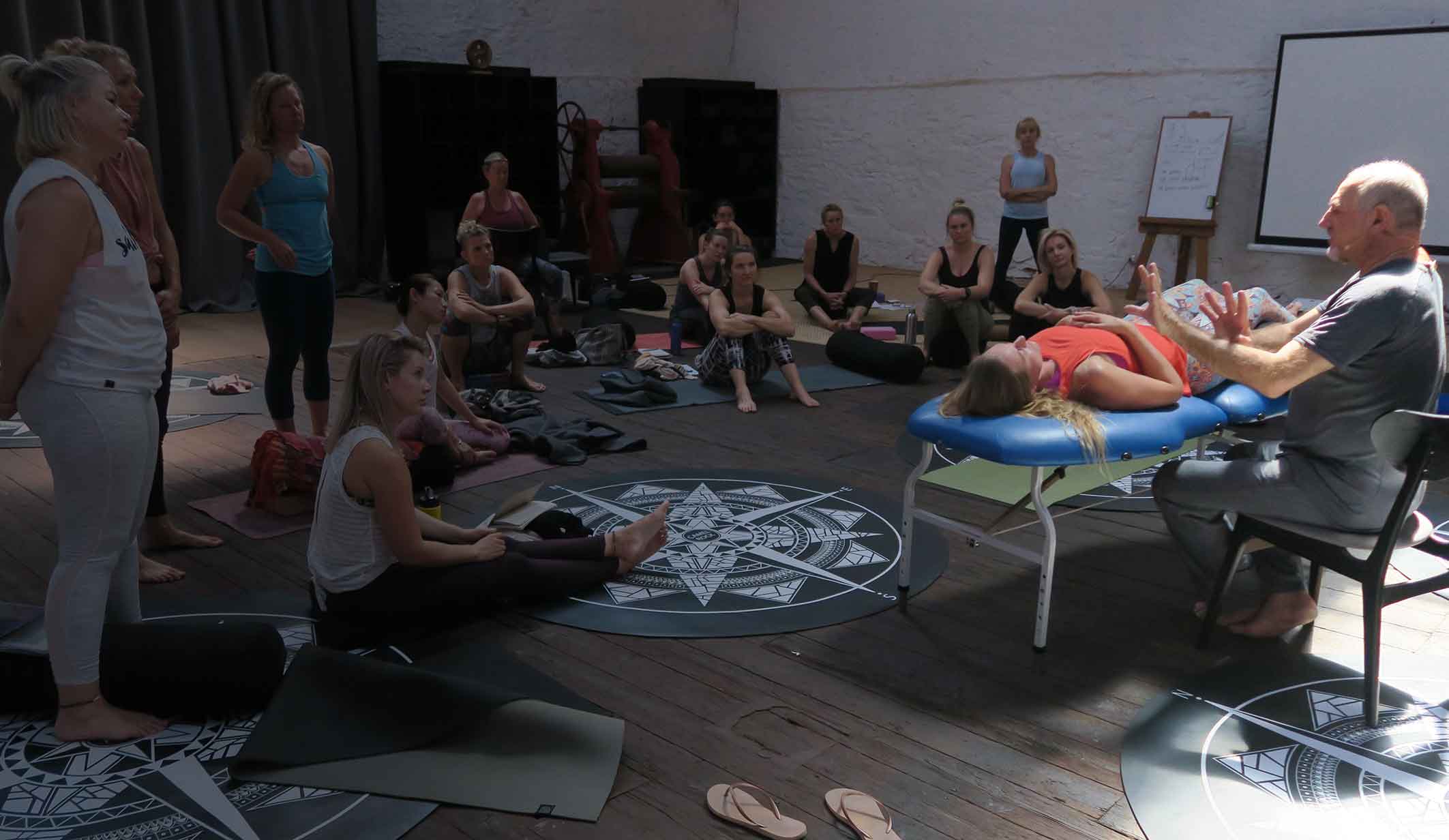
Leslie seated at a massage table demonstrating a technique for a roomful of students

Leslie Kaminoff is a best-selling author and yoga educator.

Blog

  • The Case for the 3-D Diaphragm © Leslie Kaminoff

    This is a rough draft of some material I’ve been working on for the past couple of months. It is written in a somewhat technical style that presupposes a certain level of anatomical knowledge in the reader.
    It can be viewed as a follow-up to the discussion of “Breath Flow” archived on e-Sutra. It is also a preview of some of the key points I’ll make in my presentation to “The Future of Breathing” symposium at Kripalu this Fall.

    The Case for the 3-D Diaphragm © Leslie Kaminoff

    Please keep in mind that this is copyrighted material. I have no problem with you forwarding it to anyone who may be interested, as long as the attribution, copyright warnings, permissions and links to e-Sutra are kept intact; so, if you forward it, be certain that everything between the dotted lines gets copied into your message.

    Enjoy, and (as always) let me know what you think.

    Leslie

    ===================================

    ****BEGIN INFO****

    copyright 2004, 2005 Leslie Kaminoff and The Breathing Project, Inc.
    All rights reserved. No copying, transmission, or other use permitted without specific permission of the author.

    The author permits the forwarding of this piece to anyone who may be interested, as long as the attribution, copyright warning, permissions and link to e-Sutra are kept intact; so, if you forward, be certain that everything between “BEGIN INFO” and “END INFO” gets copied into your message (including the words: “BEGIN INFO” and “END INFO”) .

    The author of this piece is the founder of the e-Sutra yoga e-mail list. If you wish to participate in a dialogue about this, or any other topic of interest to the yoga community, you may subscribe to e-Sutra by either of the following methods:

    To subscribe by e-mail, click here
    To subscribe by web, click here

    To view the e-Sutra blog, click here

    ***ROUGH DRAFT***

    The Case for the 3-D Diaphragm
    By Leslie Kaminoff
    copyright 2004, 2005 Leslie Kaminoff and The Breathing Project, Inc.

    There is no question that teaching people the efficient use of the diaphragm is very important. Problems arise, however, when the action of the diaphragm is viewed in the limited context of its effect on movements in only the abdominal region of the body. This action, often referred to as “belly,or abdominal breathing” represents only one dimension of the increase in volume that the diaphragm creates in the thoracic cavity; the vertical. I will explain how the diaphragm is capable of increasing all three dimensions of the thoracic cavity, namely: the vertical (top-to-bottom), the transverse (side-to-side) and the sagittal (front-to-back).

    What are the problems that arise from this limited perspective?

    Many people who teach and learn abdominal breathing determine the quality of their breathing only by its location in the torso, i.e.: abdominal movement is good, thoracic movement is bad. This ignores the critical issue of effort. It is possible (indeed, quite common) to do tense belly breathing, just as it is possible to do relaxed chest breathing. In addition, this top/bottom distinction is only one-dimensional, as it ignores important lateral and sagittal breath movements.

    By equating abdominal shape change with diaphragmatic breathing and thoracic shape change with accessory (non-diaphragmatic action), a false distinction is perpetuated between diaphragmatic and non-diaphragmatic breathing. ALL breathing is diaphragmatic (except in cases of paralysis, such as quadriplegia). It is untrue and damaging to suggest to someone who predominantly exhibits thoracic shape change that they are not using their diaphragm. They are using it inefficiently, and perhaps in combination with many other unnecessary muscles, but they are certainly using the diaphragm.

    By accepting abdominal breathing as “correct,” learning and automatizing the habit, the breathing mechanism becomes less adaptable. Being stuck in any pattern will create problems, regardless of how useful that pattern may be in a given context.

    Please keep in mind that it is not my intention to negate or disparage the enormous benefits that derive from learning the conscious use of the diaphragm thru abdominal breathing. It is my intention to literally bring a more three-dimensional approach to the field of breath training.

    Breathing as Shape-Change

    To clarify this perspective on the breath, it will be useful to clearly define what I mean by breathing. In the context of this argument, the term breathing is being limited to the mechanical act of increasing and decreasing thoracic volume; in other words, inhaling and exhaling.

    A useful definition for breathing is: “The shape-change of the thoracic and abdominal cavities.” Both cavities – by definition – must change shape in the act of breathing; the diaphragm is the floor of one and the roof of the other. There is, however, a significant difference in how the two cavities change shape in the act of breathing. The thoracic cavity – like a bellows – changes its shape and volume, while the abdominal cavity – like a water balloon – changes its shape, but not its volume. This is why it is misleading to describe an abdominal breath as an “expansion” of the belly; it is actually a bulging of the abdomen, who’s contents are non-compressible or expandable. This is in the context of breathing only; in the context of other life-processes, the abdominal contents will of course fill and empty, thus changing their volume. It should be noted though, that any increase in abdominal volume will require a decrease in overall thoracic volume. This is why it is temporarily harder to breathe “on a full stomach” and chronically harder to breathe if you are obese or pregnant.

    The muscles that control the shape-change of breathing are usually categorized as “muscles of inspiration” and “muscles of expiration.” This can be confusing, since some “exhaling” muscles can be quite active during an inhale, and vice versa. I prefer to categorize the muscles by their effect on thoracic volume; there are muscles that act to increase thoracic volume (principally the diaphragm), and there are muscles that act to decrease thoracic volume (primarily the abdominals and internal intercostals).

    A New Definition of Accessory Muscle Action

    Muscles other than the diaphragm that can increase thoracic volume are commonly referred to as accesory muscles of inspiration, and these include the external intercostals, the scalenes, the strenocleidomastoids, the pectoralis minor, the serratus anterior, and others that must work to stabilize them.

    There are no accessory muscles of thoracic volume reduction due to the fact that they are ALL accessory to the passive elastic recoil that produces exhalation in a relaxed state.

    Since the contraction and release of the diaphragm alone is capable of producing both the inhale and the exhale, a case could be made for referring to ALL muscles of throaco-abdominal shape-change other than the diaphragm as accessory.

    Of the accessory muscles of thoracic expansion, the external intercostals are most important to understand. Although the diaphragm is capable of expanding the ribcage without their help (see below), they are frequently involved in thoracic breath movements. It has been argued that ANY intercostal muscle – because of its location between the ribs – is incapable of expanding the ribcage by virtue of the fact that muscles can only shorten; therefore it would be obvious that a shortening muscle lying between the ribs could only draw those ribs closer to each other in an exhalation.

    The above argument would hold up if it were not for the fact that the space between the ribs actually remains constant during all phases of breathing, and the changes in volume of the ribcage are brought about by the SLIDING of the ribs in relation to each other during respiration. The intercostals, being arranged in perpendicular layers oblique to the direction of this rib sliding are, in fact, ideally suited to assist in respiratory movements.

    A useful analogy of the relationship of the diaphragm to the accessory muscles is the relationship between a car’s engine and its steering mechanism. The motive power for the car is provided by the engine, but you can’t steer the car with the engine; that is the job of other structures. In a similar way, the diaphragm is the engine of thoraco-abdominal shape-change (breathing), while the accessory muscles modify, or “steer” the shape-change in a particular direction (e.g. “belly breath” or “chest breath”).

    How the Diaphragm Expands the Ribcage in 3-D

    A closer look at how the thoracic cavity changes its shape reveals several facts:

    The best-known fact is that the contracting muscular fibers of the diaphragm pull the central tendon downward, lowering the floor of the cavity, thus increasing its vertical dimension. This is a description of the famous “abdominal breath.”

    A lesser-known fact is that the contracting fibers of the diaphragm pull the base of the ribcage upwards, causing the ribs to hinge at their costovertebral articulations, thus increasing the transverse and sagittal dimensions of the thoracic cavity. This is why it is correct to say that the diaphragm creates three-dimensional expansion of thoracic volume.

    Like many muscles, the diaphragm can move its insertion towards it origin (central tendon towards base of ribcage), or its origin towards its insertion (base of ribcage towards central tendon). It’s all a question of which end of the muscle is mobile, and which is stable. From this perspective, a belly breath is the result of stabilizing the diaphragm’s origin and mobilizing its insertion, while a chest breath is the result of stabilizing the diaphragm’s insertion and mobilizing its origin.

    Without this three dimensional perspective on the relationship between diaphragmatic and accessory action, the role of the “yogic locks” (bandhas) cannot be integrated in any meaningful or useful way by the yoga practitioner.

    Limited Direct Control of the Diaphragm

    Our direct control over the action of the diaphragm is limited to its timing. We can accelerate or retard its contraction within a range of choice that is severely limited by physiological barriers. Keeping this in mind, it is important to note that specific breathing patterns are not directly brought about by any changes in the action of the diaphragm itself; all it knows how to do is to shorten its fibers, and then stop shortening its fibers. The nearly infinitely variable breath patterns are created by the accessory muscles’ ability to stabilize various regions of the thorax and abdomen while the diaphragm is doing its work. Of course, uncoordinated action of the accessory muscles can lead to both acute and chronic dysfunction of the diaphragm, while the coordinated action of the same muscles leads to increased breath and postural integrity.

    This is why it is misleading to refer to breathing exercises simply as “diaphragmatic training.” Breath pattern retraining can more correctly be referred to as accessory/diaphragm coordination.

    The Unobstructed Breath

    Of course, it’s possible to release all of the diaphragm’s stabilizing muscles, and allow its origin and insertion to freely move towards each other. This is the definition of an “unobstructed breath.” This rarely occurs, as the need to stabilize the body’s mass in gravity will cause many of the respiratory stabilizing muscles to remain active through all phases of breathing. The goal of breath training (on a planet with gravity anyway) is to create the most efficient (least obstructed) postural/breath patterns possible in an ongoing context of body position/movement and effort/intention.

    Breath and Posture

    Since the diaphragm, in an unobstructed state, will create 3-D shape change in the thorax, intentionally isolating that shape change in the abdominal region requires one to block the other dimensions of movement. In other words, isolated abdominal breathing requires the contraction of the muscles that restrict rib movement. Furthermore, it also requires the relaxation of the abdominal wall. By persistently breathing in this pattern, one will develop a chronic tightness in the thoracic structures that support the shoulder girdle and head, as well as a chronic weakness in the abdominal wall, which provides support for the lower spine. In short, habitual abdominal breathing interferes with effective postural support. It is precisely this action of disengaging postural support that can make abdominal breathing useful for supine relaxation (if it’s done in a non-tense manner). Significant problems will arise if that pattern persists upon standing up, for the breath will be prevented from adapting to the demands of vertical support.

    The Emotional Connection

    It should be noted that the pattern described above also limits emotional flexibility, as it habitually reduces the sensory perception of space and movement within one’s chest and abdomen – the metaphorical “heart and gut centers” we all seem to need more connection with. In short, although belly breathing may reudce some stress symptoms in its practitioners, getting stuck in that pattern presents the very real possibility of reinforcing one’s emotional defense mechanisms.

    Think of what you do in your belly to protect yourself from a punch; now picture doing that more or less all the time on a subtle, subconscious level. Now picture moving that tension forward and back as you breathe, and you’ll understand how many people do their abdominal breathing without ever really releasing the underlying tension.

    In other words, moving your belly tension around with your diaphragm through “abdominal breathing” may provide some very real short-term benefits, but releasing the tension altogether requires a more comprehensive, system-wide understanding of the breath.

    Yoga

    In a fundamental way, this relationship of breathing patterns to the critical issues of support and release forms the methodological basis of yoga practice. Breath and posture are different ways of viewing the same thing.

    Breathing is how we mobilize the space through in our bodies, and posture is how we stabilize our bodies in space.

    This perspective is clearly expressed by Patanjali in the second chapter of the Yogasutra when he defines asana practice as Sthirasukhamasanam: Sthira (stability) and Sukha (ease) are the dual qualities of Asana (yoga posture).

    Another take on Sthira and Sukha relates those terms to the exploration – on all levels – of the healthy relationship between boundaries and space. This includes our sensory, emotional and conceptual spaces – but it all starts with getting the physical spaces to cooperate in a harmonious way.

  • Tension or Compression: The Fundamental Distinction

    This thread contains an essay that Paul Grilley wrote, at my request, for e-Sutra. The follow-up posts are from myself, senior teachers of The Breathing Project and others. This is still an open thread, and more comments are welcome, including a response from Paul.

    Tension or Compression: The Fundamental Distinction
    Paul Grilley
    September 20, 2004
    Ashland, Oregon

    Posted to e-Sutra January 4, 2005

    Architectural principles start from the premise that all structures, including our bodies, are a balance between stretching forces and crushing forces, or briefly “tension and compression”. The cables that stabilize telephone poles or lift elevators are being stretched, they are subject to tension. The telephone pole itself or the support columns holding up a building are being pressed, they are under compression. When we practice Yoga asana the fundamental distinction to make is this: “Are the physical restrictions I am feeling tension or compression?” Tension is due to the stretching of muscle or connective tissue but compression is determined by the shape of our bones.

    Skeletal differences
    The bulk of my work as an invited Yoga teacher is anatomical. A few years ago I walked into “The Bone Room” in Berkeley, California and purchased five human femur bones. It was the best investment I ever made. In nearly all my presentations I point out the dramatic differences between these bones. Besides the obvious size and length variations I point out how some bones are twisted 40 degrees backward or rotated 30 degrees upward. These differences might remain a mere curiosity but when these skeletal differences are coupled with the idea of compression it usually turns a student’s yoga world around. Because all of our bones are different, all of our joints compress at different angles of flexion and extension. Through our Yoga practice we can discover where we compress but our Yoga practice will not change where we compress.

    A brief outline of the ideas presented in an “Anatomy for Yoga Workshop” is as follows:

    1. When we practice asanas we move our joints.
    2. When we move our joints our bones pivot away from each other.
    3. Because the bones are moving apart tissues are stretched.
    4. At first our limits of motion are determined by how much we can stretch.
    5. But the ultimate limit to our range of motion is compression.
    6. Compression is due to the shape of our bones.

    Tensile Metaphors
    Virtually all the metaphors of present day Yoga instruction are tensile.
    “Relax” – relax the muscle tension, “Breath into it” – soften up the tissue, “Let go” – relax tension, “Make a space” – let the bones move apart. But limiting our conceptions to tensile metaphors is walking with one leg. For the vast majority of us who have practiced yoga for several years the restrictions we experience are compressive, not tensile. It is the inherent shape of our bones that determines what we can or cannot practice safely. And because each person’s bones are differently formed then what is beneficial for one person is destructive to another.

    Perfect Postures
    My goal in presenting compression as the ultimate limit to a range of motion is to free ourselves from the tyranny of “proper form” and “perfect pose”. Asana practice is supposed to be a mild therapeutic that allows us to influence the movement of prana and fluids through our bodies, but in the present environment there is a naive belief that if we all try hard enough we can “do all the poses”. This is wrong. More damaging then the physical strains caused by pushing to “perfect” a pose is the lingering feeling of inadequacy. Many instructors explicitly or implicitly teach that our inability to perform asanas “correctly” is a reflection of deeper emotional problems. Because of this many students place far, far too much emphasis on “perfecting poses”. Many students pursue this imagined perfection not out of any vain desire to look good but because they earnestly want to uncover whatever is “holding them back” in their spiritual life. Note that “holding back” is a tensile metaphor. Having no idea of compression they dimly imagine that their joints must be restricted by soft tissues that they should be able to “lengthen”, “soften”, or “relax” if they could just “let go” of their emotional baggage.

    Teach Skeletal Differences and Compression
    Compression is not a native conception to Yoga students. Even if a student senses a “natural limitation” in their movements they will not use the word “compression” to describe it. The closest they will come is “I don’t bend that way.” Time and again I have seen students unable to tilt his pelvis forward in a forward bending posture because the trochanter of their femur is compressed. When I ask them where they feel the restriction they are not sure what to say because they don’t feel a “stretch” in their groin or hamstrings. They are not in pain. Pushing on them doesn’t bother them much. They just “can’t do down”.
    Because of the nature of my work I am constantly asked by students what they can do to “improve” different poses. After a quick examination of their skeletal movements I can usually tell them there is nothing to “improve”, their asanas are fine as they are. I tell them that they don’t look like the pictures in the book because of the shape of their bones. People in my workshops usually accept this opinion with a huge sense of relief but this is because they have been introduced to the ideas of skeletal differences and compression. Without these two ideas Yoga students sometimes interpret any suggestion of limitation as “pessimistic”. But if it is possible to communicate to a student that it is the unique shape of her bones that is limiting her then she will start to let go of trying to make her poses “perfect” and begin to relax and enjoy her practice.
    I will end this brief introduction with two caveats. One, our mental and emotional life is reflected in the tissues of our bodies but this reflection is primarily in the soft tissues of the body. Two, asana practice influences the health of our bones but this is something different from their general contour. It is the general contour and proportion of our bones that determines our ranges of motion.

    =============================
    ============================

    Posted March 23, 2005

    (LK: Here, finally, are the responses to Paul Grilley’s article about tension and compression. Amy Matthews and Carl Horowitz are senior teachers here at the Breathing Project in New York. Sara Tirner is a New York yoga teacher who has graduated from our Yoga Anatomy program. Matt Huish is an accomplished yogi, teacher and scholar who I had the pleasure of meeting when I taught in Portland last year. His wife Nicole did the cadaver dissection with us last August. My comments are at the bottom of the post.))

    ==============================
    From: Amy Matthews
    Comments on Paul grilley article for e-Sutra “Tension or Compression: The Fundamental Distinction”

    Dear Leslie –

    Thanks for asking for my comments on Paul Grilley’s article. It was a pleasure to consider his ideas, and doing so helped me organize my own thinking on some of the issues he raised.

    I agree that one way to organize our perceptions in a yoga pose is between the sensation of “tension and compression”, as Paul Grilley points out. The sensation of compression is very different than the sensation of tension (or stretching), and is a rich area for exploration – especially for those who are more flexible. For a student to begin to refine their perceptions to distinguish between these two sensations is a starting point for further refining their experiences.

    Rather than having compression be the end point for the exploration of a pose, it can initiate another level of exploration – with consciousness, by changing our alignment we can also change the vector of compression, to flow along the line of force in the bone or to shear off at an angle and create stress at the joints.

    In my own teaching, as I’ve shifted my focus from encouraging students to seek the sensation of stretching in muscles to sensing the flow of weight or force through bones I have seen them come to a new understanding of the dynamic relationships between the parts of the body, and how those relationships are affected by breath, attention and intention.

    I absolutely support the idea that we should be freed from the “tyranny of “proper form” and “perfect pose”” . . . and I would say that part of finding that freedom is re-defining how we describe limits, and how we describe a perfect pose. Instead of saying that a perfect pose is not achievable, my hope is have students look at what they define as their limits, and see if they can change their understanding of what perfect pose is. With that idea, the understanding of perfection would integrate each individual’s context, and no two ‘perfect poses’ will look alike.

    To limit our understanding of the body’s potential movement to a question of flexibility is indeed a disservice to the students and the practice – we can explore the sensation of stretching in the muscles and connective tissue as Grilley points out, develop our sense of compression and lines of force in the bones . . . and we also have the ability to explore consciousness in asana in the nervous system or the endocrine system, in our fluids and tissues, in our senses and perceptions, our reflexive and developmental patterns . . . the possibilities are infinite.

    So instead of using compression as the ‘ultimate limit’, we can explore compression as another way of changing what we define as our limits. And rather than looking at flexibility as the ‘ultimate goal’, if consciousness and understanding of the relationships within our bodies is the ultimate goal there is no limit to the depth of our experience in asana.

    ====================================
    From: Carl Horowitz

    I think this is a nice submission by Paul Grilley and it was quite generous of him to take the time to write this piece for this forum. From my personal perspective, anything that will enable students to understand that they do not have to go any farther, when they have reached their limit, could have very useful applications.

    Here are a few simple examples of some ways in which bone on bone compression can occur diagramed in “Anatomy of Movement” by Blandine Calais-Germain on page 183 and 188.

    My feeling is that the following are some very insightful statements:

    “My goal in presenting compression as the ultimate limit to a range of motion is to free ourselves from the tyranny of “proper form” and “perfect pose”…More damaging then the physical strains caused by pushing to “perfect” a pose is the lingering feeling of inadequacy. Many instructors explicitly or implicitly teach that our inability to perform asanas “correctly” is a reflection of deeper emotional problems.”

    The kind of flawed thinking that Paul is trying to help uncover is well worth examining. And if this concept of compression being the “ultimate limit” to range of motion can help free people from this kind of deluded thinking, I am all for his use of the concept. Hopefully it can help people understand that they do not have to continue pushing themselves (note: the term pushing, as Mr. Grilley used it in the above quote, is a compression metaphor) :o) to go any farther.

    I also understand that in the context of this forum it is not possible to give a complete or exhaustive analysis of anything and I am sure Mr. Grilley understands that often a joint reaches end range of motion for reasons other than bone on bone compression and frequently has to do with the purpose and function of the joint and the way the joint capsule has formed for a person over his/her lifetime.

    I will use the joints in the fingers to give a simple example of what I am talking about. If you push your fingers (the distal and proximal interphalangeal joints and metacarpophalangeal joints) into extension (the opposite of making a fist) they will reach end range and it has absolutely nothing to do with bone on bone compression even though it may feel to some like compression. But it is still end range and going farther could cause serious damage to your fingers.

    Often end range of motion is end range of motion and there is no reason to try and change it regardless of why or how a person has gotten to end range. By practicing in a way that is right for you things that are supposed to change will change over time and things that should not be pushed against will change in ways that a practitioner might not consciously realize are necessary. So if your practice is about going farther and you start realizing that by practicing in this way you are actually becoming less open and are not able to go as far, it is an indication that your body is trying to tell you something and I would say that this would be well worth listening to.

    I would also say that looking at the body from the perspective of tension and compression in end range of motion could cause people to stay within a concept of farther being deeper and more “advanced”. However, farther often does not mean deeper and more advanced often has nothing to do with either farther or deeper. There are a limitless number of directions for one’s awareness to evolve and grow towards and I would say that more awareness ultimately might be a more useful equation for more advanced than further or deeper. Awareness of internal sound during practice, the flow of the breath inside the body, feeling the circulatory system and how it affects the fluidity of the muscular and skeletal systems, the effect of any technique on the energetic or emotional systems, the effect of practice on the intellectual system and the personality are just a few examples of a small number of different directions that more awareness could be directed. In reality the options are limitless.

    This being said, I feel fairly strongly that any information that will help people practice more safely and intelligently, whether anatomically accurate or not, can be useful and beneficial.

    Thank you, Paul for this thoughtful submission.

    Peace.

    upsidedowncarl@earthlink.net

    ==========================================
    From: Matt Huish

    Comments on Paul Grilley Yoga Anatomy Video

    I have finished watching the Paul Grilley anatomy video and have a few comments. Paul, both in the article and in the video, uses tension and compression as his “mantra” but ends up focusing almost exclusively on the nature of compression in yoga. Tension and the role of muscular/fascial limitation is sorely neglected. A student who was interested in learning about the complex topic of anatomy and how it relates to yoga would get a very one sided and limited view from this video.

    Let me make it clear that I do think that bony compression has its place in the limitation of the range of motion within asana. However I think that Paul completely overstates its place in the context of yoga practice. It was apparent even from just looking at many of the students that there was still tensile factors present, muscular/fascial limitation of the neck, arms, shoulders, etc. Even Paul himself demonstrating the pronation of the forearm obviously seemed limited by an overdeveloped muscle mass of the forearm. Taking these factors into consideration, some of the students would find a still greater range before encountering the bony compression. I have seen many students like these in the hundreds of students I have worked with and I have watched their range of motions increase vastly with healthy proper practice. To say that “these are the bodies they are born with” and leave it at that seems somewhat fatalistic and limiting to one’s practice.

    I was also a bit concerned with Paul’s assessment of the hyperflexible folks. He seemed to be saying that there is really no hyperflexibility and that it is ok to overbend in the elbow and shoulder region. The basic implication of this is that it is ok to keep stretching stretching stretching until you hit bony compression. This ignores the balance of strengthening in yoga. Too many folks today are already under the assumption that yoga is just about stretching the body. Muscular integrity comes about even more through a proper balancing act between opposing muscle groups and the act of strengthening areas that are weak. Hypermobile people oftentimes have incredible weakness in these same areas. Also, muscles acting across a joint that is angled beyond 180 degrees are going to have to work harder and run a greater risk of injury.

    Beyond these basic points I was also disappointed in the fact that there was not a very good introduction to the fundamental concepts of anatomy that would be useful to the yoga student. Some of the examples were very poor. For example, when he asked the students to raise the arms in flexion, it was obvious that the shoulder blade was involved in the mobile student even as he claimed it wasn’t. Another thing I found disturbing was the assessment that one of the students couldn’t squat due to bony compression in the ankle. Squatting ability is not just due to the angle of the ankle. There are other factors involved such as abdominal and shin strength. The example of “neck” bending in the dvd ignores the complex nature of that region with its many vertebrae, different ranges of motion through each of these joints (the neck is not one joint), and the muscular/fascial bindings on this area. Just looking at these students it was obvious that certain tensions were held in this region.

    One last point. I think that sometimes it is really the muscular/fascial bindings that cause the compression in the first place and it is these factors that need to be worked with. While compressive factors may have a say in a particular student, I have sure not seen it near as much as the tensile factors in the many students I have worked with.

    ==============================

    From: Sara Tirner

    I don’t fully understand what he means by compression. Is it when bone hits bone, no matter what we do, we can go no further? And by the shape of the bones and how they fit together, this may be significantly different for each individual? If that is true, than what he says seems to make sense. (We probably all experience this in one place or another in our bodies.) With me, it is at the location of the ankle. I am fairly convinced it is this relationship that prevents me from more deeply bending my knees and therefore limiting my ability to jump, never was a good jumper in ballet class! But self diagnosis can be grossly inaccurate! Perhaps just something that sounds like a credible excuse. However, this anatomical relationship also prevents me from taking the warrior 1 position as defined in the Iyengar tradition. If I try to do that position, the limitations in the ankle result in a nasty compression in the lower back, no place – else for it to go, it has to give somewhere! As a result, the Viniyoga alignment ((LK: shorter, wider base)) works so much better for me, try to tell the folks that think I’m wimping out! Instead, I was practicing ahimsa.

    I appreciate that he (Grilley) is trying to recognize differences in the individual and encourage them not to try to achieve some predetermined ideal, but is it really true that all limitations are based solely on the shape of the bone? I also am no anatomy expert. It would be great to get an MD that specializes in bone and soft tissue to comment. Perhaps an orthopedic type. ((LK: Actually, our own Carl Horowitz does a good job in his post, above.))

    ========================
    From: Leslie Kaminoff

    Paul Grilley makes a very important distinction in discussing the concepts of compression and tension in the context of recognizing anatomical differences. His advice to asana practitioners to ask themselves: “Are the physical restrictions I am feeling tension or compression?” is sound. Whether we are teachers or students, learning about the unique shape and proportions of individual skeletal systems is a very important step towards making the practice of asana safe and effective. For anyone who wants to go deeply into this material, I can recommend Paul’s video as a good introduction.

    However, even in the limited context of asana practice, I don’t consider “Tension or Compression” to be “The FUNDAMENTAL Distinction.” Paul’s phrasing of his topic is part of the problem, because it implies that the distinction to made is between tension AND compression, and if we can sort out which of the two are responsible for our physical sensations/restrictions, we will know what we’re dealing with.

    In reality (and gravity), we are ALWAYS dealing with a COMBINATION of tension and compression forces. What we experience at any given moment is a result of how and where we focus our attention. In fact a valid definition of asana practice is: “getting the tension and compression forces in our bodies into a state of balance.” When we are neither obsessed with tearing through our limits nor bashing into our boundaries, we can unlock the natural forces of intrinsic equilibrium that nature has built into these remarkable bodies. That many of us learn this lesson only after going too far in one or both of those directions is unfortunate. Paul’s teachings can be an important step towards greater understanding and less self-inflicted suffering.

    My point is, calling something like tension/compression *fundamental* to Yoga needs to be done in context. In fact, if you removed all reference to yoga or asana from Paul Grilley’s video, it could just as easily apply to stretching, gymnastics, dance or martial arts. This does not in any way invalidate the truth of what he’s saying, it just means that I think any discussion of asana needs to connect with the greater universal principles of Yoga, such as Sthirasukhamasanam (YS 2:46) and Tapasvadhyayaishvarapranidhanani kriyayogah (YS 2:1).

    In this context, I see Paul’s information as a valuable lesson in Ishvara Pranidhana: accepting with an attitude of surrender the things you cannot change or control — like the bony limitations of your skeletal system. Having accepted the reality of those boundaries, we are free to pursue change in the areas that are actually capable of changing (tapas). An introspective process of self-study (swadhyaya) allows us to distinguish one from the other.

    In the interest of full disclosure, I feel obliged to reveal that I am signing a contract to write a new book about Yoga Anatomy. Some of the points I have just briefly made involve key concepts that I will cover in the book, so I apologize if some of my comments seem a bit cryptic. For a full explanation of my view, you are of course encouraged buy the book when it comes out next year ; ).

  • Yogis Behaving Badly

    Yogis Behaving Badly and Notes From a Concerned Practitioner

    The following articles are well worth reading. The first is from the September 2002 Issue of Business 2.0. I am presenting excerpts from the beginning and end of the piece. Follow this link to read the full article.

    The second is a piece from e-Sutra member J. Brown. At my request, he has edited it specifically for our list.

    The rest of the post contains fascinating comments from e-Sutra members in what turned out to be a rather intense dialogue.

    Yogis Behaving Badly

    For millennia, the intricate techniques of yoga were passed down from teacher to student in a sacred exchange. But today, in the booming yoga industry, it’s (downward-facing) dog-eat-dog.

    By Paul Keegan

    You can’t take it anymore. The greed, corruption, and selfishness of the business world have broken your spirit. You need inner peace. Everyone’s walking around with a yoga mat these days, so you fly to Los Angeles, yoga capital of America, hoping for a little enlightenment: a quiet candlelit room, some gentle stretching, the chanting of mantras, a sage Indian guru dispensing ancient truths.

    But when you arrive at one of the most popular yoga centers in the country — the Bikram Yoga College of India in Beverly Hills — it’s a giant mirrored studio crammed with more than 100 buff and sweaty devotees of the resident guru, Bikram Choudhury, a short Indian fellow sitting on a raised-platform throne wearing nothing but a black Speedo swimsuit and a diamond-studded wristwatch.

    ………………

    Later on, Bikram brags about his mansion with servants in Beverly Hills and his 30 classic cars, from Rolls-Royces to Bentleys. He also claims to have cured every disease known to humankind and compares himself to Jesus Christ and Buddha. Requiring neither food nor sleep, he says, “I’m beyond Superman.” When you ask how he can make such wild statements, he answers, “Because I have balls like atom bombs, two of them, 100 megatons each. Nobody fucks with me.”

    ……………

    Needing inner peace more than ever, you take off your shoes and enter a little studio on Manhattan’s East Side. The Dharma Yoga Center, quietly run since the 1960s by a respected yogi named Sri Dharma Mittra, is just what you’ve been looking for all along: a small room with carpet and dim lighting, chants of Om-m-m-m, and a few people in baggy sweatsuits moving through their poses.

    Later, lying again in the Corpse Pose, enlightenment dawns: There are thousands of devoted teachers like Dharma Mittra out there. You just don’t hear about them because they’re not driven by riches or fame. To them yoga is not a business at all, but a service through which they simply provide themselves with life’s necessities — the very definition of aparigraha.This was the idea behind Swami Vivekananda’s historic visit to Chicago in 1893, when yoga first arrived in the United States.

    ==========================
    From: J. Brown

    Notes from a concerned practitioner/teacher.

    After years of study in several “styles” of asana and pranayama practice (i.e. Ashtanga-vinyasa, Iyengar, Sivananda, & Viniyoga), I have become increasingly aware of the problem/trap that many of these standardized systems present. People come to yoga class for different reasons, but the experience that we have when we do and our ability to receive benefit from it is determined by the teachers we choose and how we use what they teach us. As the yogic forms are being adopted by the physical fitness industry and used for their purposes, the essence of practice is often being lost. This concerns me greatly.

    Often it seems that people are practicing asana that do not serve them and in fact impose struggle and injury on the student. More than bringing about the proper functioning of the body, Hatha practice is intended to be a vehicle for cultivating thought and behavior. If in our practice we are constantly struggling to attain something that is always in the future, carelessly throwing ourselves into positions that make us feel inadequate, then this is the pattern we are reinforcing. If we teach ourselves to be measured, patient, and to experience joy in our breathing and moving exercises, then we create a model by which to do anything in this same way. If an asana does not encourage grace, ease and well being in the student then perhaps this is not the right asana.

    Again and again students come to my class after years of practice having never received any instruction on how to go about facing the challenges that asana presents or having received instruction that actually encourages them to hurt themselves in the name of “tapas” or “opening”. Often it is described as a cathartic experience to simply get through their practice and what a torture it is some days to do so and how this is all part of the practice, to use force and will to plow through overwhelming obstacles, striving to receive clarity or peace. This is not an asana experience that is leading one towards yoga. How we go about overcoming the obstacles in the present moment is the practice not where we will end up at some point in the unknowable future.

    There is no linear progression to asana. No one pose is more advanced than another. To do a simple thing with ease, precision, and joy is infinitely more advanced then doing something complex without. To do something that hurts your body or in some way makes you feel inadequate is perhaps the most beginner thing you can do.

    The art of having a Hatha Yoga practice is developing the tools to know what you need on a daily basis and then provide it to yourself. One’s asana program must be allowed to breathe and change with the phenomena of ones life. To stick to a set system as if it were a formula for “enlightenment”, to be enjoyed by only those capable of withstanding the torture of an unforgiving and inappropriate practice, is horribly silly and ultimately destructive.

    I invite others to take issue with my comments.

    May all beings be free from suffering,
    May our practice contribute to peace, and
    May we have the strength and the courage to overcome any obstacles that lay before us.
    OM TAT SAT

    J. Brown
    Summer 2002

    ==========================
    ======================
    10/1/02
    From: Judith Lasater

    Dear Leslie:
    Thank you for sharing the comments of “J. Brown” as well as the suggestion to read the www.Business2.com article. The latter I had already read.

    My reaction to the magazine article was simple. Teachers who act out of their own interest and not the students’ interest are not really yoga teachers AT ALL in my opinion. They are teaching exercises with Sanskrit names. To me, a yoga teacher first and foremost takes the student’s welfare into account; this welfare is what comes first and foremost in every case, regardless of the teacher’s desires.

    The student-teacher relationship is at the core of the process we call “yoga”. Unless and until there is a deep integrity and respect there, anything that follows will be a waste of time at best, and potentially deeply damaging at worse.

    As to the comments of “J. Brown”, I enjoyed them. Perhaps this is so because I agree with these comments so heartily.

    My question is, when are US teachers and centers going to refuse to support teachers who cross sexual, personal, even financial boundaries with students? I believe that all us us must share in the responsibility when what is considered “yoga” is inflicted on the public since many of us are not willing to speak out and act to protect students.

    Sorry for my intensity, but I am passionate on this issue and growing a bit impatient as over and over again I hear from students who have been physically and emotionally damaged by teachers who do not understand boundaries, and have surprisingly little training in even the rudiments of anatomy, physiology, kinesiology, not to mention the Yoga Sutras or the entire context of yoga studies and what it means to our life to study yoga.

    In fact, I like Ken Wilbur’s approach on this issue. In my words, we do not learn yoga to become more comfortable in this world, but rather to look deeply into our uncomfortableness. We practice yoga to transcend our attachements and suffering and that is often a messy, difficult business. By pushing ourselves in asana, we are sometimes using yoga to avoid yoga, to avoid looking deeply into our heart because we are distracted so much by the difficulty of our hamstrings. Yoga practice thus becomes just another way to avoid ourselves, much like drugs, tv, overeating, etc. How sad I am when I do that and when I guess that others are using yoga in that way as well.

    Thanks for listening. I continute to enjoy the dialogues on eSutra.

    May we live like the lotus, at home in the muddy water.

    Namaste,
    Judith Hanson Lasater
    www.judithlasater.com

    ——————
    Leslie responds:

    For those who don’t know, Judith was the key architect of the CYTA’s pioneering set of ethical standards for yoga teachers, which have since been adopted by other yoga groups and schools. I admire her long-standing, passionate dedication to this issue.

    ================================

    Thanks Leslie for running these two pieces.

    Re Yogis behaving badly, although we probably could have guessed how some of this would play out, the beans are now spilled: Some emperor(s) have no clothes!

    and,

    Kudos to J. Brown, whoever he is; his words remind us of the basic integrity of the practice.

    K. Hawkins

    =======================
    From: Sandra

    Dear Leslie,

    Thank you for these two lovely little gems. My only defence of the more vigorous ‘systems’ that are out there is that they provide a doorway in. For a few, force and will will eventually lead them to taking a deeper look at what and how they are doing yoga and their life. From this place some grace and union may emerge. The Yoga craze we are now experiencing reminds me a bit of the Shirley McClain books that came out about twenty years ago. Many folks read them because they were written by a celebrity (including my mother!) and some were opened to a different way of ‘being’ in the world. So let the craze run its course and let grace and union emerge.

    It is only the truly courageous that choose to follow this path of yoga – truth can be a hard thing to live in.

    Nameskar,

    Sandra
    Yoga in the Rockies.

    =====================

    I so enjoyd reading and totally agree with the comments of J. Brown,
    especially “how we go about overcoming obstacles in the present moment is
    the practice”.
    Thank you and God bless,
    Barbara Bobrow (White Rock, BC Canada)

    ======================

    From: Jenny Chandra Picciotto
    Re: Yogis Behaving Badly

    Dear Leslie and other readers,

    I did read the entire article. My reference for this response is one of reflection about what I wish for my self and those students who enter into a relationship with me as a yoga teacher. The comments made here are personal observations and opinions and I invite others to contribute their thoughts as well. I cannot make sure everyone behaves the way I wish they would. But I can be reasonably informed about what my expectations in the relationship are, and watchful to discover if I am safe and comfortable in that relationship.

    Personally, I am not overly suprised by this article, or the fact that there are yoga teachers who have alternate views about profit, sexuality and content than what I choose for myself and my students. People practice yoga for many different reasons and with many different personal agendas. America is a unique culture, and there are lots of hatha yogis who don’t embrace yoga as a spiritual path, but a purely physical one. Certainly in America, yoga teachers are produced and begin businesses for the purpose of making money and supporting themselves. (Obviously, this generalization does not apply to all yoga teachers, there are those who teach purely for the joy of sharing).

    In Indian culture, the search for God was considered a sacred path and Yoga one of the 6 ‘darshans’ or worldviews. The public was generally supportive of sadhus and holy men/women that took renunciation and had nothing but their desire to become enlightened to live on. Some were beggars, some mystics. Villages considered them to be wisemen and teachers and offerred food, money and shelter to them. (Again a generalization, sorry! Can’t be true in all situations, some were/are charlatans and fakes, and some did not support them.) Similarly, in America some yoga teachers are driven by the desire for money (rather than the repulsion from money which is at the opposite pole, but with the same focus as beggars), others are spiritual seekers. Buyer beware! We live in a world of polarity! Expect to see it all!

    The potential of being powerful or influential has always been a risk of falling from spiritual heights (or political ones…). It is known in Christianity as temptation, in the marketplace as corruption. The need to look deeply at what motivates the actions one takes in the world are what is called for. Patanjali YS III 52 states “Even when the highest celestial beings admire you, you should once again avoid attachment and the resulting pride, because of the potential for the revival of the undesirable.” and YS III, 56 “When the purified mind becomes equal in purity with the Transcendental Spirit, then absolute freedom arises.” (from Yoga Sutras of Patanjali as interpreted by Mukunda Stiles) Is pride influential in the actions of these teachers? What is their internal experience of Spirit and their place in the cosmic dance? Are they pure in mind, and free of afflictions, passion and desire, attraction, attachment? Do they experience ‘kaivalya’ (absolute freedom), or are they at the mercy of their residual impressions, still turning on the Wheel of Becoming like the rest of us, with lessons to learn, some difficult, some easier to swallow? Only they can reflect on and learn from the experiences life has presented, consider their innermost desires, acknowledge their humanity, and choose their goal.

    Perhaps we can draw lessons for our own struggles from their example, but unless we can read their minds, we cannot begin to understand what lessons they are learning internally. I am reminded of a story of a monk who lived across the street from a prostitute. He spent most of his waking hours deriding her in his mind for the unholy life style she lived and thinking continuously that she should be punished and made to stop. Conversely, the prostitute yearned continuously to have the luxury of being a monk and pursuing knowledge of God, instead of raising a family and having to earn a living by selling the only thing she had, herself. When the monk died, he was astounded to find that he had been sent to hell, and the prostitute to heaven. That which one meditates upon, one becomes.

    In my opinion, these teachers are doing what they need to do and are where they need to be – in front of the magic mirror of life. Life is showing them it’s lessons as it does for one and all, even if we are blind to them. Ma World is confronting their ego with it’s source of identification, that which it seeks to fill the (perceived) void in the heart, it’s source of suffering. It is an opportunity to become more consious of the internal residues which keep the individual in conflict with the other. It is a challenge, to overcome, to let go, to stop the war, the separation, and the ego based action which produce further seeds of future suffering. It is a call for awakening.

    May we all look honestly into our own ‘magic mirrors’ and determine which of the ‘me’ images reflected there is Real. May we take responsibility for what we project onto others. May we all learn to live from Reality, and leave the Illusion behind.

    Asatoma sat-gamaya Tamaso ma jyotir gamaya Mrityor ma amritam gamayaa OM…Shanti…Shanti…Shanti…
    =====================
    ================================
    10/22/02

    From: J. Brown

    To those who found agreement in my “notes”:

    Thank you for responding so.
    The sea of misinformation that is the current yoga industry can sometimes be overwhelming, more often than not I feel somewhat apart from my fellow teachers.
    It is comforting to know that these thoughts make sense to others.
    (Behold the power or the internet).
    May our behavior embody our beliefs,
    and may we have the fortitude to maintain integrity.

    All Blessings.
    J. Brown
    www.yogijbrown.com

    ========================
    From: Paula

    Dear Leslie,
    I forwarded both articles to my students as a kind of a warning. I wanted them to know that they also had a responsibility to their practice. And that the practice was about surrender and inner wisdom. I am very much a optimist and feel that most people believe what they are teaching/preaching is the truth. And in fact it is” A “truth for them at that time. But in the end it is the student that needs to be aware and take make sound choices about their body and practice. Especially when there are so many new teachers out there. How are they to learn as well all did with training mistakes, success and more training

    We must remember that this is a journey for all of us! Both student and teacher. And it is a basic teaching that we should hold no one in judgment. I hold my students very close to my heart and want to deliver the truest message possible , but alas I am still and always will be a student myself. I have just understood the following quote in a profound way in my practice and my life. Does that make me or anyone else a bad teacher. I don’t believe so. I feel that is a journey and the lessons come as the come whether they be through scandal or inner awareness. We fool ourselves if we think for one minute that the students in front of us are not there to hear what we have to say and learn our lesson in one way or another. Nothing is arbitrary it is all divine. Please don’t get me wrong. I believe that the job of the teacher holds an overwhelming amount of responsibility, as I have been one for over 15 year in one form or another. I am speak more about support and compassion and the strength of the yoga community. Perhaps a helping hand to those new at the trade or lost on the path… Isn’t that really what the heart of yoga is about?!

    [Judith said:]
    “In fact, I like Ken Wilbur’s approach on this issue. In my words, we do not learn yoga to become more comfortable in this world, but rather to look deeply into our uncomfortableness. We practice yoga to transcend our attachements and suffering and that is often a messy, difficult business. By pushing ourselves in asana, we are sometimes using yoga to avoid yoga, to avoid looking deeply into our heart because we are distracted so much by the difficulty of our hamstrings. Yoga practice thus becomes just another way to avoid ourselves, much like drugs, tv, overeating, etc. How sad I am when I do that and when I guess that others are using yoga in that way as well.”

    Love and light
    Paula

    =================================
    From: ~Jodi

    Hey Leslie,

    I don’t know if you heard about this but it might warrant a thread.

    ((LK: I’d consider this to be an extension of the “Yogis Behaving Badly” thread. ))

    ‘Hot Yoga’
    New Form Is Revolutionizing the Spiritual Exercise
    By Judy Muller

    Full article:
    http://abcnews.go.com/sections/wnt/WorldNewsTonight/muller_judy_bio.html

    Excerpts below:

    L O S A N G E L E S, Oct. 13 – Yoga – an ancient spiritual practice of
    intricate poses passed from teacher to student in a sacred exchange. Yoga –
    a booming business of glamorous poses in which millions of dollars are being
    exchanged.

    That’s an unusual way of describing the Hindu discipline, but as yoga’s
    popularity spreads, it is being adapted for different audiences.
    “America is changing yoga,” said Paul Keegan of Business Magazine. “It’s
    turning from a spiritual discipline to a fitness routine and a marketable
    commodity.”……

    The very concept of “selling” a spiritual practice has offended some
    traditionalists. ….

    That aspect of the growing Bikram movement troubles Max Strom of the Sacred
    Yoga Movement.
    “If the intention is to make money, I think it is not a good thing because
    it’s like franchising a church,” he said.

    But don’t tell that to Choudhury. According to him, he is beyond criticism.
    He bragged, “I am bulletproof, waterproof, fireproof, windproof,
    money-proof, sex-proof, emotion-proof. Nothing in the world can take my
    peace away from me.”
    Or, for that matter, his net worth, which is estimated at $7 million.

    ======================

  • Yoga and Vegetarianism

    The Yoga and Vegetarianism thread contains highlights from the original “Yoga and Vegetarianism” discussion that occurred between September 8 and October 12, 2000.
    If I may indulge in a bit of shameless self-promotion, the piece at the bottom is one of the best things I’ve ever written for e-Sutra. It is my response to John Robbins’ comments, which appear a few posts above it.

    =================================
    =================================
    The double dotted lines (like the ones above) mark the division between postings from a single day.
    9/8/2000

    From: Leslie Kaminoff

    I’d like to know the views of e-Sutra members on the subject of Yoga and Vegetarianism–specifically: “Is a Vegetarian lifestyle essential to the practice of Yoga?”

    Let’s hear from you…especially the “lurkers” 🙂
    ==================================
    ====================================
    From: Leslie Kaminoff

    Thank you to all of the people who responded to my question….especially those of you posting for the first time. As I hoped, this thread has inspired many of you to send in thoughtful, heartfelt responses.

    The original idea for this thread came from a passage in the first draft of a book I’m helping to edit. The book is about ancient healing systems, and the chapter about yoga therapy is based on the work of my teacher, T.K.V. Desikachar. At one point in the chapter, the essential qualities of the yoga teacher are being discussed:
    ———————
    Only the student matters. The teacher must have no predetermined ideological, or religious agenda — nothing that might engender conflicts. One recurring issue in schools of Yoga concerns diet. There have been sincere protests to Desikachar’s point of view that strict vegetarianism is not an imperative prescription, either ancient, or modern, for serious students of Yoga. “To be a vegetarian may indeed be essential to health for some individuals — or a matter of taste, environmental conviction, philosophy, or religious belief. But it is not a commandment embedded in Yoga.” For some, he suggests, strict vegetarianism might even be unhealthy. The teacher of Yoga seeks no disciples, only the well-being of the student.
    ————————————
    I agree with Desikachar in this matter.

    Personally, I was a veggie for many years, but now I go through cycles with my diet, based on the time of year, and what my body is telling me it needs. I enjoy a guilt-free steak every so often with no ill-effects…but right now, I’m predominantly going for a raw food, sprout-heavy menu.

    I believe that the practice of AHIMSA must start with oneself. If I neglect to include myself in my practice of ahimsa, the only way to non-hypocritically follow that doctrine to it’s logical conclusion would be to commit suicide. That way, instead of killing other living things in order to survive, once in the ground, I’d become nurturing food for them—instead of draining resources from the earth, I’d actually contribute a few pounds of minerals and trace elements back to it.

    I will not dispute the fact that there are some good health reasons for certain people to avoid animal products, so the health argument may be valid for some people. I also know that most confirmed vegetarians are sincerely trying to be moral, good people by following their beliefs, but as to the animal-rights argument, it is based upon the same faulty ideas as the pro-life movement. As much as I know this will upset many people, it needs to be said because it’s true and it’s important: Animals don’t have rights–only people do. Any arguments to the contrary require one to confuse the essential nature of humans with that of non-humans. Assigning rights to anything that, by nature does not possess them (animals, plants, embryos) necessarily compromises the rights and freedoms of those who do possess them.

    I welcome any further responses–positive or negative.

    ============================

    From: Shirley

    Thank you, Leslie, for all the time and effort that you spend on ESutra. I
    have enjoyed the lively discussions about certification, yoga as therapy,
    and many other subjects. Thanks also to all those who have shared their
    articulate opinions and viewpoints, and for the spirit of respect and
    open-ness to other ideas that characterizes the conversations on this list.
    And finally, thanks for the invitation to “lurkers”, which I have been for
    several months.

    Let me introduce myself before I comment on Yoga and Vegetarianism. I
    began practicing yoga in earnest about 17 years ago. At first it was
    “hatha yoga–just physical exercise.” After a couple of years, it started
    becoming apparent that it was more, and my teacher recruited me as a
    teacher (now, I think, far before I was ready to teach!) After a few
    workshops with famous and not-so-famous teachers, the principles of yoga
    gradually became a guiding force in my life.

    The best-trained teachers all told me that the desire for meat would drop
    away, and I believed them. They told me that eating meat made them feel
    stiff and lethargic, and I decided to find out if dropping meat from my
    diet would make me feel more lithe and energetic. I became a strict
    vegetarian, and maintained that diet for ten years. I also became anemic,
    in spite of best efforts to maintain a balanced, nutritious diet and taking
    supplements. (There is a history of pernicious anemia in my family).

    I began reading Ayurveda, and found that meat or fish is sometimes
    recommended to balance the doshas, and I began to question whether a
    vegetarian diet is really necessary for a yogi. I began eating meat again
    (*after* I had conquered the problem with anemia) a couple years ago, when
    I was a guest at a meat dinner at a friend’s home. It was not just a
    casual dinner; it was a “feast” sort of meat, specially prepared to honor
    their guests. I felt that to refuse their gift would insult and hurt them;
    I decided that to do so — especially since I was not a lifelong
    vegetarian, but had eaten meat in the past — would be a greater harm than
    eating the meat. I thought of the advice I heard Baba Hari Das give to a
    yogi farmer years ago, who was having a hard time growing enough food for
    his family without harming the rabbits and others who seemed to be getting
    first pickings. He said, if it comes to a choice between the life and
    health of your children and the life and health of the rabbits, if you must
    choose, you have a right to choose your children.

    I still practice yoga. I have come to believe that it is not so much
    whether or not I eat meat, but rather that whatever I eat, I eat it with an
    awareness of where it comes from, how it nourishes me, where it goes, and
    how its gift of nourishment allows me to serve other beings. What I gained
    from my experience as a vegetarian–and the resulting friendships and
    conversations with other vegetarians and ethical vegans–was the gift of
    thinking very hard about the value of life and the meaning of killing and
    eating. About the differences and similarities between sentient life and
    vegetable life. About the ways I feed other beings (mosquitoes and other
    insects, and tiny organisms inside my body and on my skin). About the many
    ways that all lives on earth are interconnected.

    I still generally choose vegetable life over sentient life as my food, and
    I am much more aware that it is a choice, not a habit and not a prescribed
    rule. Like going to the mat each morning (or not), like choosing the
    practice for the day (hard work or restorative), it is a choice that I make
    again and again. I think of yoga as an experimental science, myself as the
    subject. The only “control” is changes over time… in a few years, I may
    decide that eating meat has not been so great for my practice and my life,
    and go back to a strict vegetarian diet. One of my favorite early famous
    teachers, Judith Lasater, once described yoga as a smorgasbord. What a
    delicious analogy! We can choose asana, or meditation, or service, or
    devotion, or intellectual inquiry, or all of it (if we have enough energy).
    There is no dogma. There is no one right way. It is truly a “pathless
    land”.

    May all beings be happy.
    Shirley

    =========================
    From: Leela Bruner

    hum, non-violence if is the issue for being a vegetarian. Just think if you
    eat an animal that has been killed it only hurts once, but people can hurt
    with their words and actions and that can hurt over and over again.

    I used to be a vegetarian but I had to give it up because of a death in the
    family. My ego. If I went in a grocery store and was offered a sample of
    food, I would see what it was and instead of just saying ‘no thanks’ I
    always had to add, ‘no thanks, I’m a vegetarian!’…. as if I was some sort
    of do gooder and because they weren’t a vegetarian, they weren’t. Pretty
    disgusting.

    If my father fixed a meal for my family when we came to visit and it was
    meat and if I didn’t eat the meat he was upset – again because he thought I
    felt less of him because he hunted with bow and arrow and killed the animal.
    When I was born he made his living as a butcher. Lord Krishna says that
    even the child of a butcher can be an enlighten being. Dad did what he had
    to do to provide for his family. We had a wonderful discussion when I asked
    for a deer skin for my meditation seat… and then he learned that it was
    not a personal offense……. but just think of how my simple act of not
    eating the meat created modifications of the mind for him.

    For the several years that I was a total vegetarian, I did not feel any
    different than when I ate meat. I had the same energy level and the same
    flexibility. However, I do think I messed up my metabolism and gained much
    weight during that time.

    ====================
    From: britt bruce

    “Is a Vegetarian lifestyle essential to the practice of Yoga?”

    Certainly most of us have been aroused by the practice of ahimsa-thou shall do no harm. As a counselor, this is echoed in my daily work as well with clients. For me, personally, the practice of yoga and deep spiritual work within myself and the world around me prohibits me from eating dead flesh. It is as if there is a block between my lips and the food of animals that have passed. In fact, my sensitivity is so heightened that it is difficult to view dead animals in any state: on the road, cooked, etc.

    I wonder if those who practice different types of yoga feel similarly. I know many friends and other teachers who do not partake, but some people feel it is necessary for their lifestyle/blood type.

    It is a beautiful goal in my opinion, to refrain from meat-eating, but the practice of yoga is so peaceful and beneficial that I am glad it is not restricted to vegetarians/vegans alone.

    p.s. I stopped eating meat before I began the practice of yoga, but would be off-again/on-again until i started daily devotional practice.

    peace!!!

    britt bruce
    astralyogi@yahoo.com

    =======================
    From: Paula Tepedino

    I eat fish once a week and would like to eat more.
    I was a strict vegetarian and didn’t have a lot of energy
    during that time.
    My hair was turning gray and my overall health
    wasn’t optimum.
    Vegetarianism at that time of my life helped to
    detox, cleanse and get me on the right track
    after having left a decadent life style on Wall Street.

    Eating animal protein has only furthered my commitment
    to growth in Yoga and in life.

    Now I like integrating some animal protein such
    as whole foods market fish. I totally honor
    the situation and have only gratitude to the fish
    for giving me the energy that helps me live.

    Paula Tepedino
    The Energy Center

    =========================
    From: MAS

    Given that I have fibromyalgia and dietary requirements that are above and

    beyond what I need to live from a Vegan diet, the answer is a resounding

    “NO!” I think that one has permission from the “universe” to first do no

    harm and that begins with self. ((LK: Thank you. This is an essential point to remember about AHIMSA.))

    One can enter into what happens to the animal source prior to its arrival at my table. I honor that. But I try to keep it down to a low level, and try to eat minimally processed meats and fish, none that are red, etc so that it is as low impact as possible.

    If that gets me karmic demerits, then so be it. Otherwise I would literally

    starve as soy alone, etc. does not and cannot do it for me metabolically.

    With no apologies and rationalizations-

    Namaste-

    MAS

    ======================
    From: Arya

    Am I a lurker? Don’t know….((LK: Not any more…. 🙂 ))

    On vegetarianism and yoga, seems to me that practicing yoga requires
    developing mindfulness, consciousness, whatever you might want to call
    it–awareness?

    As we practice, we become more sensitive both to our own needs and feelings
    and the needs and feelings of those around us. Over time I’ve noticed a
    willingness to do without things I enjoyed decades ago (french fries,
    milkshakes, cheeseburgers) and a development of a taste for fresh vegetables
    (unlike those canned and frozen ones Mom, bless her heart, used to cook).

    Since I was raised as a milk and cheese consuming meat eater, I continue to
    eat dairy products happily (though going without rBGH whenever possible) and
    occasionally choose consciously to eat fish (very occasionally, like once or
    twice a month). I believe that choosing vegetarianism can be a good health
    decision for some, and not for others. The bodymind will tell you whether or
    not it is a good choice for you.

    As a teacher, I NEVER guilt-trip students into considering vegetarianism
    because it’s thought that a whole grain, fresh food approach is better for
    yoga practice. I encourage them to explore with their tastebuds as their
    practice develops and just see if their tastebuds change. I’ve had many
    students over the years who notice that their cravings for cokes or beers or
    cupcakes or whatever diminishes, and that their taste for fresh, whole food
    increases naturally. Even ayurvedic doctors would advise giving meat to some
    types depending on their prakruti!!

    So, in answer to your question, Leslie, NO, I don’t think vegetarianism is
    necessary for the practice of yoga, but I DO think conscious eating IS.

    Namaste,
    Arya

    =======================
    Yes.
    Baxter Williams
    yoga_astanga@yahoo.com

    ==========================
    My Answer is YES. Ishwari@erols.com
    ==========================

    From Matt Lerner

    Hi Leslie. I’ve been “lurking” a while, so I thought I would reply to your

    interesting question: “Is a Vegetarian lifestyle essential to the practice

    of Yoga?”

    My thoughts: I don’t think so. Even Astanga Yogis working on ahimsa

    (non-hurting) have to make choices. I do not interpret ahimsa as an

    absolute – just to be alive on the planet will cause hurt to some other life

    forms. To me, ahimsa is making choices that cause the least amount hurt. At

    times, ahimsa might even require eating meat – it might even require eating

    human flesh in order to save life. I hope none of us are ever faced with

    such a choice…

    On a practical basis, does vegetarianism support spiritual development?

    Again, a personal choice, but I suspect it does, if one is knowledgeable

    enough to stay healthy without eating meat. I have heard it said that the

    hormones and chemicals in the bodies of animals can cause disturbances to

    the subtle states of meditation, but I have no personal experience of this.

    If I do notice it, I will probably eliminate that distraction from my

    lifestyle.

    Actually, to me, that is the heart of yoga – observing how things affect

    you, and then making choices that help you reach your goal. In the case of

    Yoga, the goal is union…

    Matt

    ===============================
    From: Linda

    I get asked this queston all the time…once in awhile a teacher will

    confess to having eaten shrimp, etc. I think back to the aborgines
    who telepathically contacted their prey before killing, asking

    for permission, and giving thanks, and taking only what they needed….seems

    sacred and respectful of life to me. I also think that even plants have

    consciousness…..if anyone has worked with flower essences, they probably

    know what I mean. So do we need to get to the point where we can live on

    air as the old masters did??? ((LK: It’s never been proven that this is possible. All the recent people who have claimed to be breatharians have turned out to be frauds.))

    Then I think about Iyengar’s answer to this question which was basically that people who were vegetarians are nicer, gentler in nature and less agressive, and think to the carniverous nature of some meat eaters I have met. Then what about Donna Fahri???? ((LK: Actually, I’ve seen many vegetarian animal-rights people get extremely aggressive when confronting meat-eaters or fur-wearers. It’s not diet that makes you peaceful or aggressive, it’s ideas and belief systems. I don’t understand the reference to Donna here…))
    I don’t have any judgements here, but look forward to hearing from others.

    Namaste,

    Linda in Florida

    ============================
    wendy green
    bradley beach nj
    Om,

    Ahimsa…nonviolence, that abouts sums it up in my book. It is the Jains who wear masks over their noses and mouths, so they do not inhale any insects and also sweep the dirt in front of their holy men, so they do not step on a living thing…….obviously, vegetarianism is a natural observance of the first yama.

    ((LK: Yes, it’s true. The Jain monks usually have a lower caste, bent-over, human servant walking in front of them sweeping away bugs from their path…))

    More importantly, is the raising of ones energy. In order to obtain a space of miracle making, enlightenment, samadhi, we must “raise” our energy, consciousness. We do this through asansa, diet, meditation, and karmic action. meat is heavy. It slows the body down. It putrefies in our long digestive system. That causes disease. Period.

    =========================

    From Carl Horowitz

    Vegetarianism and Yoga:

    I think the answer to this is similar to how I feel about how yoga should be
    taught and practiced. Everyone is different, lives under different
    circumstances, and needs different things from their practice. I understand
    that the way animals are bred is really not very good for the planet, and in
    a different world it would be great if everyone could obtain the benefits of
    a vegetarian lifestyle. However, there are people who actually do harm to
    their systems by embracing vegetarianism without a proper understanding of
    their dietary needs. Being able to have a complete and balanced diet is
    especially important for a vegetarian. Environment, lifestyle, profession,
    every aspect of a person’s life determines what is right for that person.
    And there are times when a person’s situation determines that a vegetarian
    diet could end up being more harmful than beneficial to their system. Can
    that person continue to eat red meat, poultry, and fish and still get the
    benefits of improved health and well being that can be obtained through the
    practice of yoga? Of course. Will a practice of yoga make somebody think
    more carefully and clearly about what they put into their body? Most
    likely. Does change happen? Do people who practice yoga make changes in
    their lives that help bring them towards a more balanced healthy lifestyle?
    Sometimes! But not always!

    Meeting the practitioner where they are, I would never tell someone that
    they should stop practicing yoga because they cannot and will never be able
    to perform padmasana; and I would not deny somebody the benefits of yoga
    because of their diet. Yogascittavrttinirodhah (yoga sutra 1.2) really does
    not have to do with what you had for dinner and in the end tasyapi nirodhe
    sarvanirodhannirbijah samadhih (yoga sutra 1.51), the mind reaches a state
    when it has no impressions of any sort. Even impressions of what yoga is
    supposed to be come to an end. And when the mind folds up, then you
    experience yoga. So in the end a person’s ideas about vegetarianism can get
    in the way of yoga happening.

    Leslie, thanks for the format to express these issues.

    Peace

    Carl

    =============================

    FROM: CHARLIE STEEHLER IN ROCHESTER,N.Y.

    “WHERE’S THE BEEF”

    NO I DO NOT BELIEVE THE VEGETARIAN LIFESTYLE AND YOGA NEED TO GO HAND IN

    HAND. I STARTED THE ATKINS DIET APPRX. 2 YEARS AGO AND CONTINUE TODAY.NO HEADACHES OR FATIGUE ANYMORE.

    THIS IS WHAT “MY” BODY NEEDS.WITH BEEF IN MY DIET I STILL FEEL ALL THE

    ENERGY MOVING THROUGH OUT MY BODY FROM MY PRACTICE.MATTER OF FACT MY

    PRACTICE TOOK OFF WHEN I CHANGED MY DIET.YES, I HAVE THOUGHT OF

    EXPERIMENTING WITH CUTTING OUT THE MEAT TO SEE WHAT MAY HAPPEN IN MY BODY

    AND MY PRACTICE:I’M NOT READY TO MAKE THAT CHOICE YET.

    MARK AND CARRIE HAVE ASKED ME TO TEACH FOR THEM,MY PRACTICE IS GOING WELL-SO

    DON’T MESS WITH IT IF ITS NOT BROKEN. ((LK: Mark and Carrie Sandler, Directors of Yoga Wellness Center in Rochester, NY.))

    BOTTOM LINE EVERYBODY NEEDS TO EAT WHAT IS GOOD FOR THIER BODY,IT WILL TEEL

    YOU WHAT IT DOESN’T CARE FOR.

    CHARLIE–
    YOGA RULES!!!

    ==========================
    From: Laura Miller

    I was vegetarian for ten years before I started practising
    Yoga, so _ahimsa_ was an “of course” to me. I think
    vegetarianism is essential for an honest pursuit of Yoga.
    My vegetarianism is ethics-based, and interweaves very
    closely with my Christian religious principles of mercy and
    compassion toward the powerless. I realise that animals do
    not belong to me and that it is not within my rights to
    take their lives away, or to pay to have others (an
    economically oppressed underclass) kill animals for me.
    Eating animals involves a culturally institutionalised
    violence.

    My own health is not an issue in my decision. I wouldn’t
    care if not eating animals made me pallid and sickly and
    weak; I still wouldn’t eat them. I enjoy some health
    benefits from being vegetarian, but they are of far less
    concern to me than the health of the animals I don’t eat!

    I have noticed in my readings (especially in _Yoga
    Journal_) and in some classes I’ve taken how often this
    _particular_ discipline is glided over or apologised for,
    because it really goes up against culturally accepted
    consumptions. I guess we are afraid that people might get
    turned off of Yoga if it actually requires that they make a
    sacrifice.

    I am not a teacher, yet, but I wonder often how I will
    bring ahimsa up in my classes. I know that David Life and
    Sharon Gannon are very upfront about vegetarianism, for
    which I respect them immeasurably. I wonder what the
    response is of their students when they are introduced to
    the animal-rights aspect of Jivamukti — from the immense
    success of their school, it can’t have hurt them too
    terribly!

    Namaste,
    Laura Miller

    =====================

    From: Robin Reich, Seattle

    As a vegan and Yoga practitioner and teacher, I feel very strongly
    that one make every attempt to be vegetarian. As the first precept to
    both Yoga and Buddhism is Ahimsa, I think we must be truly conscious
    of our relationship to what we eat. I switched to veganism from
    vegetarianism when I visited an animal farm sanctuary where abused
    chickens (their beaks off), cows (left on a dead pile because they
    didn’t produce sufficient milk), pigs, goats, turkeys and other
    animals had been rescued from the horrors of factory farming. And
    quite frankly why do we take animals to be our rightful food in the
    first place? I never understood this one. For health issues certain
    people can not be vegetarian 100% of the time, including the Dalai
    Lama, but as he says he is vegetarian 6 monthes of the year as every
    other day he is vegetarian! For certain climates as well, it is not
    always possible, but at least indigenous people seem to have a
    connection to the animal before killing it, in many ways with the
    least one being they do the dirty work themselves! I think the basis
    of Yoga, Buddhism, and all spiritual practices should be compassion.
    In the end it is love and compassion that truly matter. In terms of
    vegetarianism, we should do the best we can to do the least harm
    possible.

    PS. Thanks so much for having these discussions, and by the way, what
    is a “lurker”! ((LK: A lurker is someone who prefers to just read postings on a list, rather than contributing them. ))

    ==========================
    From: Coeli Carr

    No matter how pure our intent to practice yoga, our
    work with the asanas has the best chance of succeeding
    when we are physically strong and vital.
    I’d like to address the growing body of scientific
    literature that addresses the need for animal protein
    to stimulate an underactive thyroid. Since the
    thyroid produces cholesterol used to manufacture
    progesterone in the body, the health of the thyroid
    gland is key, especially for women. When the thyroid
    gland functions poorly, one is always cold and tired –
    not good conditions to motivate one’s practice.
    For anyone whose temperature tends to be lower than
    normal (a key indicator of hypothyroidism), eating
    certain animal products may improve one’s health and
    therefore enhance one’s practice.
    A good book on this subject is “The Enzyme Cure” by
    Lita Lee, Ph.D., who is quoted in Yoga Journal’s 25th
    Anniversary Issue.
    Vegetarianism and Yoga have become proverbial
    bedfellows, but the stereotype may not fit one’s
    biochemical individuality.

    ====================
    From: Kali Ray

    Namaste’

    The heart of the ageless teachings is AHIMSA….non-violence.

    A pure vegetarian diet, is important not only for the practice of Yoga,
    but for the health of the animal, the planet, the human.

    Kali Ray
    TriYoga

    ============================
    VEGETARIANISM AND YOGA
    by Sharon Gannon

    When you are Self-confident the need to hurt, humiliate or kill another being is absent from your personality. Only a person with low self-esteem would harm another to feel better about themselves. Self-esteem and Self-confidence are the results of yoga practice, and they have their highest manifestation in Samadhi.

    Samadhi is the aim of the Yoga practice. It is a Sanskrit word meaning ‘same as the highest’. It is the identification of the individual with the Absolute supreme consciousess which is Truth, Knowledge and unending Bliss. What keeps us from that Supreme Realization is our own selfishness; thinking that we are separate from the Divine Source.

    The great yogi Jesus said that if you want to know yourself as one with the Source then follow this practice: “do unto others as you would have them do unto you.” Notice that he did not specify the gender, color, or even the species of “others”. As long as you perceive others and not the One, then treat those “others” with kindness, respect and compassion. In other words, “love thy neighbor as thyself” and you will realize that “I and my father are one.” In other words, you wil realize Samadhi.

    The first step in Patanjali’s system of Yoga is Ahimsa, which means the practice of non-harming and nonviolence. This is the reason vegetarianism is a main tenet of Yoga. You simply cannot eat another being without harming them first. The practices of Yoga are meant to be practices, meaning you work toward the attainment of perfection, knowing that perfection may never come.

    As long as we are living in physical bodies we will continue to cause some harm to others on this planet. So the practice of Ahimsa becomes one of trying to cause the least amount of harm. Everyone knows that eating a vegetarian diet uses up the least amount of natural resources and so causes the least amount of harm to the whole planet.

    As you get better at Ahimsa, you get closer to the realization of your True being as that which is Peaceful and free of debilitating internal conflicts. Many people have difficulty with accepting a vegetarian lifestyle as intrinsic to the practice of yoga asana. Perhaps we can clarify that by examining the Sanskrit word “asana”. It means “seat.” Seat means connection to the Earth. Earth means all things: animals, plants, minerals, all existence. To practice asana really means to practice your relationship to Earth and all of her manifestations.
    Yoga has been called the perfection of action. All actions originate as thoughts, so a perfect action must come from a perfect thought. What is a perfect thought? A perfect thought is one that is free of selfish desire, anger and hate. We return to Ahimsa as the means to perfect action. See yourself in others, all others, and then go beyond seeing. BE yourself in others until there are no others, until there is only Love, only One.

    The single most important part of your yoga practice is the strict adherence to a vegetarian diet, a diet free of needless cruelty, harm and injustice. Ahimsa is not an optional part of the program, it is the first step.

    =================================
    ========================
    I don’t think the practice of Yoga is dependent on a vegetarian lifestyle; however, I don’t think the results will be nearly as good as those achieved while on a vegetarian diet. It’s about opening up your energy channels and this is more easily done on a cleaner burning diet, one with fewer toxins and more easily digested and assimilated. That being said, I’ve seen lots of people get too caught up in the food/diet trap and miss the point. Sri Yukteswar said, “Eat a diet that suits you and then forget it.” It’s one part of a complex practice, important, but not worth “chewing on” for too long.

    Thoughts from a “lurker”,

    ==================
    From: Collyn Rivers

    Re Linda’s quoting BKS Iyengar (in the Yoga and ‘Vegeterarianism” debate)

    that not eating meat “”makes one nicer, gentler, and less aggressive” –

    maybe someone should feed him a hamburger..

    Collyn Rivers

    Broome

    Western Australia

    (collynr@bigpond.com.au

    =======================
    From Nancy (Namita) Freedom:

    How do you know that people have rights? How do you know that non-humans have no rights? What are rights? Is the notion of rights an illusion?
    I’m eager to hear anyone’s thoughts on these matters.

    I posed the (above) questions about rights because I read a message which I thought was from you saying only people had rights, animals didn’t. ((LK: That was me.))The message didn’t say why the writer thought so. I want to know why the writer said that.

    What I think the answers to my questions are: One of the meanings of “rights” is a human idea, not a cosmic one. I do not have a right unless I have the strength & vigilance to assert it & stop infringements against it. Therefore, there could be rights I could defend FOR animals, but they only have those they are powerful enought to defend– as in rights to water, prey killed, territory, a mate, etc.

    Another meaning of the word “rights” is what I can hardly survive without–as in the Margaret Riddle book from the 1950s, The Rights of Infants, which had a chapter on the right to suck. By this definition we can say all humans & many animals have rights to air, viable temperature, food, water,
    clothing, shelter, space to stand, swim or fly, etc.

    A third meaning of “rights” is what the legal rights in that jurisdiction are.

    Therefore, my answer to whether the idea of rights is an illusion would depend on how the term was defined.

    Sincerely, Nancy
    ——————–
    Leslie responds:

    I agree with Ayn Rand’s definition of “Right” as being: “a moral principle defining and sanctioning a man’s freedom of action in a social context…..which means: the freedom to take all the actions required by the nature of a *rational being* for the support, the furtherance, the fulfillment and the enjoyment of his own life. (Such is the meaning of the right to life, liberty and the pursuit of happiness.)…..Individual rights are the means of subordinating society to moral law.”

    Rights are possessed by *individual people* by virtue of their fundamental nature as beings endowed with a volitional consciousness. This is what Jefferson was referring to when he wrote in the Declaration of Independence that all men were “Endowed by their Creator with certain inalienable rights.”

    This is the key distinction between people and animals. The concept of rights has no application to a creature that cannot exercise the faculty of free will. Note that certain humans who fail to exercise their faculty of free will, or who willfully violate the rights of others (criminals), lose certain of their rights as a consequence. Of these people, we tend to say; “They acted like animals.”

    Don’t get me wrong. I’m not anti-animal…..I just keep the distinction clear between animals and humans. I know that when I eat a steak, I haven’t deprived a rational being of its right to life.

    I’d like to hear the views of list members who believe in protecting animal rights, but who are also in favor of a woman’s right to abortion. I’d like to hear the reasoning that gives rights to an animal, but denies them to an embryo.
    ==========================
    ============================
    From: MariAnne

    Leslie,

    Great reply. I cannot even begin to “go there” when it comes to ahmisa and

    feeling guilty of depriving animals of their lives so that I can live. I’m

    not sure who has rights to what, but in some things I am certain. If I do

    not eat a diet w/ animal protein in it, I am hurting myself. I have studied

    much about Nutrition and understand very clearly that I have a medical

    condition that causes me to suffer greatly when I do consume carbs, fiber

    and a little fat w/ no animal protein.

    We should all live in a perfect world where the politics of food is a

    non-issue and that no animal should have to suffer or person or plant.
    ((LK: That’s not a perfect world–that’s a world where there’s nothing to eat.))

    I do not consider myself any less of a humane person because of my diet nor

    do I consider myself less of a practitioner of Yoga. I just am trying to do

    the best I can and to live it off the mat and refrain from judgement about

    what others are doing.

    As a digression, I am pro-choice. Karma is Karma and free will is free will

    and we all make the choices that get us on/off the wheel. Maybe next time I

    I’ll be privileged to come back in a less high maintenance body and have

    fewer lessons. My life at this point as I know it is about learning to honor

    my limits and to graciously take care of myself as I have nothing to give

    when I am not a well vessel. But am I less because of what I do? I hope no

    one would EVEN presume to call themselves spiritually evolved and then

    pronounce me so (i.e. less).

    MariAnne
    ===========================

    ((I’d like to hear the reasoning that gives rights to an animal, but denies them to an embryo. ))

    From: Jodi Taylor

    Hmmmmmmm………’Tis all about choice. I can choose to join PETA or not. I can choose to have an abortion or not. Animal rights? Embryo rights? Hell, those are MY rights.

    Let me start out by stating that I am a vegetarian who has gone through many phases for many different reasons. First I wouldn’t eat anything that had a face. Then I changed that and decided that I wouldn’t eat anything that had a mother. Then I changed that to not eating anything that defecates. Currently, I only eat meat if I personally know the individual who killed it. That is how I choose what goes into my body.

    I chose to have a baby come out of my body 4 years ago and I feed my 4 year old son as much soy-meat as I can but don’t deny him the meat that doesn’t fulfill my vegetarian reasoning du jour. He can make his own decisions as he grows older.

    I think the distinction between “animal rights” and “embryo rights” is that they can only be compared if one is talking about the “rights” of an animal that one has chosen to cultivate and the “rights” of an embryo that one has chosen to cultivate.

    In other words, I buy a calf, I can choose to feed her, breed her or chop her up into bite sized morsels. Or I can choose to bathe her in lavender and put a bow in her fur and invite her to sleep in my home. She is my calf. Any “rights” I grant her or deny her are my CHOICE, as caretaker of said calf.

    Same goes for embryos. I don’t have a “right” to walk up to some pregnant lady and yank her placenta out of her. But I do have the right to yank it from myself as host of said embryo.

    OK, I can hear the cries “How selfish! What about the greater consciousness? What about karma and ahimsa?……Man that chick clearly has a non-evolved sense of ego to think that only HER choices matter.”

    Here’s my response. I certainly don’t think that I am “enlightened” enough to speak for all animals and zygotes. It takes a pretty inflated and indulgent sense of self to appoint oneself as speaker, keeper and emoter of all other species and “beings”.

    But I feel pretty comfortable making choices for my own body – what goes in and what comes out. ((LK: Amen.))

    Om,
    ~Jodi

    ===========================
    From: Trisha Lamb Feuerstein

    Namaste,

    Leslie writes in response to my comment:

    (( Whatever one’s reasons might be for eating other beings, I think it is important to become informed about the conditions under which the vast majority of the 44+ billion beings slaughtered worldwide each year for human consumption are raised and killed. (Please note that this figure does not include aquatic beings.)
    ((LK: Trisha’s use of the word “being” in this context is misleading. My dictionary defines being as “person”….not “creature” or “animal” or “living thing”.))))

    My Webster’s Ninth New Collegiate Dictionary defines the term “being” as “a living thing,” and Georg Feuerstein adds that in Hinduism and Buddhism all humans, nonhumans, spirits, etc., are referred to as bhuta–or being.

    ((LK: Bhuta is “Being” in the sense of having some existence–of being real–from the root “bhu”; becoming, being, existent. That’s the primary definition. “Creature in general” is the third definition down the list in my Sanskrit Reader.))

    Leslie further comments:

    ((LK: Trisha raises a valid concern about the conditions in which animals are raised and slaughtered. I am in favor of making those conditions as sanitary and humane as possible. Apparently McDonald’s shares this concern, as they have recently made a committment to not use eggs from producers who de-beak their chickens. ))
    ))

    Even though McDonald’s has agreed (after a campaign conducted by People for the Ethical Treatment of Animals) to ask suppliers to make certain ameliorative changes in the conditions under which chickens are factory farmed, the changes do not begin to constitute reasonable or natural conditions. Again, I would encourage ESutra readers who consume chickens as well as eggs to become well informed about the conditions under which factory-farmed chickens are both raised and killed.

    In addition, McDonald’s suppliers are thus far refusing to meet McDonald’s demands, saying it will put them out of business because the changes would not be “cost-effective” (once again leaving the chickens’ needs out of the equation). Thus it remains to be seen if even the small changes requested will ultimately be made.

    Kind regards,
    Trisha
    ———————————-
    Trisha Lamb Feuerstein
    Yoga Research and Education Center
    mail@yrec.org
    ===========================
    From: Barbara Benagh

    I was glad to see that I’m not the only one who was startled by
    some of the earlier comments made on this topic. I’ve been a “lurker”
    until this point but have thought about this topic quite a bit. Might as
    well write it down.

    I, too, noticed a self centered tone to some discussion of ahimsa.
    The message seemed to be that non-violence is fine as long as I take care
    of number one, ME, first. What does non-violence to myself mean? Phillip
    Moffett’s essay in the Sept/Oct Yoga Journal is timely. I think this topic
    could be an interesting “thread”, Leslie. ((LK: Go for it…send in a separate post.))

    I have also thought about Leslie’s provocative comments regarding
    rights – as I suspect he intended. Talk of claiming our inalienable rights
    and free will aside, rights are largely bestowed by government.

    ((LK: Not actual rights..the proper role of government is to protect individual rights–not bestow or create them.)))

    We, in democratic countries benefit from contemplating how lucky we are, since
    rights can be lost in a heartbeat. Examples abound. ((LK: Rights can be violated, but never lost–they are an intrinsic part of human nature; as necessary to humans life as thinking and choosing.))

    Abortion and birth control, killing of animals for human
    consumption, our responsiblity as consumers,the death penalty, and any
    number of other topics are BIG questions relevant to an examined life in
    Western society. As yoga practitioners we are not only taking care of our
    bodies we are awakening our spirit. It is spirit, the Consciousness that is
    in each of us but that is bigger than the individual, that makes us care
    about these and make considered, moral choices. From this viewpoint and
    after having read the postings, I am contemplating these questions:

    Do we humans, because we have free will, have an obligation to develop
    empathy and respect for other living things. In other words can we bestow
    rights on those who suffer from our hubris?

    How often is vegetarianism abandoned for convenience sake? Most of us were
    raised eating meat so its a habit and it can seem anti-social not to
    participate in family feasts. Sometimes we may just crave a familiar taste
    – like a burger.

    How often do we blame a vegetarian diet for ill health instead of
    considering other factors? It can take more time and effort to make a
    nutritious veggie meal and our palates must adjust to different tastes.

    Knowing that animals suffer terrible lives and deaths (especially veal
    calves and chickens) isn’t it a joke to talk about thanking the animal who
    gave his life for my dinner, like I’m a Native American of old? Knowing
    that the planet suffers greatly (Clare Fleming’s comments were well taken)
    to support the meat demands of a growing population, should we try to be
    “low impact” in our own meat consumption as well as by-products such as
    eggs and cheese by only eating organic and free range?

    Do I, as a yoga practioner, have the obligation to take this seriously and
    consider that by taking care of the planet I am taking care of myself?
    Should I think of the repurcussions of my actions not just on my health but
    the health of the planet in my food choices and make every effort to be a
    vegetarian? Doesn’t this support both the ancient teachings of Yoga as well
    as the urgent need for conservation of the planet,which is after all,our
    home?

    Thanks, Leslie, for the work you do in keeping this discussion
    group going.

    ===========================
    From: Chris Holmes

    Hi Folks:

    Yoga and vegetarianism: to eat meat or not to eat meat. The most
    compelling material I have read on this topic is Alan Watts’ short essay
    “Murder in the Kitchen.” I haven’t read it for years but my understanding
    of his main point is that all life is energy, and all beings subsist by
    consuming energy.

    The claim that eating the energy we call salmon is
    morally preferable to eating the energy we call parsley is arbitrary. My
    experience has been consistent with this idea. My meditation practice has
    revealed to me the energetic nature of all things. For me, my eating
    practice is about being present, conscious and grateful for the energy God
    has given me to consume. I do my best to feel how it is to eat what’s on
    my plate. I feel better eating certain things and not others, but I don’t
    draw what feels like an arbitray line restricting meat consumption.

    The energy I get from a Hamburger is different then from sprouts, not better or
    worse, just different. I do feel the meat industry is generally violent,
    both to animals, the earth and the people who work in it. So is much of
    the produce industry (witness large scale monocropping, chemical use,
    underpaid, underinsured workers). This is due to the structure of the both
    industries. This brings me deep sadness and anger. My choice is to
    support with my words, my votes and my wallet more sustainable methods of
    rasing food.

    Chris Holmes
    Karma Yogi, Kripalu Center

    =================
    From: Laura Miller

    As to whether animals have rights:

    Humans don’t HAVE rights — not in the same way
    they have and possess arms, legs, &c. Rights are ideas,
    that are culturally, philosophically, and historically
    determined and agreed upon through discourse. People grant
    themselves rights, and grant each other rights. They agree
    to treat one another a certain way. Rights are not
    essential; they are not written on the souls of humans.
    Rights change according to what history is doing at the
    moment. ((LK: As I’ve said above, what changes thru history is the degree to which people recognize the fact that rights are indeed written on the souls of humans. Don’t confuse the recognition of rights with the creation of rights.))

    For any human to say, “I am a human, therefore I
    have rights; “X” is not a human, therefore he does not have
    rights” is transparently self-serving. How convenient for
    humans to declare that rights are based on the ability to
    communicate in human language, and to think and act and
    “demonstrate awareness” according to human terms. How easy
    for one to define “being” according to a dictionary written
    by humans!

    Anyhow, I thought that as yogis we tended to
    operate accroding to the notion that we are all one BEING
    beneath and beyond the illusion of our seperation. Oh — I
    get it: “We are all one, but some of us are more one than
    others.”

    Peace,
    Laura Miller

    —————————————————————–
    Miller, Laura Marjorie
    Vanderbilt University
    Email: laura.m.miller@Vanderbilt.Edu
    ((LK: You’re not by any chance in the philosophy department, are you? 🙂 ))
    =========================

    from Coeli Carr

    Re the politicizing of this thread:
    I wondered while reading all the wonderful comments
    how many of the “vegetarian is best” comments had been
    borne out of a genuine choice vs. pure theory.
    I had been a vegetarian, almost vegan, for more
    than 20 years before scientific data was presented to
    me regarding my own physical health that made me start
    eating meat again. I trusted the source of this data
    and I made a fully informed choice.
    I had loved being vegetarian and it was a big
    downer to surrender that.
    I think that, if you are rigid in either a pro- or
    con- stance (about anything), there may come a point
    when you are presented with having to make a choice
    180 degrees away from your original position.
    What if you were a serious vegetarian family and
    you learned your child had a biochemical need for meat
    or flesh protein. Would meat be okay, then, because
    you wanted the best for your child? What you then
    tell the members of your community? Do you then
    espouse a different stance or moral relativism?

    =====================

    From: Sambhavi

    when we are trying to culitvate unity and peace through yoga how can we gain our
    sustinance by killing another?
    when we are trying to evolve and enlightne how can we ingest death and on a sublte
    level, the vibration of fear that the flesh of murdered animals holds.
    the sublte particles of food feed the atma and energy body so how can we choose
    conciously to bring in negative sublte energies when we are trying to rise to
    higher layers of conciousness.
    as far as nutrition goes, the major portion of the indian population does not eat
    meat and those who do only once or twice a week and that would be chicken. Red
    meat is ruled out for all spiritual aspirents.
    every swami will say to cut red meat ompletely out of ones diet.
    we do not require meat to live. i have not eaten meat for 14 years since i was a
    twelve year old girl and i am very fit and healthy.
    in india though people do not go to the dentist their teeth do not ro as quickly
    as those of us who go to the dentist twice a year herte.
    my husband went to the dentist for the first time when he was 33 and had not a
    cavity.
    the same is true for many of our friends.
    the feeling is that the enzymes in red meat stick to the teeth and the meat it
    slef is difficult to get out of the teeth causing decay.
    even me and my sister has the same thing happen she always had at least 4 cavities
    when going to the dentist and i did to when i ate meat but when i quit i had none.

    so if the meat spoils the teeth and can not be broken down sufficiently by slaliva
    how can we expect stomach acids to adequately disolve it?
    i prefer to look at the ayurvedic whole body aproach to nutrition than that of
    western medicine.
    it encorperates the whole self and not just the gross physical. A system that has
    exsisted since the emergence of humanity. Our medicine here is an evolution of
    people coming detatched from nature.
    i feel it is time that nutritionists also start looking at herboloygy and ancient
    sytems to find some truths about what our bodies need.
    sambhavi
    =============================
    =============================
    from Leela Bruner:

    Sambavi writes: “every swami will say to cut red meat completely out of ones
    diet.” Swami Kripalvanandaji (Kripalu for whom Kripalu Yoga Center was
    named) instructed me personally, to prepare and eat the foods that my
    husband likes. My husband is a typical American meat and potatoes man.
    Even though Kripalu was very strict in his own diet and sensitive to the
    degree that he could tell if a cow had been beaten to give milk, he felt
    that it is most important to lovingly serve one’s husband. He also was
    sensitive to eating habits based on culture. So there you have it – a swami
    and one who was a recognized saint who did not say to cut red meat
    completely out of ones diet.

    Furthermore, Kripalu always encouraged his disciples to test and re-test
    everything that was told to them. How else are we to know if our
    conclusions are pyschological, physical, mental or emotional? When I was
    coming off being a vegetarian, I noticed that I had a reaction to eating
    chicken. My gurubrother was quick to point out that I was not allergic to
    it before, thus it must be more psychological than physical. As soon as
    this was pointed out there was no more allergic reaction.

    I also encourage everyone to test for themselves everything that has been
    taught to them yogically including the ‘belly breathing experiment’ that
    Leslie asked about shortly after esutra started.
    We have our own bodies for laboratories for yogic experiments…. and we
    have the brains to observe and discern what works and what doesn’t work and
    why.
    =========================
    From: Katchie Gaard (and John Robbins, author of “Diet for a New America”)

    Hello everyone,

    It has been a while since I have written, I guess that makes me a lurker too….
    But this one is just to juicy to pass!
    Curious about the rights issues: Why again are humans born with it? Says who? Is it not a concept that humans have come up with?

    As some of you know, I am in close contact with John Robbins, author of Diet for a New America. I sent him some of the postings and here is some of what he wrote back to me:

    “Leslie says animals aren’t beings, because they can’t exercise “volitional consciousness,” because they “cannot exercise the faculty of free will”.
    How do we know what goes on in animals’ consciousness? Would we deny that mentally retarded humans have rights? And even if animals don’t exercise free will as we know it (a highly debateable point), does that give us the right to inflict suffering and pain on them?

    “The real question we must ask, if we are going to attain any kind of moral or ethical relationship to animals isn’t “are they rational” but “do they suffer”?
    For if they suffer, and there is absolutely no question that they do, then to cause them to suffer when we could prevent that violates the principles of Ahimsa, and is an affront to our interconnectedness with all of life.

    “This business about defining “rights” so that animals don’t have any is absurd. How about balancing rights with responsibilities? What are our human responsiblities to people less fortunate than ourselves? To the world’s hungry? To the ecosystems? To the urge in our hearts to extend compassion to all beings?

    “Anyway, it has been interesting to see the different opinions in the yoga world (or to see the excuses people come up with to justify eating the dead bodies of our fellow earth inhabitants!)”

    ((LK: I thank Mr. Robbins for taking the time to send in his thoughts on this issue. I will respond in a future post.))

    ========================
    Leslie,

    Would you please make sure that it is clear that the last remark, the one about eating the dead bodies, is from me not John!
    Sorry about the confusion!

    Lot’s of love
    Katchie

    ((LK: Katchie is referring to the following: “Anyway, it has been interesting to see the different opinions in the yoga world (or to see the excuses people come up with to justify eating the dead bodies of our fellow earth inhabitants!)”))

    =================

    From Suza Francina
    Hello yoga friends in cyberspace,

    I read the ESutra postings with great interest, especially the latest discussions about Yoga and Vegetarianism. I think it’s important to bring people like John Robbins into this discussion, as the ethical treatment of animals is their Life Work.

    Personally, my experience from having a long relationship with a potbellied pig, numerous dogs and cats, chickens, rabbits, goats and most recently, coyotes, I feel it is the height of arrogance for us human beings to assume we know what goes on in an animals consciousness. As the years go by, I am increasingly delighted and amazed to discover how intelligent other creatures are.

    ((LK: I never said I know what goes on in animals’ heads; all that matters is what doesn’t go on–volitional, conceptual consciousness–reason. When we recognize animal intelligence, we are unknowingly anthropomorphising–projecting our own faculties on those of animals.))

    Another way to shed more light on this issue is to bring the work of people like Gail A. Eisnitz, chief investigator for the Humane Farming Association and author of SLAUGHTERHOUSE, THE SHOCKING STORY OF GREED, NEGLECT, AND INHUMANE TREATMENT INSIDE THE US MEAT INDUSTRY (Prometheus Books, 1997) and others who have witnessed first hand how animals are treated in the slaughter industry, into this ESutra discussion. Gail Eisnitz describes how in the last fifteen years, thousands of small to mid-sized slaughterhouses have been displaced by a few large, high-speed operations, each with the capacity to kill more then a million animals a year. With fewer slaughterhouses killing an ever-growing number of animals, slaughter “line speeds” have accelerated and a production mentality has emerged in which the rapid slaughter line never seems to stop for anything-not for injured workers; not for contaminated meat; and, least of all, not for slow or disabled animals.

    While investigating the slaughter industry, Eisnitz interviewed dozens of workers across the United States. Without exception, the individuals interviewed admit to deliberately beating, strangling, boiling, or dismembering animals alive in violation of the federal Humane Slaughter Act in an effort to “keep the production line running.”

    Many of these workers also discuss the web of violence in which they have become ensnared and the alcoholism and physical abuse which plague their personal lives.

    I interviewed Gail A. Eisnitz and was reading her book around the time that Judith Lasater asked me to write a foreword to her new book, LIVING YOUR YOGA. When I wrote the words below, I was also thinking of the animals:

    “Yoga addresses the ethical life through a whole range of practices that encourage us to live in harmony with nature, making our actions conducive both to personal and planetary health. The great yoga teachers urge us to consider all aspects of our lives, to revere all living things, and to take no more than we need. Surely, a complete yoga practice must encompass a way of life that addresses the harm we inflict on ourselves and other living things, as well as doing our part to reduce pollution and to share the limited resources of our planet fairly with all other beings.”

    Thank you Leslie for creating the space to share these thoughts.
    Sincerely,
    Suza Francina
    Green Mayor, City of Ojai, California
    Author, The New Yoga for People Over 50
    www.Suzafrancina.com

    ===============
    From: Andrea Cione

    Dear Katchie,

    Thank you for sending John Robbins opinion about vegetarianism, an opinion with which I happen to agree. When I became a vegetarian, it was for three very strong reasons. The first was for dietary reasons. High blood pressure and heart arythmia runs in my family, as well as colitis. Being a vegetarian for 10 years has kept me in very good sted physically, even my Doctor concurs. The second reason is ethical. I do not believe in causing any being, including animals, suffering. In addition, as a vegetarian, I also express my compassion for our planet, as the beef industry is draining our planet of valuable resources. I have been doing yoga for 14 years, and am grateful as the practice of yoga helped me overcome cravings and desire for meat, as well as cigarettes and alcohol and other excesses. No, it is not necessary to be a vegetarian to do yoga and as a teacher, I recognize each individual’s need to follow his own consciousness and physical and dietary needs. (There was a time when I would go around lecturing everyone and thank goodness I passed through that stage with my personal relationships still intact).

    Yoga, as we learned at Omega last week, for those who were at the Yoga Beyond the Body Seminar with Desikachar, is and should be completely separate from Hinduism, or Christianity or Buddhism for that matter. Clearly, telling someone they have to become a vegetarian if they do yoga is imposing one’s personal view on another and is irresponsible.

    In the Yoga Sutra of Patanjali, Sutra II-30 states, “Yama comprises: 1) Consideration towards all living things especially those who are innocent, in difficulty, or worse off than we are.” and Sutra II-35 defines ahimsa as: “The more considerate one is, the more one stimulates friendly feelings among all in one’s presence.” (Both definitions are from Desikachar’s translation). But if Yama covers the spectrum of social responsibility, the question remains, is that responsibility only towards other humans, or “towards all living things” and as our planet changes and the population explosion begins to seriously affect the balance of life on earth, what choices each individual makes will make a substantial difference to all life. The important thing is that yoga opens our eyes and gives us room to reflect and decide for ourselves.
    ((LK: Well said!))

    Peace.
    Andrea Cione

    ======================
    From: Mark

    Hello:

    I am a new member of the Esutra family and absolutely enjoy the thought provoking discussion. After having read with interest the thread re: veggie vs. meat eater and especially after reading Mr. Robbin’s words I felt I had to put in my two cents. Mr. Robbins seems to have already decided for us just where to draw the line on right vs. wrong. His justification is that “animals surely suffer”. I agree. However, if you carry that one step further then how can he justify eating anything at all. How bold of him to decide that vegetables don’t suffer. Just because they don’t have the same physiological makeup as the animal world doesn’t mean that they can be ruled out when it comes to suffering…… What it all comes down to is a personal experience of reality. I do my thing, you do yours. If Mr. Robbins doesn’t want to eat animals then by all means don’t . I will not force him to eat meat if he doesn’t try to make me not eat meat. If we bring this train of thought full circle we end up with the ultimate fact that in order to live a life without experiencing or causing suffering of any sort we must cease to be alive at all. Life in itself, after all, is suffering.

    Thanks again for the opportunity to share thoughts here.

    Mark

    ((LK: Mark and I are on the same general track with this. He wasn’t on the list when I made my previous comments:
    “I believe that the practice of AHIMSA must start with oneself. If I neglect to include myself in my practice of ahimsa, the only way to non-hypocritically follow that doctrine to it’s logical conclusion would be to commit suicide. That way, instead of killing other living things in order to survive, once in the ground, I’d become nurturing food for them—instead of draining resources from the earth, I’d actually contribute a few pounds of minerals and trace elements back to it.”))

    ==========================
    ==========================

    This post originally appeared on 10/12/00 under the subject:

    “Leslie responds to John Robbins”

    From: Leslie Kaminoff

    Only by rationally resolving fundamental questions like: “What is the essential difference between man and animal?” can we answer derivative questions like: “Do animals have rights, and do humans have the right to eat them?”

    Imagine, if you will, a world untouched by the hand of man. The earth is covered with lush vegetation, pristine deserts, unmelted ice caps, and a completely intact ozone layer. Animals of every species roam freely in their natural habitats and reproduce in profusion. Every type of creature is both hunter and prey to another type of creature, and the great circle of life operates as a continuous, self-sustaining food-chain without anything at the absolute top or bottom. The larger creatures eat the smaller, but the microscopic can also eat the largest. In this world, all creatures live natural lives and die natural deaths by way of predation, disease or extinction via natural catastrophe.

    Do these animals have the right to live…to not be eaten, stricken or smitten? Can the concept of “rights” even arise in such a world? Or, does every living thing simply act in accordance with its nature, driven by its own innate, unthinking instinct–the automatic apparatus that gives it the ability to survive? Some may survive better than others, but in all cases, survival depends upon one thing: the ability to successfully adapt to the environment.

    Now, add human beings to this world. By what method can Man survive? Born without fur, fang or claw–without strength, size or speed, and with offspring that remain helpless for many years. How can such a vulnerable creature live on instinct alone? How does he act in accordance with his nature? Where is his proper place on the food chain? Like other animals, he can eat or be eaten. But unlike other animals, Man survives not merely by instinctively adapting himself to his environment–he possesses a unique mode of survival that distinguishes him from all other creatures; he uses his mind to adapt his environment to suit himself. Man survives through the excercise of his rational faculty.

    Mr. Robbins has said that it doesn’t matter if animals are rational or not; it only matters that they can suffer. I say it does matter because only a rational creature can suffer. Why? Because pain and suffering are not the same thing. Can animals feel pain? Certainly. Can they suffer? That depends upon whether they are capable of evaluating their own pain. Suffering is the conscious evaluation of a painful experience.

    Even leaving that issue aside, the fact remains that humans definitely CAN suffer, and many humans will become seriously ill on a strictly vegetarian diet–so the question for those humans is: If suffering is so undesirable, how can you justify the desire to relieve the suffering of other creatures at the cost of your own suffering? In other words, how can suffering only be a problem when it is someone else’s, and a virtue when it is your own?

    I have no problem with people who have concluded that they can exist happily and healthily on a vegetarian diet. I happen to be one of those people who can’t, and as such, I am not a citizen of the “New America” for which John Robbins has prescribed a vegan diet. Choosing a diet is a purely personal decision that every individual must make for themselves–based upon the facts at their disposal and their own knowledge of what is best for them.

    What I do have a problem with is anyone engaged in a sustained attempt to use sentimentality, fear, disgust or stilted statistics as tools for pounding an unearned guilt into people who’s only “sin” is the possession of the human faculty of being able to choose their diets in the first place.

    Thinking back to the world I asked you to imagine–the earth untouched by man; did you feel a wistful longing for a return to that world? Did you feel a sense of foreboding when Humans entered that world? Did you feel indignant that Man presumed to alter that world to suit his selfish needs? If your answer is “YES” to any of these questions, I would ask you to honestly consider whether you are really pro-animal, or simply anti-human.

    As always, I welcome your feedback.

    Leslie

  • Breath Flow in Yoga Practice

    This is an excellent thread that contains lots of valuable technical information about breathing styles in various traditions of Yoga practice. It was initiated by a query from Mukunda Stiles, and feautres comments by myself and many other knowedgeable practitioners.
    The dialogue turned into a challenging re-evaluation of some of breathing’s “sacred cows.”

    FROM: MUKUNDA STILES

    Query – A basic question for the group. Some Indian yoga teachers teach how to breathe in three part motion like filling a glass from the bottom upward. In this image one is to inhale expanding the belly first then let the air raise upward into the chest. Some others teach breathing in reverse following the pattern of the diaphragm. I would like to take a survey and find out which method goes with each of the styles of Hatha yoga. I would appreciate hearing from students representing each method. I would also like to hear your personal and teacher’s comments as to what you experience as the benefits or detriments of each.

    Leslie responds:

    This post addresses an area in which I specialize, so I can’t resist a response.

    The easy part of the answer relates to which schools teach the different approaches to breathing.

    The only lineage I’m aware of that explicitly teaches the “top to bottom” breath is Krishnamacharya’s. Specifically, Viniyoga, the method taught by his son Desikachar, is the system in which this is found. The ashtanga yoga of Sri K. Pattabhi Jois (another student of Krishnamacharya’s) teaches the control of the lower abdomen through mula bandha, so the “top to bottom” breath is somewhat implicit in that approach, although many of K.P.J.’s students have different opinions about breathing methodology ( a few of them are on the list, so perhaps they’d like to chime in). Prof. K.’s other famous student, Mr. Iyengar, seems to favor the bottom-to-top pattern (at least that’s what I recall from reading his book “Light on Pranayama”).

    It should be pointed out that in Viniyoga, there is no “right” way to breathe; all instruction is given on an individual basis, and “bottom to top” breathing (or any number of other patterns) may be prescribed if it is useful for certain students in certain situations.

    All the other schools of yoga that I’m aware of teach some variation of the “bucket breath” (bottom to top) approach that Mukunda describes; which brings me to the second part of my response.

    Embedded in Mukunda’s description of these breathing patterns are a few oft-repeated inaccuracies that perpetuate much confusion about breathing (I don’t mean to imply that the well-learned Mukunda is confused — he’s just asking the questions). Let’s look at: “Some Indian yoga teachers teach how to breathe in three part motion like filling a glass from the bottom upward. In this image one is to inhale expanding the belly first then let the air raise upward into the chest.”

    **Air never rises upward into the chest** Here’s why: A glass or a bucket filling from the bottom upward is a very common image and justification that’s given for this 3-part breathing pattern. The problem with it is that the lungs are not a bucket, and air is not water. Actually, what’s more fundamentally erroneous is the entire notion that the order in which you change the shape of your body cavities during inhalation has something to do with the order in which the different parts of the lungs will fill with air. This is simply not the case, and it comes from the almost universal confusion between muscular movements and air movements.

    During breathing, air only goes in and out from the lungs, and it can only move through the lungs by means of the bronchial tree. The inhaled air enters from the top downward, branches left and right, then fans out from center to periphery. The path of the exhaled air, of course, follows the exact opposite pattern. This pathway remains the same no matter how you manipulate your respiratory muscles.

    **A belly breath does NOT bring air into the belly NOR does it cause the lower part of the lungs to fill first.** Sorry, folks; I know how often this stuff gets repeated, and how attached to our teaching language we can become.

    Mukunda’s next statement was: “Some others teach breathing in reverse following the pattern of the diaphragm.” I don’t really know what Mukunda means by “following the pattern of the diaphragm,” so perhaps he could clarify it for us. I do know that the statement would be more correct if he substituted the phrase “bronchial tree” for diaphragm.

    There’s a lot more I could say about this (enough to fill the book I’m working on!), but I’d prefer to continue this dialogue by answering questions about my response, and posting other responses to Mukunda’s question.

    FROM – MUKUNDA STILES

    I thank Leslie for his comments. Indeed even such a simple instruction as this has been the source of much confusion and deliberation. I am reminded of the great Lilliput controversy in Gulliver’s Travels as to whether to open the egg from the pointed side or the rounded side. Grounds for war! Or at least an inflamed pitta. Today such controversy pales in contrast with the greater concerns for peace and recovery of our connection with the universal Life Breath’s rhythm that was lost in the recent tragedy (9/11/01).

    In the last post I said: “Some others teach breathing in reverse following the pattern of the diaphragm.” The diaphragm moves downward as one inhales thus setting in motion a wave from the lower thoracic region into the abdominal and pelvic cavities. While breath of course first enters the bronchial tree as Leslie points out, the principle respiratory muscle is the diaphragm temporarily able to be under our control. Some instructors, mostly those trained by Krishnamacharya, Desikachar, and Indra Devi – myself included — use this image to convey how to breathe. My curiosity is to what variations are there in the different schools of yoga.

    stay well and happy,

    Jai Ma, Mukunda Tom Stiles

    *LK: Not to nitpick too much here, but “…the diaphragm moves downward as one inhales…” is unclear. First of all, the phrasing makes it seem like the movement of the diaphragm is something distinct from the act of inhaling.

    Also, the fundamental activity of the diaphragm is not downward movement; it is contraction. It is possible to contract the diaphragm in such a way that it creates upward movement of the ribcage rather than downward movement of the central tendon (this is what occurs when you keep your abdominals engaged during an inhalation). For more on this, see my notes following the next post.

    So, I would rephrase Mukunda’s statement as: “The inhale is created by the contaction of the diaphragm.” Even that is a partial statement, as it doesn’t include prior factors in the causal chain of inhalation.*

    From: Valdeane W. Brown, Ph.D.

    Part of the confusion in these various approaches to instruction come from conflating the anatomical, with the physiological with the phenomenological. Anatomically, we can divide the respiratory system into three component: viz., the diaphragmatic, thoracic and apical each correlating with a specific “region” of the physical body. In most people, most of the time, diaphragmatic breathing is sacrified and even precluded, by a forward rotation of the lowest ribs.

    *LK: See note #1 below…*

    This rotation drops those ribs downwards and this partially encloses the diaphragm — and this prevents it from expanding (fully).

    *LK: See note #2 below…*

    Because of this constriction, the majority of the respiratory activity (what Leslie refers to as “muscular”…) is carried by the thoracic region (the “rib cage” area), or even the apical region (the clavicular region). The most direct result of this is a huge increase in respiratory rate, with baselines of 16-22 bpm (breaths per min) being reported in western literature as being normative!

    *LK: See note #3 below…*

    In beginning to shift this pattern and, among other things, slowing down the respiratory rate, a number of observable and demonstrable changes begin to occur. The first is that the lower ribs must be rotated back up to their “natural” positiion. This is one of the direct outcomes of correct asana, esp with the standing poses, in terms of effect on respiration. Unless this rotation occurs, and the spine is naturally upright (with its intrinsic gentle curves) it will simply be impossible for the resipatory rate to decrease. This shift is frequently experienced by the student as “breathing dropping down into the abdomen” or something like that — this is the phenomenological part I spoke of above.

    In any event, regardless of how it “feels” to the student, regardless of how the muscular engages, regardless of how the skeletal structure aligns to support “full breathing” — or doesn’t! — Leslie is correct that the actual respiration follows the bronchiolae and that occurs in a downward fashion. This is the physiological perspective I mentioned above.

    Light on Pranayama by Iyengar describes much of the phenomenological level, and is, IMO, quite thorough and clear. Most other traditions, in my experience, emphasize one or the other perspectives and one or other of the specific pranayama practices at the expense of the others. This is, in my experience, generally due to a lack of complete understanding of all of the various practices and their applications.

    I hope this helps clarify this somewhat.

    Leslie’s notes: #1 – In most people, most of the time, diaphragmatic breathing is sacrified and even precluded>> Here, the term “diaphragmatic breathing” is being used synonymously with “abdominal breathing” (Val confusingly labels the abdominal component of breath movement as “diaphragmatic”). What I think he is really saying is that most people’s bellies don’t move enough when they inhale. Surely, Prof. Brown can’t mean that in most people, most of the time, the diaphragm is not functioning! An accurate example of a person who’s diaphragmatic breathing is “precluded” would be Christopher Reeve. IMO, it is inaccurate and harmful to suggest to people that their diaphragm is non-functional; it may be functioning *inefficiently* because of habitual tension in its antagonistic muscles, but all of us certainly have functioning diaphragms (except in cases of paralysis).

    #2 – …and this partially encloses the diaphragm– and this prevents it from expanding (fully). Again, Val says diaphragm when he means abdomen. The diaphragm doesn’t expand. Like all muscles, it only contracts and relaxes. The question is how effectively/efficiently a muscle is able to do that. Actually, to be technically correct, it’s not even accurate to say that the abdomen expands; the abdominal cavity is non-compressible like a water balloon; it changes its shape, but not its volume. If you squeeze on one end, it will bulge somewhere else. What appears to be expansion is a forward displacement of the organs caused by the descending diaphragm; so rather than expanding during an inhale, the abdomen bulges forward. The ribcage does expand during an inhale, though; its ability to change its volume is what creates the pressure changes of breathing. So, the abdominal cavity changes its shape, but not its volume; while the thoracic cavity changes its shape AND its volume.

    #3 – Because of this constriction, the majority of the respiratory activity (what Leslie refers to as “muscular”…) is carried by the thoracic region (the “rib cage” area), or even the apical region (the clavicular region). >> Here again, equating diaphragmatic with abdominal breathing creates confusion; this time promoting the common misconception that thoracic breathing is non-diaphragmatic. In fact, the diaphragm is constructed in such a way that it causes expansion in all three of the areas that Val mentions (abdominal, thoracic and clavicular).

    When discussing the ways in which our chest and abdominal cavities change shape during respiration, it is less confusing to refer to the components of the breath by the spatial dimensions in which they move.

    The vertical (top to bottom) dimension corresponds to the downward movement of the central tendon (insertion) of the diaphragm, which results in the forward bulging of the upper abdomen (belly breathing).

    Along with the downward pressure, an upward lift is created by the diaphragm’s contraction as it acts upon its attachment (origin) at the circumference of the lower ribcage. This creates movement in the lateral (side-to-side) dimension in the lower ribs, as well as a sagittal (front-to-back) movement in the sternum.

    In short, the diaphragm can create 3-dimensional expansion of the thoracic cavity; so, to equate diaphragmatic breathing only with its abdominal component is to leave out at least two thirds of the picture.

    From: Collyn Rivers

    Leslie, I appreciate your rational explanation of up/down breathing because many of the various theories seem at variance with basic anatomy.

    The thorax surely is basically a cylinder open to the atmosphere at the top (via the bronchial tree) and closed at the bottom by the diaphragm. The diaghragm is periodically caused to contract downwards, creating more space, and thus a partial vacuum at the base of the lungs. This in turn causes air to flow into the lungs from top to bottom via the bronchial tree. As you say air cannot possibly flow from bottom to top (unless one somehow breathes through the anus via passages yet unknown!).

    In the process the diaphragm presses down on the abdomen causing it to move outward. Relaxing the abdominal muscles will therefore enable the diaphragm to move more easily and/or fully – enabling more air to be drawn in.

    Contracting the abdominal muscles will push the diaphragm upwards and thus presumably enhance exhalation.

    Or is there something that I’m missing? Collyn Rivers

    *LK: No, sounds pretty good to me. The only thing I would change is this: rather than saying “the diaghragm..contract(s) downwards, creating more space, and thus a partial vacuum at the base of the lungs,” I’d say “…the diaphragm’s contraction increases the volume of the thoracic cavity, thus lowering it’s pressure relative to the atmosphere” (volume and pressure are inversely related). The partial vacuum is not located specifically in the base of the lungs; there is never actually a vacuum anywhere, as the pressure is constantly maintained as long as the respiratory passageways remain open.

    One can experience a partial vacuum during uddiyana bandha performed on the retention after an exhale, as the ribcage increases its volume, but no air enters to equalize the pressure. That is why the abdominal organs are pulled upward towards that vacuum.*

    From: Fran

    To quote Leslie: **A belly breath does NOT bring air into the belly NOR does it cause the lower part of the lungs to fill first.**

    It has always been my understanding that, as is quoted above, the “belly breath” does not actually bring breath into the belly (an anatomical impossibility, I should think); but that through the expansion of the belly and rib cage area, it DOES provide additional space for the expansion of the diaphragm, which in turn provides additional space for the lungs to expand.

    Fran

    *LK: I hope my notes above clarify my points. Please remember my quote was referring primarily to the *sequence* of expansion during an inhale, which was what Mukunda’s original question was addressing.*

    From: Larry Payne

    Mukundaji, Leslie Kaminoff is a real expert on this but this is my personal feeling on the matter.

    The chest to belly is primarily from Viniyoga. When I first came to Desikachar’s house in early 1980 there was an article in the French Yoga magazine that said he was the “Yogi who breathed backwards.” When I took my first teacher training from Sivananda they taught belly to chest. Both methods certainly have merit and have helped a lot of people. Desikachar quotes numerous ancient texts that talk about the prana going down to the apana.

    From a mechanical standpoint if you watch closely the spine gets more continuous work when you start from the chest going down. The chest fills, then the belly – there are no gaps or breaks in the working of the spine. When you start from the belly up there is a slight pause as the diaphragm is going down it looks like an S. It is subtle but noticeable.

    Also in Viniyoga, chest to belly works nicely in coordination with the raising of the arms. Finally, if you talk to a Yogi who has had a partial lung removed or something of that nature (like Marsha Accomazzo who was one of the founding board members of the International Association of Yoga Therapists) they will tell you that they feel more volume of air if they start from the top.

    This is just quick off the top of my head as I am in the final stages of my book but I hope it is a helpful start.

    Shanti, Larry

    From: Matt Lerner

    My first training back in the 70s was in the style of the Himalayan Institute. We learned to teach “from the bottom up”, but I believe this was only suggested as a teaching aid, so that a student could visualize filling completely. I don’t think it was ever suggested that the air actually moved that way. We called this particular breath the “complete Yogic breath” and we only taught it to beginners. We started with a deep exhalation, then we began : 1) expanding the belly; 2) expanding the ribs; 3) lifting the shoulders/clavicles to completely fill. We would often count “1-2-3” for each of the three segments, then reverse it for the exhalation.

    I look forward to Mukunda’s response, but I believe he is referring to the movement of the “dome” of the diaphragm. As you inhale, it contracts, and the dome moves down as the diaphragm flattens.

    Namaste, Matt

    matt@aum.org Spiritual Life Society and Hudson Yoga Center www.aum.org

    *LK: What is usually referred to as the “dome” is the central tendon, which is non-contractile tissue. The muscular fibres of the diaphragm are primarily oriented in the vertical, not the horizontal plane; as they shorten, they pull downward on the central tendon and upward on the base of the ribcage.*

    FROM: gilli harouvi, Ashtanga Yoga- the israeli center, Tel-Aviv.

    Lovely thread! and an utterly important one. YES, let us deal with the stigmas. first- a few feed backs :

    leslie responded to Mukunda: It should be pointed out that in Viniyoga, there is no “right” way to breathe; all instruction is given on an individual basis, and “bottom to top” breathing (or any number of other patterns) may be prescribed if it is useful for certain students in certain situations.

    I am of the Ashtanga Vinyasa school, Sri K.P.Jois’s tradition. But anyway, me, too, do not recognize anyWRONG WAY to breath. the problem is that most of us forget to breath – mostly because we are afraid to get hit on the butt by an “authority”, with or without brackets. So, if you breath- you are on the right track. then- choose it. Whenever I hear the term “correct breath” I freack out. there is no wrong way to breath, guys. please, be specific! also in Leslie’s response:

    A glass or a bucket filling from the bottom upward is a very common image and justification that’s given for this 3-part breathing pattern. The problem with it is that the lungs are not a bucket, and air is not water Of course. elementary, Mr. Watson. air is no water, amazing, ha? brrrrr…..! (actually, it is adifferent element. but do not tell anyone else. this info is still a sectet)

    And for my humble input:

    As I mentioned, I am trained in the Ashtanga vinyasa way, beloved Sri K.P.Jois’s tradition.

    During practice of the Ashtanga sequences,there are 2 key elements (to start with) that the oractitioner has to observe, learn, undrrstand AND practice: one is the famous Moulla-bandha-Uddiyana-bandha concept, and the other is the Ujjayi breath, through the nose, via the partially closed Larinks (beginning of the air pipe, base of the throat) and into the lungs, filling them fully and in specific rythme. breathing slowly and strongly, same tythme in and out, creating the famous “stable fullo of co-ordinated astmatic horses” sound (all rights for the expressin reserved, be warned!). the breath and the bandhas support each other, quite cleverly I think:

    1. proper mulla-uddiyana-bandha control lifts the pelvic floor and controlls the lower abdomen, creating a relatively tight bathing-suite all around the middle section of the body, protecting the lower back AND the abdomen from possible over-strain during the intense asana practice, which the Ashtanga is famous for

    2. if the abdomen is held in and controlled due to the bandhas, breath cannot go into the abdomen Nor the abdomen should expand: for most people, if breath goes into the abdomen- Bandhas will release automatically. and then one is more likely to injure onself IF PRACTICING INTENSLY. and ashtanga, as I recognize it and love it passionatly, is intense. but practiced properly with those protective measures one os fully protected. guaranteed. and on: so the breath goes up to the lungs, opening up the chest and its entire anatomy (Yogic and western) , LIFTING prana and doing clever tricks with the prana-apana relationship. on the physical level we extend up and away, creating more space between the vertabraes and enhancing our ability to practice asanas correctly, strongly, and behold- the ultmate stira-sukham evolves. (as I said before, my oppinion)

    Mukunda, hope this is helpful.

    blessings from the troubled Holy Land, and please pray with us to stop violence. Or at least to create a little “violence-vritti-nirodha.”

    NAMASTE,GILLI

    *LK: Thanks, Gilli. BTW, I think your English is great for a guy who’s not used to writing vowels into his words. : ) *

    From: Carl Horowitz

    I have also encountered one school of practice where the breath is taught in this order.

    1. Expansion of the rib-cage.

    2. Expansion of the chest.

    3. Expansion of the abdomen

    on inhale. And:

    1. Contraction of the abdomen from the bottom up.

    on exhale.

    I don’t know what I think about saying that this is the right way to breathe.

    But it also depends on the pose you are doing what part of your body expands first.

    When you are swinging your arms out, around and up, like in many popular versions of a sun salutation, the above order of expansion may naturally happen with the movement, because the arms reaching out to the side causes the rib-cage to expand out to the sides, and the arms raising then causes the chest to expand. But if you focused on beginning the same movement with external rotation of the arms before you started swinging them out around and up you would end up breathing into your chest first.

    If you were doing a side lean you may expand the rib-cage on one side more than the other as you inhale. You also may focus on the expansion of the rib-cage on that side before you expanded the chest. This should just happen as a result of the shape your body has taken in the pose.

    Twists change the shape of the body asymmetrically as well and if you are doing a twist and one leg is restricting movement of part of you abdomen, then you would not be able to breath as deeply into the part of the abdomen where movement is restricted. You may also breathe more into one side of the rib-cage, and you would probably use the intercostal muscles and the muscles of the abdomen that are creating the twist to help press air out on the exhale a little more than you would normally.

    Some forward bends may demand that there is very little movement in the abdomen because the abdomen’s expansion is restricted by the legs. Child’s pose would be an example. Try breathing into your abdomen in child’s pose and notice how much tension this can create.

    Some back bends enhance the expansion of the chest on inhale, and some back bends are so deep that they can restrict movement in the chest while you are holding the pose; so you may not be able to expand the chest any more than it already is while inhaling in a pose like urdhva dhanurasana.

    So the way the body expands and contracts during the breathing process not only changes as a result of the individual and his/her needs, but also as a result of the shape the body has taken in the position it is in.

    Peace.

    From: Owen Daly

    Dear ESutra,

    I do not have Leslie’s broad and deep exposure to different teachers and traditions, and I have not made the effort Mukunda is making to differentiate between the different styles of Hatha Yoga. I honor both of your approaches as good and useful. I do offer my take on the subject in hopes that it will add to the discussion.

    Filling the lungs from the bottom up or from the top down are images, not biological reality as Leslie correctly points out. That does not invalidate them, but to the contrary, helps point out that images are one of the most evocative tools a yoga teacher has. As Angela Farmer has said in her workshops and on her beautiful tape ’The Feminine Unfolding’, “The body loves images.”

    We call the asana ’Mountain’, not ’standing up straight’ and ’Down Dog’, not ’on hands and feet with your butt up in the air’. My thought is that we do this because of the images they evoke and the body’s response to those images.

    Long before medical science looked inside the body to see the mechanics and then the chemistry of how the body functions yogiis had very useful images of the flows of energy throughout the body, of which breath was a key part. Paying attention to the breath helps you concentrate. Giving yourself or a student an image facilitates this process. Different images result in different physical results. These physical results are reasonably consistent for different individuals. To me, one of the delights of Yoga is the discovery of the physical result in my body from working with the images that have been discovered, refined and handed down over long periods of time.

    I find that ’bottom up breath’ has somewhat different physical results from ’top down breath’, but both result in a slow conscious filling of the lungs to near capacity. The sensation I get is that bottom up draws more attention to the belly and is more grounding and top down draws attention to the head and is more uplifting.

    I do not mean to communicate that images are the objective, but they are a useful tool, remembering that there is both embracing an image and the ability to let go of the image and be with what is, but that is another discussion.

    -Owen Daly

    *LK: I would say that images, like metaphors and emotions are real. They are real as *experiences*. For me, the relevant question is: “Do the images, metaphors and emotions that I experience correspond to objective reality or not?” All the images I use when teaching yoga correspond to anatomical reality.*

    From: jj gormley

    Hi Leslie:

    I’m certainly no expert on all this, but thought I’d at least share how I teach breathing–which does not follow any particular school, but what I’ve picked up on over the years. My personal background is about 50:50 iyengar and non-iyengar.

    To my beginning students I teach softening the belly muscles to allow the breath to move the diaphragm downward, hence moving the organs outward. this i call belly breathing.

    Next, I teach what I call complete breath which sounds like what Mukunda is talking about. I teach students to keep the belly muscles soft at first to allow movement of the belly by the initial part of the breath. But then the rest of the breath–most of the breath will begin to expand the ribs outward and upward. next (the third breath i teach to my beginners) is keeping a little bit of abdominal muscles working, while at the same time releasing the ribs so that the breath expands the ribs outward/upward/backward.

    This is the beginning practice of moving toward Ujjayi which I refine a bit more in the more intermediate level classes. I might remark that I teach the breath down the back of the nasal passageway to create the “sound of ujjayi” is from a relaxation rather than a tension or constricted feeling that is usually taught in Iyengar methods.

    I also of course, teach numerous other breaths in the upper level classes I teach.

    Also, I teach that the way the breath or “air” enters into the lungs is always the same, but how you relax and/or tense parts of the body can create different breaths and that there are hundreds of breaths in yoga. And, that NO breath is right and NO breath is wrong. What is important is to assess what kind of breathinng we’ve been doing all our life and then, as all yoga practice is to bring balance by making changes in our habitual way of moving, thinking, and here in breathing, we change our breath habits in a short breath practice each day (roughly). Over time, our ability to do many different types of yogic breaths will improve. As this happens, our nervous system becomes stronger and able to handle stress better. That’s it in a nutshell.

    in love and light,

    jj gormley

    sun and moon yoga studio

    2105 N Pollard St

    Arlington, VA 22207

    703 525 9642

    1-888-786-9642

    Isn’t it the movement of the diaphragm that brings the air into the lungs? This may be part of the confusion. On inhale the diaphragm causes the air to enter the lungs, the diaphragm goes down (contracts)which causes (or can cause) the abdomen to go out (thus the idea is created that air goes there, which it doesn’t). On exhale the diaphragm rises, stale air is released and then new air is sucked back into the lungs. At least this is what I understand.

    Sharon

    *LK: yup.*
    TOP
    From: Shirley Worth

    I haven’t contributed much, though I thoroughly enjoy the “conversations” on this list and very much appreciate Leslie’s efforts in keeping it going.

    But Tom Stiles’ question about breath touched a chord from my early yoga days, when I took classes from a teacher who taught the “3-part yoga breath” and taught us to breathe first into the belly, then middle chest, then upper chest — a practice I felt was effective in deepening my breath. After practicing that for a while, I took pranayama classes from Iyengar teachers who introduced me to more complex patterns and empasized observing the sensations associated with the breath — a practice I felt succeeded in softening my breath. After several years, I had an opportunity to observe another class taught by my early teacher — and was a little shocked at the harshness of the breath in students who were putting such forceful effort into following her careful instructions on how to breathe. Since then it has been my fascination to find out how to both soften and deepen the breath in my own practice, and how to help students in my classes do the same. What I think I have figured out is that it’s not enough just to describe a practice to the student who will then do her best to do what I describe, working into all his weaknesses and conditioned movement habits to do so. I need to observe how the student interprets and expresses what I describe, and then adjust my description for that individual student at that particular time. Leslie, I liked your comment about “confusion between muscular movements and air movements” and explanation of both. I have a question: You said, “A belly breath does NOT bring air into the belly…” I wonder is that the same as saying a b.b. does not bring prana into the belly? I’m thinking (could be wrong of course) that expanding the belly really does nothing for deepening the breath, because lung expansion comes from the ribs doing that pump handle thing and the diaphragm going flat. (Does poofing the belly out really help the diaphragm contract??) But I remember sometimes after a vigorous session of belly breathing, I would feel like belching.

    Any comments??

    Shirley

    *LK: Many people learn to exaggerate the “bulging belly inhale” because they were taught that this is the proper way to use the diaphragm. A belly breath is actually created by simultaneously contracting the diaphragm along with the muscles that limit ribcage movement. Overdoing this pattern has the effect of tightening the ribcage and upper back and over-stretching the muscles of the upper abdomen. Other effects can include belching and acid reflux.*
    TOP
    From: Valdeane W. Brown, Ph.D.

    Actually Leslie I was being very precise and did mean to reference diaphragmatic breathing as an emphasis of the entire respiratory process and to keep that distinct from any emphasis on the movement of the abdomen per se. My experience is that the focus on the movement of the abdomen is not that useful and is not very clear. There are many, many reasons that the abdomen may move during respiration — and many of those reasons may have little to nothing to do with facilitating respiration re se and certainly not with facilitating pranayama.

    The use of the term “Diapragmatic breathing” vs “Thoracic” or “Apical” breathing is fairly standard in psychophysiological circles and indicates the relative prominence of each of these anatomically localized “regions” rather than any absolute reference to just the relevant musculature. In actual fact it is extremely difficult to register no muscular activity in any of those regions whenevery any respiratory activity occurs; however, it can and does happen. The relevant psychophysiological measure is the relative degree of muscular activity within each region (referenced to its own prior history as measured by EMG sensors) and the degree of muscular activity within each of the regions in contrast to the amounts measured in the other regions. These measurements, coupled with measurements of total volume of air, end tidal volume, shape of the response curve of the muscular activity, and the blood gas dynamics, have been used to really understand the psychophysiology of respiration in various contexts.

    *LK: I’m still confused by your terminology. If “diaphragmmatic” refers to a region of movement, what is that region? The structure of the diaphragm extends from “nipple to navel” (between the 4th and 6th rib spaces and the 2nd and 3rd lumbar vertebrae). Also, how does one get a direct EMG reading of diaphragmmatic activity? Where do you stick the electrodes?*

    When I reference the downward rotation of the lowest ribs as enclosing the diaphragm and precluding its “expanding” fully, it seems to me that that message is fairly clear. When they are rotated downwards, the lower ribs become, in effect, a cage enclosing the diaphragm in that and this “cage” precludes the radially outward movement range of the diaphragm. This effect can be demonstrated quite easily with EMG sensors.

    *LK: The diaphragm is a muscular structure, and as such, it does not expand; it contracts. So, your terminology is still confusing me. The only structures that truly expand (increase in volume) during respiration are the lungs and ribcage. It’s anatomically correct to say that the contraction of the diaphragm causes the expansion of the ribcage, yet you seem to be saying that a contraction of the ribcage prevents the expansion of the diaphragm!*

    One of the major reasons to emphasize this aspect of the respiratory process is that, while much attention is frequently focussed on decreasing respiratory rate, not many instructors focus on the precise postural disturbance of the downward rotation of the lowest ribs which is what directly increases respiratory rate for physiological reasons. Without correcting this precise imbalance, the diaphragm will remain constricted in its “centrifugal expansion”, and this will place a limit of range of decrease possible in respiratory rate. Focussing on the movement of the abdoment will not alter this structural limit, the lower ribs must be rotated back upwards first or else a fairly absolute “floor” is set re: lowering respiratory rate.

    *LK: The above would make sense to me if you simply said: “….. the *ribcage* will remain constricted in its ‘centrifugal expansion’…….” *

    The faster respiratory rate directly affects the amount of CO2 saturated in the blood and this directly affects the degree of anxiety experienced by the student. Yes, in end stage COPD (chronic obstructive pulmonary disease) the movement of the diaphragm can become almost totally eclipsed. Again, this has been demonstrated with EMG sensors and other psychophysiological monitoring systems. It is one of the specific reasons that the “air hunger” encountered by person suffering from COPD is experienced as anxiety instead of suffocation even though it is, in fact, also suffocating. Administering anti-anxiety agents helps alleviate both symptoms in those cases, and is another factor in understanding that it is respiratory rate that is critical as the direct pharmacologic affect of anti-anxiety agents is to decrease respiratory rate.

    BTW, I am a psychologist but not a professor; however, my wife was a professor of psychology/psychiatry. I am also a 35+ year yoga, meditation and chinese martial art practitioner and very long time teacher of all three. I also ran a pain management program for a number of years that was based on an intensive yoga and pranayama component, somewhat along the lines of what has been done by Kabat-Zinn and Ornish.

    I hope that this forum continues to be an arena in which sharing about yoga, pranayama and practice can continue and I thank you for your efforts to establish and facilitate it.

    Jai Bhagwan, val

    From: tatiana

    YOGALOCA@aol.com from Los Angeles would like to throw her hat into the pranayama debate.

    In most instances, I teach mulabandha breathing, as taught by my teacher Dona Holleman. Exceptions are when student is creating tension by using this method. BKS Iyengar in Light on Pranayama also explains this same breath, but calls it complete pranayamic breath.

    As one inhales through the nostrils, the breath descends through a wide, lower throat down into the abdomen. The abdominal muscles gently contract to the sacrum, while the perineum lifts gently. The breath then should be visualized as moving up the inner spine to the top of the head, using the jalandrabandha to complete the inhalation. On the exhalation, the breath releases from the nostrils downward again toward the abdomen. Of course, the breath only moves into the bronchial tree.

    *LK: You mean the *air* only moves into the bronchial tree. It is important to use the words “breath” and “air” appropriately in order to avoid confusion. “Breath” can mean any type of movement (air, pressure, muscles, blood gasses, imagery, etc.) that accompanies respiration. In her article in Yoga Journal about a year and a half ago, I specifically remember Dona Holleman saying that in “Mulabandha” breathing, the *AIR* descends into the abdomen during the inhale. Look it up…it’s right there in black and white. I was stunned that nobody corrected it prior to publication. So, you said breath when you meant air, and Dona said air when she meant breath.*

    However, the movement of the abdomen toward the sacrum on the inhalation creates a wave action, which as the sit bones descend and the perineum (mulabandha) lifts, then, moves up the spine. As the abdominal organs have been moved up and back (gentle uddiyanabandha), the diaphragm cannot descend on the inhale, and thus has to move sideways, expanding the lower ribs. The wave which began in the lower body then moves up the inner spine, elongating the spine, moving into the latissimus, pectorals and brings the entire ribcage up. Finally the wave is caught by the jalandrabandha and extended to the crown of the head, much like a wave of the ocean, cresting, then crashing down, as the breath is exhaled. This breath can be used in pranayama, but more importantly, can also be used in asana to create more energy in the body.

    In Dona Holleman’s book, DANCING THE BODY OF LIGHT, there is a fuller and more eloquent description.

    I also use the analogy of a glass filling with water to describe the filling of the torso with breath, with energy. The idea being that prana and apana must be kept moving. That prana must be moved into the sushumna, up towards the brain. More oxygen, more quiet mind, soothed nervous system.

    Expanding the abdomen on the inhalation is more a relaxing breath.

    tatiana

    *LK: The abdominal breath can be relaxing if it’s done in a relaxed manner. It’s possible to do tense abdominal breathing, just as it’s possible to do relaxed clavicular breathing. The location of breath movement is just one among many factors that determine the quality of breathing.

    Also, watch your “p’s” and “P’s” when writing about Prana. When you speak of the prana/apana relationship, it’s a lowercase “p.” When you speak of Prana as the sum total of our life-energy, it’s the Uppercase “P.” In Viniyoga breathing methodology, it’s the “Big P.” that you want in your shushumna — which is where it will naturally go once you’ve removed the obstruction called kundalini.*

    FROM – Mukunda Stiles

    I just returned from 2 weeks away teaching in Boston and was delighted to see such a wonderful dialog on breathing. I am still getting some personal questions about this process of how we breath. I am especially appreciative of all of you who engaged so fully in inquiry about the benefits to physiology, energy and questions that were raised about how the respiratory muscles are involved when we go into controlled yogic breathing. Clearly we all have a lot to learn and share from each other. I am grateful at reading Leslie’s insightful comments on the motions of the diaphragm. This is the kind of dialog I used to enjoy in Institute for Yoga Teacher Education (now Iyengar Yoga Institute) during my trainings with yoga physiology teacher (now psychiatrist Paul Copeland) and Judith Lasater.

    I am surprised that I did not notice several groups represented in the discussions and I would love to hear from Anusara Yoga, Bikram Yoga, and Swarupa Yoga teachers about whether you are taught to breathe from top down or bottom up and your findings of its benefits and detriments. I don’t know of other groups that might not have input into the dialog but I would love to hear from all methods.

    stay well and happy,

    Jai Ma

    Mukunda Tom Stiles

    1660 Egret Way

    Superior, CO. 80027

    720-304-3922

    From: Leslie Kaminoff

    I just found the passage I previously referred to in Iyengar’s “Light on Pranayama.”

    On page 23 of the hardcover edition, Chapter 4, Sec. 18 refers to a “total or pranayamic inspiration” as progressing from the action of lowering the dome of the diaphragm to “the next action of the sequence, the elevation and expansion of the lower ribcage in ascending upwards.” Basically, bottom-to-top.

    This appears to be different from what Judith Lasater has said she was taught personally by Mr. Iyengar, i.e.: expanding the inhale three-dimensionally.
    TOP
    From: Carl Horowitz

    *LK…All the images I use when teaching yoga correspond to anatomical reality.*>>

    What if an image that does not correspond to anatomical reality causes a particular student to understand what they are doing with their body and/or their breath more effectively than an image that corresponds to anatomical reality? Wouldn’t this be a way of matching the practice to the needs of the student? Of course it might be a good idea for the teacher to understand what is going on anatomically first, before coming up with visual images that do not correspond to what is really going on anatomically.

    Peace.

    Leslie responds:

    I agree. I didn’t mean to imply that I had a problem with non-anatomical images used in yoga teaching; as long as the teacher knows what they are doing. I have a personal preference for anatomy-based images because I teach anatomically based classes and workshops that focus on the structure of the breathing mechanism.

    Even so, there is a distinction between on the one hand, anatomy-based and reality-based imagery, and on the other hand, faulty anatomy-based and fantasy-based imagery. The former brings you closer to clarity, while the latter brings you further from clarity.

    Not all reality-based imagery is anatomically grounded, but it does correspond to the sensory, emotional and practical realities of what’s going on with a particular student; I believe that’s what you’re referring to above.

    An example of faulty anatomy based-imagery would be: asking a student to inhale the *air* into the base of the lungs first, then make it rise upwards to the top of the lungs. As we’ve discussed, this doesn’t happen because of the structure of the bronchial tree, and reinforcing that image takes one further from clarity.

    An example of fantasy-based imagery would be: asking a student to breathe in white light, surround themselves in it, breathe it back out into the world, so it can expand all the way to the Middle East, where it will enter into the hearts of all the terrorists who want to kill us, and suddenly make them realise that they should stop hating us because they are contributing to the wounding of our collective soul. Reinforcing an image like that takes one really far from clarity.

    In short, my view is that the use of imagery in the teaching of yoga should for the purpose of bringing the student closer to a state of clarity about the interrelatedness of their mind, body and breath.

    From: Tatiana Yogaloca@aol.com

    I am greatly enjoying the breath dialogue. Thank you for creating this forum where we can understand better our own training by juxtapositioning it with other training.

    In your response to me re: ’mulabandha breathing’ as taught by Dona Holleman, you pointed out quite correctly that breath, air and prana (little p, or big P, makes a difference), are to be treated carefully. Recalling that Dona was trained originally by Mr. Iyengar over 40 years ago, and that as you pointed out in Light on Pranayama, Mr. Iyengar calls it a full pranayamic breath, I believe this ’mulabandha breath’ and pranayamic breath are the same.

    *LK: I don’t get that at all, but it’s hard to tell from written accounts.

    It’s difficult enough to be clear when teaching this stuff one-on-one to a student. One absolutely should not try to learn pranayama from a book or an article.*

    I am pleased to read Mukunda’s call to teachers from the various schools to explain their training in the breathing flow, and look forward to more dialogue.

    …..wanted to add that the Iyengar system does teach a three part breath called Viloma, inhaling from the pubic bone to the navel, pausing, continuing the inhale from the navel to the nipple area, pausing, then completing the inhalation from the nipple to the clavicle, pausing, then one long gentle exhale. (This also has variations Viloma I, II, and III).

    This, of course, includes visualization, as you correctly pointed out before, the inhalation only goes into the bronchial tree. So what is being felt is a movement of energy.

    Thanks again. tatiana
    Hi from NYC

    Re: Sivananda yoga = 3-part breath, starting from the abdomen, then ribcage (and all around the back for more advanced) and all the way up to under the clavicles (all around to the shoulder blades for more advanced) = Bottom to top

    The exhale is also bottom-to-top.

    FYI – Sivananda also relaxes “bottom to top” *LK: I think you mean the progressive relaxation in Savasana at the end of class…*

    Om shanti, Vani Devi

  • ARE WE STILL BELITTLING YOGA?

    http://4.bp.blogspot.com/_F2FOvGoBFzE/S3hsq8IKLVI/AAAAAAAAAMc/Jo1MaSZw678/s320/yoga+devanagari.pngThis thread features a piece called ARE WE STILL BELITTLING YOGA? by Georg Feuerstein in which he proposes a campaign to push for the captialization of the word “Yoga.”

    My dissenting reply led to a lively discussion among list members.

    Originally posted 6/27/00

    From: Georg Feuerstein

    In response to a query from Leslie, I would like to tender the following comments (a version of which was published in a recent issue of Yoga World newsletter published by YREC):

    ARE WE STILL BELITTLING YOGA?

    For many years now, I have been writing Yoga instead of yoga. My reason for doing so is that comparable traditions such as Samkhya and Vedanta are written with an initial capital letter. Surely Yoga deserves no less.
    Most publications still use the lowercase yoga, which not only is inconsistent but also perhaps subtly suggests that yoga is not to be taken as seriously as the other traditions. Possibly this custom of spelling goes back to the popular confusion of Yoga with mere physical exercises. But Yoga is a spiritual tradition that should not be “belittled.”

    I am calling for a letter-writing campaign to the major Yoga publications and publishers, as well as the publishers of dictionaries and encyclopedias, to educate them and encourage them to appropriately honor the depth of Yoga by using uppercase Y.

    Leslie also wanted to know whether I thought there is ever an occasion for writing yoga? My answer is: only if we focus on the term itself or if it occurs in the context of a transliterated Sanskrit compound, such as yoga-anushasana (“exposition of Yoga”) or yoga-bhumi (“level of Yoga”).

    NAMAS TE,

    Georg Feuerstein

    ——————————–
    Leslie Responds:

    While I admire and respect Georg’s scholarship and commitment to his principles, I feel the need to present an alternative view on this issue.

    Although I completely understand the context of Georg’s desire to see Yoga capitalized, I fear that the result of his campaign would be an “us vs. them” climate in the yoga community, with the “capitalizers” viewing the “non-capitalizers” as disrespectful to India’s rich religious and cultural tradition. I believe that there is enough of this attitude in the yoga world already, and I also believe that there are better ways to determine someone’s level of respect for yoga than seeing whether or not they capitalize the word. How do they use the word?……..In what context do they place the concept of yoga?………What place does the practice hold in their lives?…..How do they treat other people who’s views may not agree with theirs? If one of the basic tenets of Yoga is tolerance, shouldn’t Yogis be able to tolerate a little “y” if the context calls for it?

    In my life, yoga does not hold the place of a religion, and my use of the word reflects that fact. For me, always capitalizing would be hypocritical. For those who do view yoga as a religion, of course it makes sense for them to write “Yoga” in a way that reflects their beliefs.

    What would we do if the Judeo-Christians insisted that we always capitalize the word “exodus” because it is one of the books of the Old Testament? The word exodus, like yoga, has come to have many different shades of meaning other than the original.

    I have not consistently capitalized the word yoga in these paragraphs, but does that mean I’ve belittled Yoga? Notice how much more written nuance I’m able to communicate by switching between “Yoga” and “yoga”. I’d have a lot less freedom of thought if I felt constrained by political/religious correctness to use only the uppercase “Yoga”.

    If we rigidly followed Georg’s advice, always capitalizing “yoga” could actually have the opposite of the intended effect; for example, the following sentence would read: “My friend, the aerobics instructor, decided to do a weekend Yoga certification.” Capitalizing the word in that sentence doesn’t do anything but belittle Yoga….it certainly doesn’t elevate the idea of a weekend training for aerobics instructors!

    In summary: lower-case does not always belittle, and upper-case does not always elevate….what matters is the context of the usage, and the intent of the writer.

    As always, I welcome comments.

    Leslie

    ========================
    7/1/00

    From: Georg Feuerstein

    Leslie’s remarks about my notice “Are We Still Belittling Yoga?” (submitted at his request) have magnified my thoughts beyond their original intent, perhaps in order to fuel discussion.

    That Leslie does not practice Yoga as a spiritual discipline (he calls it “religion”) is of course his prerogative. That authentic Yoga is exactly a spiritual tradition is also beyond dispute.

    Perhaps I may suggest–tongue-in-cheek–that we should continue to use “yoga” for all despiritualized (desacralized) pursuits that claim the name “yoga” and reserve “Yoga” for the kind of approach that coincides with what the originators of the yogic tradition had in mind. Ideally, I would like to see the word “yoga” or “Yoga” dropped from any approach that does not include the spiritual principles of the authentic yogic heritage.

    Leslie expressed his concern that my suggestion would cause a split in the contemporary Yoga movement. Surely, surely it is obvious to everyone by now that there already exists a huge gap between the camp of traditional Yoga and the gymnastic variety. Should we attempt to bridge it? Of course. The question is how? From my perspective–and this is what I have in fact been endeavoring to accomplish for the past thirty years–we create a bridge by getting the gymnastic Yoga camp to consider the deeper aspects of the yogic tradition.

    For what it’s worth, I tend to wholeheartedly agree with a recent statement by Swami Janakananda, who in a recent issue of the Dutch Yoga magazine Bindu, commented on “the current fashion to call gymnastics Yoga only because it sells better.” The title of his editorial reads “Call it something else! The yogis are turning in their graves.”

    Georg Feuerstein
    Yoga Research and Education Center

    ———————————–
    Leslie responds:

    Yes, I have enlarged the topic in order to fuel discussion about a more fundamental issue: how we react to versions of yoga with which we disagree.

    For the sake of clarity, I’ll complete Georg’s incomplete syllogism: “That Leslie does not practice Yoga as a spiritual discipline (he calls it “religion”) is of course his prerogative. That authentic Yoga is exactly a spiritual tradition is also beyond dispute.” The only possible conclusion is: “Therefore, Leslie does not practice authentic Yoga.”

    In order to imply this conclusion, Georg must equivocate between “spiritual discipline” and “religion.” They are not the same thing. It is possible to practice yoga as a spiritual discipline, and not as a religion.

    As to the question of whether my yoga is authentic or not; that is between me and reality. What anyone else has to say about it is, with due respect, irrelevant. I’d go further by saying that what anyone has to say about anyone else’s spiritual practice is irrelevant. In fact, anything I could say about my own spiritual practice is equally irrelevant if I can’t back it up with appropriate action. What kind of action? Let’s let Georg Feuerstein translate what Patanjali has to say about it:

    (Y.S. I.33) “The projection of friendliness, compassion, gladness and equanimity towards objects–[be they] joyful, sorrowful, meritorious or demeritorious–[bring about] the pacification of consciousness.”

    I also like Desikachar’s rendering of the same sutra:

    “In daily life we see people around us who are happier than we are, and people who are less happy. Some may be doing praiseworthy things and others causing problems. Whatever may be our usual attitude towards such people and their actions, if we can be pleased with others who are happier than ourselves, compassionate towards those who are unhappy, joyful with those doing praiseworthy things and remain undisturbed by the errors of others, our minds will be very tranquil.”

    My impulse to judge the authenticity of other people’s practice is the outcome of my human tendency to be attached to what I think I know — what has worked for me. I have found it useful, though, to ask myself how well my yoga has really been working if I keep finding fault with other people’s practices.

    Authentic experience in yoga is not limited to those who view themselves as practitioners of an authentic Vedic heritage. How about a novice student in a health club who feels her lower back release for the very first time? Does it matter that she’s taking a yoga class from an aerobics teacher who’s had just a weekend of training? Does it matter that she or her teacher are unaware that yoga can be Yoga? If her health-club class was called something other than “yoga,” how could she eventually discover the link between her first experiences and the larger tradition?

    Everyone has to start somewhere. I say, the more, the merrier! If that means that some long-dead yogis are spinning in their graves, let them — most of them were cremated anyway — so I’m taking a long, deep breath, and letting a few of their molecules rattle around in my trachea.

    Leslie

    ———————————-
    From: Eve Grzybowski

    > In summary: lower-case does not always belittle, and upper-case does not
    > always elevate….what matters is the context of the usage, and the intent of
    > the writer.

    Re: Should yoga be Yoga….

    I’m with you on this one, Leslie.

    Yoga has been in my life now more years than it hasn’t; and, even from the
    time of the beginner’s yoga course I did in 1971, I knew I wanted yoga to be
    a part of my life.

    Yoga ebbs and flows through my life every day because, over time, I’ve woven
    it in in so many ways: doing pranayama, thinking about issues of morality,
    self-study, asana practice, teaching, understanding my mind, relating to
    myself and others.

    I’m still learning about aspects of yoga and practicing those aspects that
    resonate with me. I have huge respect for yoga’s long and vast tradition.

    However, for me it’s the everyday-ness of yoga that makes it meaningful. A
    little thing like thinking of yoga as only upper case would make it seem a
    little too special, a little remote and unattainable, and maybe even not my
    yoga.

    Still, I’m all for choice.

    Cheers,
    Eve Grzybowski

    ===================
    7/3/00

    From: David Frawley

    I prefer to capitalize Yoga, though I have discovered that the common usage is in the lower case. I don’t know how consistent my books have been, but Georg has a good point.

    Yoga is a system of philosophy, religion and spirituality like Samkhya and Vedanta, which are invariably capitalized. We have been belittling Yoga. Even to call Yoga not a religion can be belittling it.

    Religion, like Yoga, means to unite. The concern of Yoga like that of religion is union with Divinity or gaining of immortality. Yoga is not a dogma or a church like most religion that we know, but it is a spiritual system worthy of respect.

    ———————————-
    From: Zo Newell

    If the discussion about yoga and Yoga were being carried on in Devanagari
    script, we wouldn’t have to worry about upper case and lower case….I’ll
    no doubt regret getting into this but, as a Harvard-educated theologian
    and the childhood disciple of a pretty traditional teacher, who finds
    herself teaching asana under the supervision of aerobics departments, I
    think about these things. Also, I serve as adjunct faculty to the
    Southern Institute of Yoga Instructors’ teacher training program, and
    it’s my role to break it tactfully to the students that there is more to
    the field than physical culture.

    I think I’ve solved the yoga/Yoga issue in my own mind by using “asana”
    whenever possible, rather than “yoga”, since what’s being taught in
    health clubs and Y’s throughout the country tends to be an eighth of the
    discipline at best. Capital-Y Yoga is one of the six philosophical
    systems of India. If we capitalize Samkhya and Vedanta, it follows that
    we capitalize Yoga. This does not amount to deifying it. Yoga is not a
    religion, it’s a philosophy which includes the spiritual dimension. I
    would define religion as being about God, and philosophy as being about
    getting out of suffering. It’s true that Patanjali – like Bill W. of AA –
    holds that our efforts are more fruitful when they are supported by
    faith in a higher power, but he doesn’t presume to dictate what that
    ought to be.

    I’m in agreement with Georg Feuerstein in hoping to bridge the gap
    between the asana-only or “gymnast” folks and the traditional/ holistic
    party by introducing them to the deeper aspects of Yoga. I find that
    when I do this in a sensitive and non-threatening way, students almost
    always respond positively, even here in the “Buckle on the Bible Belt”.
    (We just had a huge Billy Graham crusade here in town, y’all; in fact, to
    illustrate just how popular Yoga has become, he preached against it as
    part of his publicity campaign.)

    I’d like to quote R.S. Mishra’s take on YS I:33: “By cultivating
    feelings of friendship and fellowship toward those who are happy, by
    great compassion and love toward those who are unhappy and suffering, by
    joy and entertainment toward those who are meritorious and virtuous, by
    neutrality and indifference toward those who are demeritorious and
    evil-natured, a yogin should attain undisturbed peace and happiness of
    mindstuff, chittam.” I guess if people find joy in small-y yoga, the
    most it’s appropriate for me to do is offer to share my Yoga toys, and if
    they don’t want to play, let it alone.

    Namaste, Zo Newell

    ————————————

    From: Gilli Harouvi  (Ashtanga Yoga-The Israeli Center)

    Well friends, Being born a Jew, I have a simple offer: in Hebrew there are NO
    capital letters. end of story. convert to jUdAiSm, you infidels!! and by the way,
    which other languages do the same?
    ((LK: How about Sanskrit?))
    and seriously- (as I usually get told off regarding my tendency to teach stand-up
    Yoga)-  Writing “Yoga ” seems good and appropriate, as I love it so much. I usually use
    UPPER CASE when I write in english, And George Feuerstein is right in my opinion
    about writing it like that, as Yoga is an equal member of the “six classical
    systems club”.
    And on the other hand…. (of course! I’m a jew, and a Libra)- was
    it not Patanjali that wrote: (1-39) “Or (restriction is achieved) through meditative absorption as desired.” Was Patanjali a jew in disguise?

    Thanks to all our teachers, thank you Georg for the translation, thank you leslie
    for the e-project.

    NAMASTE, GILLI.

    ((LK: How come Georg gets a capital “G’, and I get stuck with a small “l”???? ))
    —————–
    From: Baxter Williams

    Hi Leslie,
    I am with Georg 100% on this one. Those who treat Yoga
    as less than the full & complete darshana that it is
    should take pause when they consider their
    relationship with it. I think a more apt analogy is
    Judaism or Islam. Would one ever not capitalize these
    words? I think not.

    Way to go Georg.
    Regards & Namaste’,
    Baxter

    ———————
    From: Leslie Kaminoff

    I want to make it clear that I agree that it is entirely proper to capitalize “Yoga” when it is being referred to as one of the six classical systems of Indian philosophy, or in a religious, mystical or Hindu context.

    My point was that it is too rigid to have a blanket rule to capitalize the word under all circumstances, regardless of the context of usage.

    Other than that, the Yoga/Religion issue becomes one of semantic usage, and there are arguments on both sides for viewing the terms synonymously, or as distinctly different.
    ===========================
    7/5/00

    From: Al Bingham

    I am loving the discussion of this thread and don’t want to do anything to get in
    the way of it. But in the back of my mind I seem to recall hearing about a story
    of the yogis whose job it was to go around and get all of the other swamis on the
    same page teaching-wise. They come across some guy on a remote island and correct
    the way he is doing asana or pranayama or some such thing. Their job “finished
    here”, these folks hop on their boat and row off. A few miles later the guy they
    were correcting, having run on the water after them, finally catches up to them
    and says “Wait! Was that yoga with a capital or a lower case ‘y’ that you were
    just teaching me?”

    All due respect,
    Hari om,
    Al Bingham

    ——————–
    From: Georg Feuerstein

    I appreciate all the thoughtful responses to my remarks about “belittling Yoga.” I wholeheartedly agree that we should keep all doors open so that everyone can discover and benefit from Yoga at whatever level. This also has been my teaching practice. I particularly like the idea of speaking of asanas rather than yoga (with lower case initial).

    Namas te,

    Georg Feuerstein
    AUM TAT SAT

  • National Yoga Certification Debate

    National Yoga Certification Debate

    4/14/99 thru 2/9/00


    from Leslie Kaminoff

    re: National Yoga Certification Standards


    ((LK:  This was the very first posting to e-Sutra..))


    This is, in my judgment, the most vitally important issue currently facing the yoga community.  What we do or don’t do about this process will affect the teaching of yoga in America for the next several generations….and the clock is ticking.  Just recently, Yoga teachers in the state of Arkansas narrowly avoided state-mandated certification.

    I have been personally engaged in countless discussions relating to this topic for at least the past seven years.  In those seven years, my fundamental views about certification standards have not changed, although my arguments supporting those views have become simpler and clearer with each new discussion.

    I have become convinced that any discussion of the practicality of enacting National Standards must be preceeded by a discussion of the *ethical principles* underlying such actions.

    I will now present to you what I hope will be a clear and persuasive overview of my position.

    …………………………….


    In 1993, while serving as Vice-president of Unity in Yoga, I authored the following position statement that UIY subsequently released:

    “We enthusiastically support the ongoing dialogue addressing higher personal, professional and ethical standards for yoga teachers and therapists.”

    “We are in support of a process that results in the establishment of yoga as a respected personal and academic pursuit, and any certification or accreditation that may result.”

    “We are, however, opposed to the establishment of any entity that assumes the authority to license or regulate yoga teachers as professional practitioners and to enforce it’s standards on the yoga community.”

    Actually, my former colleagues on Unity in Yoga’s executive board saw fit to release only the first two sentences, leaving out the final one.  I did not agree with the omission.

    Now, six years later, my former associates on the Ad Hoc Yoga Alliance (operating under Unity in Yoga’s nonprofit status), are in the process of making a similar error in collective judgment.


    ***The error is this: It is not enough to say that I am supporting and establishing high standards for yoga teacher training and certification.  I must also state clearly, consistently and defensibly what I am NOT SUPPORTING–on ETHICAL grounds.***


    Yoga ethics are very clear on this point. In fact, the teaching concerning what we should avoid (Yama) is presented BEFORE we are given the teaching concerning what we should pursue (Niyama).  Furthermore, the first injunction is AHIMSA…the avoidance of doing harm.

    In the context of National Standards, what exactly is it that we must avoid harming?…………….The process of teaching yoga.

    What is the vehicle for the process of teaching yoga?………The student-teacher relationship.


    The simplest way to put it is this:  “I avoid engaging in any action that will lead to third-party interference in the student-teacher relationship.”

    The positive counterpart to the above is:  ***”I support and protect, through my actions, the sanctity, integrity and freedom of the student-teacher relationship.”***


    The above statements serve as the fundamental core of my ethical and practical values as a yoga teacher/therapist.  It would be imposible for me to overstate their importance in my life. Those statements are fundamental principles, and as such, they tell me which actions to avoid, and which to pursue.  Without consciously identifying those principles, and validating their truth through my life’s experience, I would be lost and confused.  My actions could proceed from fear and ignorance, and I could end up doing harm to myself, my students and my profession.

    Those principles, once again, are:

    “I avoid engaging in any action that will lead to third-party interference in the student-teacher relationship.”

    “I support and protect, through my actions, the sanctity, integrity and freedom of the student-teacher relationship.”

    These should be the guiding Yama and Niyama of the Ad Hoc Committee, because the Ad Hoc Committee is comprised of yoga teachers.  If this is not their ethical core, they will be lost and confused; their actions will proceed from fear and ignorance, and they will end up harming themselves, their students and their profession.


    In all the discussions I’ve had with people who support national standards, I have not been able to discover what serves as the core of their ethical and practical values.          Many people profess to agree with me philosophically/ethically, but when it comes to practical implementation, they go off and argue in favor of “compromise”; meaning that they would allow “some” interference with the student-teacher relationship in order to preserve “some” semblance of freedom or control in our profession.

    You, as a yoga teacher or student, should know that this seems to be the current unchallenged attitude regarding “compromise” among the members of the Ad Hoc Yoga Alliance.  I know for a fact that this is the attitude of the president of the Alliance, Rama Birch, because she told me explicitly and unconcernedly that: “We are right in the middle of the student-teacher relationship” (Rama, please correct me if I in any way misunderstood your statement).

    I have been called “extremist” and “impractical” because of my refusal to compromise–ie: because of my unwillingness to separate my ethical and practical values. There can be no mistake about this: if a value is correct philosophically and ethically, then it is also correct practically…period.   Any other view does not constitute a compromise, it amounts to a total surrender of principles.

    Again, I have Patanjali behind me on this one. Yoga’s ethical principles, the Yamas and Niyamas, are expounded in the second chapter; “Sadhana Pada” –the chapter on PRACTICE.


    ………………………..

    I could elaborate on the various details surrounding this issue, but I would prefer to see what you think about it.

    I know that I’ve jumped into this discusssion “midstream”.  Do you need more context regarding the Certification Standards process?

    Maybe someone from the Ad Hoc committee could post some background information about the history of the dialogue, and the progress to date.

    If I have misrepresented the views of any of the members of the Ad Hoc Alliance, I will gladly be corrected, and I will post the corrections.


    *************************


    From: Leslie Kaminoff


    I am (finally) responding here to an objection raised by Stefan Armstrong regarding my assertion that the integrity of the student/teacher relationship would be destroyed by any sort of insurance or government regulation of yoga in America.


    Stefan summarized his objection as follows:

    “It is a fallacy to claim prerogatives from the guru/disciple relationship in the context of yoga teaching as “healthcare delivery” — your felicitous term.

    “If you see yourself as a traditional healer, you should eschew posing as a healthcare provider. If you promote yourself as a healthcare provider, then the burden is on you justify why you should be exempt from the restrictions and obligations placed upon other healthcare professionals.

    “If, as you claim, the Western model of healthcare delivery is somehow bankrupt, you should not trade on the credibility of this model by calling yourself a yoga “therapist.” The therapist/client model is a product of Western healthcare, and relationships within this model should not enjoy the same freedom from regulation that the more traditional teaching and healing models can rightfully lay claim to.”


    My response to Stefan:


    I can see that I was not clear or complete enough in my original postings about this subject, so I will state my view as broadly and unequivocally as I possibly can.


    **I am opposed to the government regulation of ANY consensual, contractual, voluntary relationship between adult persons.**


    This includes doctor/patient, guru/disciple, yoga teacher/yoga student, yoga therapist/yoga therapy client, priest/parishioner, prostitute/john, and an infinite number of other possible relationships.


    I need to backtrack a bit here.

    This thread originally developed because I saw the need to refute the views held by some prominent yoga teachers who are influential in the current debate surrounding national standards for yoga teachers.

    I disagree with Judith Lasater and others who are in favor of licensing for yoga teachers.

    Licensing is very different from certification.  In this context, licensing is the governmental control of the field of yoga for the supposed benefit and/or protection of the public.

    Certification is the necessary foundation for any profession.  It denotes the successful completion of a specific course of study in a given field.  The higher the standards are for certification, the better (we hope) will be the professionals who graduate.  I am concerned, though, that in the process of developing these national standards for yoga, we are (intentionally, or through indifference) inviting eventual regulation and licensing of our field.

    In a previous post, I suggested that insurance reimbursement for yoga equals insurance regulation of yoga, and that there is no essential difference between the way the insurance industry or the government would regulate yoga.

    In a future post, I may want to show precisely how government licensing has the exact opposite of it’s intended effect; for now I’ll just simply say that the negative effects of licensing are a good example of what happens whenever the government takes on a job that it was never meant to do.


    What (if any) IS the government’s proper job regarding the above-mentoned relationships (e.g., yoga teacher/student)?

    In order to answer that question, it is first necessary to define the nature of governmental power.

    In a society, “the government holds a legal monopoly on the use of physical force.”           In a FREE society, the proper application of that force is to use it to protect the rights of it’s citizens from all forms of violence.  The specific governmental institutions that do this are: the police, to protect us from domestic criminals; the army, to protect us from foreign criminals; and the courts, to protect our property and contracts from breach or fraud by others.

    How does this apply to certification vs. licensing of yoga teachers and therapists? It’s simple to show that we don’t need licensing at all.

    If a teacher/therapist lies about their qualifications, we already have laws against fraud; if a teacher/therapist abuses a student, we already have laws against assault and rape; if a teacher/therapist unintentionally hurts someone, we already have liability insurance available (thank you, Judith and CYTA).

    What other protection does the public need?

    I think we can all agree that licensing is no guarantee of competence; even certification is no guarantee of competence; in fact, there can be no such thing as a guarantee of competence.

    The only relevant judge of a yoga teacher’s competence is that teacher’s students.

    If enough students judge a teacher to be incompetent, that teacher will be prevented from teaching by virtue of having no one left to teach.  If they have violated anyone’s rights on the way to becoming unemployed, they can be held accountable for any laws they have broken.

    If we, as yoga educators are concerned about protecting the public from unqualified teachers, then we should focus our efforts on training qualified teachers.  What anyone else is doing in the name of yoga is actually none of our business; it certainly isn’t the government’s business.

    Creating a new government regulatory agency for each new profession is a gross reversal of the government’s true role; here it is actually *initiating* the use of force against certain professionals, instead of protecting them against force.  It is also initiating the use of force against the citizens it is supposedly trying to protect by establishing what is, in effect, a government sanctioned monopoly of a profession; e.g., the American Medical Association.  Truly coercive monopolies like the A.M.A. and the health insurance industry are only possible with the government’s power to wield force behind them, and they always lead to the degradation of the quality of what the public is being offered.

    Is there any doubt that this has already occurred in the field of medicine in this country?

    Do we want the same for our profession?

    People have been seeking out yoga teachers by the millions because we offer an inexpensive, useful, healthy alternative to mainstream medicine.  I’m certainly not against broadening the medical applications of yoga (it’s something I specialize in); I’m simply against any person, organization or institution that will destroy my freedom to offer that alternative on any terms other than my own.

    If this be treason, then make the most of it.


    Leslie


    P.S.  Does it upset me when I hear about the latest lunacy perpetrated by some newly-certified “yoga teacher” with a weekend’s worth of training?  Sure, it upsets me; but human stupidity in any form has always upset me.  I’ve learned to live with it, and have committed myself to not adding to the stupidity by going around mumbling that there ought to be laws against it.


    ****************************************


    From:  Leslie Kaminoff

    Responding to:  Mala Cunningham, Ph.D. – founder of Cardiac Yoga

    Re:  Licensing and Certification


    Dear Mala,


    This is a somewhat belated response to your thought-provoking post from December 7, 1999.  I’ve quoted the passages that are relevant to my counterpoints.  For the sake of clarity, I’ve rearranged the order of your quotes.


    I can’t disagree with your strong stand for high standards among yoga teachers – particularly those of us who specialize in therapeutic applications.  I have always said that the higher the standards, the better.


    My disagreement with you stems from the fact that you make the common error of conflating issues of certification with issues of licensing.  They are not the same thing, and should not be treated the same way.  You also seem to have forgotten what the true nature of licensing actually is.


    High standards are created by those of us who train professionals and certify that those professionals have successfully completed a certain course of studies.  Your following statement is a good example of that:


    ((Students who go through my course in Cardiac Yoga are thoroughly trained in the anatomy & physiology of the heart, psychosocial aspects of heart disease, contraindications of certain postures and heart disease, modifications of postures, breathing etc., as well, they are trained in how to interact with medical professionals and in understanding medical protocol.  This is vital and important information, and students need to pass a rigorous competency test in order to be certified as a cardiac yoga instructor.))


    The final sentence of that statement is the only one that doesn’t make sense to me:


    ((The standards I have set for this program are similar to the standards I had to pass when I applied for state licensure as a psychologist.))


    You make it sound as if the standards for your training were based upon licensure, rather than the other way around, as you yourself assert in an earlier statement:


    ((…any state board that regulates professionals has usually implemented their standards and testing with the input of the experts in that field (in this case yoga teachers).))


    You say the same thing near the end of your post as well:


    ((…These issues all fall under the realm of competency and standards and proper training.  Please bear in mind that the standards that would be set by state boards would really be developed and coordinated with yoga experts from various traditions…the experts in the field of yoga will be the ones supplying information and recommendations to the state boards on standards, qualifications, testing, etc. etc…))


    So, rather than saying: “…the standards I had to pass when I applied for state licensure…” it would be more accurate to say: “the standards that the state licensure board adopted that were based upon my certification process.”


    Only yoga trainers like you can test the true competence of the people you train.  You assert this when you say: “…students need to pass a rigorous competency test in order to be certified as a cardiac yoga instructor.”  You’re the one who wrote that test. The people at a state or federal regulatory agency know nothing about your specialty, and could only copy their test from what you have already done.  How could passing their licensing test do anything to assure further competency?


    What shows me that you’ve really missed the boat regarding licensing is the following:


    ((I believe licensure is a very positive direction to go in.  It would enable yoga teachers to teach in medical arenas, it would provide an avenue for yoga teachers to receive insurance reimbursement, and it would elevate the field of yoga into a professional arena for those individuals who would like to pursue yoga in the medical and therapeutic areas and bring the light of love and compassion into those areas.))


    All of these things are already happening without the benefit of licensing, and will continue to happen.  Many of my clients have been reimbursed, and I’m not licensed…I’m not even certified…in fact, now that I think of it, I never got my high school diploma.  Who, then is to judge my competence, you may ask?….My clients, of course.  If I lie to them or abuse them, there are already laws against that; we don’t need another government agency to police my professional behavior.


    ((For those who are not interested in this area, that is fine…I don’t believe it is wrong for yoga teachers who are interested in these areas to pursue the concept of licensure…. I would only ask that if you are not interested to please not stymie the process for those of us who are.))


    No, it’s NOT fine.  Can you name any other medical field where the practitoners who decided it was fine not to be licensed are allowed to practice?  You seem to have forgotten that LICENSING IS NOT VOLUNTARY.  You are asking me to leave you alone so you can pursue an agenda that would make my current professional activities ILLEGAL.  In other words, you want to be left free destroy my freedom!


    No, Mala.


    I will continue doing everything I can to “stymie the process” of anyone who is working for licensing in the field of yoga; and if I fail, I will never submit to licensing and will continue to practice illegally if I have to.


    Please realize that people like you could land people like me in jail…is that what you really want to stand for?  You can take a stand for high standards without advocating licensing.


    Leslie


    P.S.  If anyone on e-Sutra wants to know how to qualify thier clients for insurance reimbursement, e-mail me and I’ll tell you.


    ********************

    From:  Jane Vogel, PT, PCS


    When I refer to licensing and it sounds confusing, it is because I am confused about the conversations that are happening here.  I do not believe that licensing equates with high standards.  In fact, licensing usually equates with minimum, entry-level standards, ie, new graduates take a licensing exam.


    In some professions they are not allowed to see clients unsupervised until they pass that licensing exam. This should tell any fool that a professional with a license is a professional who can pass an exam, not necessarily the same as a professional who is good at what they do.


    This gets to my question about what are you talking about licensing yoga teachers for?


    Are people saying a yoga teacher can go through a licensing process and then offer their services, group or individual  to anyone that comes through the door? Are you considering the type of stepwise certification that American Council on Exercise has, where someone get be certified as a Personal Trainer and then after further coursework and work experience take an exam to certify for Special Populations.  If your profession goes to licensing, there will be restrictions on what you can and cannot do because that is what a license is about.


    Because of the legislative process, yoga teachers can expect to have a presence at state legislatures because all kinds of odd things can happen to a practice act in committee that have nothing to do with what you want or what is good for your students.  Some of these same questions apply to certification, except this is regulated within the profession and you have less concerns with state legislatures.


    Please don’t take my comments as throwing cold water over your plans.  I think that this forum is taking on some hard questions and there are pros and cons to both sides.  One of the reasons I did not post to the general discussion board is  that I am not sure if I am confused because there are still many things about yoga that I do not know or if I’ve missed part of the discussion that would have answered my questions.


    Jane Vogel, PT, PCS


    —————————–

    Leslie responds:


    No one I’m aware of is currently pushing on a national level for licensing of yoga teachers.  There is every likelihood, however, that this will occur in the near future.  It will occur either through the direct action or the passive indifference of people in the yoga community.


    Mala Cunningham has come out in favor of licensing on e-Sutra and I have offered a refutation of her ideas.  If anyone on this list can find an error in the points I have made, they are certainly welcome to do so.


    From the very beginning of e-Sutra, I have repeatedly argued against doing anything now that would make it easier to create licensing in the future.  The National Registry of yoga teachers that has been proposed falls into this category.


    Insurance regulators and their cousins in the government can currently only deal with individuals who choose to deal with them.  I say leave it that way.  A registry would put into the hands of the regulators a powerful tool for creating an exclusionary framework that woud put non-registry teachers at a serious disadvantage in the marketplace.  These people would put a regulatory noose around the neck of any yoga teacher they deal with; I see no reason to offer them a collective neck and tie the knot for them besides.


    Make no mistake about it…there are insurance and government bureaucrats in the U.S. who see it as their job and duty to regulate ANY professional practitioner or educator – including yoga teachers.  Why should we make it any easier for them to do that?


    I, for one am in favor of actively opposing regulation.  We can do this by strongly stating that we, as yoga teachers, value the integrity of the student-teacher relationship and will protect it against any forces that would compromise that relationship.


    The following is a section of a post I wrote on Nov. 23, 1999 on this very same topic.  I stand by it now as much as I did then.  I would only add that however benign and inclusive you may try to make the registry, there in no way to avoid the fact that a registry would put one group of yoga teachers in the position of judging the qualifications of another group of yoga teachers.  That’s why I say to the Yoga Alliance that they should establish the standards, publicize them, disband, and then leave it alone; with no administrative structure to turn over to the regulators.


    11/23/99 Post:

    ((If we are going to create a registry of teachers and hand it over to HMO’s, etc., we had better realize what they are going to do with it. They will regulate us in the same way they regulate any healthcare providers. They will immediately impose price controls and time limits on yoga instruction. Eventually, if they ever get around to reimbursing teachers directly, we can expect demands that we carry insurance (premises and professional liability), lists of prohibited postures (e.g., headstand, plow), and lots of paperwork (ask any healthcare provider what it’s like to deal with insurance reimbursement).  Is this what we want to help them to do to yoga teachers in America?


    I respectfully suggest that the Alliance do the following:

    ** Complete it’s task of creating 200-hour standards for instructors, 500-hour standards for teachers, and maybe 1500-hour (or more) standards for yoga therapists.

    ** Recommend the number of those hours to be spent on the various practices, subjects, apprenticeships, etc.,

    ** Make it clear that training programs and individual teachers will comply with the standards on a completely voluntary, honorary basis…No enforcement or verification.  It will be up to the students to determine the honesty of their teachers (it always has been, anyway).

    **Publish and thoroughly publicize the standards and the terms of compliance to the entire world.

    **Disband.


    We don’t need another yoga organization in the world.


    Yoga in America has done just fine up until now without the benefit of a registry.  A registry should be created and maintained by whoever will benefit from having and using it (e.g., HMO’s).  Let them do the work; they already employ professional bureaucrats, and we don’t need more of them in the world either.))


    =========================


    Why National Yoga Certification Standards is a Bad Idea


    A critique in progress prepared by Ganga White, Tracey Rich, Joel Kramer, Diana Alstad and other teachers and friends of White Lotus Foundation.)


    Last Updated: October 8, 1999


    This letter is posted at www.whitelotus.org/standards.htm and may be updated and modified as it evolves. Unedited copies may be shared in their entirety with interested parties.


    A group of yoga teachers have formed an organization, The Yoga Alliance, and are pressing teachers and organizations to agree to certain national standards for yoga teacher education. They have also proposed a registration mark or seal, “RYT” (Registered Yoga Teacher), to be issued by them and used nationally. There is good reason to want to improve the quality of yoga teaching in America. Questionable certification programs, self-appointed masters with little or no training and instances of abuse have been reported. This cannot be disputed, but the real question is whether regulations will change or improve things at all. We argue that it will not only fail to do so, but will probably make things worse.

    The Purpose of Setting Standards

    Some overt reasons why people want national standards for teachers include: 1) improving quality and ensuring that people don’t go to teachers who are harmful or destructive; 2) giving a baseline for helping people choose teachers; 3) giving a specific meaning and standards to teacher certification. Presumably, the whole idea behind this is “consumer”-oriented—giving students better choices. It assumes that now the consumer could be getting poorly trained teachers. It is also hoped that standardization will allow good teachers to connect into established systems, like insurance companies, to get benefits and payment. Another rationale is that standards will construct a certain kind of professionalism in the field. Point-by-point it can be shown that this is not a good idea and will actually rebound and have a negative effect. A number of things the Alliance plans to do, like dissemination of information, do not need an exclusive or standard-controlling organization of teachers at all. All one needs a Web site. Another stated purpose is “to nurture the yoga community”. Do we want to create a bureaucracy to nurture yoga students? When has a controlling bureaucracy ever nurtured anyone other than its own members? Having standards neither guarantees nor is required for any of these types of things to happen. If one wants to do these types of things, one can simply do them—national standardization isn’t needed.

    “To educate about the Yoga Alliance” is another stated purpose. Even if this national registry comes about not every teacher and organization will join. This means there will be teachers who operate under their seal of approval and those who do not. Would this education by the Alliance then basically take the form of propaganda that says or implies that only those with their seal are the good guys and those who do not have it are the bad guys? Creating the Alliance will force the Alliance to claim themselves the best and most qualified—increasing division and conflict.

    Blurring the Secular and Religious

    The Alliance’s standards cross the line from the secular to the religious. By including meditation, chanting, instructions on how to live, right livelihood, lifestyles and ethics, they have crossed the boundary into sectarian, religious perspectives. What differentiates yoga from professions with licenses and standards, such as the medical, the dental, chiropractic and even massage professions, is that in many people’s minds, yoga has two levels—the physical/technical and the spiritual. Unless they want to divorce these two levels from each other—which it appears they do not, then it is not the same thing as, say, the medical profession which has fixed standards of scientific knowledge, practice and procedures that can be tested. One reason you can certify a doctor is that there are these objective standards of knowledge that one has to demonstrate and fulfill. Basically, as soon as you begin to combine these two areas, like bringing in right livelihood and meditation, there is no agreement as to what these things are. The Alliance has not yet defined these things, but requiring them without definition is meaningless. Defining them would confine them to one group’s belief systems and opinions. The Constitution of the United States specifically states that no government laws will be established regulating religious beliefs or practices. But in order to be certified by the Alliance we must accept the values, mindsets and beliefs that they set. There is no one yoga philosophical standard. Some yogis are vegetarian, some are not. Some Raja yogis (followers of Patanjali) believe in Hatha Yoga; some believe it a trap and pitfall. Some say that one should only or mainly do yoga in classes in order to be corrected and sure of doing it right. Others say yoga is an inner exploration that can only truly be done on one’s own and that a personal practice is therefore a more essential “training” than classes. Some believe celibacy is absolutely necessary; some think a free sexuality is necessary. Some say yoga is a path to truth; others that there is no path to truth. What then is right livelihood, right diet, right ethics? And most importantly, who decides—and on what basis?


    Mininum hours of training as a Standard?


    Standards could possibly make sense if purely physical practices were separated from the spiritual aspects of yoga. Asana and pranayama would then have to stand alone. But most yoga teachers would not wish to see the context of yoga stripped down and shifted in this way. Say one decides to limit the standards to the physical aspect of teaching.


    What kind of standards can be set other than the number of hours of training? Certainly standards of strength, flexibility or how many positions one can do cannot be the measure. There are acrobats, dancers and gymnasts who can do more than many yogis who have practiced all their lives. Does this mean they understand or can teach yoga? Suppose we use numbers of hours of class attendance. Does this ensure the person is a good teacher? Does a massage certificate (a profession with standards already set) ensure a good massage? Some great and renowned yoga teachers have never taken a class—this means they could not make the registry! Many teachers who have taken hundreds of hours of classes haven’t practiced in depth on their own. Can one become a good teacher without a personal practice? Should minimum numbers of hours of personal practice also be required?


    The problems are endless.


    It could be argued that while a minimum number of training hours won’t be a guarantee of teaching quality, it would be a bottom line of basic training. If one attended a certain number of classes, it would at least show exposure and supposedly increase the likelihood of becoming a better teacher. Then does it matter what kind of training these hours offer? Can it be eclectic and broad? Is this the same as focused and specialized hours? Which is better, how do we decide and who sets the standards behind this? What if the standards are totally open (as the Alliance is presenting them now) with only specific numbers of hours of any style of training. What does it really mean to have the seal of approval? Does it mean one is qualified to teach yoga to anybody? How does choosing a RYT teacher protect people from getting injured by teachers using techniques that are inappropriate or improper? How does the Alliance protect the consumer who sees the RYT seal and feels this assures good instruction? The seal certifies or implies that a person is a trained professional meeting the standards. This would open the Alliance to lawsuits for the acts of registered teachers. Many doctors regard certain yoga practices as dangerous and harmful and could testify as such. These are other ways registration can rebound.


    Do standards prevent abuse?


    It’s unfortunate that some teachers seem to lack ethics and there are instances of abuse. There’s no question that various types of abuse, both physical and mental, occur. But abuse won’t be eliminated by regulations which attempt to control it. Does anyone seriously think having rules against it will stop it? Yoga abuse is often between consenting adults, one of whom is naive. Abuse covers a whole spectrum of interactions that depend on the context, motives, and many things—it’s not just a clear-cut act that can be externally regulated. We must educate people’s understanding so as to reduce naïveté. This movement to regulate is power-oriented and is trying to institutionalize yoga by making it into a static, defined, structured, hierarchically controlled activity.


    The government already has protection, laws and punishments against fraud, sexual abuse and injury. We don’t need the Alliance for this. Furthermore, a few of the swamis and yogis on the list of supporters have already been exposed for sexual and other forms of abuse, but they are now the champions of ethical standards! Imposing ethical standards is very precarious, especially in the arena of dating and love. Many fine teachers are happily married to former students! Will a teacher and student’s falling in love be stopped by a rule? People will still do what they do and just make it more secretive. The vast majority of yoga practitioners are adults. Are we to treat people as adults or children?


    What we must do instead is make people more aware. Yoga at its best is an activity that brings more self-awareness. The teacher’s job is not so much to legislate what’s right and wrong, but to help people move into realms of greater awareness. It is not the job of the teacher to tell people what to do, nor how to live, nor how to be, but to allow them to gain more self-awareness so they make the decisions for themselves that are right for their lives. The solution to complex, knotty problems is not regulations. Such attempts at problem-solving through bureaucratic control neither work nor are conducive to growth—on the part of the student or the teacher.


    What is the Essence of Yoga?


    In delineating between the physical and measurable content of yoga and the immeasurable spiritual-religious content, who are the watchdogs of all this? Who will supervise the supervisors? Once the door is open to standardization and legislation, how far will it go? Yoga is at least as much an art as it is a science. Do we register artists and musicians? Dance schools are just lineage affiliated. Yoga is not just a mechanical process. Even though it has a mechanical and measurable aspect, it is a non-mechanical, living thing at its core. Basically it has a very creative, non-mechanical essence that people tap into. Do we really want to turn yoga into a mechanical structure that a bureaucracy regulates? This so goes against the very essence of yoga that it cannot be permitted!


    Yoga has been free and unregulated for eons. India has every manner and type of yogi and no government or other regulation. For millennia the tradition has been that the student chooses the teacher, and the choosing is part of the growth. Now our Western conditioning wants to try to control it. Why not educate students in intelligent choices instead? We should let the public decide who they want as teachers. Keeping the field free and unregulated keeps people aware that they must choose wisely. This is wiser than making the choices for everyone by registering a small group of teachers as “the good ones.”


    Fundamentally, the abuses that will come from attempting to regulate something that essentially cannot be regulated will be greater than the abuses occurring now. Let’s not synthesize the worst of both East and West, combining old authoritarian tradition with modern authoritarianism—bureaucracy. Rather, wouldn’t it be better to take the best from both worlds? Take the questioning, free spirit and scientific wherewithal from the West and combine it with wisdom and insight from the East. Making a bureaucracy of yoga and trying to regulate it goes against the core of what yoga is.


    Should we put yoga into the mold?


    Much of the mind and reason of these standards is trying to mold yoga into the Western medical-insurance model in order for some people to make a living. Do we really want to try to make yoga fit into the flawed, Western bureaucratic health care system, dictated to by corporations and insurance companies? (If insurance companies want to have rules or standards, let them make their own.) Every one knows this model is highly flawed to begin with. We may not totally accept the Eastern worldview but we don’t want to mold it into non-viable Western structures. Is the RYT to become the AMA of the yoga world?!!! Even the goal of getting yoga into the school systems would be weakened by these proposed standards because they promote the religious parts of yoga such as chanting, meditation, ethics, lifestyle and study of Hindu scriptures like the Bhagavad Gita and Patanjali.


    Yoga is not about professionals making a living. It’s fine if people make their living with yoga but this is not what it’s about! It’s more about self-exploration and the self-knowledge and insight into life one can glean from this study and practice. It can be deeply personal and private. Are we going to treat people like adults or children—the latter, incidentally, is what the Western bureaucratic model does. It takes people, plugs them into the system, tells them what to do, and says, “Don’t ask too many questions. We know what’s best; we know the way.” The issue is really about economics, control and power. Many people are fighting hard against this dysfunctional approach and here the Alliance is trying to fit yoga into it!


    Fear of the “Outside”


    A good part of the motivation for the registry is justified by a fear that regulation will be imposed upon us from the outside. There also seems to be a subtle interest here in controlling the inside. We feel that fear of government control is unwarranted and specious. The government has as much interest and ability in controlling yoga classes as it does dance classes! You can’t control this kind of thing. The same reasons we would fear government control from the outside should be applied to governmental control from the inside. It will still be “government” control! Inner government or outer government regulation of yoga are both undesirable. Though their motives might be sincere, what types of people want to establish this kind of controlling body? Additionally, it is not now, and could not possibly be, a democratic government. Did all yoga students or even all yoga teachers decide to do this, vote on it and elect this group? This group does not represent even the inside of yoga! There is neither agreement nor acceptance of this—it is being imposed. Even if it were democratically decided upon, we still find it ill advised for all the reasons already stated.


    Haven’t we learned that power corrupts? No matter how sincere and well-intentioned people may be, once put in a place of bureaucratic power they face the danger of being attached to the power that that gives them. Controlling ourselves out of fear of being controlled by the government, is in fact being controlled by the government. Postulating that the government is going to control us is specious because they can’t—if for no other reason than the Constitutional prohibition.


    Let’s not institutionalize Yoga


    Some teachers or organizations may qualify for the proposed seal and, being unaware of implications and repercussions, feel there is no harm or loss to join and sign on. Even though White Lotus’ teacher training meets the proposed standards we are not joining this movement. We feel this whole movement is contrary to the feeling and inner spirit of yoga. We feel it will cause far more harm than it will correct. We feel this movement is attempting to institutionalize, bureaucratize and police yoga. We do not want to see such yoga politics created. We’ll have the same number of good and bad teachers with or without national standards. Yoga is far too big to be put under one umbrella! We ask, is it good for yoga at its core to be both institutionalized and bureaucratized? No, it’s in our best interest to oppose strongly all such attempts to institutionalize yoga. We must educate students in right choices and what to look for in teachers instead. Education and awareness is the only answer!

    =====================================

    7/27/00

    from Rama Berch, President of Yoga Alliance


    Dear fellow Yogis,


    In serving as the volunteer President of Yoga Alliance, I have made contact

    with many different people.  One great connection is with a Feldenkrais

    practitioner who offers his volunteer work on a legal committee with their

    national organization.  He offered me a lot of information based on his

    experience in this volunteer role, so I asked him to write it up to share

    with all of you.

    If you would like to communicate with him, please email me — I forgot to

    ask his permission to give out his contact information!


    Namaste,


    Rama


    Rama Berch

    Master Yoga Academy

    7592 Fay Avenue, La Jolla CA 92037

    phone 858-454-6978  fax 858-454-5541


    …..

    Dear Yoga Friends,

    It has come to my attention that yoga practitioners are being concerned

    about the possibilities that yoga might become legally regulated. I have

    also heard that there is an organization that has developed standards for

    yoga teachers. Let me say right away that I am not a yoga teacher, or even a

    yoga practitioner, but I have a great deal of respect for any good yoga

    teacher/practitioner. I am a physical therapist; massage therapist and

    Feldenkrais(R) practitioner.

    The reason I am writing is that I have followed the dealings of the massage

    board in Arkansas in their attempt to regulate “any hands-on practice”. That

    would include Feldenkrais, even though our guild specifically says that we

    do not do massage. Trust me — it took a long time, and involvement of

    attorneys (one who luckily enough was very competent and a Feldenkrais

    practitioner) to solve the situation in Arkansas.

    I think that I can say that the only reason that we were not regulated

    under the massage board (!) is that the Feldenkrais Guild has trademarked

    the term Feldenkrais, and has VERY CLEAR EDUCATIONAL STANDARDS. I know that

    at this point it would be impossible to trademark yoga, but I think you

    would be very wise to have some kind of internal standards.

    One question that kept coming up when we met with the massage board is

    “what are your standards of training?” and “How do you regulate yourself?” I

    can guarantee you that we would not have the freedom to practice in Arkansas

    if we had said that anyone can call themself a Feldenkrais practitioner, or

    if we had no central regulating organization.

    To be a certified Feldenkrais practitioner you need 800 hours of training.

    That is more than the 500 hours of training that many massage programs seems

    to advocate. I am not saying that yoga teachers need 500 hours, but I think

    it would be beneficial if you could show some kind of internal standard,

    even a voluntary internal standard. The important point is that you have

    some standards to point towards.

    Trust me, sooner or later yoga will be dragged in to the regulation game.

    Right now yoga is big, but there is still not enough money to be made in

    yoga. As yoga continues to grow, or maybe I should say explode, the

    financial incentives for regulation will also grow, and the government will

    want a piece of the cake. The states will claim that they are protecting the

    public.

    Please be preventive and put some regulations in place before the

    Government does it for you. At that point the yoga community will have lost

    control of their future, and legislators with little or no knowledge of yoga

    will decide your future.


    Cheers,


    Staffan Elgelid

    ===========================


    From:  John Kepner


    I appreciate the thoughtful, experienced and helpful words from my good friend and extraordinary teacher, Staffan.  Still, I would like to draw some distinctions between Yoga and Feldenkrais that have some relevance for standards and regulation.


    Loosely speaking, Yoga can be taught in group classes for fitness, awareness and related, privately for therapeutic application and in many different ways as a spiritual discipline or for spiritual support.  Feldenkrais is practiced only for the first two.  (Yes, I know there are many gray areas here and many problems with the word “therapy” for both Yoga and Feldenkrais.)


    For better or worse, states are regulating most therapeutic practices, from massage to medicine.  Some “alternative” health care practices such as Acupuncture have purposefully established regulatory boards to set standards of practice and training in order to achieve professional recognition, consumer safety (and economic protection say some economists).  Some would like to apply that health care model to Yoga.  Indeed, there was an ill-advised effort in Arkansas to mandate the state certification of Yoga teachers based upon this perspective.


    However, Yoga is still a spiritual practice for many in America.  For example, when the efforts to regulate Yoga were publicized in Arkansas, many spiritual practitioners “came out of the woodwork”, so to speak, to oppose such regulation on classic first amendment grounds.  This was in addition to opposition by the many, ostensibly “asana only, keep your spiritual practice to yourself” practitioners.


    The Yoga Alliance appears to be keeping to a fine line by establishing a voluntary means to recognize teachers whose training meets certain minimum standard but leaving alone the many practitioners that don’t want anything to do w/ standards and regulation and especially leaving alone the many “spiritual practitioners.”


    One could say the current minimum standards by the YA are far too low for anything as formal as a national registry or worthy of initializing.  (Contrast the 200 hours w/ the 500 hours for massage).  Still, the history of professional standards in many disciplines is a steady increase in training requirements so perhaps this will increase over time for Yoga as well.


    A more difficult challenge for Yoga will be standards for therapeutic practice.  This is where Staffan’s comments may have the most relevance.  Yoga does not have any common standards for therapeutic application.  Instead, we have widely different notions of even the dimensions of such therapy.  Some say Yoga therapy must have a spiritual dimension if it is to be authentic Yoga-cikitsa, others say “why?” if the therapeutic practice is limited to back care.  Part of the problem is the word therapy itself and the diverse implications.  Probably, however, if Yoga therapy, whatever it is called, is to have the respect and understanding in the health care field along the lines of massage therapy, physical therapy, psycho-therapy, etc, some common standards will be necessary.  Especially if insurance reimbursement is desired.  Whether respect and insurance is worth the cost is still debated.


    I trust, however, most would not debate the necessity to preserve and not interfere with the efforts of many to practice and teach Yoga as a spiritual discipline or for private spiritual support.


    ===================

    From:  Paula M. Tepedino


    Equating Yoga with religion evokes memories of ‘having to go to

    church on Sundays’ back when.

    The sheer word ‘religion’ has emotional charge to it.  And it’s one

    of those subjects we were advised not to delve into at parties

    (along with politics).


    Of course, now that I’m all grown up the realism of what religion

    means to me now is quite different.  I don’t go to church because

    sitting in front of my altar in my Yoga room gives me more peace

    and insightfulness than any church ever could.  It’s my conscious

    choice to stay at home versus join the congregations who flock

    to practice their religion every Sunday.


    I’ve never considered Yoga to be a religion for me.  It’s something

    I study, practice, and live every day.  For me it’s a way of being

    in right relationship with myself and others.  It’s a way for me

    to connect to my higher self and the realms of the Divine.


    Call it what you like.

    Personally, I want less Government intervention in my life –

    particularly my spiritual life.


    Namaste,

    Paula M. Tepedino

    http://www.globalthink.com/yoga


    =================


    from Rama Berch, President of Yoga Alliance


    in response to John Kepner


    Dear John,

    Thank you for your thoughtful comments on this subject.  It is a pleasure to consider your well reasoned offerings and considerate comments.


    Yet, I think you have not fully addressed Staffan’s primary point.    Ignoring it does not make it go away!  In fact, it is Yoga’s popularity and effectiveness that brings it to the attention of the medical professionals and government regulators.


    In addition, Staffan’s point is that the existence of their professional organization helped to prevent government regulation in this case.  Historically, the professional groups that define themselves also protect themselves.  I find myself in the middle of the attempt to do this, and would willingly give the job over to someone else.  Still I do it, in my best attempt to follow Krishna out there and do what needs to be done.


    Regarding the Yoga Alliance, we do walk the razor’s edge.  How do we serve the Yoga community without regulating it?  How do we define ourselves when Yoga is so broad that there is always someone outside of any definition we offer?  How do we set up standards without creatind “standardization” or “homogenization?”  Our starting point in the dialogue over 3 years ago was – historically, what have we been doing as Yoga Teachers in America, because it has obviously worked!  We looked at the programs that have been training teacher for over 20 years, then looked at the newer programs, and found common elements, along with great areas of diversity.  So we worked with that paradigm, and set up standards at a 200-hour level, as well as the 500-hour level.


    The good news is that some people think the standards are too high, and others think they are too low.  This means we haven’t been too extreme!


    Any Teacher is welcome to exceed the minimum standards – in fact, most teachers I know are “lifelong learners.”  Also, anyone can teach without becoming a RYT (Registered Yoga Teacher) – I support their right to do that.  But who is going to support the organization that supports your right to be outside the organization?


    I personally do not have a hidden agenda that Yoga Alliance standards increase over time.  I hope that the Board members who follow me and the others who have been doing this work for 3 years will agree.  But I can only promise you one thing — the ones who offer their time and energy, the ones who put their hearts and minds into it (along with their body and soul – and a piece of their budget), are the ones who will determine where it goes.  It’s easy to stand on the sidelines and take potshots!


    And – John – you are one who puts your heart and soul where your mind and body go – and I thank you for that!


    Namaste,


    Rama


    =====================

    From:  Leslie Kaminoff


    Rama said about yoga: “the likelihood of it being included in legislation or regulation…is high.  If we Yoga Teachers ignore this, we are like ostriches with our heads in the sand.”


    I am not ignoring this issue, or sticking my head in the sand, but I also refuse to base my actions on fear of what the government can do to me.  If I do that, I have lost before I’ve even started; and so have my family, students, clients and friends.


    I have said from the beginning that the movement to create National Standards should be based upon something other than the fear of someone else doing it for us;  as yet, I have heard no justification for National Standards other than this.


    The goal of Yoga is freedom — on all levels of our existence: physically, energetically, emotionally, mentally, intellectually, spiritually.  How can any of these be attained if we neglect our freedoms politically?  Living in fear of what your government will do to you is not living freely; it’s agreeing to play by their rules, and that’s the same as losing the game before it’s even gotten started.


    =====================

    From:  Rama Berch


    Dear Leslie,


    Your assumption that my actions are based on fear (“I also refuse to base my

    actions on fear of what the government can do to me..”) is inaccurate.  I

    see what is happening, and make a choice to act, but it is not out of fear.

    I prefer to be proactive rather than reactive.


    In other words, I agree with you when you say, “the movement to create

    National Standards should be based upon something other than the fear of

    someone else doing it for us.”  It is not fear, but a clear assessment of

    the external reality!  Of course, levels of reality can be discussed

    forever…


    I also agree with you, The goal of Yoga is freedom… How can any of these

    be attained if we neglect our freedoms politically?”  What I do in

    volunteering my time is my way of speaking out politically (not in “yoga

    politics”, but making a personal statement that will carry weight with

    government officials).


    Actually, more important to me, the questions raised at the Yoga Journal

    Conference 3 1/2 years ago provided an opportunity to step into relationship

    with yogis from all backgrounds and practicing all styles.  This is

    important to me — it’s not easy to do, I grant you, but for some deep

    reason, it is important.  If we yogis cannot find a meeting ground, who can?


    Namaste,


    Rama


    ((LK:  Correct me if I’m wrong, but wasn’t the whole motivation to create standards a reaction to the idea that others were already doing it for us?  Anyway, my point about fear was mainly addressed to the letter from the Feldenkreis practitioner; which was basically saying that we’d better get ourselves organized, or the government will be knocking on our doors.  Now, I’m not saying that’s not true; I’m just saying that I’m not willing to base my actions on the fear of it happening.  If I do that, I’m already playing their game, and it’s a no-win situation.


    Incedentally, I’d like to hear more about the positive experiences of the people who have been working to create standards.  We’ve already heard how hard it’s been…what are some of the other things that’s made it worthwile on a personal level?))


    =======================


    From Rich McCord:


    Dear Friends,


    I appreciate Rama Berch’s reply to John Kepner and her further comments on

    Yoga Alliance’s work. As a member of the Board of Directors of the Alliance,

    I am completely with Rama in saying that I have absolutely no interest in

    (she used the words, “commitment to”) making the Alliance’s standards

    stricter over time. I’ve observed no “hidden agenda” within the Alliance.


    I wanted to share with you a recent comment of Swami Kriyananda’s about the

    Alliance. Since the beginning, he has been VERY skeptical about the Alliance

    — and even more skeptical about standards. He feels that organizations, by

    their nature, tend toward bureaucracy, control, loss of vision, and

    suffocation of the spirit. When I told him what the Alliance has done so far

    — and the spirit in which it has been done — he was both amazed and

    pleased. He said, “If the idealism of the Alliance’s founders can continue,

    it could be a good thing.”


    Granted, that’s a big “if,” but the Alliance seems to be off to a promising

    start.


    I also want to comment on Leslie’s response to Rama’s letter. Two of

    Leslie’s paragraphs follow, referring to possible government regulation of

    yoga:

    ))

    )) I am not ignoring this issue, or sticking my head in the sand, but I also

    )) refuse to base my actions on fear of what the government can do to me.  If I

    do that, I have lost before I’ve even started; and so have my family,

    )) students, clients and friends.

    ))

    )) The goal of Yoga is freedom — on al levels of our existence: physically,

    )) energetically, emotionally, mentally, intellectually, spiritually.  How can

    )) any of these be attained if we neglect our freedoms politically?  Living in

    )) fear of what your government will do to you is not living freely; it’s

    )) agreeing to play by their rules, and that’s the same as losing the game

    )) before it’s even gotten started.


    Leslie, are you looking for total and absolute freedom in this relative

    plane of existence? Even  Self-realized masters work within the laws of this

    universe: gravity, aging, other people’s free will, etc. (At times they

    choose to transcend some of these, but not often). And if, as those masters

    often tell us, the entire cosmos is subject to the will of God, where is

    absolute freedom to be found?


    Only in one’s own heart. To me, finding that inner freedom is what Yoga is

    all about. Trying to preserve outer freedoms can be a good thing — a

    service to others, for example — but the nature of reality limits what one

    can do outwardly.


    One can act with fear or without fear. But not acting when one believes that

    action is appropriate seems to me to be, well, inappropriate. I don’t fear

    government regulation of yoga, though it would be sad news indeed. I simply

    want to avert it. Therefore I act in the best way I know. Nor do I feel that

    Yoga Alliance is acting from fear; we simply are acting in the best way we

    know.


    To those who don’t believe that what Yoga Alliance is doing is appropriate,

    I say, “You may be right. In fact, I wish I agreed with you, because I have

    lots of other things I’d rather be doing with my time and Ananda’s money.

    But neither one of us knows the future. We can only perceive likelihoods.”


    The likelihood I perceive can be expressed in analogy: Imagine a small

    country with a huge, powerful neighbor that had a very consistent history of

    overrunning its neighbors once they became “visible enough” to be worth

    thinking about. And lately, the small country has become quite visible.

    Suppose that a group of citizens in the small country felt there was

    something they could do that might help their country stay free of that

    neighbor, without lessening their fellow citizens’ freedoms. Would it be

    appropriate to act?


    I think “Yes,” and that’s why I’m working with Yoga Alliance. The Alliance’s

    accomplishments to date have been worth the major tapas of committee work,

    conference calls, Board meetings, memos, significant expenses and all the

    rest. It’s been inspiring to see the growing respect and cooperation among

    the participating teachers and traditions.


    As Rama stated, the Alliance walks a razor’s edge. How well it continues to

    do so remains to be seen. I will do my part to help. And if ever I see the

    Alliance fall from its initial high-mindedness and try to limit freedom

    within the yoga community, I will not only depart the Alliance, but oppose

    it.


    At that time, I would have the choice to act with fear, to act without fear,

    or not to act at all. I don’t think I would be afraid, and I would, I hope,

    choose to act.


    It would be appropriate.


    Blessings to all,

    Rich McCord

    Director, Ananda Yoga

    Ananda Village

    Nevada City, Calif.

    rmccord@expandinglight.org

    ———————————-

    Leslie responds:


    It sure saves me time when you ask and answer your own questions.  Let it suffice to say that I disagree with the dichotomy you are making between what happens in “this relative plane of existence” and what happens “in one’s own heart”.  That way of thinking leads ultimately to the renunciation of material values in favor of “spiritual” values…very prevalent in the yoga world, and very dangerous.


    Values and actions in the material and spiritual realms are linked in the same way that the values and actions of our bodies and souls are linked.  I can’t help thinking of one of my all-time favorite quotes from Ayn Rand:  “You are an indivisible entity of matter and consciousness.  Renounce your consciousness and you become a brute.  Renounce your body and you become a fake.  Renounce the material world and you surrender it to evil.”


    As to the “large country, small country analogy,” it doesn’t quite apply to this situation.  We (in the U.S.A.) are all living in the same country, a free country–well, let’s say at least the freest one in the world.  Even if full-blown regulation/licensing came to yoga, I’d still have any number of ways of dealing with it so I could keep on doing what I’ve always done.  I don’t intend to paint a large target on my back by elaborating on this, but I have given it a lot of thought, and I know what I would do in that situation…that is why I don’t fear the government.

    =============================


    From Clare Fleming.


    Leslie…you have summed up my feelings on this just beautifully – heartfelt

    thanks for your succinctness and clarity.  Let’s get some real proof of

    monsters (or even an Aussie bunyip) under the bed, rather than just beating

    up a story and preying on reaction.


    Cheers from the land of GST, where the sun still rises afterall!


    Clare Fleming, Melbourne


    =============================

    2/23/02


    From:  Leslie Kaminoff


    Teachers in the American yoga community have had a few years’ experience with national standards for yoga certification.


    I’d like to hear from those of you who have had any of the following:


    *Dealings with the Yoga Alliance

    *Dealings with the insurance industry

    *Dealings with the medical profession

    *Dealings with employers who request/require certification for yoga teachers

    *Dealings with certifying yoga schools who have adopted the Aliiance’s national standards.


    I’d like to get a thread going on this topic.


    Rama Berch, and any other member of the Alliance is welcome to send in their comments about the current state of affairs regarding national certification standards.


    Leslie


    =========================


    2/27/02


    From:  Kausthub Desikachar


    dear Leslie


    thanks for raising this thread…this has also been a topic that i wanted to

    share with our friends in esutra….before i write more on this (i am

    preparing to leave for europe and the US) in a few days…. i just wanted to

    present a teaser on which our friends can reflect on……


    my grandfather, t krishnamacharya, used to say this. *”when a doctor gets

    his degree, he usually stays a doctor for his life… but a yoga teacher has

    to earn his yoga degree every day…..” *


    I really would like to share this and let people think about it… I have

    been wondering about this for a long time…. and it makes a lot of sense to

    me…


    much love…


    kausthub


    ===========================


    From Steeve:


    Yes Leslie I’ve got some thoughts for you today.  Straight off however I

    would like to offer an additional sub-heading to the list you had given

    in the seed post.


    *Dealings with students / prospective students

    (asking about accreditation / registration status, etc.)


    -First a case of one industries indifference to an others?

    I had a health club employer for a time last year in San Francisco.

    They were REQUIRING of all group activity teacher to be certified by one

    or more of a list of ‘national’ bodies which over-sees well aerobics

    teachers mostly.  Amongst some other skills we’d have learned to

    synchronize movement elements with 4/2 & 4/4 music time I believe.

    Given the loss of work time and effort involved in retraining in

    teachings less-than-parallel to yogasana and classic pranayama and

    although the club is attracting a lot of clients, the result of the

    policy is that either yoga classes go untaught, or ‘body action’

    insiders are going for  the condensed courses we’re hearing about to

    fill the void.


    -A case of partial knowledge?

    More recently, the Foundation of Pathanjala Yoga Kendra is a traditional

    yoga school in Bangalore where I am studying just now…we receive

    inquiries from students interested in the teacher training programs

    offered here where they sometimes ask about our affiliation with the

    Alliance, but more generally they want to know how  our certification

    differs from that which they have seen in the US, etc.  My sense is that

    at least some students who are shopping for a YTT course have the

    impression that all “certification” offered in the US at least, is

    standardized.


    Just two bodies among many for the Alliance lobby to reach.


    Yours in Yoga,


    Steeve Buehler

    GoYoga@YogElements.com

    ====================

    From: Zack Kurland


    My biggest concerns with the alliance are.


    1) Who is setting the standards?

    2) Why are they in a position of authority?

    3) Who is being represented by the alliance?

    4) Who is not?

    4) What criteria makes certain paths, lineages, centers or certification

    programs more acceptable than others?

    5) Whose  financial interests are being represented in the process?


    At times it seems like a perfect opportunity for certain individuals or

    lineage holders to obtain control and power over the entire domain of Yoga

    as a profession. On the other the current atmosphere in the marketplace

    lends itself to allow any teach and train others without any prerequisites

    other than desire for power or financial gain.


    I’m curious to see the posts and looking forward to hearing from members of

    the board of the Yoga Alliance. I think that if you put yourself in the

    position of judging others you yourself need to stand up and be judged. I’m

    not saying I’m for or against any of the individuals involved in the process

    but I don’t recall anyone being democratically elected to lead the Yoga

    community do you?


    ((LK:  Democratic votes don’t ensure fairness.  Just because a majority of people vote for something doesn’t make that thing right or desirable.  Besides, in a truly free society, the outcome of votes would never threaten our inalienable right to life, liberty, property, or the pursuit of any path of yoga teaching you choose.


    A valid definition of Democracy is “rule by the mob.”  Does anyone remember how a majority of Athenian citizens democratically decided that Socrates should drink poison for corrupting their youth?  Speaking of Greek Ideals, I think that the yoga community should only elect a governing body if it ever becomes an Olympic sport — an idea which doesn’t seem so farfetched these days.  How about it…anyone willing to support Yoga as a demonstration sport for the Athens Games in 2004?  I’d be happy to start a petition on the internet.  ; )  ))

    =======================


    From: Faith Minton

    RE: National Certification


    Hello E-Sutra


    I am a Kripalu trained teacher living in rural NH., (towns 2000-5000

    people) teaching yoga since 1990. I am glad The Kripalu Center worked with

    the National Alliance and is a certified school.

    I am a member of the Yoga Alliance. As a Registered Yoga Teacher, R.Y.T., my

    students are able to  be reimbursed by their insurance company if it is

    covered under their plan. This was the first question the insurance company

    asked. Is the yoga teacher a member of the Yoga Alliance? When I prepare a

    presentation package to a new organization to teach I am able to provide

    information an certification and the Yoga Alliance.


    In one school district where I teach all the teachers are covered for

    reimbursement under their plan. I teach after school in four public schools

    and all the teachers are reimbursed. I think this offering by this insurance

    company motivated many of the public school teachers to try yoga. I

    recommend other yoga teachers to investigate this. It has worked very well

    for the public school teachers and for me.


    Faith Minton


    =======================


    From: Stefani Pappas


    I am new to esutra and I am enjoying it already.  I have been certified as a

    500 hour level school for 2 years(Soma Yoga Teacher Training) and now a 200

    hour level registered school (Devalila Yoga Teacher Training) with Yoga

    Alliance this year.


    I feel really good about being registered; it insures high standards and

    quality for yoga certification. For a teacher trainer it is a good, balanced

    format to use to cover all aspects of yoga teaching.


    Potential students DO ask about whether or not you are registered with the

    Yoga Alliance.  One of my current teacher trainees works for an employer for

    paid for her training, but would not have if I were not registered they

    said.


    Employers, yoga studios and corporations have asked myself and my trainees

    about their status.


    Overall my experience is that having a national registry is highly benefical

    to teacher trainees AND to the public; ensuring that both get quality,

    in-depth exposure to the many facets and dimensions of the yoga practice

    (not just postures/asana).


    I am proud to meet the Yoga Alliance standards for a training program!


    Thanks,

    Stefani Pappas

    http://www.devalilayoga.com


    =================

    From:  Cathy Guerra


    Hi Leslie,


    I am writing to you as the owner of Yoga West, a school which provides a 200-hour training course which meets Yoga Alliance’s standards.


    When I first learned of Yoga Alliance and its requirements for individual yoga

    teachers, I was a bit dismayed.  I was not sure if I met their standards, and I

    was concerned about my future as a yoga instructor if I did NOT meet their

    standards.  One well-known yoga instructor in my community was circulating the

    opinion that Yoga Alliance had NO RIGHT to set standards for ANYONE.  My own

    thought was, “SOMEONE needs to set standards.  If not Yoga Alliance, someone els WILL.  I’ll see what they are proposing and make my own decision.”


    After reviewing their requirements, I felt and feel that Yoga Alliance’s

    requirements are reasonable, appropriate, and well-rounded.  I believe much care

    and thought went into their work and I am grateful for them.


    Yoga West’s program provides students with much practical experience and/or

    information of anatomy and asanas, teaching techniques, breathing, philosophy,

    meditation, class plan preparation, public speaking, etc. — but also in dealing

    with ethical situations.  Ethics is critical in yoga.  During our training, we

    not only introduce hypothetical ethical situations, but have certain ethical

    situations “going on” which give the students an opportunity to think — and

    possibly respond.  We have guest teachers who introduce anatomy, Sanskrit, and

    information on chakras.  This is practially non-existant in some teacher training

    programs.  Asking teachers to have a certain level of knowledge and ability to

    handle situations well is a GOOD thing!  Having certain standards and

    requirements is a GOOD thing!  Excellence is a GOOD thing!


    I believe Yoga Alliance will continue to grow, learn, change, and respond to the

    needs of yoga teachers and the public. They have a big job to do, and are doing

    it well.  It is my hope that the yoga community will support them.


    Sincerely,

    Cathy Guerra

    YOGA WEST

    www.yogawest.net

    yogaclass@earthlink.net

    281-392-5575


    ==========================


    From: M.R. Smith  Director, Morningside School

    of Yoga & Physical Culture, Syracuse, NY.

    Re:   Standards and the Yoga Alliance


    Building a legitimate presence for yoga in Central New

    York has been an uphill battle.  For my school, the

    Yoga Alliance is a lifeline to a source of legitimacy

    and professional support.  I am personally

    grandfathered at the 500 hr level and my school will

    hopefully become registered within a few weeks.


    Regarding the fears and concerns about standards for

    the Yoga profession, I offer the following:

    *You cannot create a healer, but you can require

    that someone complete medical school.

    *You cannot create a spiritual leader, but you can

    require that someone complete a Masters of Divinity.


    No educational system is airtight with regard to the

    ability of persons of deficient character to slip

    through the cracks.  Moreover, no regulatory system is

    totally immune to bureaucratic meddling by those

    uninformed about the profession they regulate.  But I

    can tell you there are individuals operating in my

    area who have neither the training nor the

    professional maturity to accept money for Yoga

    instruction.  I believe they should be steadily

    replaced by a new generation of individuals fully

    accountable to science, tradition, and to the nascent

    profession of Yoga itself.


    I will soon be lobbying representatives of the

    insurance industry regarding the place of Yoga within

    the medical mainstream.  The Yoga Alliance association

    gives me credibility and a sence of moral force as I

    build my argument.   Thank you Yoga Alliance.


    ==============================

    From Beth McCarthy


    I’m currently working towards my 2nd certification through the Temple of

    Kriya Yoga which is Yoga Alliance approved.


    I have mixed thoughts on this subject.  How can one become an

    outstanding teacher simply by becoming certified through one program.

    Yoga is a life long journey of learning.  What alliance might we form to

    truly measure the riches of a teacher’s learning experience?


    More important than any certification, there is an ever present flame

    that must be measured and measured by the teacher alone.  This flame is

    called learning.  Love of study, love of yoga.  When a teacher stops

    learning, the flame looses its light.


    So how can an Alliance help us? Their presence is possibly enough.  A

    quiet reminder that many unprofessional, questionable certification

    programs are on the rise. A reminder to continue to keep your flame

    bright. To do your share in the yoga community and uphold your

    responsibilities as a yoga teacher.  Will I become a member of the Yoga

    Alliance?  For now, no.  And I feel that the Alliance would support this

    decision.


    Namaste,

    Beth McCarthy


    =====================


    3/9/02


    From:  John Kepner


    Some observations on American Yoga standards


    1. Technically we do not have certification standards.  We have a volunteer registry of students and schools whose training and certification processes meet recommended standards by one organization.  ((LK:  How does that differ from Certiciation Standards? ))


    2. The standards for registration are very low by almost any other professional registration standard.  Massage for example is ~ 500 hours.  They are also low relative to average European standards.


    3. Despite the standards, there appear to be “market forces” to stretch the boundaries at the low end.  Some organizations appear to be able to fit 160 hours of contact hours into 14 day stretches.  It’s not clear to me how much students can really absorb and integrate in stretches of such intensity.  There is at least one advertisement in the Yoga Journal that offers a YA approved course in 10 days.


    4. The YA is a young organization, not well funded, with well meaning intent to be inclusive.  Some “challenges” w/ quality control are to be expected.  Especially where quality is so subjective.  Despite all the problems, I have personally elected to try and be part of the solution.


    5. Of course, there are other well-known teachers and traditions that have certification requirements far beyond the YA recommendations.  There are complementary market forces for more depth, but these appear to be more driven by personal interests in the breadth and depth of Yoga.  Thank God.


    6. Yoga therapy is a field where there might be stronger arguments for higher and tighter standards.  Standards for most health care providers are much higher than existing YA recommendations.  For example, almost all require a year’s worth of A&P.  Throw in the psychological and spiritual dimensions of Yoga practices and one could see much high standards for well-trained, well-rounded Yoga therapists.  We are all familiar w/ the problems of the health care industry but it will be difficult for Yoga therapy to be part of the solution w/out high standards for those claiming to be therapists.


    7. Despite the pros and cons of standards, I believe there will always be room for teachers and students who want to stay outside this bureaucratic system w/ its necessary evils.


    John Kepner

    Little Rock


    ===================

    Yoga is an, a science, a philosophy, a way of life–Can you certify these?

    Do you certify ballet, violin, jazz?


    I think not.

    Thank you, Yoga Alliance, but no thanks–I have been teaching since the 70’s

    and have my own trademark.


    Shirley A. Weisenburger


    =====================

    From Wendy Green


    I appreciate what yoga alliance is trying to do. I think it’s important to be a well trained yoga teacher.  I’m not sure if national certification is the way to monitor that. According to the Hatha Yoga Pradipika…one becomes an adept at yoga after 12 years of daily practice with a teacher. Let lineage, experience and depth of practice be the yardstick.


    I have heard of teachers that have had a weekend of training thru the aerobics assoc. and now are “certified” to teach yoga, how meaningless.  but, yahoo, they can get a “job” at the local gym because they are “certified.”  I also know of teachers that have “certification” thru vigorous month long trainings….but still,  can one learn yoga in a month? or even a year?? If Sri K Pattabhi Jois came to teach at a facility or corporation here in the states…would he be denied because he had no certification?


    everyone knows quality can not be certified.  It is said when the student is ready the teacher will come. Let the students decide. Experience, dedication, sincerity and expertise speak for themselves.  If the student isn’t interested in those qualities in a teacher, they just might deserve what they get.


    om shanthi


    ================

    From:  Andrea Cione


    National Certification vs. Personal Responsibility

    Readiness is the First Sutra of the Yoga Sutra


    My feelings on this subject are also highly personal.  But here goes.


    A very great yoga teacher once told me that being a yoga teacher is, above all, to care.  To strive help your students any way you can to became healthier and more whole.  Of course, you need some technology to do that.  But, being a yoga teacher is also to put your ego second after their needs and betterment.


    Being a yoga teacher is to embody the teachings yourself – and this represents a life-long search within your own heart for who you really are.  If you are striving to answer this question yourself, you can teach yoga.  You don’t have to have all the answers, but that you are sincerely searching.


    In the old days, a disciple would live with the teacher for 20 years, then the teacher would say you are ready to teach.  Let us not be too quick to forget this tradition of the teacher passing on the teachings and determining the readiness of the student.


    The first sutra of the Yoga Sutra is Atha Yoga Nusasanam.  You could study it for the rest of your life.  It is about readiness.  It’s taken me 16 years of studying yoga to understand readiness – and I’m still not ready, I’m still searching to understand.  The first sutra is about having a deep respect for the teacher and the teachings.  This manifests as a state of readiness to receive and also to pass on these teachings having fully practiced them, experienced them and understood them.  Many of us think we are ready and yet, we are not.   But to care, that is what matters most.  To care.  Who can set standards for that?


    I teach because I want to pass on that which I have been fortunate enough to learn.  I traveled far and studied many years devoting myself to a teacher and tradition until I felt that teaching was a part of me.  I started teaching when my teachers said I was ready.  Now, I have to write letters and beg an organization who doesn’t even know me for their blessings to continue to do what I have been doing for myself and others for 16 years.


    Yoga is a personal journey.  Your students will find their way.  And if they find their way to you, your blessed interaction with them will determine the learning to take place.  Not a certificate.  But the yoga world is changing and the personal relationship with a teacher is no longer possible.  Thus, the need for standards.


    Upon returning from living in India last Spring, I asked my doctor, who specializes in Chronic Illness if I could teach a class to her patients with chronic fatigue syndrome.  We are involved in a study now, the results of which will be presented, hopefully as some conferences with medical professionals next year.


    The students are all doing well and now see yoga as a part of their regime of taking care of themselves.  Step by step, little by little, we are making progress.  I asked my doctor if I could teach because I felt readiness.  That gave her confidence in me.  Each individual teacher needs to ask themselves, am I ready for this?   If not, they will find out soon enough, and that will compel them, if they are meant to pursue teaching, to go and get the knowledge necessary to continue.  Personal responsibility.  Isn’t that what yoga is all about?


    Good luck to all on your journey.  May we meet along the way and discuss these great subjects and help each other to become better human beings.

    Love and light,


    Andrea


    ======================

    Re:  National Certification

    From:  Jerry Hoff


    I’m presently taking an Iyengar based Yoga Alliance teacher training course with plans to be both Iyengar and Yoga Alliance certified.


    ===================

    From: Zack Kurland


    I was giving the subject some more thought. What is it that really concerns

    me about the Yoga Alliance. Perhaps I’m a bit uneducated so I will put this

    out there and perhaps someone from the alliance can shed some light on it.


    I currently make my living teaching Yoga at Haelth, Yoga People and Yoga

    Zone in New York City. I am certified at the 500 hr level by Mark Whitwell

    and the Heart of Yoga Association, as far as I know not currently recognized

    by the Yoga Alliance. I have two teachers both of whom are or have been long

    time students of T.K.V. Desikachar. I have spend several years and countless

    hours learning from my teachers, Leslie Kaminoff and Mark Whitwell.


    My learning of Yoga and teaching Yoga is the result of a natural evolving

    relationship between my teachers and myself. My experience does not fit so

    easily into standardized definitions. My training as a teacher has been

    ongoing, less formalized and more organic.


    I’m not putting this out there so much to get some clarity on my specific

    situation, although that would be nice, but I am concerned that the Alliance

    does not allow for teachers/students of Yoga who have choosen paths that

    fall outside of the conventional Yoga center certification program model.


    Is there still room within the Yoga World for the age old tradition of the

    teacher/student relationship as a valid and acceptable path to teaching and

    learning Yoga?


    ((LK: There is room, as long as participation remains voulntary.  Government regulation — at any level —  would lead to the death of voluntary participation.))


    ============================


    3/18/02


    From:  David Kahn


    Re:  National Certification


    Being an M.D., I’ve been certified, recertified, and meta-certified by several agencies, governmental and non.  They purport to protect the public from imcompetence, but my competence has not been tested once as a physician.  What has been tested has been: my memory, my endurance (of physical, mental, and emotional stress), and my allegiance (or appearance thereof) to conventional medical protocol.  The only test of my competence has been an ongoing one, based on each patient’s evaluation of their results.  So what function do these certifying bodies serve?  I can’t imagine any other than that of concentrating power and wealth in the hands of a few.  And the saddest consequence that I’ve witnessed is, in my estimation, exactly the opposite of  the stated purpose:  more practicioners motivated to develop “certificationmanship” skills (which I mentioned above), and relatively less interest in competence.  In my opinion we get more practitioners “going through the motions.”


    David Kahn

    ========================

    LK


    Hats off to your comment.


    “GOVERNMENT REGULATION LEADS TO THE DEATH OF VOLUNTARY

    ORGANISATION”


    This is one hundred percent true.


    LK, please enlighten people,  often and again.


    yogivishwa


    ==========================


    3/19/02


    From:  Chuck Miller


    ((Dr. David Kahn said: …the saddest consequence [of certification] that I’ve witnessed is, in my estimation, exactly the opposite of  the stated purpose:  more practicioners motivated to develop “certificationmanship” skills…and relatively less interest in competence.  In my opinion we get more practitioners “going through the motions.”))


    I completely agree with the comments of David Kahn.

    Chuck Miller

    Yoga Works

    Santa Monica, CA


    =====================

    From:  Vishwanath Mysoreshivram


    I agree with thew views of David Kahn on the subject

    National Certification


    Yogivishwa

    ================


    Deborah Cohen

    Re: National Certification


    While I read this thread quite regularly, I have never felt that motivated to respond or contribute.  The certification issue definately pushes my buttons.  I thought that Dr. David Kahn’s letter was a very accurate portrait of certification.  His outlook puts the responsibility on the practitioner.  That is where it should be.


    The idea of certification largely leaves the one being certified powerless to be the master of their own self-motivated practice.  The whole imbalance of the import of certification in the U.S. and I am afraid, soon to be the world, has produced a lot of ill qualified mimics.  The authentic practice of yoga is antithetical to certification.  Period, the end.  Without accusing, many of the ancient lineages have been thoroughly co-opted and corrupted by this completely out of control certification mania.


    I was in fact “certified” to teach about 4 years ago.  Certification practically ruined my practice.  It did a whammy on my ego and created a false sense of my abilities.  I have now returned to an almost 100% home practice and feel like I am back on the road to being able to help others.  I think that the yoga community needs to chill out on the frightening direction that this practice has taken.  Encourage your students to teach themselves.  That is ultimately the only way.


    Namaste


    =====================

    From:  Al Bingham


    My one experience with the Yoga Alliance was positive.


    A few years ago I was in the position of  “directing” a Yoga teacher

    training program. My primary objective was to do my best to anticipate

    and meet the needs of the teacher trainees who would be enrolling in the

    training program (with the awareness that these trainees might one day

    have students in front of them, who would themselves have various

    needs…) A secondary objective was to design a program that satisfied

    the standards advocated by the Yoga Alliance (as some of the enrollees

    desired to be “certified”).


    The program I ended up creating was multi-disciplinary in approach.  It

    included people from within the “Yoga community” as well as some from

    “outside” (a psychologist specializing in trauma, an m.d. who was also

    an ayurvedic doctor, et al).  These people were selected because of

    their expertise and because of their ability to transmit that expertise

    to the trainees.  (Each “faculty member” was asked what he/she needed in

    order to be at their best – what hours they taught best during, how many

    breaks they needed, what size group they preferred working with, etc.;

    my hope was that if these faculty were supported they would be more able

    to meet the needs of the trainees).


    Once all of these details were in place – and I saw that the faculty

    could be fairly compensated and the program could be affordable and

    profitable – I contacted the Yoga Alliance.  In speaking with Ramananda,

    I found him very open to my creativity.  I discovered that the

    Alliance’s required “categories” were elastic. He supported my

    interdisciplinary approach and did not object to having “outsiders”

    participate in the training process.


    From the feedback I received, the students who went through this

    particular program found that it met their needs.


    Thus here is one case where it was possible to tailor a teacher training

    program around the needs of the trainees in such a way that the Yoga

    Alliance’s guidelines were not an obstacle in that process.


    ============================

    from: Sandra K. Nicht


    My path to yoga evolved from my work in the fitness industry as an

    aerobics instructor and program director.  I’ve experienced first hand how

    certification has perverted that industry (and contributed to my decision to

    leave it).


    Fitness certifications are now a dime a dozen, all requiring continuing

    education to remain current.  Instructors who become certified can ask for

    higher pay, but then spend a great deal of money taking approved

    workshops to get enough CE credits, obtaining specialty certifications to

    improve their marketability, etc.  Walk into any facility now and you see few

    aerobic exercise programs targeted to the masses who need to learn

    basic skills;  most of them are targeted to more skilled athletic people

    who need all kinds of bells and whistles to keep them from being bored.

    The beginners who take those classes do so risking serious injuries.


    The beauty of the yoga world is that there are so many traditions, so many

    levels of physical vigor, so many paths to spiritual awakening.  To try to

    make all these paths conform to one vision of competence is an exercise

    in futility.  What works for one person may be completely inappropriate for

    another.


    ===========================

    From:  Suzanne


    ((  And the way you really learn how to teach is by going

    through the process of teaching.  The more experience you get the better

    you get at working with those things that invariably come

    up.  Once you are teaching your students are really your best

    teacher.  And every day that you go out there and teach you have to be open

    and receptive to the needs of your students and the messages that your students

    are sending out.  You must be able to continually adapt your teaching

    to the current situation.  As Kaustub pointed out, his grandfather

    used to say “…a yoga teacher has to earn his yoga degree every day…..” ))


    I think this statement of Carl Horowitz is really at the heart of yoga (or Yoga). Helping students learn to use their breath to move their bodies… & create  fluidity & strength with a joy & freedom in being is a continual process. My surgery last June brought home underlined even more, for me, the healing power of the breath with visualizing the asanas. Every student has a different perspective, & so may need a different way of communicating the breakdown of a form of a particular asana that is appropriate for them.


    I have contemplated becoming Yoga Alliance certified. Can you recommend any programs that are on the West coast & that emphasize a “round table” approach with

    communication & is preferably Viniyoga based?


    =========================


    3/20/02


    From: Paula Tepedino, VP Yoga Alliance


    If not self-regulation, would we prefer to be regulated

    from outside the Yoga community?  What would that

    look like?  How would a state be able to determine

    who is and who isn’t qualified to teach Yoga?  Are the massage therapy

    associations or fitness associations suitable headings

    for Yoga to go under and be regulated by precedences

    through those modalities?

    —————

    Leslie responds to Paula:


    You seem to be assuming that regulation is desirable, necessary and inevitable.  I do not.  To me, regulation equals the end of freedom; so your statement sounds like a death-row inmate choosing suicide over execution.


    Let’s be clear about the terms we use.


    First of all, the Alliance is NOT a regulatory agency; nor is it determining who is and who isn’t qualified to teach yoga.  All the Alliance does is to establish standards for hours of training in yoga, and accept or reject RYT applications from teachers and schools based on the payment of fees and compliance with those standards.


    Furthermore. the only people who are qualified to properly judge the competence of a teacher are that teacher’s students.  After all is said and done, the students are the ones who determine whether or not a teacher will stay in business — not the government, and not the Alliance.


    Additionally, regulation of a profession is the sole province of the government.  It is properly referred to as licensing, which is not voluntary.


    If yoga professionals want to prevent government regulation, they need to take a strong stand for high standards and against licensing.  What they shouldn’t do is attempt to perform the regulators’ job for them.


    If any branch of state or federal government decides to force licensing on the yoga industry, the existence of the Alliance will not prevent that from happening or lessen its negative impact — regardless of who gets to set the standards. In fact, I would argue that the Alliance would make it easier by giving the regulators already-established minimum standards and a single entity to deal with, rather than thousands of individual yoga teachers.


    That is why I pleaded with the Alliance to disband itself after establishing and publicizing the 200 and 500 hour minimum standards.  Those standards could be voluntarily adopted by individuals and schools, without any need for review by a central body like the Alliance.  That way, the power to judge a teacher or a school’s compliance would remain where it really belongs — in the hands of the students (and decentralized).


    For myself, I have decided that it is very important — both in the language I use and the actions I take — to make a strong statement against ANY regulation of the field of yoga; it’s simply unnecessary from the standpoint of protecting the public.  Think of all the bad things that could possibly happen between a teacher and a student — don’t we already have laws that protect the public against fraud, assualt, abuse and rape?  For injury caused by accidents or incompetence,  have premises and professional liability insurance.


    Valid laws are based upon the presumption of innocence and only punish those who violate the rights of others.  Regulatory laws are based on the presumption of the potential guilt of an entire profession, and thus punish the innocent along with the guilty — while giving the public the illusion that the government is protecting them.  Remember, all the doctors who malpractice happen to be licensed by the government.  As Dr. Kahn so eloquently said it, passing licensing exams only proves you are capable of passing licensing exams.


    For the record, I’m against government regulation of any professional relationship between consenting adults.  That includes doctors, lawyers, auto mechanics and hookers.


    I’m defintely for high standards for certifying professionals, but that’s not the responsibility of the government — it’s up to the educational institutions that train practitioners.  Increasingly higher standards for yoga teachers and training programs would be encouraged by competition with each other, and by remaining accountable to their students.  Right now, by remaining accountable to the Alliance, training centers and teachers are competing to meet minumum standards.


    =========================


    3/23/02


    From:  Jay Itkowitz


    ((LK said:  For the record, I’m against government regulation of any professional relationship between consenting adults.  That includes doctors, lawyers, auto mechanics and hookers.))


    Leslie,


    I am shocked. You lump us lawyers together with hookers?  Who are you insulting, the lawyers or the hookers?


    ((LK: That depends – whose clients are happier after getting screwed?  ; )  ))


    ================================

    From:  Christopher Morey


    I was recently asked to teach a class on Pranayama and meditation at a

    friends studio. We did a couple of workshops together  and had great success

    so I thought why not?  I called the woman in charge of scheduling classes

    and was confronted by a very nervous and aggressive ‘did you get a

    certification or something!’ The ensuing conversation was exhausting and I

    decided to forget it rather than deal with the chaff. Too bad because it’s

    the best venue around here but the competition thing pretty much shuts me

    down.


    ================================


    From: Madelana Ferrara


    It seems the overwhelming response among yoga teachers is NO to certification. So many wonderful points were raised by this astute group. Don’t  we teach our students to develop a “home practice?” That our personal practice is the only real practice??? It wasn’t until I began teaching others that I learned to teach myself. I learned to allow my own body to teach me rather than to memorize and spit back to my students what my own very wonderful teachers have taught me.


    As teachers,we must develop our own words to communicate with our students. This comes from developing an inner dialogue with our bodies: physical, mental, emotional, energetic and spiritual! No one can certify us in that journey!


    The real proof of our ability to teach will be directed and confirmed by our students. If we do our work and learn from our own study, practice and life, we will become effective teachers. Our students will continue to come back and to trust us. If we just become obsessed with credentials, no amount of letters behind our names will earn that trust from our students.


    I”d rather have a wonderful following of students who know that I myself continue to be a student and from that vantage, I become a better teacher than to be credentialed and certified by an organization that is only concerned with whether I paid my money and attended a certain number of workshop hours!


    =========================


    From: Deb Medenbach


    It’s been my observation that you could line 20 teachers up in a row and it’s not the paper on the wall that the students are attracted to. It’s the heart connection and sense of safety that allows the student and teacher to be capeable of having an exchange of knowledge and shakti. I’m grateful for the various certifications I’ve taken that help me become a better equipt teacher, but I kind of like the old fashioned way better. Iyengar studied with his teacher just a couple of months as a teenager and was sent out to teach. It was the grace of the lineage that carried him through his own healing and helped him impart his teaching to others.


    Certification programs just breed more certification programs. Pretty soon someone will be certifying teachers for only a year at a time. Is the guru’s grace retractable like a pen cartridge? How absurd!

    Deb


    ============================

    From:  Robert Moses


    Reading all the accolades about Dr. David Kahn’s comments (with which I

    agree) reminded me of that great book “Confessions of a Medical Heretic” by

    Robert S. Mendelsohn in which he recounts how he taught medical students at

    the University of Chicago Medical School. He taught them exactly how to pass

    the exams to get out of there very quickly so that they would not be further

    corrupted by the system. And a lot more common sense wisdom as well.


    ============================

    From:  Cathy Guerra


    Whoah!!!!!


    Maybe things are different in my part of the country, because what I’ve witnessed of people seeking certification is a deep desire to learn and well-serve their students.  At our school, upon registering, students submit a paper telling us why they want to teach yoga.   It is ALWAYS because they feel it is a “calling;” they have fallen in love with yoga and how it has changed their life — and they want to share it; they want to be the best teacher possible.


    I have not witnessed — once — people motivated to develop certificationmanship”

    skills vs. competence.  These lovely souls desire very much to be competent and ‘competent’ is defined differently by different people); to be excellent teachers;  to have skills that can assist others to find peace in body and mind.  These  people go through the training with a light of LOVE in their eyes, a vision of helping others, a hope that they can change their corner of the world in some way, and with a sense of great obligation to their students.


    Please don’t generalize and label them as shallow certificate chasers.  I’d also like to add that through Yoga Alliance, each school designs its own curriculum and there is MUCH  room for creativity in each school’s program.


    Thanks for listening.


    Cathy Guerra

    (Name of school omitted to avoid accusation of advertising.)

    ——————

    Leslie responds:


    What’s wrong with advertising, Cathy?  People should know where they can find such a wonderful atmosphere to train in.  Here, I’ll do it for you:


    Yoga West

    21949-B Katy Freeway at S. Mason Rd.

    Katy, TX 77450

    Phone: (281) 392-5575

    yogaclass@earthlink.net

    www.yogawest.net


    Yoga West, just minutes west of Houston, offers free introductory classes, beginning and continuing level yoga classes, meditation, supplies, teacher training. Yoga style is eclectic. Director, Cathy Guerra, is registered with Yoga Alliance. Studio has a fireplace and is lit throughout with candles; we use soft music and aromatherapy. Massage is available by appointment. Please contact us for a free brochure.


    ((LK:  By the way, back East, we spell “whoa!!!!” without the second “h”….must be a Texas thing.   ; )  ))


    ====================


    From:  Andrea Cione


    Is there any other profession which has a “certifying board” which has “created itself” and “sets minimum standards” AND which is not government approved?  If so, does it have a history of working out to everyone’s advantage?


    Just curious.

    (I am against certification, by the way)


    Happily Uncertified in New York

    ————————————–

    Leslie responds:


    Just to be clear, I am not against certification.  I am against licensing.  “Government approval” is a slippery term.  The American Psychics Federation says on thier infomercial that they are “recognized” by the US government.  I suspect that this is because the IRS has issued them a Federal Tax ID number.


    To further clarify the difference between certification and licensing:


    Certification is the assurance that someone has completed a course of training or study.  There is nothing to stop anyone from issuing a certificate to anyone else for any reason whatsoever.  The process is voluntary.   I can certify that John Q. Yogi has completed 202 hours of training with me in yoga teaching methodology, and it’s only my reputation that would be at stake if I was lying.


    Licensing is the permission that a branch of the government grants to a business or individual to engage in an activity that the government has chosen to regulate for the alleged sake of the “public good.”  Only the government can do this, because it is the only institution that holds a legal monopoly on the use of force in a society.  The ability to weild force is implied in the act of licensing, because a licensing agency must have the ability to punish those who conduct the specified activity without a license.  The process is, therefore, not voluntary.  This applies to everything from licensing a dog to a doctor.

    Additionally, certification isn’t always a necessary prerequisite to licensing; sometimes just paying a fee is enough — as in the case of a dog license, or in the “Rhode Island” example written about by Suzanne Newton in the following post.


    To sum up:


    Certification = voluntary past actions asserted by private individuals and associations.


    Licensing = non-voluntary future actions permitted by public institutions.


    It really boils down to being able to do something by right, or by permission.


    ================================

    From:  Suzanne Newton


    Hi Leslie,


    I’m writing to you and anyone else who is interested in the topic of local government regulation. For several months I have been having an interesting and maddening struggle with Rhode Island’s attorney general’s consumer protection office.


    Thru a certified letter I was informed that all yoga businesses in R.I. must be registered as “health clubs”. According to a state statute, ” a health club means any corporation, partnership, unincorporated association, or other business enterprise offering facilities for the preservation, maintenance, encouragement, or development of physical fitness or well-being in return for payment of a fee entitling the payer to use the facilities.”


    The A.G. investigator informed me that this statute was passed in the early 90’s after an area gym with yearly memberships closed their doors in the middle of the night and made-off with the membership money.


    Oddly enough, when I made calls to city hall 5 years ago to inquire of how to set-up my yoga “business”, I was told just to go to the bank and set-up an account. I informed the investigator of this and she just said, “I’m not surprised.”  But that comment has not saved me from an extensive process of proving that the place I rent teaching space from ( by the hour ) is up to code.


    On one occasion I pointedly asked the investigator where this was leading. I pointed out to her that no where on the application form was there a question about credentials or liability insurance. “Why would we want that ?” , she asked.


    I could give more details but I’d only be ranting. One official who issued a document for me asked, ” Are you part of a sweep?”


    Perhaps this is happening all over the country ? And if it is, how does it feel to be officially designated as a health club ? I must say, I don’t feel comfortable about it. When I said this to the investigator she advised me to get a lawyer. Wow.


    ((LK:  Is it so surprising that a branch of the Rhode Island government is looking to collect protection money?  It’s really nothing new for that state.))


    By the way, Re: Deb’s comment about Mr. Iyengar only studying 2 months. That is not correct factually. I believe he lived at Krishnamacharya’s home for approx. 3 years, altho not studying closely with his guru all the time. I would suggest 2 years rather than 2 months. But Mr. Iyengar certainly was steeped int the presence of this powerful teacher.


    =====================


    From Rama Berch, RYT


    Dear Leslie,


    This is a quick note to say —


    Sorry for the delay in responding to this thread, and that I will put something together in the next few days.  I have been traveling a lot in the last few weeks, and am just catching up with all the comments – thank you to everybody.


    Also – just to keep you all up to date – Yoga  Alliance changes over 1/3 of its Board every year, with new members.  We all serve 3 year terms.  As of March 1, I am now President Emeritus (immediate past president), and we have new officers, including Ally Davis from Florida as President.  They are just getting their feet on the ground, so I will serve in this communication capacity for one last time.  And I will give you all the new Board members names & contact info – I just don’t have it all with me right now.


    Thank you for your consideration and patience.


    Namaste,


    Rama

    ================


    From:  Christine Thompson


    I thought long and hard about certification some years ago.  I decided that

    it was important that if asked that I showed that I had been prepared to be

    examined.  I chose a nationally accredited, broad based organisation which

    emphasised ethics and encouraged a very basic general approach.

    The wonderful thing about teaching is the opportunity to be creative, with

    each class like a canvas on which to paint, looking at composition, and

    allowing structure and intuition.

    I love to teach for that very way of teaching.

    Life is such that most students want the security of mainstream structure in

    just about everything they do. I find that it is not so important after the

    first class!

    I agree wholeheartedly with Leslies opinion about regulations.

    I do however think there is some responsibility to society to provide the

    accepted levels of operating, which meant my doing the certificate.


    ==========================

    From:  Jodi Taylor


    I am really struggling with this issue because since I freelance around town, I am dealing with gymnastic studios, martial arts studios and pilates studios that want to hire what they perceive as a more ‘marketable’ teacher (i.e. someone with “credentials”) My desire to share yoga with my fellow human beings is strong enough that I might just be willing to meet their demands for paperwork just so I can get on with my calling.


    Here’s an observation.  I recently got liability insurance as a yoga teacher.  (Why?  One of my employers asked me to.)  Not once did the  insurance agent ask me if I was certified or associated or anything.  If non-certified teachers pose such an enormous physical risk to students, I would think that would have been an issue.  Then again, the insurance agency may have only been interested in getting the money for my premium.  And that kind of cynacism haunts me when I consider training programs, certifications and associations.  For if there are unethical teachers out there (and there are) then clearly there are unethical schools and programs that will crank out a piece of paper if the price is right.

    ==========================

    From:  Christopher Morey


    Nice Dialogue,


    I think many people seek certification as a way of getting solid training

    and building confidence. This is good, obviously. But, and this is

    happening, more and more we will see people who are merely technicians, or

    who merely accumilate certifications. I ran into this in martial arts. I

    stopped taking tests toward my black belt when I observed that skill had

    very little to do with earning the belt. It became clear the process was

    about gaining credentials.


    My earlier post was about the competitive atmosphere which is fed by this

    process. As a student of martial arts I can tell you the atmosphere in Yoga

    Classes is sometimes MORE competitive – and worst yet it is

    passive-aggressively competitive. This is what I ran into when I wanted to

    schedule a class.


    What I like about teaching yoga is the opportunity to be in ‘Presence’ with

    others – Satsang. The competitive spirit has no place in that, nor is any

    certification apt to invoke it.


    On another level, however, Hatha Yoga is a healing technology. Training,

    knowlege and experience are all factors contributing to skill. It is our way

    of making reference to sense of lineage – but it has no meaning with regard

    to spirit.


    A couple of questions linger in my mind.


    ))Will the market continue to become the Definition of what Yoga is?


    ))When you ‘fall in love’ with Yoga – are you falling in Love with Yoga, or

    through Yoga?


    ============================

    From:  Shari Davidson


    I do believe that certification is a good thing. And I am registered with the Yoga Alliance.


    My concern is the “group ” that controls all the decisions for the certification.  Isn’t it interesting that all of the controlling forces are schools that teach yoga to teachers to be certified. And this is the first group of people to state that say “Yoga is not a business!”.


    So who is regulating the schools?  I been to several programs — at the 200 level … each teacher teaches something different. And I have taken advanced classes. And some of my advance training should have been at the 200 level.


    Best of all the Yoga Alliance is deciding what keeps up the certification process. I received and email stating that there more credits needed to keep the certification.  I for one will always take as many classes with senior teachers and other teachers to learn and grow. My concern is that this organization will determined what I need to do to grow as a teacher, mind body and soul. And if I need to take classes to keep up a certification — time and money may only keep myself and other teachers studying what on their agenda.


    From my studies — This is not Yoga. This is about big business.


    The yoga alliance is doing a good thing in registering teachers. The public should know the teacher has taken training. However there needs to be a voice … our voices in what needs to be on the certification and the regulating of schools.


    ((LK:  Well, your voice gets heard here.  Many of the principal officers of the Alliance are on e-Sutra.))

    ============================


    from:  Mike Zolfo


    i follow this thread with much interest for a couple reasons.


    first, i originally studied hatha, raja, jnana, and bhakti yoga with a

    man from india (here in the united states) who after several years felt

    it was not best for me to begin teaching.  he often told me of the

    tradition in india of spending several years living “the life of yoga”

    in an ashram, studying self and sacred texts, and submitting to the

    discipline.  now, several years later, after honoring his wisdom on

    teaching and living the life of yoga myself, i understand what he meant

    when he felt 5 years was not enough time for me to study the yoga system

    and then teach it.  so, in one sense, i honor those who seek some sort

    of lengthy period of study with an enlightened and inspiring teacher who

    lives the life of yoga.  however, i do feel the yoga alliance standards,

    while a good beginning, fall short of an acedemic/scholarly,

    experiential, study of the yoga system.  georg fueurstein and others

    have rightly shown that yoga has been “dummied” down here in the united

    states.


    second, the yoga alliance would be a good organization to begin to

    certify some HATHA yoga instructors.  hatha yoga has been minimized to a

    physical practice spreading throughout american health clubs.  health

    clubs and systems like them operate within the framework of several

    levels of certifications amongst aerobic teachers and body workers and

    personal trainers.  yoga instructors should have some system for

    certification as well, within those systems.


    also, maybe there needs to be other organizations created to guide,

    maybe certify, some of the other schools of yoga.  (don’t ask me how to

    go about this.)  those of us who react most strongly to certification

    issues may have more a meditative bent to our practices and trainings

    and wonder, “how do you certify me under the yoga alliance system?”

    maybe we need a test to see who is enlightened and who isn’t.  then,

    only let those whose E.Q.’s (enlightenment quotient) are the highest to

    instruct the rest of us.  🙂


    peace and blessings,

    mike zolfo

    the yoga room

    crown point, indiana

  • Leslie Kaminoff Interviews T.K.V. Desikachar in Madras, October, 1992

    Originally posted to e-Sutra on April 24, 1999  This is an amazing interview, and well worth reading. In it, Desikachar and I talk about a wide range of subjects, including the relationshop between Yoga and Hinduism, the view of ego in Yoga, the difficulty in preserving tradition, Patanjali’s view on the inevitability of suffering, and the future of Yoga in America.   Originally posted to e-Sutra on April 24, 1999  (Present also were Paul Harvey and Adrianna Rocco.)

    DESIKACHAR:  Last week, Leslie invited me to deliver an address at the big Unity in Yoga conference in May of 1993. The theme of the conference appears to be about honoring the people who did so much for Yoga for the last 100 years, and also looking forward to the future of Yoga. I suggested that instead, maybe we can do something here in Madras, as it is easier because we are both here now.

    LESLIE: So I have prepared a few things…

    DESIKACHAR:  Please.

    LESLIE: As you’ve just mentioned, next year in America we’ve chosen to view 1993 as the hundredth anniversary of Yoga in America. The reason for this is that 100 years ago in September of 1893, Swami Vivekananda presented Vedanta philosophy to a large audience at the World Parliament of Religions. What would you say to the American yogis about the past century of our involvement in Eastern teachings, particularly as it all started with a Vedanta Swami presenting to a parliament of religions.

    DESIKACHAR:  Well, I am amazed at this interest. In fact, I didn’t know it was a 100 years ago that our great master Swami Vivekananda went to your country and spoke. All I can say is it reflects upon that interest in America about our great heritage. Having learned so much from the West, I want to thank the West for the interest. Because of their interest, we have learned a lot about our own heritage, so I am very grateful.

    LESLIE: You mention that heritage, yet however there does seem to be a continuing intermixture of Vedanta and Yoga in the way it is presented in the West. There is a Hindu religious association with Yoga that many teachers are promoting, whether implicitly or explicitly. So I’m curious about what you would want people to know regarding the distinction your tradition makes between Yoga and Vedanta .

    DESIKACHAR:  When I was an engineer, Leslie, my boss was from Denmark, and we always thought he was an expert in structural design, because he was our boss, and this was a company where we were experts in the construction and design of structures. Today it is the best company in India and I always thought that he was an expert in my field, which is structural engineering.  So only later I came to know that he was an expert in fisheries! It seems the only way he could come to India was as as an expert in a field where we don’t have experts!  (laughter)  So, he got his work permit to come to India and he was our “structural expert”. I never knew he was a fishery man.  So what I’m trying to say is that when people come to our country from the West, we assume many things -they know a lot about technology -they are experts in computers -they are very good in English -they know everything that the West represents-et cetera. Often with these expectations they try to live up to them, so we can’t blame them because we expect them to be like that. Perhaps they don’t want to disappoint us. I think this works both ways – you know the more ignorant we are the more this happens.  But the facts do remain that Yoga is a different system, Vedanta is a different system, and there are six such systems based on the Indian heritage called the Vedas, and we don’t deny that Vedanta is one such system with Hinduism, but it is not Yoga.  I must say again and again that for different reasons, including this stress on Hinduism, the Vedanta Sutras refute Yoga. Because of the attitude Patanjali has about God, for example, creation, etc. ..so Vedanta Sutras refute Yoga. The sutra is “Etena yogah pratyuktah”(V.S. Chap.II, Sec.I, Sutra 3). So there is a clear cut distinction between Hinduism, Vedanta, and Yoga.

    LESLIE: What is the literal meaning of that sutra?

    DESIKACHAR:  “By what we have explained, we have refuted Yoga.”  What they have said is that Yoga speaks about Ishvara as a teacher, but Yoga doesn’t say God created this world, Yoga doesn’t say everything goes back to God, Yoga doesn’t say there is one thing and only one thing and that is God Brahma. This word Brahma doesn’t exist in Yoga Sutra, so these are very fundamental issues.  These issues are important for the Vedantins who believe in the reality of the one Brahma. Yoga doesn’t have even the word, let alone talking about what Brahma is.  Patanjali’s Yoga talks about Ishvara as a possible entity, maybe the best teacher, the first teacher, but he doesn’t speak of a God who created this world. He only speaks about what we should do with the mind, and if God helps my mind as a point of focus, then O.K., God is fine with me, if God doesn’t help my mind, forget about God, look for something else. This is not easy for a Hindu like me.  I am surprised that this is not obvious for many people because these presentations are not my presentations, not even my fathers presentations, not even from 100 years ago. Vyasa spoke about that in his Vedanta Sutras (200 A.D.?). This is very important for us to emphasize that Yoga is not Hindu religion. Yoga is a system that helps the mind and Hindus may use it as they have been, and anybody can use it.

    LESLIE: Atheists can use it , Agnostics can use it…

    DESIKACHAR:  Yes, yes. Krishnamurthi used to practice Yoga. People who reject all systems have practiced Yoga.  I hope I have made myself clear, and I am sorry for this confusion. My sincere apologies that we Indians have not made this clear.

    LESLIE: A related question also could pertain to the different concepts of ego.  There seems to be confusion about the concept of ego both from the Yogic perspective and the Western perspective. Is it possible for you to clarify what is meant in Yoga by the term ego or the term that gets translated as ego, and what role it plays in the process and eventual goal of Yoga.

    DESIKACHAR:  Regarding these questions, my reference is Patanjali. I want to make this very clear because that is the text on Yoga. There are thousands of ancient texts on Yoga but the most important text, the most accepted text, the fundamental text on Yoga is Patanjali. So my response is now based on his teachings, the very practical teaching of Patanjali.  Now, because of the proximity between Patanjali’s speaking and what is known as Samkhya, which is another of our schools, somehow this word ego has entered the field of Yoga. As far as I understand even if I myself have said it, there is no word called ego in Yoga. The word ego itself does not appear in the Yoga Sutra of Patanjali. Does it ?

    LESLIE: Are you referring to Ahamkara?

    DESIKACHAR:  There is no word Ahamkara in Yoga Sutras. You go from the first sutra to the 195th sutra – there is no Ahamkara in the whole Yoga Sutra . Some people have used that word, but it is not Patanjali’s fault.

    LESLIE: Has Vyasa used that word in his commentary? …

    DESIKACHAR:  Yes, that is what I mean…some people might have used it….I might have used it, but according to the authority (Patanjali) there is nothing. But there is an interesting concept in Yoga and that is association: I associate myself with certain things.  For example, “I am the son of a great Yogi, you know”, this is an association. “I am a very educated person.” “I have been teaching Yoga for so many years”, “I am an expert”, and so on. We all have these associations. Now these associations could be good associations or bad associations. For example, I can say, “I am very lucky to have the blessings of my father”, these are also associations. “When I think of him I am nobody, he is so great and I am very small”, this is a type of association.  So Patanjali talks about these associations, the good associations and the bad associations, Asmita, it is called Asmita. So this Asmita could be good, could be bad. Now often the word Asmita is confused to be ego, so when you study the Yoga Sutras you learn that we have good association and bad association.  For example, if I am in a state of meditation, I’m completely absorbed in the object of my meditation this also called Asmita. So it is the goal of my life to be in that state. Suppose I have become used to a certain way of behaving, losing my temper, getting irritated, this is also an Asmita because I am strongly associating to some of my bad klesas that are considered not worthy to be kept.  Patanjali’s very intelligent about this. First, he never used the word ego. Second, he talks about mind only. Mind with good associations and mind with bad associations. One is desirable, one is not desirable. So in Yoga we don’t even have this problem.

    LESLIE: So, Yoga would speak merely of a collection of associations between the mind and some objects, but not a distinct identity or entity in and of itself which can be isolated as an ego. Am I understanding correctly ?

    DESIKACHAR:  I don’t think ego can be just taken out of my pocket and kept here. I would like to see a demonstration where ego can be taken out of my pocket and kept -“This is my ego.” Because the word Ahamkara itself was defined by my father as “where something that is not me is considered as me.”  According to this, to understand ego I have to understand myself. I have to understand what is not myself. How many people have the good fortune to understand that? So without understanding that how can I even take it out of my pocket and throw it anywhere?  So in Yoga we are not worried about this question. We are quite happy that we don’t have an ego problem!

    LESLIE: That having been clarified, what then does the Yoga of Patanjali have to say about the nature of an individual’s identity?

    DESIKACHAR:  Yes, that is possible. We have identity and these identities are associated with what has happened to us in the past and what we think about ourselves. How far this identity really represents my true nature- that is basically a peaceful nature, a state of being where there is some happiness, where I am clear about things-I don’t know. So identities could be two: wrong identity and right identity.

    LESLIE: And the right identity is basically…

    DESIKACHAR:  Yes. Wrong identity for example is for me to assume that because: I speak English, I have been to a technical education, I am very smart in public relationships, and I have a lot of students, I begin to believe that maybe I am even better than my father. After all, he did not go to engineering college, he did not speak English, he does not have as many students as I have, he never went abroad like I did and he doesn’t have the fat bank account that I have, so he is nowhere near me. This is a false identity .

    LESLIE: Aren’t you glad I wont quote that out of context?!  (laughter)

    DESIKACHAR:  You can do anything because it is black and white and I have no ego problem.  (laughter)

    LESLIE: Well, speaking of ego problems, in your broad experience these last 20 or 30 years teaching both Western and Indian students one on one, have you found that the concept of surrendering the ego is helpful or harmful for people when they get the notion that surrendering is something that will bring them peace?

    DESIKACHAR:  Many people have tried it. It has not worked.:  (laughter)

    DESIKACHAR:  The problem, whether it is Indians or others, is because, “What is it that I am surrendering? I don’t even know what I am surrendering!” If it is my army, I know. It is like in a war when what happens is we surrender to the winner. So, we take the sword or the gun and we place it at the feet of the other man.

    LESLIE: That’s clear…

    DESIKACHAR:  Yes, you can take a photograph or a video like in Bangladesh. We often saw how the Pakistani army had to surrender to the Indians. We have that in war, but even then it is not clear sometimes.  This is not a very happy situation and I’m sorry if people are trying to surrender and then feel bad about it because first, they don’t know what they are surrendering and secondly they feel they have surrendered. You cannot really verbalize these phenomena because it is something much deeper.  Let me give you an example. Some of my friends have promised to give up coffee. I also do semi-medical work as you know Leslie, where we advise people about a few things and for example in some cases we say, “Maybe you have such a bad liver and you must give up coffee because it has side effects.” So they say, “Sir, when you say it is for my own health I am ready to do anything! I am so sick I am ready to give up anything!” I say, ” Oh please if you cant give up don’t give up because I am a very practical person.” They reply, “Yes, no problem sir. I can give up!” The next day they tell their family, “No more coffee!”  One or two days go by and then you know what happens? The smell of coffee pulling you – and everybody’s taking coffee – and people even offer you coffee – and you want the coffee – but then you have given it up! So you see for one day, two days, three days, you succeeded to give it up, but slowly, even before you realize it, coffee is coming to you and then you finally take the coffee. Now you feel like a thief taking your own cup of coffee!  What a shame that you have to feel like a thief taking your own cup of coffee!  Then you go and meet the teacher and he says, “So, no coffee?” Now you have two choices. One is you tell a lie and feel bad about it, or two is you tell the truth and feel bad about it. So many times people feel so bad. Not because I asked them to give up coffee, they wanted to give up, but they just couldn’t.  So the question of surrendering is like this. I must very much inside be prepared for this to happen. It is not simply like giving up a blank sheet of paper- it is not possible. This is why in India great teachers like my father have said the act of surrender is the last stage of a person’s life. It is called Prapatti.  Prapatti is not possible for a young boy. One has to go through a lot of evolution – one has to suffer a lot – one has to experience life – one has to enjoy life, and then one has to build up devotion. Then, maybe at the end of the whole story, maybe surrendering is finally possible. So it?s a long project ? it?s not a one-day project for that to be really an act of surrender.

    LESLIE: I guess you must actually have something there that you have contacted in your life in order to give it up.

    DESIKACHAR:  Yes. Well, as you said the other day, “I can only give up what I have and what I know.” If I don’t have it and I don’t know, my giving up is a false thing like when the politicians say they are not corrupt – it is not true.

    LESLIE: So if we were to make a radical statement here, could we say then that a useful way for people to practice Yoga would be for the purpose of creating a strong, integrated ego or identity?

    DESIKACHAR:  Without using the word ego, because I know very little about that.

    LESLIE: Identity perhaps then.

    DESIKACHAR:  All I want to say is; “I must know something about myself before I know what I’m doing with myself.” That I would say.

    LESLIE: This reminds me of a discussion Paul (Harvey) and I were having last evening.  The question we wanted to ask you is this; “Do you feel that in the West the role of Yoga is emphasizing or needs to emphasize wholeness rather then transcendence?”  Since the topic of this interview is the future of Yoga, would you like to see Yoga teachers in the future more be understanding of this need for developing an integrated identity?

    DESIKACHAR:  What I would like to say about this is to confess that I don’t have the authority to say what is the best thing for the West.  I am from India, and I can only speak for myself. I can say what Yoga has done to me.  Yoga has helped me to discover my tradition, both the greatness and the weakness of my tradition. Yoga has helped me to know something about myself – my good side and my bad side. Yoga has also helped bring me to my teacher. Because I cannot say Yoga is something I could have picked up myself. I had the help of a great teacher. My associations with my teacher include having stayed with him, lived with him, washed him, and learned from him.  What Yoga has also done is reduced to some extent my bad side and it has really given some hope that I have a good side. It also has made me happy to learn that my Indian tradition is very great. It has a lot of good things and I also know a lot of things of my tradition have no relevance today.  This is my discovery through Yoga. How can I answer what Yoga can do for the West? Only the West can answer this.

    LESLIE: What are some of the things you’ve discovered about your tradition don’t seem to be useful for you, and what do you think of the notion of preserving a tradition primarily because it is old?

    DESIKACHAR:  For example, the type of discipline my father went through I am unable to do. Obviously the faculties he had I don’t have and probably will never have. At 90 years what he could do with his body -I don’t think I’m able to do it now!  So also, the way he would express his devotion to his God – sitting and offering his prayers for hours – I am not able to do this because my life is so different from his. While I respect him, I don’t live like him. Between my father and myself, there is a gap of 50 years, and Yoga is a very old tradition – at least 1000 years, so how can I claim to represent the Patanjali Sutras when I cannot even represent my own teacher?  So many things that he expressed through his life are not possible for me. Many things that he did are irrelevant to me. He spoke in Sanskrit and I speak in English. Look at these simple things: I used to sit on the floor with him – I am sitting with you across the table. So things are changed and that is what he always said: “Things are changing- many things, many things.”  You see my father’s photograph – he would always have his mark on his forehead, he had a tuft, he would wear a shirt only when it was very cold. I don’t have a forehead mark. It doesn’t make any sense to me – I don’t have a tuft because I never had one and I’m 90% Westerner compared to my father. I wear Western clothes, I speak English. So it’s clear much has changed though I have lot of respect for the tradition, the details of tradition have lost their meaning.  When I see my colleagues and my students it is important to remember that something like this always happens even within India.  So, I am now giving you a model where here is a father, a son and student, and there is a lot of irrelevance at every stage. At the same time, there is something constant – that is, we want to improve ourselves and we want to learn something about our tradition. There’s something good here, and probably we can help people through this tradition, but not in words, not necessarily even in deeds, but in spirit.  Regarding preserving traditions, I don’t understand how I can preserve the tradition of my grandfather because I have few palm leaves on which my father’s father had written some words in a language I don’t understand. My father would read them, cherish them, and he would keep them very carefully. This is something he had received from his father, and now I have kept it, but it doesn’t make any sense to me, you know, so I cannot keep this tradition.  There is a sheet a paper in which a beautiful verse is written in the way of my father. He kept it alive by reciting it, meditating on it. Now I am just keeping the sheet of paper, and in fact, if you ask me where it is, I would have to say please give me three days because I have to search for it.  So how can the present preserve the past? I don’t understand – I can only – as has been said – protect the container. Paul was giving the beautiful example of a container, and preserving the dead container very beautifully. What is inside, I don’t know and I don’t even know if something exists inside, so what is it I am preserving if it is an empty vessel?  Preserving the container without the contents is like a museum. You know I am not talking about archaeologists, I am talking as a living person – a person who is living in the present.

    LESLIE: That’s a very good analogy. I think many people have become cultural, religious, or Yogic archaeologists rather than people who are capable of creating something by themselves in the present. I’m assuming that what was available to the rishis, or the great teachers of the past is still available now at this moment through our own creative efforts.

    DESIKACHAR:  Yes- that is the basic idea of Parampara. Parampara is to maintain continuous deeds from the past to the future – not by making my ancestors alive – because it is not possible, my ancestors are dead, and I am going to soon be dead. So how to continue the sutra, the thread that was there – that is there – and will be there; that is Parampara.  So the thread is that man is suffering, man is looking for peace – that is the thread.  How to make him suffer less – what will help him is for us to find according to the situation. We are a certain way in India- in the West, maybe it is different, so that you cannot help. This tradition of human suffering and seeking happiness will continue, whether we preserve or not, it will always be there, but what I do with that is for me to decide.

    LESLIE: Is that how you would describe what does remain constant as the spirit of the teachings?

    DESIKACHAR:  My ancestors, myself, and hopefully my children and grandchildren will have something in common. They were concerned about some human problems.  They spoke about Dukha (suffering). They spoke about Dukha so many thousands of years ago, now we speak about, it and still tomorrow we’ll speak about it. So, these are constants.  This need for a person to be happy- this need for a person not to have suffering is a constant thing. Then the details arise out of what has to be done – what means are to be to employed according to the present situation.

    LESLIE: You just mentioned the seeking of happiness and the avoiding of suffering. Now, to me, those seem to be two distinct motivations. Is there a way of seeking happiness for its own sake-not as an avoidance of what is unpleasant or intolerable in our lives?

    DESIKACHAR:  With due respects to what you are saying the way I have understood Yoga Sutra is as follows:  Yoga Sutra is an extraordinary text for people like us – ordinary people. Yoga Sutra is taking a lot of trouble to explain how we cannot help but suffer, how we cannot escape suffering. No matter which way you go, on this side or that side it will hit you.  If you read the second chapter (Y.S. II-15), how because of my own condition – because of evolution – because of my desires – because of the nature of change, there will be guaranteed Dukha.  “Sarvam dukham vivekinaha.” That is to say the more you seek clarity, the more you will find Dukha! Sorry about this – Patanjali is very much concerned about Dukha.

    LESLIE: What is underneath it all? Which stuff is the basic nature? In consciousness there is no Dukha, just Ananda…  (…cuts in)

    DESIKACHAR:  What do I know about basic nature? If somebody told me there is a pot of gold under my house, but I don’t even know where my house is, what good is that?  Now I suffer more because before, I didn’t even know about the gold, and now somebody comes and tells me: “You’ve got a pot of gold – go and dig it up!” If I don’t even know where my house is, maybe I am suffering more because of this pot of gold.

    LESLIE: That is a brilliant analogy. I can see that is the dilemma of most people who…  (…cuts in again)

    DESIKACHAR:  It is not a dilemma – it is a fact! The more I tell you: “There is something deep inside you that is always happy – there is always Ananda – you are that Ananda – your true nature is Ananda” – it makes you feel much worse!

    LESLIE: OK, well, let me rephrase that then…

    DESIKACHAR:  I hope you forgive my bad English…

    LESLIE: ?No, no! If anything, it’s too clear! Sticking to Patanjali and Yoga then, the question is as follows:  “Is true happiness possible for human beings on this earth in this reality in this body?

    DESIKACHAR:  Happiness is relative, no? Let me give you an example.  There was a couple – a very happy couple, two very good children – very happy. They became interested in spirituality so they went to hear a speaker and they liked the speaker. So they thought they will have a darshan and interview with this master.  They went to this master whom they have so much reverence for, and this master said, “Who are you?” So the husband said, “I am so and so, and this is my wife.” “What!? You are married!? What a pity!” said the master.  Three years later the marriage broke up. Now I don’t know whether they were unhappy when they were together, or if they are unhappy now. What I mean is these are the people who were very, very happy – then they became unhappy.  So happiness and suffering are relative terms, and I don’t think you can measure it. That’s why the definition of Dukha is how we feel when there is no barometer.  So much money – so many hours of sleep – this is not what makes a person happy or unhappy – it is how I feel. Rich people are often unhappy, and I saw recently in Tibet how those people are, so happy! (D. had recently returned from a pilgrimage to Mount Kailash and Lake Mansarovar in search of the hidden ashram where his father lived for 7 years with his teacher, Rama Mohana Bramachari.)   href=”http://photos1.blogger.com/blogger/6039/746/1600/Mansarovar%20wesrt% 20bank.jpg”> http://photos1.blogger.com/ blogger/6039/746/320/Mansarovar%20wesrt%20bank.jpg” border=”0″ alt=”” /> a>  Leslie, you must go to northern Tibet! They have no extra clothes, they are dirty, they don’t have toilets, they don’t have television, they eat just some flour – barley flour – and some water with tea – and they’re so happy! I think if you bring them here, in two days they will become unhappy. As my father said, happiness and sadness are experiences that only I feel.  I often see people unhappy, and I say, “How can you be unhappy?”  They say, “How can you understand my suffering?”  So happiness is a subjective experience – sadness is also, and they are relative. That’s why often when I go to the West I am stunned because they have everything that we don’t have. Why are they sometimes saying, “Oh?I am not happy!” And they don’t know how to smile – I don’t understand! I am a fool because I don’t understand why these most developed countries can be so miserably unhappy.  Having seen Tibet I understand more now, before I start talking about some logic. How happy those men and women were!  So, if happiness is not based on what I have, and my feelings are relative, then in brief, Dukha and Sukha are relative terms.

    LESLIE: What is beyond this dilemma of Sukha and Dukha? Patanjali, although he may have been accused of being an atheist, hasn’t to my knowledge been accused of being a pessimist!  So sticking with that idea then, how would you describe what is available through Yoga apart from this constant gap between Sukha and Dukha?

    DESIKACHAR:  Well, this is a big question, and I agree that Patanjali uses Dukha as the first step towards happiness. That is his strategy: “There is going to be Dukha. Don’t feel ashamed of that because that is going to take you to a place where you may have less Dukha!”  This is the fantastic idea of Patanjali – that there is nothing to be ashamed of! It is the best thing that can happen to me – the moment I recognize I am in trouble! Thus, I want to agree with you and emphasize this.  What is the second question? What can Yoga do?

    LESLIE: Well, relating the question to the theme we’ve developed, let’s say that someone has managed to develop a sense of wholeness – an integrated identity. Then, in Yogic terms, how you describe that person’s experience of happiness in this world? Is this the idea of Kaivalya?

    DESIKACHAR:  Patanjali has never described these things. He’s struggled to explain how difficult it is for him to describe Kaivalya – the word you mentioned so, I repeat it.  He’s trying to describe that in so many ways – every chapter he’s trying to say something about Kaivalya in so many ways. This means that he has difficulty to properly describe that state. So how can I describe it?  What he has said somewhere is that: “I know a person is happy or not by the way he feels when others are happy, and the way he feels when others are unhappy.” (YS I:33)  It’s an important idea. So a happy man is not going around saying, “I am happy! I am happy!” but by his own emotions in relation to what is happening to other people’s happiness or unhappiness – then perhaps we can tell this man is a blessed person.

    LESLIE: So the best we can say is that this Kaivalya can only be known by it’s effects, and how we can observe the way a person is living their life…

    DESIKACHAR:  As my father said: “The moment I say I am a Yogi – I am not a Yogi!” That’s what he said, and I quote my father exactly.

    LESLIE: Well, it seems what is also dangerous is the other side of that equation. That is, when other people call you a Yogi and you believe them.  People seem to have a need to find somebody to whom they can give up a certain amount of responsibility. We see this happening very much in Yoga.

    DESIKACHAR:  You see it?! I am on the receiving end!  (laughter)

    LESLIE: Yes, and I’ve always admired the skillful way you deflect that sort of behavior – bouncing it back. It is a real skill. Historically, some of the wisest people have been tripped up by the projections of their students and it seems to me that we’ve seen a lot of this happening in the West. I don’t know of any major teachers who have completely escaped this problem to one degree or another.  Do you see this as a function of the confusion between Yoga and Vedanta, or is this just basic human nature?

    DESIKACHAR:  We are all human beings – we like appreciation.

    LESLIE: This is another of Paul’s questions: “What is the role of Kaivalya and Moksha for us in the West?”

    DESIKACHAR:  Well, you have to answer that question for yourselves anyway, so…  (laughter)  Actually, I think the main objective of Yoga is to know about myself – my culture, what we call Swadharma. I think Yoga helps me to identify and learn Swadharma.  The question of Moksha and Kaivalya is for when I have transcended Swadharma- so, I think the question is far fetched until I understand myself – what I am, I must not feel ashamed of that.  Also, it takes some time to feel not ashamed of what I am because I can’t help being what I am, and often we feel ashamed because we compare. So the important thing is, let us first go through all that, and then I’ll tell you, my Indians, as well as myself, “We’ll cross the bridge of Moksha when we get to it”.

    LESLIE: So we’re back to that same issue-the real work that’s ahead of us; the work of building strong, integrated wholeness – identities. Knowing who we are, not trying to skip steps, or in some way contact another dimension separate from the reality we live in, where somehow our suffering is going to disappear.

    DESIKACHAR:  Some problems will always be there. I won’t say suffering will disappear – some contributing factors and some problems will be reduced.

    LESLIE: Do you feel that some problems will be increased, or some new problems will appear? Can you give some examples?

    DESIKACHAR:  Yes. You know, discovering my own tradition – something about myself – is not always a pleasure.  Suppose (as I had I found) that there is so much to be known about my tradition – that I want to know – and I need to find some source where I can go and learn. If I don’t find it, I am really unhappy – this is a problem.  Then I find about myself that I have certain characteristics which are not desirable, and I would like to find a means to reduce these characteristics. If I don’t find the means, I will be unhappy.  So, it is a part of our growth. I am not saying that by discovering my tradition – my Dharma – that I am going to be permanently happy. All I can say is – at least I am more realistic about myself.  Then, I am not in somebody else’s territory – I am in my own territory. This, you know, is not what I would call freedom from suffering, but it is definitely freedom from Vikalpa (imagination replacing comprehension).

    LESLIE: You told me once, that what you learned from your father was really only half the picture, and the other half had to do with what you’ve learned from your students.  Since your father has now passed away, and he was your teacher for so long, that first half – your father – is no longer present. Where do you turn now to continue your growth and your learning?

    DESIKACHAR:  Actually, I was lucky. I became a teacher almost the same time I became a student, so I made lot of mistakes as a teacher, but people were very nice. In fact, one of the first things my father did before he asked me to teach, was he first asked me to watch his teaching. Then he would supervise my teaching. It helped me, and I made mistakes, which he corrected.  I accepted that, so I have to acknowledge gratefully both the parties. I had a fantastic situation with lots of feedback. So, here I was, practicing, learning something from father, and I was also teaching at the same time. I fumbled a lot, and I had new questions from that, so I had to go back to him. So this system helped me.  If I have learned so much from my father, it is because I was in front of my students and if I learned so much from my students it was only because I had some thing to give them from my father.  I’ve been really lucky because of this situation being there right from the beginning, and it continues with the students now.

    LESLIE: Now that he’s not here, I know you have said that sometimes all you have to do is focus on him, or his image, and an answer comes. Do you also think of what he would do in a particular situation?

    DESIKACHAR:  Many things happen. For example, I would not say that I have the capacity to do things the way he would do, nor can I say I would do the style he would do. With all respects, neither would I say that what he would do is what I would like to do.  This is because of certain things about the West, for example, or about specific ways of communicating. So, I take some clues from him, and that clue comes to me because of my strong association with him. These days, I don’t feel that he’s far from me. Anyway, I never missed him before – even when I was very far from my house. Somehow it happens that way.

    LESLIE: That association that you are referring to leads me to another consideration, and this is the importance of the individual relationship between the teacher and the student.  In Viniyoga in particular, this has been made very clear. Would it be fair to say that in the future, you would like to see more of an acknowledgement of the importance of that association to the individualized nature of Yoga teaching?

    DESIKACHAR:  This is a very difficult question because of the numbers involved. We learn when we are with a group. At this moment, we are a group of four. I understand the importance of groups and I know what I am saying now may go to many people I don’t know, so I am aware of that.  Suppose you turn the tape recorder off, and ask the same question. For you Leslie, I would not say it the same way, but now there is this consideration. So both have their value.

    LESLIE: I can see that you’re taking the nature of my question into consideration in answering it because of who I am as an individual!  So in other words, you’re not the kind of person who could make a general statement that’s intended to be true for everybody or a large group of people.

    DESIKACHAR:  That is not easy to do, because I would have to be a Buddha or Patanjali!  (laughter)

    DESIKACHAR:  This is very difficult. I am scared when I give the lectures! It scares me – everybody taking notes, you see Paul is taking notes!  ( laughter)  It scares me because they think I represent a great teaching. How can I claim that?  There are people who are very serious – its not a very pleasant situation to be where I am, so I am always very careful, and I always pray God to forgive my mistakes. But when I’m alone with Paul, I know I have nothing to worry, no acts to put on – he can always come back and say, “What is that you said?” I can say, “You were right Paul, I was wrong!” I can’t do that when I meet somebody casually for two hours and go away!  That’s what I was telling Adrianna (Rocco): “What business have I to come to Italy? I don’t do any good – I only confuse people, then I pack and run!”  (laughter)  I told her this – we had long discussion about this, so perhaps there is some message that can be delivered in a very, very light way to a group – but each individual?  Look at you three! You smile, she smiles, Paul hardly smiles!  (laughter)  Three people who I know! They are different in front of me! So what about the strangers? So its a tough job!

    LESLIE: Here’s an even tougher one.  Let’s just say that through some magic, this microphone is hooked into the future, and it’s next year at our 100th anniversary of Yoga in America celebration. Is there something very, very mild you could say now that would be heard by this group of 500 Yoga teachers and students? Is there anything that you would feel safe about saying to them concerning the future of Yoga?

    DESIKACHAR:  I think the future of the Yoga is in the hands of those people who are concerned about the future of Yoga!  People like you, for example. Now you are the people and, to some extent we are the people. We (Indian teachers) are the people who spoke about Yoga. We are the people who opened the eyes and ears and minds of people to Yoga first. We must accept this.  Oh, it is a big responsibility! And then when we speak about the future of Yoga, we are talking about the future of Man. This is very important – we are not talking about the tradition of Yoga for the future, we are concerned about the future of Man. So, if Yoga has to contribute to the future, it should contribute to the future of Man.  Speaking in Madras, in my own culture, I cannot envision the future of the United States – it is very difficult. All I would say is, the future of Yoga is safe in the hands of those people who are concerned about the future of Man.  Man is one word, but the man of Italy is different from the man of the United States, and definitely different from England! So these people who are concerned about the future of Man also must know that this is a different culture, different traditions. As an Indian, I may not be able to do justice to the future of America. So, I always feel that the future of Yoga in America is safer in the hands of Americans. Perhaps much more so than in my hands, because I am a stranger to America.  My culture is different than America’s. Even when I know so much about the West, I am very much an Indian in my heart. This is all I would say: “Let the future of American Yoga be in the hands of those Americans who are concerned about the future of Man!”

  • Kaminoff and Frawley on Yoga and Hinduism


    July 5, 1998

    This is a very interesting exchange that occurred between myself and David Frawley when I raised the question of the distinction between Yoga and Hinduism.

    The exchange opens with David responding to a list member who asked for his opinion about my suggestion that Yoga and Hinduism are separate systems.

    From: David Frawley

    Leslie Kaminoff is misinformed and uses terms improperly, though there is a point to what he says.

    He identifies Hinduism with the Vedanta darshana, one of the six systems of Vedic thought, and says that Yoga is a separate Darshana. The Vedantic darshana, more correctly the Uttara Mimamsa based on Badarayana Brahma Sutras has some differences with the Yoga darshana of Patanjali. However Hinduism is not reducible to any of these darshanas and includes them all. All six darshanas accept the authority of the Vedas and many Hindu teachings developed later than these six systems.

    No one becomes a non-Hindu by practicing Yoga. All Hindu traditions have some form of Yoga as asana, mantra, pranayama and meditation. Yoga itself arises through the Hindu tradition in the Vedas, Upanishads, Gita and Mahabharata long before Patanjali. In fact it could argued that Yoga is the essence or characteristic of all Hindu teachings, Yoga meaning not just asana but pranayama, mantra and meditation.

    Hinduism as Sanatana Dharma, or the universal or eternal set of Dharmas is beyond sectarian divisions and recognizes the existence of many paths.

    You could ask Georg Feuerstein his views as well (or examine his books) and some Hindus also.

    Best Wishes,

    David Frawley

    Leslie replies:

    Hi David.

    Thank you for your enlightening contribution to this dialogue. The key point that I am trying to make here is that just because two things may have a relationship to each other (eg: Yoga and Hinduism) that does not make them identical to each other. Am I misinformed and using terms improperly when I identify Yoga (Patanjali) as a distinct Darshana with it’s own unique mataphysics? Is it accurate to use the term Hinduism as if it referred to a single religion that is synonymous with Yoga?

    I certainly am saddened by the the tendency to view Yoga merely as a form of exercise and thus divorce it from it’s rich spiritual tradition. All I am saying is let’s not go overboard in the other direction, and in the name of defending Yoga’s spirit attack those who choose to practice and teach it without also being Hindus.

    Incidentally, if I am truly misinformed about this issue, we had better take it up with Desikachar so we can figure it out once and for all.

    Take care,

    Leslie

    From: David

    Dear Leslie,

    Thanks for the reply. Much depends upon definition and semantics.

    If we identify Yoga with the Yoga Darshana, whose chief, but not original or only text is the Yoga Sutras, we are placing it among the six schools of Vedic philosophy. As schools of Vedic philosophy we cannot claim they are not Hindu. After all Patanjali describes Ishvara as the original guru identified with OM – and the source of the Vedas in the commentary of Vyasa. To say Yoga Darshana is not Hindu would be like saying a Biblical based philosophy is not Jewish or Christian.

    Yoga Darshana does not have its unique metaphysics. It relies on Samkhya for its cosmic principles (tattva), and Samkhya and all its principles can be found in the Upanishads (for example Katha and Prashna) and Mahabharata (Gita and Moksha Dharma Parva) long before Patanjali. Yoga has its own minor variation of Samkhya and Upanishadic metaphysics, to be sure, but there are many such varient schools.

    As the Vedanta (more correctly Uttara Mimamsa) Darshana is another one of the six Vedic schools, we have to place any disagreements between it and the Yoga Darshana within the greater field of Hinduism or Sanatana Dharma.There are also many disagreements both within the different Darshanas, like the many arguments between Dvaita and Advaita Vedanta. That the Yoga Darshana has its uniqueness does not place it outside of Vedas or Hinduism any more than the specialities of the other Darshanas makes them non-Hindu. The Purva Mimamsa system, for example, also is not theistic and is refuted by Vedantic Darshanas for this reason as is Samkhya. There are also many schools of Vedic and Hindu thought outside the six darshanas.

    According to my view one does not have to be a Hindu to practice Yoga even up to Samadhi. However, if one does not accept certain views like karma and rebirth, Moksha and Self-realization, which are inherent in the Hindu tradition, then much of the deeper aspect of Yoga cannot be accessed.

    I think we have to respect that many Hindus are offended by the non-spiritual and commercial way that Westerners use Yoga, and that they see exploitation of their traditions in this regard. Probably Deshikar falls to some degree in this category as well. Perhaps some Hindus have overreacted but clearly the lack of connection with the spiritual traditions behind Yoga is a real problem. Those who claim to teach Yoga, unless they want to make it clear that they are only asana teachers, should have some sense of what Yoga really is.

    Yoga clearly was meant to be a religious practice in the sense that its goal is Self-realization or God-realization, transcendence of rebirth and gaining of immortality. While Yoga is not a dogma or belief system like most Western religions, to say that Yoga is not religious is simply not true, if we are referring to the Yoga Darshana. Yoga did arise as one of the schools of Hinduism, though we can take it beyond the bounds of that religion as long as we remain true to its spiritual principles.

    If we take the term Yoga in a more general sense than the Yoga Darshana, we will find Yoga practices of asana, pranayama, mantra and meditation employed in all Hindu traditions of karma, bhakti and jnana yoga, as well as tantra and in all schools of Vedanta, which almost universally follow an ashtanga model. Many of these practices can be found in other Indic or Dharmic traditions like the Buddhist and the Jain. Several have parallels in mystical and shamanic traditions all over the world.

    I hope this clears things up. Perhaps Deshikachar could be encouraged to address this issue directly. I am sure he could enlighten us on many points.

    Best Wishes,

    David

    From: Leslie

    Dear David,

    Thank you for your lucid, complete and thought-provoking response. As I am currently composing some correspondence to Desikachar (next month marks the tenth anniversary of our association), I would be happy (with your permission) to forward your comments to him and ask if he has anything to say.
    Let me know.

    Leslie

    P.S. I pulled this off the AOL yoga board. It is one of your Hindu pals responding to a posting. Is his attitude the practical consequence of your views regarding the inseparability of Yoga and Hinduism? I’m curious to know your response.

    Hello,
    I want to take up yoga but i’m not sure about the “spirituall” aspect of it. I’m a christian and a baptist and don’t really believe in hinduism. I really want to meditate and relax my body and mind and soul. And I’m also wondering if there are any home videos I can buy, and what you recommend? thank you very much! 🙂

    Kella

    Swami Param responds:

    With all due respect, (Hatha) Yoga is, then, not for you. To believe in the truths of the spiritual disciplines that are Yoga is to believe in Hinduism–they are one and the same.

    From: David

    Thanks for the email. I don’t think I would answer the query the same way.

    I would probably say something like:

    “If you are really worried about protecting your religious beliefs you should probably avoid yoga, except for the physical exercise aspect of it, which is only a small part of the entire system. The Yoga tradition is based upon the view that truth is not limited to any savior or scripture and holds that the goal of life cannot be gained by mere belief or adherence to a creed. It comes from a tradition that teaches karma, rebirth and Self-realization, ideas that most Baptists are quite opposed to.”

    A note to you Leslie:

    Western missionaries, including Baptists are still quite active in India and would put an end to Yoga in its own country if they could. Hindus in America are routinely under seige by such groups, who are now even faking an interest in yoga as a means of getting in to promote their conversion agendas. I would rather see Hindus being more assertive than passively letting themselves get run over, which has more been their tendency.

    From: Leslie

    Dear David

    Well, all I can say is that I am very happy to an Atheist. My commitment to Yoga remains very clear and doesn’t get tangled up in religious turf wars.

    I’ve attatched a Word document that contains an interview I did with Desikachar in India in 1992. Towards the beginning, you will find his comments on the separation of Yoga and Hinduism. Let me know what you think.

    Leslie

    From: David

    Dear Leslie,

    Thanks for the attachment and Deshikachar’s responses. It explains a lot about where your ideas come from and makes the whole issue clear to me.

    He has his points but I would not agree with him on many things, nor, do I think, would most teachers from India. I also wonder if he still subscribes to these views.

    He does appear to recognize that both Yoga and Vedanta are Vedic systems, which is to make them part of Hinduism in most peoples eyes.

    Certainly atheists or agnostics can use Yoga to some degree but that is not to say that Yoga has no concern for religion. Bhaktas can also use it.

    What is most confusing about his presentation is that he reduces Yoga to Patanjali Yoga Sutras. The Sutras are the main text of Yoga Darshana but not the only, the first or the last, and much that Patanjali mentions briefly in the short Sutra style is explained in great detail elsewhere. If we reduce Yoga to a few cryptic sutras that are often little more than subject headings, we will take away most of the Yoga tradition.

    Hiranyagarbha, not Patanjali is the traditional source of the Yoga Darshana. Patajanali is just a compiler at a later period, just as Ishvara Krishna (not Krishna of the Gita) compiled the Samkhya Karika, the main text on Samkhya, at a much later period than its originator Kapila.

    Yoga and its terms and practices is commonly mentioned in prePatanjali literature of the Upanishads, Mahabharata and other texts. There are many other Yoga Shastras as well, like the Brihad Yogi Yajnavalkya Smriti or Vasistha Samhita that are very old also. There are also various commentaries on Patanjali that explain much. The joint study of Samkhya and Yoga is also very ancient and even the Gita mentions them as a pair. So Deshikachar’s reduction of Yoga to Yoga Sutras seems to be cutting off Yoga from its greater context and tradition.

    Like Ahamkara. The Sutras do not mention Ahamkara but they mention Abhimana, a synonymn, and the commentaries like Vyasa bring in Samkhya and its terms. The Brahma Sutras does not mention all the terms of Vedanta either but these are not rejected because the cryptic short hand Sutras have not spelled them all out! Patanjali defines avidya as the confusion of the Self and the not-Self. This is also a traditional definition for ahamkara. Of course the Western term ego has its own connotations which are not exactly the same as ahamkara or abhimana either, but we are compelled to use English equivalents.

    Ishvara in the Yoga Sutras is identified with OM which commonly in the Vedas, Gita and Upanishads is said to be the origin of everything. I don’t see how Patanjali didn’t know this!

    In any case Deshikachar does appear to have a lot of knowledge about Yoga but from my opinion, whatever it is worth, he also seems to have rather significant gaps in understanding of his own tradition that I find quite surprising, though not unique, particularly among Western educated Hindus. His Yoga Sutras commentary (or rather adaptation) was also quite disappointing but I had hoped it reflected more his students than himself.

    To understand Yoga one must study the Yoga tradition and its relates darshanas and background. To reduce it to Patanjali and take him out of context is bound to breed errors.

    But Yoga (and Hinduism) is a pluralistic tradition and doesn’t require that we all agree or all teachers teach the same thing. I am sure my opinions would not be accepted by everyone either.