Here’s a perspective your average yoga teacher won’t get to see every day; a conservative writer (Terence Jeffrey) railing against the government spending NIH dollars to study the benefits of yoga.
Although I know I disagree with him on a lot of issues, he does have a point that is valid. Some of the studies he mentions sound incredibly ridiculous; e.g.:”Yoga as a treatment for insomnia,” or “Yoga for the treatment of persons with generalized anxiety disorder (GAD).”
Why do I think this is silly? Just substitute the words “relaxation training” for “Yoga” in the studies. Do we really need government grants to find out if relaxation techniques can help with anxiety or sleeplessness? Duh.
The larger issue is that the federal government should simply not be in the business of healthcare research of any kind. The real motivation of the people behind Yoga studies like this is to provide enough evidence for the government and insurance bureaucrats to make modalities like Yoga part of “mainstream healthcare delivery.” Why do people want this? So it can be reimbursable by health insurance.
My bottom line: the more the government becomes involved in Yoga and Yoga Therapy, the less Yoga will be about an alternative practice that creates individual freedom.
Blog
-
townhall.com article: Yoga and Your Tax Dollars
-
Pre-Catalogue Registration for "The Future of Breathing".
From: Leslie Kaminoff
I’ve just recieved my advance copies of the Fall Kripalu catalogue, which prominently features my symposium “The Future of Breathing.”
I wanted to give e-Sutra list members one last opportunity to register before the inevitable rush that will accompany the general release of the catalogue. We only have room for about 100 attendees, and we’re already about half-full.
We’ve got a really spectacular program lined up for you, and I’m looking forward to meeting as many of you as possible at this landmark event.
If you are on the e-Sutra mailing list, you will be receiving a PDF attachment that can be forwarded, and/or printed out as a flyer and posted. If you are not on the mailing list, follow this link to register.
Here is a link to the PDF online.
Thanks for you ongoing support.
Leslie
-
townhall.com article: Yoga and Your Tax Dollars
Here’s a perspective your average yoga teacher won’t get to see every day; a conservative writer (Terence Jeffrey) railing against the government spending NIH dollars to study the benefits of yoga.
Although I know I disagree with him on a lot of issues, he does have a point that is valid. Some of the studies he mentions sound incredibly ridiculous; e.g.:”Yoga as a treatment for insomnia,” or “Yoga for the treatment of persons with generalized anxiety disorder (GAD).”
Why do I think this is silly? Just substitute the words “relaxation training” for “Yoga” in the studies. Do we really need government grants to find out if relaxation techniques can help with anxiety or sleeplessness? Duh.
The larger issue is that the federal government should simply not be in the business of healthcare research of any kind. The real motivation of the people behind Yoga studies like this is to provide enough evidence for the government and insurance bureaucrats to make modalities like Yoga part of “mainstream healthcare delivery.” Why do people want this? So it can be reimbursable by health insurance.
My bottom line: the more the government becomes involved in Yoga and Yoga Therapy, the less Yoga will be about an alternative practice that creates individual freedom. -
Guru’s Full Moon – From Kausthub Desikachar
 Hello All.
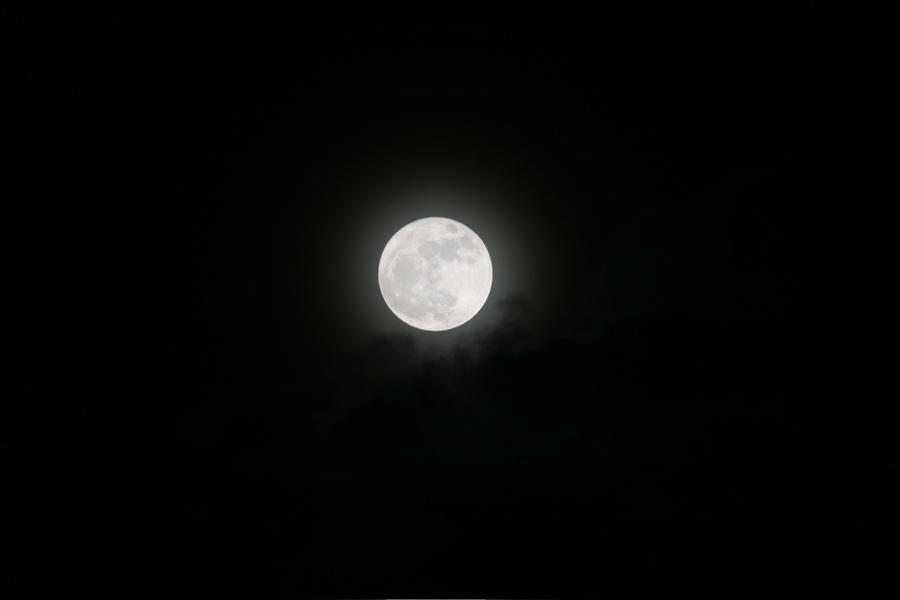
Its Vyasa’s birthday today and celebrated as Teacher’s Day (Guru Purnima). Vyasa is considered the greatest teacher from the Indian tradition. It usually is on the full moon of this month. Here is a shot I took today. Hope you enjoy it.
Kausthub
P.S. Practice asteya. Please do not use this photo elsewhere without permission.
photograph by and © kausthub desikachar. -
DISCIPLES SALUTE YOGI PATTABHI JOIS ON GURUPURNIMA
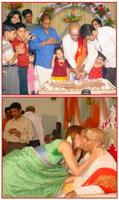
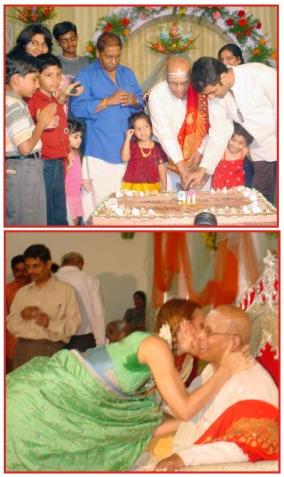
Mysore, July 22 (KMC&BLU)- City-based Guru of international repute in Ashtanga Yoga Pattabhi Jois, celebrated his 90th birthday on a grand scale, along with his family members and a large number of his disciples from India and abroad.Jois cut and shared the birthday cake at Kempegowda Memorial Hall in Gokulam IV Stage yesterday.
-
Article: Is Yoga Debased by Secular Practice?
 This article brings up points that were aired in one of the very first e-Sutra threads: “Yoga and Hinduism.” In fact, two of the Hindu authorities who were interviewed, David Frawley and “Swami Param,” figure prominently in the thread.
Is Yoga Debased by Secular Practice?
Millions of Americans are practicing yoga to improve flexibility, strengthen muscles and relieve stress.
But they also are co-opting an ancient spiritual philosophy, many yoga experts contend. A sacred practice, they complain, is increasingly being debased and commercialized. -
Two-Day Certificate Training with Robert Fried, Ph.D. at The Breathing Project, New York City
 The Breathing Project is proud to present
World Renowned breathing expert Dr. Robert Fried, Ph.D.
teaching a new 6-hour certificate course:“THE TRANSCENDENTAL BREATH™—LESS IS MORE”
Dates: Wednesday, July 20 & Wednesday August 3, 2005
Times: 12:00 noon to 3:00PM
Cost: $95.00 for both sessions, $55.00 for one
To Register: contact Leslie KaminoffAll workshop participants will have their breathing personally analyzed using state-of-the-art computerized breath capnometry, and will receive a certificate of completion signed by Dr. Fried.
For a full workshop description, click “Read more!” below.
The objectives of this workshop are:Day 1, July 20, 2005
a) To define the purpose of breathing training in terms of its impact on normalizing respiration behavior and lung and blood gases.
b) To identify common pattern of breathing that adversely alter inspiration and expiration volume.
c) To identify common medical conditions such as heart disease that require compensatory breathing changes.
d) To identify the adverse consequences of abnormal lung and blood gases on a variety of physical conditions ranging from anxiety to hypertension.
e) To learn the basic instrumentation for monitoring breathing and the lung and blood gas outcome of “deep diaphragmatic breathing exercises.”
f) To learn how to execute the “deep diaphragmatic breathing exercises” leading to The Transcendental Breath™ taught in: R. Fried (1999): Breathe Well, Be Well (John Wiley& Sons)
Day 2, August 3, 2005
g) To practice doing, and to practice teaching the “deep diaphragmatic breathing exercises” leading to The Transcendental Breath.™
h) To learn to integrate this information and these skills in a CAM treatment plan.
Dr. Fried is Professor of Biopsychology, Hunter College, CUNY
• Member of the American Physiology Society (APS)—Respiratory and Cardiovascular Division
• American Association for Psychophysiology and Biofeedback (AAPB)Author:
• The psychology and physiology of breathing in behavioral medicine. Plenum/Kluver, 1993
• The hyperventilation syndrome—Research and clinical treatment. The Johns Hopkins University Press. -
The Politics of Breathing: Still Liberating Women, After All These Years? By Kelly McGonigal

 At my request, Kelly has submitted the following provacative article. I hope it will arouse reactions, comments and thoughts that you will share. Kelly is the Editor-in-Chief of the International Journal of Yoga Therapy, and is also one of the presenters at The Future of Breathing, the symposium I’ve organized at Kripalu September 8-11.
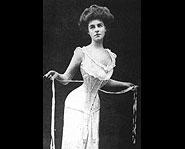
I recently came across an article from 1905 that dispelled a popular breathing myth of the time: that women naturally breathe differently than men. In the late 19th and early 20th centuries, it had been observed that men breathed “into the belly” (with the diaphragm and abdominal muscles), whereas women breathed shallowly into the upper chest and rib cage. As with any observed differences between men and women, it was tempting to attribute these breathing differences to some basic biological cause. Tempting, but wrong.
Perhaps you have already guessed the primary source of the observed breathing differences. Corsets, which dramatically restricted abdominal movement, forced women to find alternative strategies for breathing (a problem that some corset manufacturers attempted to address by developing corset braces called “lung expanders”).Corset-free, one would expect women to breathe freely and deeply, using the diaphragm. The authors of the 1905 paper reported that women who had not been raised to wear corsets breathed identically to men: diaphragmatic contraction and abdominal expansion. More amusingly, but unsurprisingly, they found that men in corsets demonstrated the stereotypical female breathing pattern of chest expansion.
What does this lesson from history have to do with current research on breathing? Some social pressures may have changed (women no longer wear corsets), but other pressures have emerged to create much the same effect on women’s breathing.
In my work as a breathing educator, I have noticed a disturbing pattern: many women are still breathing as if they were wearing a corset. In particular, women report shallow breathing and frequent breath-holding. This tendency has been called the “inhibited breathing pattern” by some researchers, and it is more common in women than in men. It is associated with chronic stress, anticipatory fear (being afraid of something that hasn’t happened yet), being on the bottom of the social power totem pole, and a reluctance to express anger.
Researchers have shown that an acute inhibited breathing response is common among threatened animals and threatened humans. In fact, this inhibited breathing pattern has all the hallmark features of the “freeze” response, which is the tendency among animals (including humans) to play dead when they are threatened by something they cannot run from (the “flight” response) or successfully overpower (the “fight” response).
If inhibited breathing is a response to feeling overwhelmed and powerless, it is not surprising that more women than men would demonstrate the inhibited breathing pattern. Women are more likely than men to try to avoid conflict or disappointing others; they are also more likely to feel powerless in work and social situations. This leaves the “freeze” response as the most likely reaction to stress – and with it, the habit of breathing shallowly and holding the breath. Unfortunately, the inhibited breathing pattern only reinforces the feeling of being overwhelmed and powerless – and it is associated with harmful health outcomes, such as chronic hypertension.
Women may be free of literal corsets, but many of us feel the pressures of a psychological or social corset that restricts our breathing. Breath education is one way to counteract learned breathing tendencies and fear responses. I teach a technique called empowered breathing: powerful diaphragmatic breathing that creates a sense of peace and purpose. Empowered breathing cannot change all of the pressures that women face, but it can transform our experience of – and reaction to – those pressures. In many cases, the pressures women face are self-imposed – based on our own beliefs about what we are capable of, or what is appropriate behavior. Breathing deeply is a way to reject those beliefs, and to build a new habit: feeling capable to meet any challenge, and powerful enough to do as we please.
Links to More Information:
The 1905 corset article: http://haabet.dk/patent/Pneumograph/index.html
Descriptions of research on inhibited breathing in women: http://www.ncbi.nlm.nih.gov/entrez/query.fcgi?cmd=Retrieve&db=pubmed&dopt=Abstract&list_uids=12360838&query_hl=36
About the Author:
Kelly McGonigal, Ph.D. is a health educator and yoga teacher at Stanford University, and the Editor-in-Chief of the International Journal of Yoga Therapy.
-
Christians Debate Yoga
 ChristianityToday.com recently ran several pieces about yoga.
First, Laurette Willis writes a cautionary piece called The Truth About Yoga, in which she claims Yoga led her into a dangerous “New Age lifestyle.” Now she’s warning other Christians of the spiritual pitfalls—and offering an alternative…
…which led to a pro-yoga rebuttal by Agnieszka Tennant called, Yes to Yoga in which she asks the burning question: “Can a Christian breathe air that has been offered to idols?” Now enter Holly Vicente Robaina, who was compelled to pen a rebuttal of Tennant’s rebuttal entitled “Take a Pass on Yoga.”
There’s lots more on the web, if you do a Google Search for “Christian Yoga”. -
Mulabandhasana Video
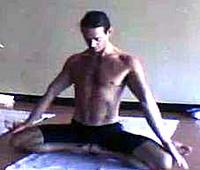 In response to my search for someone who can do Mulabandhasana, a couple of people sent me a link to Nilaf’s Web – Srange A/V Stuff. He’s got some cool Ashtanga tricks captured on video. I recommend a high-speed connection.
BTW, I have someone to do the pose for our next NYC shoot in August. Stay tuned for details.