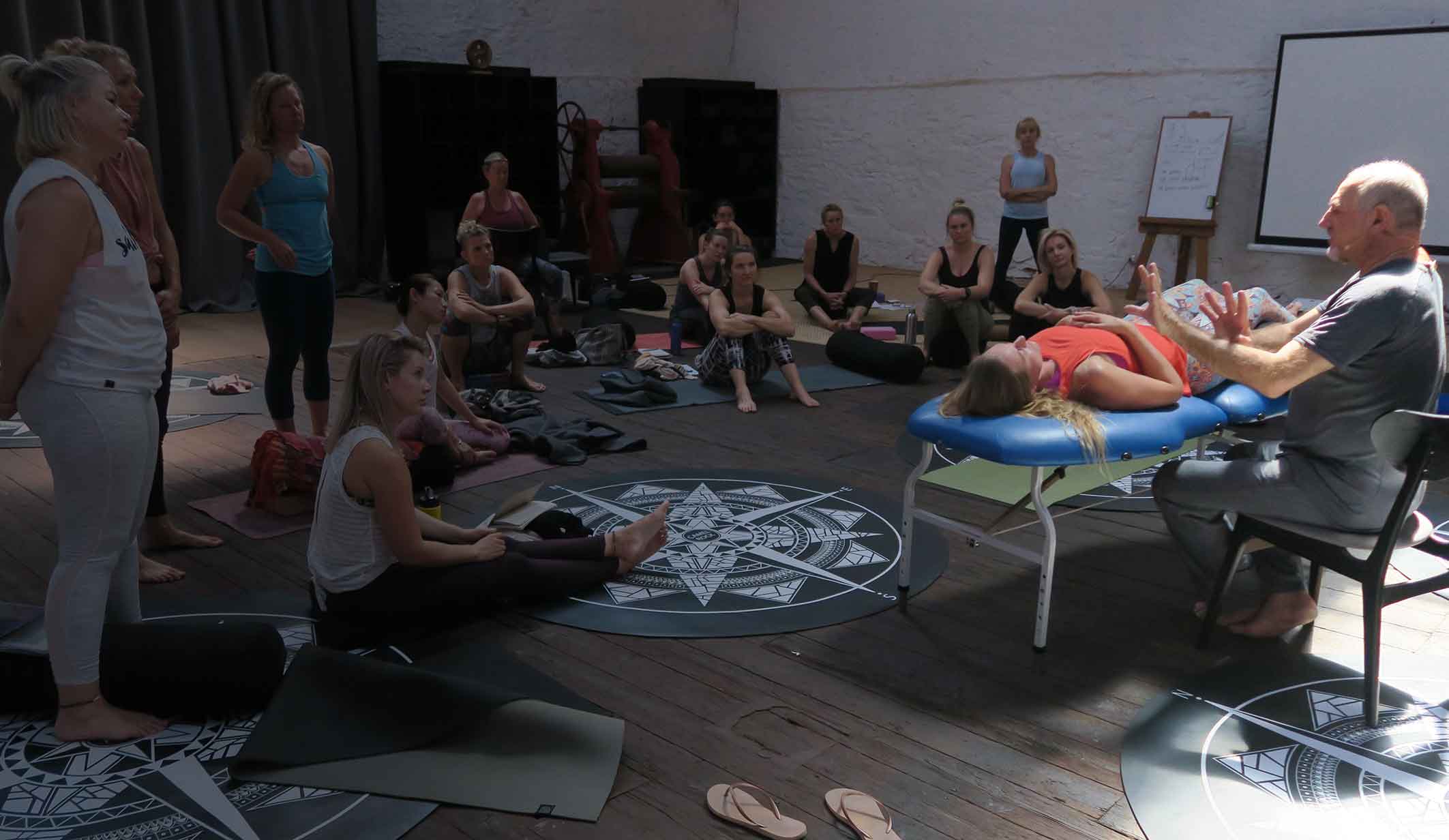
There is still room in a week-long Yoga Anatomy training I’m teaching at Kripalu from Jan 22 – Jan 27, 2006.
I really enjoyed teaching this program at Kripalu last summer. The
intensive format allowed me to work closely with the students, and we were
able to cover almost as much core material as I teach in the year-long Yoga
Anatomy training at The Breathing Project.
I’m also leading an Equinox Yoga Weekend at Kripalu Mar 17 – Mar 19, 2006.
Here’s the description of Yoga Anatomy from the Kripalu website:
Jan 22 – Jan 27, 06 (5 nights, Sun – Fri)
with Leslie Kaminoff
For all levels and abilities.
This program will provide a practical grounding in the essentials of the
anatomy, physiology, and kinesiology of yoga practice, with particular
emphasis on the relationship between breathing and healthy spinal function.
In an engaging and creative learning environment, we will make anatomy a
living, breathing, unforgettable part of our lives.
The first two days will focus on the anatomy and mechanics of breathing. The
third day will cover the evolution and anatomy of spinal mechanics and the
development of postural support and articular freedom. The last two days
will deal with yoga physiology, balance, and equilibrium, including hands-
on yoga therapy techniques and assisted practice relating to specific
asanas.
Throughout the week, ample time will be devoted to individual
questions, concerns, and structural issues.
Yoga provides a unique opportunity to the anatomy student because it shows
us which details are important and integrates those details into a unified
vision and experience of human existence. Gone are the days of memorizing
and forgetting countless details of anatomy—this is embodied knowledge.
Leslie Kaminoff is a yoga therapist with more than 26 years’ experience in
the fields of yoga, breath anatomy, and bodywork, inspired by the tradition
of T.K.V. Desikachar.
He has led workshops for many of the country’s leading yoga associations,
schools, and training programs. Leslie is the founder of The Breathing
Project, a New York City yoga studio dedicated to the teaching of
individualized, breath-centered yoga practice and therapy, as well as the
creator and coordinator of “The Future of Breathing.”
He practices yoga therapy and bodywork in New York City and in Great
Barrington, Massachusetts. He is currently at work on his first book,
entitled “Yoga Anatomy”.www.breathingproject.org
Blog
-
Yoga Anatomy Training with Leslie Kaminoff
-
Chronically Ill Patients Turn to Yoga for Relief
 Cynthia Mathis, left, conducting a yoga class for people with osteoporosis at a church in Westfield, N.J.
New York Times – December 15, 2005
By CAROL E. LEE. JACK WATERS credits yoga with saving his life four years ago. … He needed to get to a hospital, but first he wanted to do a yoga pose. …Congratulations to Cynthia Mathis, James Murphy, Jo Sgammato, and Jackie Herbach – all New York area teachers who contributed to this article.
-
Good And Bad Reasons For Believing
 The famous evolutionary biologist Richard Dawkins wrote a wonderful letter to his 10 year-old daughter Juliet on good and bad reasons for believing. “Is this the kind of thing that people probably know because of evidence? Or is it the kind of thing that people only believe because of tradition, authority, or revelation?”
I found myself involuntarily cheering: “Yes, YES!” while reading it this morning. My thanks to Jason Kottke for the heads-up.
-
Helping Students with RSI: RSI Expert Deborah Quilter Comments on Paul Grilley’s Recent Article
In this article for Yoga Journal’s “My Yoga Mentor,” Paul Grilley writes about his recommendations for students with “RSS – Repetitive Strain Syndrome.”
After scanning through it, I had some anatomical red flags waving in my brain (this happens a lot when I read yoga articles), so I sent the link to a colleague of mine who teaches here at The Breathing Project, Deborah Quilter. Deborah is an expert on RSI (Repetitive Strain Injury), and is the creator of a website and a couple of books devoted to the topic.Click here to read Deborah’s detailed response to the Grilley article. Since writing the piece, Deborah has already heard from at least one person with RSI who has hurt themselves following Grilley’s advice. In Deborah’s own words: “I hope some of my students, or people with RSI who can still type, comment. It’s much stronger if it comes from them.”
I e-mailed Deborah’s response to Paul Grilley last week, giving him an opportunity to respond, but I’ve heard nothing yet. Despite appearances, I don’t go out of my way to find fault with Paul Grilley’s ideas. I just have to listen to those red flags when they get raised.
Dear Leslie,
You asked my opinion of Paul Grilley’s article in My Yoga Mentor October 2005. Repetitive strain injury (RSI) is a vast topic. Misinformation about it abounds; indeed, very few doctors are knowledgeable in this area. Most people have no idea just how debilitating RSI can be, and all too often those who want to help unwittingly steer the injured in the wrong direction. My response follows, but obviously there is much crucial information I’ll have to leave out here. Omissions are covered in ample detail in my books and website,rsihelp.com .
I am a big fan of Paul Grilley, and thought his piece on tension or compression, posted on e-Sutra January 4, 2005, had much to commend it. But as the author of two books on RSI, and having helped countless people cope with this disease over the past 15 years, my approach to teaching Yoga to injured people differs quite markedly from his. Yoga, if expertly modified for the student’s injury, can be enormously helpful for people with RSI; however, the wrong asana practice could make matters significantly worse. More on that later.First, a little background: RSI is a highly complex soft-tissue disease. It is not just one thing, such as carpal tunnel syndrome, as most people assume. Depending on how you count them, RSI comprises about two dozen separate diagnoses to the nerves, tendons and muscles of the upper extremity (from shoulder blade to fingertip), including the best-known (but not the most common) carpal tunnel syndrome, epicondylitis (tennis elbow), thoracic outlet syndrome, De Quervains’ disease, and several nerve entrapments. A new syndrome, “Blackberry Thumb,” was recently reported by the American Society of Hand Therapists. People usually have at least three separate diagnoses and often have as many as two dozen. Also, since each person presents with a unique – and changing – cluster of symptoms, and the severity of injury varies from person to person and day to day, across-the-board protocols do not work for every body.
Unlike many other injuries, RSI is invisible. Without an astute awareness of telltale pain behavior, it is only through the student’s self-disclosure or difficulty in movement that the teacher would know someone has it. Otherwise, they look normal. This can lead teachers to greatly overestimate a student’s capacity.
RSI can be devastating. Not only can it end careers, it can also make common daily activities such as driving, dressing or eating difficult or impossible. Simple things like signing a check, holding a coffee mug or pressing an elevator button can be extremely daunting.Because of the unforgiving nature of soft-tissue injuries, it’s extremely easy to re-injure yourself if you have RSI, and relapses can be worse than the initial injury. Therefore, I typically see students one-on-one to begin with so they have my undivided attention – and receive a practice tailored to their unique needs. First, I take a thorough health history so I have a general idea of which movements to avoid. We begin with relaxation, so the student can sense breath and learn to guide and be guided by it. I emphasize that the student is in charge, and say, “If something doesn’t feel right for any reason, stop. Don’t do anything that bothers you.” Once the student has established trust in his inner teacher, we can safely proceed to moving at a slow, comfortable pace. I demonstrate postures before we do them for the first time, and ask the student if he thinks that asana would bother him before we proceed. I also watch students’ facial expressions, quality of movement and breathing, and stop them immediately if there is any sign of struggle or strain.
My approach also differs from Grilley’s in emphasis: his exercises focused on stretching. While this is very important, my program emphasizes strengthening as well. People often develop RSI because of weakness, particularly in the back muscles, so I design practices that bring balance to the muscles, strengthening and stretching them.Regarding the specifics of Grilley’s piece, I’ll respond point by point. Let’s begin with the dinner-plate analogy. In fact, most computer users do not position their arms as though holding a dinner plate. Rather, they rest their wrists on the edge of the desk because the shoulder muscles become extremely fatigued from holding the weight of the arm. Fatigue also leads to the forward head and slouched posture common among computer users. To compound the risk factors, the keyboard is often on the desk, rather than an appropriately lowered keyboard tray. This leads to more shoulder strain as the computer user constantly lifts her shoulders as she keys or reaches for the mouse. Wrist-resting leads to a multitude of possible problems: the compression of the median nerve at the wrist; and the dorsiflexion (upward bend) and ulnar deviation (sideways bend) of the wrist, both of which can strain the forearm tendons, muscles and nerves.
Grilley correctly states that computer users need movement, but the single most important – and most difficult – step toward rehabilitating RSI is neither movement nor stillness per se, but ceasing to use the computer or stopping any other offending activity. Given that most people’s jobs involve computer use, this is a thorny and frightening dilemma.
Grilley’s suggestions for movement at work may seem innocuous, but when you deal with RSI, you quickly learn that the simplest exercise or movement could be too much for someone.• Dropping your arms by your side can be very fatiguing to people with shoulder injuries or cause unpleasant tingling in people who have thoracic outlet syndrome. My suggestion: rest your forearms palms up on a big pillow or two placed on your lap – this rests the shoulders and relieves the forearms from the strain of pronation (the palms-down position).
• Many people cannot stretch their arms overhead without difficulty; and any relief from symptoms would be fleeting at best if they have chronic pain.
• Pushups, one of the exercises Grilley mentioned, are contraindicated for people with RSI because most cannot bear any weight through the wrist.
My approach is to tell uninjured people that they need regular breaks from computing, at least one 5-10 minute break for every twenty minutes at the keyboard. Most authors of articles on RSI and ergonomics offer exercises you can do seated at your desk, but because sitting in and of itself is a prime risk factor for RSI, I urge people to do what the body was designed for – full-body movement. To that end, I encourage people to get up from their chairs and go for a walk to stimulate circulation, and rest their eyes by gazing in the distance, preferably out a window. For more on why breaks are so important, see http://rsihelp.com/breaks_important.shtml.Grilley was quite right to caution mindfulness with his suggested exercises, but, with the exception of the second exercise (gently dropping the head forward), I would not recommend any of his choices. His suggestions would be fine for experienced Yogis with ample range of motion and strength, but many people come to Yoga only after they are severely injured, and they may not have exercised for years. Most of his examples too extreme for such beginners, and could lead to more pain and injury.
• In his first exercise, bending the head back would be very painful for people with limited range of motion or severe neck pain. Here’s one alternative choice: keeping your gaze on a fixed point straight ahead, make a slow figure eight with your nose in an easy range of motion, avoiding extreme upward movement of the head.
• In the Eagle variation, few of my students with RSI would be capable of sitting on the floor with straight legs and resting their elbows on the floor or even a bolster without rounding – hence straining – their backs. Doing this pose on a hard surface such as a desk could be damaging to the ulnar nerve, which is already stretched to maximum length. (By the way, habitually leaning on your elbow on hard surfaces is one of the ways people develop ulnar nerve injuries.)
• I strongly caution people with RSI to avoid the Broken Wing variation. While this pose might feel marvelous to an uninjured person, if someone has rotator cuff tendinitis, for instance, they cannot reach into a back hip pocket or unhook a bra without pain, much less place their hand between their shoulder blades – then rest their body weight on top of that! I’ve also had students who could barely bend their elbows because of pain. Placing the body weight on an injured forearm could likely set off an episode of pain or tingling.
• As for the Peacock variation, because so few people with RSI are comfortable in Cat pose, this extra-strong forearm stretch would be entirely too much for most of them. A safer choice would be a simple Namaste, going only as far as is easy, or gently circling the wrists. Later, when the student has gained flexibility, I prefer a standing variation of the pose my teacher, Kevin Kortan, showed me: place your hands on the wall for support so the body weight is more easily controlled. In this position you can ease into the pose slowly and back off quickly if it’s too much.Given Paul Grilley’s statements about “freeing ourselves from the tyranny of ‘proper form’ and ‘perfect poses,’ I feel confident that he would not intentionally encourage someone with RSI to strain. I also applaud him for caring enough to bring this topic to light. RSI is the leading occupational disease in the United States – and people’s lives are devastated by it every day – but RSI prevention has received less and less government support since the Bush administration vetoed the Occupational Safety and Health Administration (OSHA) ergonomic standard. The leading cause of RSI is ignorance. No one who uses a computer should find out about RSI the hard way by becoming injured. And no one who comes to Yoga seeking help should be further injured in the attempt to heal.
– Deborah Quilter
Deborah Quilter is the author of The Repetitive Strain Injury Recovery Book (Walker, New York 1998) and what Amazon.com called the “bible” of RSI: Repetitive Strain Injury: A Computer User’s Guide (with Emil Pascarelli, M.D., Wiley, New York 1994). She has spoken internationally on RSI and appears in the media frequently. She earned her yoga teacher certification through Spanda®: the Yoga of Movement, and holds certifications in personal fitness training from Marymount Manhattan College and the American Council on Exercise. Ms. Quilter studies Evolutionary Yoga™ with its founder, Kevin Kortan. She is writing another series of books and articles about RSI, and will also be teaching other Yoga teachers her methods for helping students do asana without exacerbating existing injuries at Kripalu and other venues including the Breathing Project next year. For more information, visit her website, rsihelp.com.
-
Neti in the News

 I actually heard this piece as it aired this morning on NPR’s morning edition:
Nasal Irrigation Makes Comeback as Cold Remedy
Morning Edition, October 12, 2005
“An age-old technique that may have developed from yoga traditions is turning out to be a simple and effective way to combat the cold. Flushing the nasal passageway with warm salt-water can help prevent colds and bring relief to allergy-sufferers.”
……
I’ve been doing this for years, and I recently bought a HydroPulse unit, which is a vast improvement over the old neti pot. It’s very much like a WaterPik with a nasal attachment, and it works beautifully. Around my house, we call it by the name given to it by my son, Jai: “The Shnozzelator.” -
Exclusive Retreat with Kausthub Desikachar Aug. 21 – 30, 2006 in Piesendorf, AUSTRIA – by Invitation Only

 From: kausthub desikachar
24, September 2005dear friends
here is a unique opportunity to explore the secrets of mantras – some of the most important mantras, their meanings, what are their symbolisms, when to use them, how to use them etc.
this intensive retreat is by invitation only. in case you are interested in participation please reply to mediagaruda@mac.com
please feel free to share this information and spread the word around to those you think may be interested. participation is limited to a maximum of 35 spots. already around 18 have been confirmed.
warm regards,
kausthub -
‘Hatha yoga’ reveals secrets of protein folding
 San Francisco,PTI:
Researchers at the University of California in Berkeley have uncovered the secrets of how proteins fold into elaborate three-dimensional shapes, by making them perform ‘hatha yoga.
A problem that has bedeviled biologists for decades is why a chain of amino acids always folds in a specific way.
Grabbing both ends of a single protein, they pulled and slowly unbent the protein, then gradually let it relax into its original 3-D shape.
As they put the protein through stretches and relaxations reminiscent of ‘hatha yoga,’ they found that in the process of folding, some proteins go through an intermediate state totally unlike their final configuration – a resting state before the final folding occurs. -
"Yoga piracy is becoming very common and we are moving to do something about it,"
I’m going to solicit comments from all of you before I post my comments on this. Please read the article linked to above, and the follow the link below..You can also reference my previous blog post on this subject
This is going to be a big battle in the very near future, and I predict it will get ugly. Please weigh in with your thoughts on this issue.
“Yoga piracy is becoming very common and we are moving to do something about it,” says Vinod Gupta, the head of a recently established Indian Government taskforce on traditional knowledge and intellectual property theft. “We know of at least 150 asanas [yoga positions] that have been pirated in the US, the UK, Germany and Japan. These were developed in India long ago and no one can claim them as their own.”
Proceedings of THE INTERGOVERNMENTAL COMMITTEE ON INTELLECTUAL PROPERTY AND GENETIC RESOURCES, TRADITIONAL KNOWLEDGE AND FOLKLORE
-
Advanced Studies at The Breathing Project
 The Fall Trimester starts Wednesday, October 5th and runs through December 21st, 2005. CLICK HERE TO REGISTER
The Breathing Project offers a uniquely flexible and comprehensive training program in breath-centered, individualized yoga and yoga therapy. The core of the training is Leslie Kaminoff’s Yoga Anatomy Course, and Zack Kurland’s Application of Breath-Centered Yoga (ABC’s). Both Leslie and Zack are inspired by the tradition of T.K.V. Desikachar.Classes meet most Wednesdays from October through June. These comprise the CORE hours of the training programs. The CORE hours are based on three 12-week trimesters though actual trimesters may be 11 or 13 weeks, depending on holidays and vacations.
There are several ways to enroll in the program. For details about the various options and corresponding pricing, visit the Advanced Studies page on The Breathing Project website.
-
Amy Matthews’ NYC Teaching Schedule
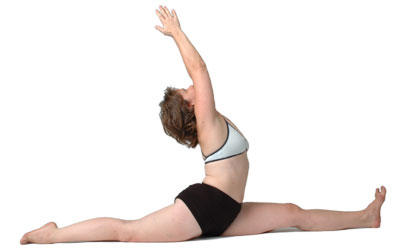
 I’m sending you this information about Amy Matthews’ classes with my highest possible recommendation. Amy is a true gem and an amazing teacher. It has been my pleasure to work with her here at The Breathing Project, where we frequently co-teach in my anatomy course. We are currently collaborating on my Yoga Anatomy book, and Amy posed for many of the photos we will use as references for the artist. The photo of her in Hanumanasana is from the last shoot we did at The International Center for Photography.
If you’re in the NYC area, you have the chance to check out her weekly classes.Every Tuesday & Thursday Morning – 7:45 to 8:45 am
YOGA FUNDAMENTALS
at the Breathing Project, 15 W 26 St, 10th Fl, NYCThese classes are based on the Bartenieff Fundamentals, developmental movement patterns, and simple breath-oriented asana and vinyasa sequences. Adaptations are offered in order to help each person develop a personal practice and to adjust for any level of ability.
($16, or pay what you can)BEGINNING SEPTEMBER 7 (after Labor Day)
Wednesdays 12 noon – 1:30 pm
BODY, SPACE & BREATH: an asana class
at Movements Afoot, 151 W 30 St, rm 201, NYCThese classes use principles of Space Harmony, the Bartenieff Fundamentals, Body-Mind Centering, yoga asana and other approaches to embodiment to support your experience of sensing the breath, moving through space and being present in your body.
($17, or pay what you can)SEPTEMBER 19
Mondays, 12:30 – 3 pm
EMBODIED ASANA ANATOMY & KINESIOLOGY COURSE
at the Breathing Project, 15 W 26 St, 10th Fl, NYCIn this 65-hour course we will explore anatomy and kinesiology from an experiential perspective, using textbooks, models, and movement experiences. There will be time for practice sensing, embodying and observing various tissues and structures, both in our selves and in others. Using movement patterns based on Laban Movement Analysis, the Bartenieff Fundamentals, Body-Mind Centering and other yoga asana, we will discuss principles of alignment and therapeutic applications.
You can take the whole course, or drop in. We will begin in September with the spine, then focus on the lower limbs in the winter, and upper limbs in the spring. Class involves both discussion and movement.
($40 per class. Class cards available, and discounts for members of Breathing Project, LIMS & BMCA.)Bio:
Amy Matthews, CMA, SME, RYT, RSMT/RSME has been teaching movement since 1994. She is a Certified Laban Movement Analyst and a Body-Mind Centering? Somatic Movement Educator. Amy has been on the faculty of the Year-Long Certificate Program at the Laban/Bartenieff Institute of Movement Studies since 2000, and has been the Program Coordinator since 2002.Amy works privately as a movement therapist, integrating LMA/BF, yoga and BMC. She currently teaches yoga classes and workshops at Yoga Union, the Breathing Project and Movements Afoot. She co-teaches karate and yoga workshops with Sensei Michelle Gay for the Society for Martial Arts Instruction, and anatomy workshops for LIMS. Amy’s ‘Embodied Asana’ workshops and anatomy classes are a part of the Breathing Project’s Advanced Studies Program, and she co-teaches with Alison West on Yoga Union’s Teacher Training program.
Amy is certified as a yoga teacher by Heart of Yoga and Yoga Union, and as a Motherhand Shiatsu practitioner. She is registered with ISMETA as a Somatic Movement Therapist and Educator, and is registered at the 500-hour level through Yoga Alliance. She studies kinesthetic anatomy with Irene Dowd and BMC? with Bonnie Bainbridge Cohen. Amy also studies yoga with Kevin Gardiner, Mark Whitwell and Alison West, and karate with Sensei Michelle Gay.