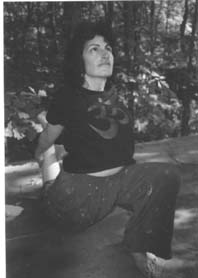
Rachel “Preeti” Greene was a yoga teacher who specialized in teaching to heart and cancer patients. She passed away May 26 of complications from open heart surgery. I met her briefly at a Yoga conference, and had heard glowing reports of her work. If anyone has memories of Rachel they’d like to share, please feel free to post them as comments.
Blog
-
In Memoriam: Rachel Greene 1963-2006
-
Dr. Robert Fried talks about “Great Food, Great Sex”

Another friend and “Future of Breathing” presenter has released a book. Bob Fried, consummate physiological renaissance man, has co-authored a fascinating book called “Great Food, Great Sex.” Personally, I prefer the original title “Eat Your Way to Better Sex,” but his agent nixed the idea, fearing a backlash from the red states.
Below, you will find a great explanation of some of the key points in his book, which is based on serious science, and speaks to more than sexual performance. His proposed diet also has profound implications for blood pressure and general cardiovascular health. I, for one, am going to protect my blood vessels by loading up on my greens-and-beans, arginine rich meats and fish and antioxidant fruits and vegetables – expect a report on the side-effects in a future post.
P.S. If you’re in the NYC area, you can attend an event with Dr. Fried sponsored by the 92nd Street “Y” on Wed, Jun 21, 2006, at 12:00pm-1:00pm.From: Robert Fried, Ph.D.
Y’all may wonder how we got the nerve (chutzpah) to write a book on food and sex, so I thought I’d explain it to you:
In 1998, the Nobel Prize in Medicine was awarded to three Americans who discovered that blood vessels are principally under the control of a curious gas molecule made by the body, in the body, nitric oxide (NO). No one imagined that, as we all assumed that blood vessels were under the control of so-called action hormones including noradrenaline. In fact, prescription antihypertensive beta-blocker meds reduce the action of noradrenaline, thus lowering blood pressure. But, we now know that action hormones only modulate blood vessels and that NO is the basic control mechanism that dilates blood vessels increasing blood flow when and where needed….click “Read more!” to view the rest of this post.
At that time also, Pfizer, well aware of the research on NO, discovered that they had developed a compound–later termed VIAGRA–that extended the duration of the action of NO on body blood vessels–dilating them– and intended to market it as an antihypertensive. But they noted that it resulted in erection in men at the same time that it reduced their blood pressure. In other words, VIAGRA dilated more than coronary arteries.
How does the body make NO? It turns out that it comes mostly from one of the principal amino acids found in all proteins: L-arginine. L-arginine rich foods include meats, fish and legumes. In addition, the body can make nitric oxide directly from green vegetables because they are rich in nitrate compounds that can be made to yield NO.I (Fried) experimented with arginine supplement readily available in health food stores in the early 1990s reasoning that one alternative to VIAGRA that prolongs the action of NO is to supply more NO to the body. As you know, this worked and resulted in THE ARGININE SOLUTION and then VasoRect, an arginine-based supplement product. By then, tens of thousands of articles had been published on the cardiovascular and erectile benefits of arginine-derived NO.
In the mid- 1990s also, the National Heart, Lung and Blood Institute (NHLBI) of the National Institutes of Health (NIH) conducted a series of clinical trials of a nutrition plan intended to raise NO availability for heart patients. Anything that raises NO production will lower blood pressure, lower heart rate and the work of the heart, and will increase sexual energy. This does not mean libido (sexual desire) but performance. NO has no effect on sexual desire, only on performance.
So, GREAT FOOD, GREAT SEX explains all that, and most of the recipes are from the NHLBI clinical trials (reprinted in the book with their permission). Thus, we have the only sex nutrition book proven by the US government to support cardiovascular and heart action and at the same time it raises NO production for increased sexual performance. So, as you can see, it is very scientific, not whimsical, nor is it prurient in intent or content.
Edlen-Nezin joined the project several years ago contributing also her vast knowledge about- and experience with special-populations nutrition. Together, we formulated the three-food factors for sexual vitality:
The three food factors are “greens-and-beans” (nitrogen rich and arginine rich foods such as vegetables and legumes that yield NO), arginine rich meats and fish that yield NO, and powerful antioxidant foods (fruits, vegetables, etc) to protect blood vessels.
This book is about a Nobel-Prize winning discovery that we have applied to enhancing cardiovascular and heart health and sexual vitality for a lifetime.
-
Yoga and The Tao of Natural Breathing
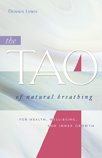
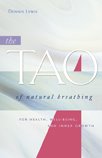 My friend Dennis Lewis has recently announced the re-publishing by Rodmell Press of one of the best books available on breathing and the breath: “The Tao of Natural Breathing.”
In conjunction with the release of the book, Dennis circulated the following piece, which mentions “The Future of Breathing,” the symposium I organized last September at Kripalu. I hope to work again soon with Dennis and some of the other presenters on a follow-up event – possibly in 2007.(OPENPRESS) April 11, 2006 — When “The Tao of Natural Breathing” was first published back in late 1996, yoga breathing, or pranayama, was all the rage. “It still is today,” says Dennis Lewis, author of this acclaimed book, “but at least now a growing number of people, including yoga teachers, are questioning the wisdom of teaching advanced pranayama exercises to people who don’t breathe very well to begin with.” They are also opening themselves to some recent research about the meaning of healthy breathing…click “Read more!” to view the rest of this post.
Last year, for example, Lewis was one of several presenters at “The Future of Breathing” Conference held at The Kripalu Center for Yoga & Health. Lewis points out that one of the goals of this conference, which was organized by Leslie Kaminoff, a leading yoga teacher and therapist, was to expose and correct some of the many myths about breathing that are still being taught today by many yoga teachers and appear in many books. One of the biggest myths of all is the belief that the more carbon dioxide you can breathe out with each breath the better. “The fact is, if you exhale too much carbon dioxide too quickly,” Lewis says (and many researchers agree), “you often not only make yourself more anxious and irritable, but you can create or exacerbate many serious health problems.” Lewis explains the reasons for this in his book “The Tao of Natural Breathing,” as well as in his latest book “Free Your Breath, Free Your Life.”But there are other problems with teaching advanced pranayama exercises to people who are not ready for them. In his book “The Tao of Natural Breathing,” Lewis points out that “Breathing exercises involving complicated counting schemes, alternative nostril breathing, reverse breathing, breath retention, hyperventilation, and so on only make sense for people who already breathe naturally, making use of their entire body in the breathing process.” Lewis believes that though these advanced practices can result in novel and even useful energetic experiences, they often do so–for people who don’t breathe well–at the expense of making their breathing even worse over the long run.
Though “The Tao of Natural Breathing” has been out of print for the past year, Rodmell Press, which specializes in books on yoga, has just republished it. Although one might think that the book would not be welcome by yoga teachers, there has been a growing awareness among yoga teachers of many of the points that Lewis makes in this book, especially with regard to the importance of “natural breathing,” which “The Tao of Natural Breathing” was written to help make possible. And so one finds may yoga teachers who think highly of this book and recommend it to their students. One well-known yoga teacher has this to say:
“Insightful in its breadth and simple in its presentation, ‘The Tao of Natural Breathing’ offers something new, especially to those skilled in pranayama (yoga breathing exercises). Dennis Lewis presents practices that are less about control and more about letting go. He gently entices us to allow our conscious breath to become the teacher, the healer, and the expression of our soul.” –Judith Hanson Lasater, Ph.D., P.T., author of 30 Essential Yoga Poses
For more information about “The Tao of Natural Breathing” and “Free Your Breath, Free Your Life,” visit The Authentic Breathing Website.
For more information about Dennis Lewis, visit http://www.dennislewis.org.
-
First Ever Symposium on Yoga Therapy and Research
 I am very pleased to join The International Association of Yoga Therapists in announcing their first ever International Symposium on Yoga Therapy and Research, to be held at the Airport Hilton in Los Angeles from January 18 thru 21, 2007.
I am excited to be a presenter at this event, along with a veritable who’s who in the fields of Yoga and Yoga Therapy.
My main presentation at the syposium will be “What Yoga Therapists Should Know About Breath Anatomy,” which is also the title of an article I’ve written for The International Journal of Yoga Therapy. I will also moderate (along with IAYT President John Kepner) a panel titled “Yoga as an Emerging Complementary and Alternative Medicine (CAM) Profession” that will address certifying and regulatory issues for Yoga Therapy. Those of you who have been regular readers of e-Sutra know that I have one or two strong opinions on this topic, so that promises to be a lively discussion.
I urge you to register early for this landmark event, and be a part of history, as Yoga Therapy takes a major step in setting high standards of research, study and practice.
-
"Are you putting me on the Internet?"

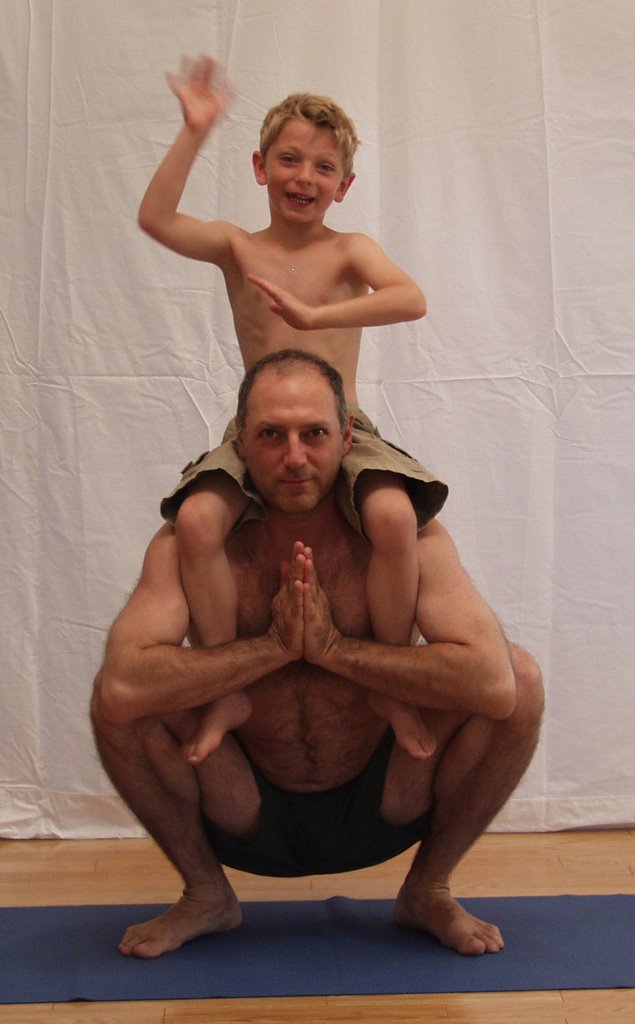
My youngest son, Sasha (6), just reminded me that I promised to put him on the Internet. I made this promise the other day, when I showed him this photo, which was taken last year at a shoot for my Yoga Anatomy book here in Great Barrington. As I type this, Sasha is standing right here, and he wants to say “hi” to the Internet. He will now click the “Publish Post” button. -
YogaAnatomy.org Website Goes Live Today!
 Finally, after many months of planning, my personal website YogaAnatomy.org is up on the web.
Many, many, thanks go out to master designer Lydia Mann for doing such a superb job, and for putting up with someone who should know how to be a better client by now. -
June Yoga Journal "Ask the Expert" features Leslie Kaminoff
 The current (June) issue of Yoga Journal’s “Ask the Expert” column focuses on some breathing-related questions. I was asked to write the responses by YJ’s former executive editor, Mary Bolster. This was one of the last pieces Mary worked on before relocating to New York to become the new Editor-in-Chief at Natural Health Magazine. It was a pleasure working with Mary, and I look forward to doing so again in the future.
Q: Will it help or hurt a person with high blood pressure to practice Kapalabhati breathing followed by breath retentions?
A: I view Yoga exercises as being instructive rather than prescriptive; I don’t prescribe them like pills to cure specific things. Quite often, it’s not so much what exercise you do that determines its effect, but how you do it.
A hypertensive student practicing Kapalabhati (short, quick exhales followed by passive inhales) is a great example of this. The truth is that you’re likely to put far more strain on your cardiopulmonary system lifting a heavy package or having a difficult bowel movement than by doing Kapalabhati. Nevertheless, it’s entirely possible that a hypertensive student might increase their blood pressure as a result of intense breathing practice. So, Kapalabhati could potentially be harmful, if it’s practiced the way it’s commonly taught in group classes.
But with Kapalabhati, the key is doing it in such a way that is beneficial rather than harmful, which means that the diaphragm must be completely relaxed so that its movement will be caused by the contraction and release of the lower abdominal muscles. This is essentially an active exhalation followed by a passive inhalation— literally non-diaphragmatic breathing. Therefore, if Kapalabhati is done with a relaxed, slow rhythm, it can help free up tension in the abdomen that is associated with the inability to shut off the “fight-or-flight” response, which is almost invariably a major component of hypertension. In this context, Kapalabhati could be quite helpful for a student with high blood pressure.
Now let’s talk about breath retention, which can refer either to suspending breath movement after inhalation (internal, or anta kumbhaka), or after exhalation (external, or bhaya kumbaka). Most Yoga systems teach internal retention after Kapalabhati, but for a student with high blood pressure, I’d try to achieve a more calming effect after a round of gentle Kapalabhati by pausing briefly after the final exhalation, then relaxing the throat muscles so that a passive inhale can occur followed by a period of easy breathing.
These modifications are examples of T. Krishnamacharya’s dictum that Yoga must be adapted to the individual. This is especially significant when breathing techniques are involved because our unique constitution, history, and habits are literally written in our breathing patterns. This is why the effect of a particular breathing technique will vary quite widely from person to person.
In short, just about any practice you do gently and with self-awareness will benefit you— even if you have high blood pressure—because it has the potential to reveal and dismantle your unconscious breathing habits.
2) What asanas and breathing techniques are good for improving the
immune system?I assume that “improving the immune system” refers to stimulating a compromised immune system, but it’s important to remember that the vast majority of immune disorders are autoimmune, in which a misdirected immune system produces antibodies to substances occurring naturally in your body. In this case, you’d want to reduce the immune system’s activity.
Regardless of whether your immune responses require stimulation or reduction, conscious breathing combined with guided imagery or visualization has been proven to be a highly effective and powerful tool for healing. Try the following: Find a quiet place, sit in a comfortable position, and bring a relaxed awareness to the breath. Think about your desired internal changes and then consciously link your breath to these goals: If you want to bring something positive in such as health and vitality, focus on the inhalation. If you want to release something undesirable like pain or discomfort, focus on the exhalation. Concentrate on what imagery you associate with these feelings, such as a certain color, a sensory feeling like warmth or tingling, or a calming scene in nature. Use whatever imagery helps you; the possibilities are endless. The key is to allow yourself the freedom to discover what is specifically nourishing to you – what works for other people is irrelevant.
In addition to breathwork, I’d recommend practicing a well-balanced asana sequence that leaves plenty of time for relaxed breathing and restorative poses. Ending your sequence in Savasana (Corpse Pose), puts the body in a state of maximum repose where it is freed from the need to contend with gravity. Here, you can bring your focus more fully to the inflow and outflow of the breath and whatever imagery you’ve chosen to help heal your immune system.
3) Can you recommend any specific breathing techniques for
asthmatic kids?When it comes to dealing with asthma attacks, how you prepare for an attack will determine how you react when you actually have one. When the airways are constricted, relaxed shallow breathing is what’s needed. This goes against what seems like common sense, as everyone’s instinct is to tell an asthmatic during an attack to “breathe deeply.” This is the worst advice, because it just makes them more tense; after all, if they could breathe deeply, they wouldn’t be having an attack in the first place! Without training it’s very difficult to relax when having an attack because relaxed, shallow breathing is so counterintuitive when you feel like every cell in your body is starving for oxygen.
What does this training consist of? Slowly and systematically lengthening the exhalation and the periods of external retention. As my teacher T.K.V. Desikachar is fond of saying: “If you take care of the exhale, the inhale takes care of itself.” Non-forcefully holding an external retention puts your body in a similar situation to when you are actually having an attack, because in both cases your body is deprived of oxygen. Remaining clam in this state is the key to being able to relax during an acute asthma attack.
Gentle, non-forced external retention has shown to improve asthmatic symptoms so dramatically that an entire asthma treatment system called the Buteyko Method is based on it.
Kids can learn how to do this, but of course training is more easily accepted if it’s fun and engaging. I recommend singing, rhyming, and chanting, because the breathing pattern is similar to what you are trying to learn: Long, slow supported exhalations followed by relaxed, efficient inhalations. Practicing silence in between verses produces the necessary pause after the exhalations. Make up games and create songs that incorporate increasingly longer phrases. Asthmatic kids, and kids in general will benefit enormously from this, because they are learning the skill of relaxing in the face of discomfort – something most of us only learned in our first Yoga classes as adults.
Leslie Kaminoff is a New York City breathing specialist and Yoga Therapist inspired by the teachings of T.K.V. Desikachar. His 27 years of teaching experience are culminating in his book “Yoga Anatomy,” to be published this year by Human Kinetics. He is the founder of the non-profit educational corporation “The Breathing Project” (breathingproject.org). His personal website is yogaanatomy.org.
-
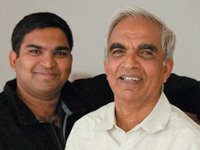
T.K.V. Desikachar and Kausthub Desikachar in Boston April 27-30, 2006
 If you’ve never experienced these teacings directly from T.K.V. Desikachar, I highly recommend you attend this weekend seminar with my teacher and his son, Kausthub.
I’ve arranged for a two-week extension of the early registration discount just for mentioning e-Sutra.
Contact Robert Birnberg at longexhale@mac.com for more information.ANNOUNCEMENT:
T.K.V. Desikachar and Kausthub Desikachar are teaching a four-day seminar entitled ‘Meditation as Medicine’, exploring the healing aspects of Yoga and Meditation. APRIL 27-30, 2006
This one-time event is a benefit for the Krishnamacharya Yoga Mandiram, the healing center in South India started by T.K.V. Desikachar to honor his father’s teachings.
We would love to invite You, Your students, family and friends to this very special event. There is still space available, but it will fill.
For more information Go to: http://www.thebreathingspace.net/healingheart.html
-
"Yoga Girl" Video
Last night, as I was watching a video of Ana Forrest’s yoga demo at the recent Yoga Journal conference, I found myself thinking that it wasn’t very impressive compared to trained gymnasts, dancers or contortionists that I’ve seen.
This remarkable video makes a good argument for my point. It’s great entertainment, and very impressive….but is it yoga? Let me know what you think.
P.S. Please don’t flame me because you think I’m dissing Ana. I happen to think she is a very impressive teacher and Yogini, and her practice is remarkable, considering she’s roughly in my age group. I was simply evaluating her demonstration for its esthetic value compared to others that I have seen.
-
Paul Z. Myers Rips Deepak Chopra on Intelligent Design
 Paul Z. Myers is an Associate Professor of Biology at the University of Minnesota, Morris. He is the creator of the very impressive blog “Pharyngula,” and he has some strong words for Deepak Chopra, who recently came out in favor of Intelligent Design.
His post starts with: “…that New Age con-man, Deepak Chopra…says all the same stupid things the right-wing fundies do. He’s complaining that we have to take Intelligent Design out of the hands of the fundamentalist Christians AND those clueless scientists.…it doesn’t matter whether he’s right-wing or left-wing, he’s just an idiot.”
All in all, it’s highly recommended reading in the “intellectual ammunition” department.