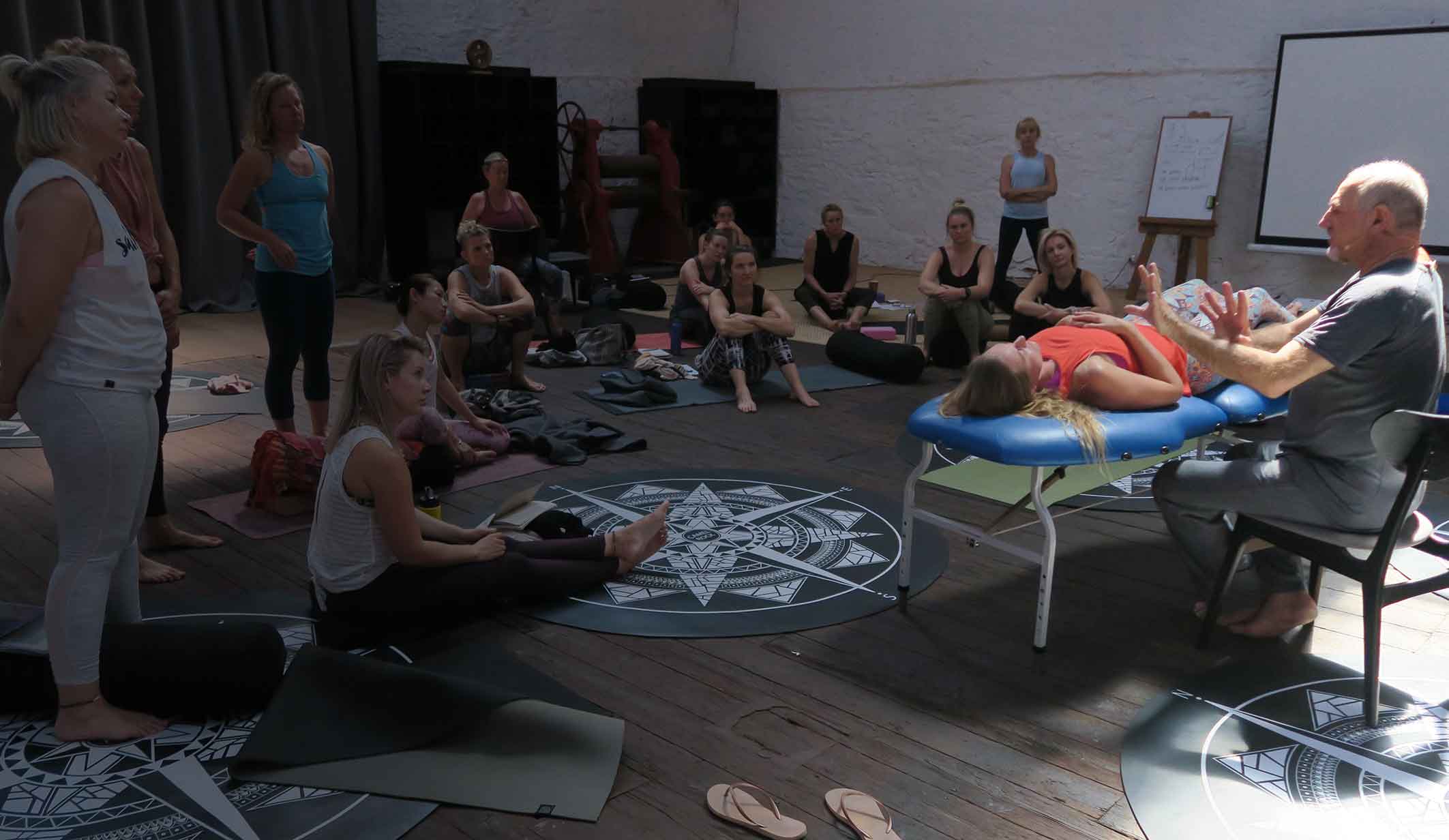
Leslie seated at a massage table demonstrating a technique for a roomful of students

Leslie Kaminoff is a best-selling author and yoga educator.

Category: yoga teacher training

  • Early reg deadline in two weeks! Join Leslie’s Walking Workshop in Maya Tulum

    Join Leslie April 5-12 in Maya Tulum, Mexico

    You know those footprints in the sand? They can provide a great deal of information about your relationship to the earth. Don’t miss this unique opportunity to study with Leslie in an intimate intensive. He’ll help you get grounded and guide you while you explore pathways through all the arches in your feet and through the rest of your body.

    Don’t miss the early registration deadline! Participants who place a deposit (only $395) by December 1 save $200 and those who pay in full by December 1 save $300.

    Read more at oneyogacollective.com or contact Laura for more information.

  • Yoga Therapy Summit in the Black Hills of South Dakota – Sept. 13-15

    YT Summit
    I am very excited and honored to be presenting alongside my esteemed colleagues and fellow students of the Krishnamacharya/Desikachar lineage at this unprecedented event.
    I hope you can join us for this one-of-a-kind experience in this beautiful setting.
    Check out the Facebook page.

    For the occasion, I’ve created a brand-new presentation entitled: The Knot of Brahma – Emotional Suppression as the Source of Common Pain Syndromes.

    Here is the description of the topic:
    The ancient model of prana/apana samayogah as a definition of pranayama offers a simple, yet powerful model for how we can uncover and resolve the internal obstructions that result from a lifetime of managing our emotional “spaces.”
    These ideas are especially important for Yoga Educators because there is mounting evidence that the most common pain syndromes suffered by vast numbers of people have their origins in the mind-body/psyche-soma mechanisms of emotional suppression.
    In this wide-ranging lecture/demo, Leslie Kaminoff will review some of the latest research that supports this view, and he will relate it to the uniquely integrated teachings of breath-centered yoga practice within the tradition of T. Krishnamacharya.
    For educators dedicated to working more deeply and effectively, these insights will be invaluable in the pursuit of reducing the “bad space” of dukha and increasing the “good space” of sukha.

  • Is Breathing an Asana?


    It’s always fun when Amy drops in on one of my advanced studies classes. This time, it was in response to the provocative question “is breathing an asana? It sparked a very interesting exchange. Enjoy!

  • Reaction to the Anusara situation and the idea of the Guru

    I wouldn’t be much of a yoga blogger if I didn’t mention the events of the past 2 weeks concerning the Anusara community.  In an attempt to contribute something constructive, I recorded this on Wednesday evening after class.

  • A lively discussion on Amazon

    I stayed up until 4AM on Feb. 7th to insure that mine was the first Amazon review of William J. Broad’s “The Science of Yoga.” My review is listed as “the most helpful critical review” and as of this writing 237 of 264 people found it helpful. It has also generated 47 comments by Amazon users.  It makes for some interesting reading.

  • Should Yoga be covered by your Insurance?

    Anyone who’s been following me for a while already knows the answer to this question, but you should watch the video anyway.  This discussion is sure to be heating up again, now that yoga has been proven to be life-threatening, and its teachers so horribly under-regulated.

  • yogijbrown: Is Your Yoga Safe?

    Another great piece from my friend J. Brown’s blog.  He’s given me permission to re-publish on e-Sutra anything I think my readers will enjoy, and I’m sure this qualifies.

    ————————————-

    From J. Brown:

    Infrequent visitors to the yoga blogosphere may not be aware of the recent kerfuffle surrounding a NY Times article about how yoga will hurt you, but there also has been some mainstream media coverage on the safety of yoga.

    While the article seems to have broken a few glass jaws in the broader yoga community, practitioners with a therapeutic orientation have been sounding alarms about questionable practice for years and getting nothing but flak in return. Those with the courage to take a stand and level public criticism of overly aggressive and guitar-hero-like approaches are usually written off as haters who are just jealous of the cool kids with their feet on their heads.

    I’m not going to address the article directly. This has been done well enough already by voices more qualified than mine (I recommend watching Leslie Kaminoff’s three-part video response.) But I am interested in people questioning what they are doing and whether or not it is safe, even if it is a byproduct of a sensationalistic and irresponsible ploy to sell books.

    Unfortunately, the subsequent conversation has largely been dominated by a reach for easy answers that avoid deeper issues. More often than not, injuries in yoga are being attributed to a lack of proper alignment or understanding of anatomy. It is said either that practitioners are not doing the poses in a technically correct way or that their teachers are not educated enough about anatomy to instruct students how to do the poses in a technically correct way.

    When it comes to alignment, I find it curious to notice teachers who are are usually quite rigid in their instruction are now bending over backwards to explain how they respond to the needs of students. Specifically, I was reading an excerpt from a new book, written by a senior teacher in a classical tradition, who was considering the instruction to “straighten your leg.”

    Without referring to any particular poses, the author asserts that the instruction is a “very coarse truth [that] new students need to hear” and that the way to accommodate different capabilities is to offer different “levels of truth” in the form of more detailed directives (i.e. lift the quadriceps, resist with the calf muscle, root the three corners of the feet, etc.) The suggestion is that different students need different details as they develop the fully realized truth behind “straighten your leg.”

    The problem is that finding different ways of articulating the same arbitrary configuration is not an example of how to adapt to the needs of students and certainly will not make the practice any safer for the large majority of people who benefit from bending their knees. The concept of “technically correct” is open to interpretation and much of what is considered proper alignment in the classical forms is contraindicated for huge portions of the population. Thus, it is possible to have perfect alignment and still hurt yourself.

    For those who are inclined to rely on science, I have written a full length article for Yoga Therapy Today magazine entitled: Does Studying Anatomy Make Yoga Safer? In the piece, I ask several prominent anatomy for yoga teachers to weigh in on the role of studying anatomy and science in making yoga safe. What I think most people might find surprising is that even the experts in the field do not agree that anatomy is the key to ensuring safety in yoga.

    As Neil Pearson, clinical assistant professor at the University of British Columbia and the chair of the Pain Science Division of the Canadian Physiotherapy Association, put it: “In the end, it is not Western scientific knowledge of the human body that will make Yoga safer. Changing the students approach to the discipline of yoga and the practice of asana will create the greatest shift.”

    Instead of looking to alignment and anatomy as a panacea for what ails the yoga profession, perhaps we would do better to foster a different mentality around the physical work of yoga practice that minimizes any potential risks and encourages smarter choices.

    Most of the professionals I have spoken to agree that the key to safe yoga boils down to the sensitivity and adaptability of the instructor, his or her capacity for dialogue with and responsiveness to a student, and the humble confidence of knowing what you know and what you don’t know.

  • Egg On My Neck, part 2 of My 2 Cents about ‘How Yoga Can Wreck Your Body’

    Last week’s video got quite a lot of attention on YouTube – over 12,500 views as of this writing.  This week’s follow-up includes an apology to William J. Broad, the author of the NYT article and the book “The Science of Yoga”, which was sent to me by the publishers this week.

    In last week’s video, I had taken Broad to task for under-reporting the “normal” range of motion of the cervical spine in axial rotation as 50º. In fact, that is the same number I give in the 2nd edition of Yoga Anatomy! Oops. Egg on my “neck”.

    In retrospect, I believe I used outdated numbers in the book and I’m in the process of researching how to revise that page (34). Here’s one of the research articles I’m referencing that gives a good overview of just how variable these range of motion (ROM) measurements can be. For example, compare the lowest ROM—for a male in his nineties—at 26º. The greatest ROM was a teenage female with a whopping 94º! So, what’s normal?

    I’m about halfway through Broad’s book now, and I’m pleased to report that it’s a great read. I will have a full review when I’m done but even at this point I can safely say I’m going to recommend every serious student of yoga read it.


  • Yoga Alliance Approved, My Ass

    Another gem from my friend J. Brown of the Abhyasa Yoga Center

    Flipping through the catalog for a big name yoga and retreat center, I was shocked to notice that they advertised their yoga teacher training programs as “Yoga Alliance Approved.” Misrepresentations like this are the dirty little secret of the yoga industry. No one really wants to admit there is no accreditation for Yoga.
    Anyone who claims to be “approved,” “certified” or “licensed” by the YA is either grossly uninformed or disingenuous. The YA maintains a registry of yoga teachers and training programs. In filling out the paperwork and paying the fees, yoga teachers and training programs purport to follow a vague set of curriculum guidelines that are posted on the YA website and assume a service mark of RYT (Registered Yoga Teacher) or RYS (Registered Yoga School.)

    What no one ever seems to acknowledge or mention is that the YA provides no oversight whatsoever. No one checks to see if anyone is actually doing what they say. Everyone is on the “honor” system. Consequently, the registry amounts to a digital rubber stamp or paid advertising. Not to mention, the YA does not disclose what they do with the money they collect from the Yoga community.

    Even if everyone is being true to their word, referring to the YA guidelines as “standards” is quite a stretch. For example, being registered at the 200 hr level is said to have 20 hours of yoga philosophy. Generally, this entails a cursory reading of Patanjali’s Yoga Sutra’s and a written test, kind of like reading the chapter and answering the summary questions in my 9th grade social studies class…

    Read the rest here…

  • Small Cell, Big Questions, by Edya Kalev

    You thought you were breathing in Trikonasana, but that was only with your lungs.  When you tap into cellular breathing, as we did in the second session of The Breathing Project’s Yoga Anatomy: Practices course, then a whole new arena of sensation – and potential frustration – opens to you.

    Taught by Amy Matthews, an expert in not just anatomy but in the “embodiment” of all the body’s systems, this asana class invited the cells in your hands and feet to breathe, just as much as the lung tissue.  How can we access these seemingly unconscious cells?

    Amy began with a review of basic cell anatomy, providing visuals for the complex processes happening deep within us at every moment.  On the most basic level, every cell must inhale nourishment from it’s surroundings, and exhale waste. It is dependent on its environment to supply that nourishment and carry that waste away, so it can continue to burn energy while not becoming toxic.

    The cell wall is the semi-permeable barrier that can either allow or reject incoming matter (proteins, lipids, carbohydrates) much like the bouncers at a popular nightclub.  The place between the velvet ropes where decisions get made is the place where we, as yoga students/embodiment novices, got to explore.  What do we let in?  What gets to sit and wait on the edge?  What do we let go of?  What identity do we create in the process?

    With images of cellular respiration in mind, we could think about the more subtle sensations in our toes, imagining that those cells were participating in our down dog as much as our spine or sit bones.  Crossing those velvet ropes into a new inner universe, we might even stop “thinking” about the cells, and be able to listen to them.  Indeed, several students found that they had altered states of consciousness while moving and breathing into all their cells.

    However, some of us felt confused or disoriented, daunted by the sheer number of cells (trillions?) we could listen to.  Lest we thought that we were unsuccessful in the practice if we couldn’t hear them speak, Amy reassured us that everyone was “100% successful” in cellular breathing.  There was no wrong way to breathe;  our cells are doing it all the time or we would not be alive.

    Yet, “along with no wrong way, there is also no right way, and that can be terrifying,” Amy pointed out.  As professional teachers used to instructing our classes how to do a pose, this was a huge philosophical shift.  Can we find another way to teach asana, one that encourages exploration rather than imitation?

    These are the big questions posed by our smallest units.  Let’s take a moment and listen to what they have to say…