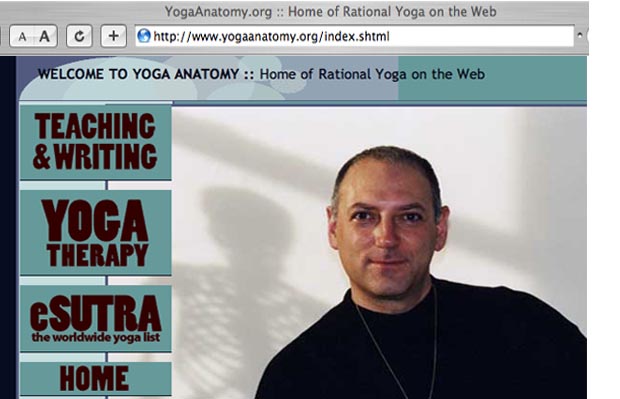
 Finally, after many months of planning, my personal website YogaAnatomy.org is up on the web.
Many, many, thanks go out to master designer Lydia Mann for doing such a superb job, and for putting up with someone who should know how to be a better client by now.
Category: Uncategorized
-
YogaAnatomy.org Website Goes Live Today!
-
June Yoga Journal "Ask the Expert" features Leslie Kaminoff
 The current (June) issue of Yoga Journal’s “Ask the Expert” column focuses on some breathing-related questions. I was asked to write the responses by YJ’s former executive editor, Mary Bolster. This was one of the last pieces Mary worked on before relocating to New York to become the new Editor-in-Chief at Natural Health Magazine. It was a pleasure working with Mary, and I look forward to doing so again in the future.
Q: Will it help or hurt a person with high blood pressure to practice Kapalabhati breathing followed by breath retentions?
A: I view Yoga exercises as being instructive rather than prescriptive; I don’t prescribe them like pills to cure specific things. Quite often, it’s not so much what exercise you do that determines its effect, but how you do it.
A hypertensive student practicing Kapalabhati (short, quick exhales followed by passive inhales) is a great example of this. The truth is that you’re likely to put far more strain on your cardiopulmonary system lifting a heavy package or having a difficult bowel movement than by doing Kapalabhati. Nevertheless, it’s entirely possible that a hypertensive student might increase their blood pressure as a result of intense breathing practice. So, Kapalabhati could potentially be harmful, if it’s practiced the way it’s commonly taught in group classes.
But with Kapalabhati, the key is doing it in such a way that is beneficial rather than harmful, which means that the diaphragm must be completely relaxed so that its movement will be caused by the contraction and release of the lower abdominal muscles. This is essentially an active exhalation followed by a passive inhalation— literally non-diaphragmatic breathing. Therefore, if Kapalabhati is done with a relaxed, slow rhythm, it can help free up tension in the abdomen that is associated with the inability to shut off the “fight-or-flight” response, which is almost invariably a major component of hypertension. In this context, Kapalabhati could be quite helpful for a student with high blood pressure.
Now let’s talk about breath retention, which can refer either to suspending breath movement after inhalation (internal, or anta kumbhaka), or after exhalation (external, or bhaya kumbaka). Most Yoga systems teach internal retention after Kapalabhati, but for a student with high blood pressure, I’d try to achieve a more calming effect after a round of gentle Kapalabhati by pausing briefly after the final exhalation, then relaxing the throat muscles so that a passive inhale can occur followed by a period of easy breathing.
These modifications are examples of T. Krishnamacharya’s dictum that Yoga must be adapted to the individual. This is especially significant when breathing techniques are involved because our unique constitution, history, and habits are literally written in our breathing patterns. This is why the effect of a particular breathing technique will vary quite widely from person to person.
In short, just about any practice you do gently and with self-awareness will benefit you— even if you have high blood pressure—because it has the potential to reveal and dismantle your unconscious breathing habits.
2) What asanas and breathing techniques are good for improving the
immune system?I assume that “improving the immune system” refers to stimulating a compromised immune system, but it’s important to remember that the vast majority of immune disorders are autoimmune, in which a misdirected immune system produces antibodies to substances occurring naturally in your body. In this case, you’d want to reduce the immune system’s activity.
Regardless of whether your immune responses require stimulation or reduction, conscious breathing combined with guided imagery or visualization has been proven to be a highly effective and powerful tool for healing. Try the following: Find a quiet place, sit in a comfortable position, and bring a relaxed awareness to the breath. Think about your desired internal changes and then consciously link your breath to these goals: If you want to bring something positive in such as health and vitality, focus on the inhalation. If you want to release something undesirable like pain or discomfort, focus on the exhalation. Concentrate on what imagery you associate with these feelings, such as a certain color, a sensory feeling like warmth or tingling, or a calming scene in nature. Use whatever imagery helps you; the possibilities are endless. The key is to allow yourself the freedom to discover what is specifically nourishing to you – what works for other people is irrelevant.
In addition to breathwork, I’d recommend practicing a well-balanced asana sequence that leaves plenty of time for relaxed breathing and restorative poses. Ending your sequence in Savasana (Corpse Pose), puts the body in a state of maximum repose where it is freed from the need to contend with gravity. Here, you can bring your focus more fully to the inflow and outflow of the breath and whatever imagery you’ve chosen to help heal your immune system.
3) Can you recommend any specific breathing techniques for
asthmatic kids?When it comes to dealing with asthma attacks, how you prepare for an attack will determine how you react when you actually have one. When the airways are constricted, relaxed shallow breathing is what’s needed. This goes against what seems like common sense, as everyone’s instinct is to tell an asthmatic during an attack to “breathe deeply.” This is the worst advice, because it just makes them more tense; after all, if they could breathe deeply, they wouldn’t be having an attack in the first place! Without training it’s very difficult to relax when having an attack because relaxed, shallow breathing is so counterintuitive when you feel like every cell in your body is starving for oxygen.
What does this training consist of? Slowly and systematically lengthening the exhalation and the periods of external retention. As my teacher T.K.V. Desikachar is fond of saying: “If you take care of the exhale, the inhale takes care of itself.” Non-forcefully holding an external retention puts your body in a similar situation to when you are actually having an attack, because in both cases your body is deprived of oxygen. Remaining clam in this state is the key to being able to relax during an acute asthma attack.
Gentle, non-forced external retention has shown to improve asthmatic symptoms so dramatically that an entire asthma treatment system called the Buteyko Method is based on it.
Kids can learn how to do this, but of course training is more easily accepted if it’s fun and engaging. I recommend singing, rhyming, and chanting, because the breathing pattern is similar to what you are trying to learn: Long, slow supported exhalations followed by relaxed, efficient inhalations. Practicing silence in between verses produces the necessary pause after the exhalations. Make up games and create songs that incorporate increasingly longer phrases. Asthmatic kids, and kids in general will benefit enormously from this, because they are learning the skill of relaxing in the face of discomfort – something most of us only learned in our first Yoga classes as adults.
Leslie Kaminoff is a New York City breathing specialist and Yoga Therapist inspired by the teachings of T.K.V. Desikachar. His 27 years of teaching experience are culminating in his book “Yoga Anatomy,” to be published this year by Human Kinetics. He is the founder of the non-profit educational corporation “The Breathing Project” (breathingproject.org). His personal website is yogaanatomy.org.
-
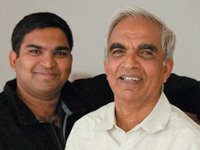
T.K.V. Desikachar and Kausthub Desikachar in Boston April 27-30, 2006
 If you’ve never experienced these teacings directly from T.K.V. Desikachar, I highly recommend you attend this weekend seminar with my teacher and his son, Kausthub.
I’ve arranged for a two-week extension of the early registration discount just for mentioning e-Sutra.
Contact Robert Birnberg at longexhale@mac.com for more information.ANNOUNCEMENT:
T.K.V. Desikachar and Kausthub Desikachar are teaching a four-day seminar entitled ‘Meditation as Medicine’, exploring the healing aspects of Yoga and Meditation. APRIL 27-30, 2006
This one-time event is a benefit for the Krishnamacharya Yoga Mandiram, the healing center in South India started by T.K.V. Desikachar to honor his father’s teachings.
We would love to invite You, Your students, family and friends to this very special event. There is still space available, but it will fill.
For more information Go to: http://www.thebreathingspace.net/healingheart.html
-
"Yoga Girl" Video
Last night, as I was watching a video of Ana Forrest’s yoga demo at the recent Yoga Journal conference, I found myself thinking that it wasn’t very impressive compared to trained gymnasts, dancers or contortionists that I’ve seen.
This remarkable video makes a good argument for my point. It’s great entertainment, and very impressive….but is it yoga? Let me know what you think.
P.S. Please don’t flame me because you think I’m dissing Ana. I happen to think she is a very impressive teacher and Yogini, and her practice is remarkable, considering she’s roughly in my age group. I was simply evaluating her demonstration for its esthetic value compared to others that I have seen.
-
Paul Z. Myers Rips Deepak Chopra on Intelligent Design
 Paul Z. Myers is an Associate Professor of Biology at the University of Minnesota, Morris. He is the creator of the very impressive blog “Pharyngula,” and he has some strong words for Deepak Chopra, who recently came out in favor of Intelligent Design.
His post starts with: “…that New Age con-man, Deepak Chopra…says all the same stupid things the right-wing fundies do. He’s complaining that we have to take Intelligent Design out of the hands of the fundamentalist Christians AND those clueless scientists.…it doesn’t matter whether he’s right-wing or left-wing, he’s just an idiot.”
All in all, it’s highly recommended reading in the “intellectual ammunition” department.
-
Yoga Anatomy Training with Leslie Kaminoff
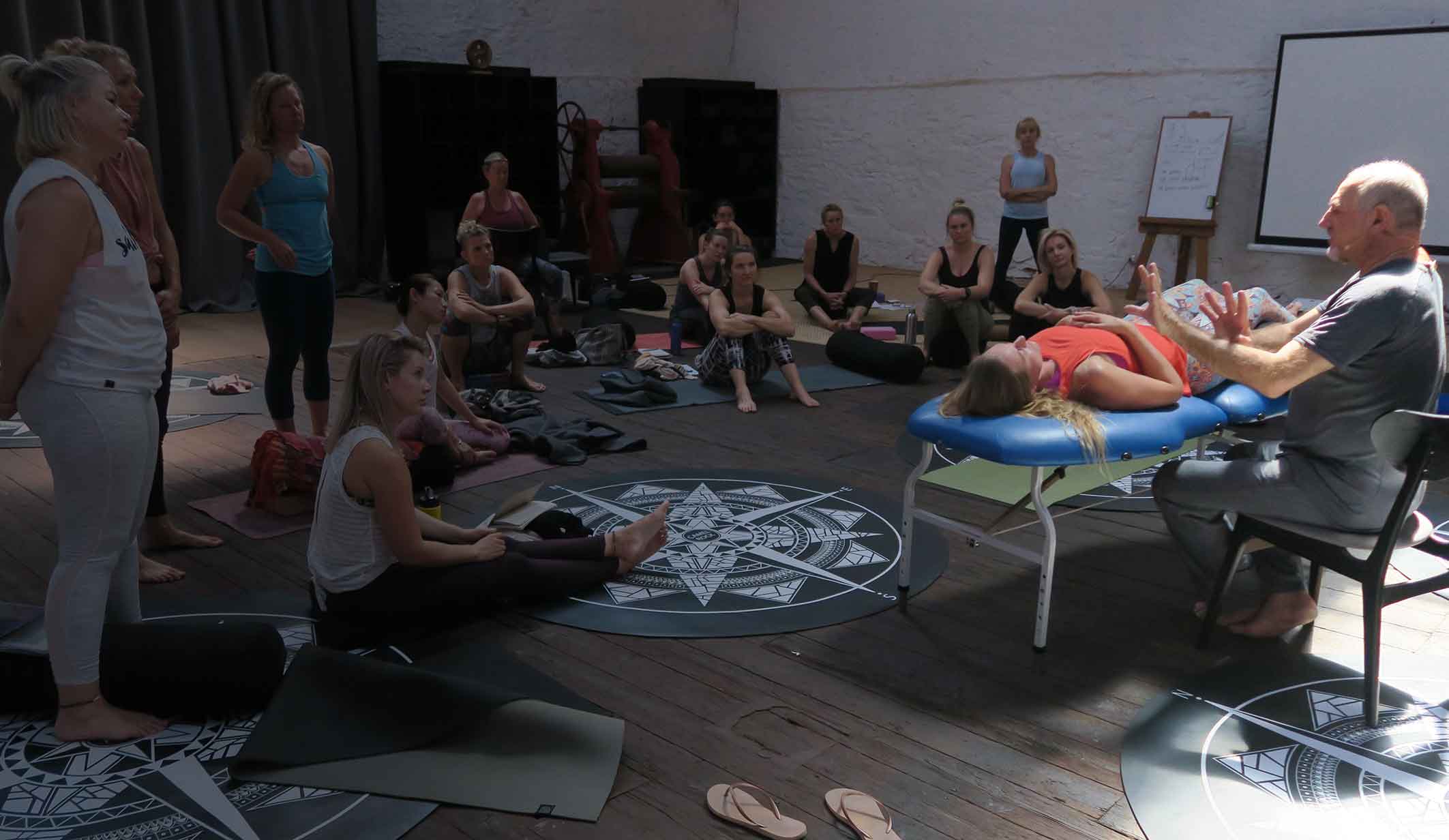
There is still room in a week-long Yoga Anatomy training I’m teaching at Kripalu from Jan 22 – Jan 27, 2006.
I really enjoyed teaching this program at Kripalu last summer. The
intensive format allowed me to work closely with the students, and we were
able to cover almost as much core material as I teach in the year-long Yoga
Anatomy training at The Breathing Project.
I’m also leading an Equinox Yoga Weekend at Kripalu Mar 17 – Mar 19, 2006.
Here’s the description of Yoga Anatomy from the Kripalu website:
Jan 22 – Jan 27, 06 (5 nights, Sun – Fri)
with Leslie Kaminoff
For all levels and abilities.
This program will provide a practical grounding in the essentials of the
anatomy, physiology, and kinesiology of yoga practice, with particular
emphasis on the relationship between breathing and healthy spinal function.
In an engaging and creative learning environment, we will make anatomy a
living, breathing, unforgettable part of our lives.
The first two days will focus on the anatomy and mechanics of breathing. The
third day will cover the evolution and anatomy of spinal mechanics and the
development of postural support and articular freedom. The last two days
will deal with yoga physiology, balance, and equilibrium, including hands-
on yoga therapy techniques and assisted practice relating to specific
asanas.
Throughout the week, ample time will be devoted to individual
questions, concerns, and structural issues.
Yoga provides a unique opportunity to the anatomy student because it shows
us which details are important and integrates those details into a unified
vision and experience of human existence. Gone are the days of memorizing
and forgetting countless details of anatomy—this is embodied knowledge.
Leslie Kaminoff is a yoga therapist with more than 26 years’ experience in
the fields of yoga, breath anatomy, and bodywork, inspired by the tradition
of T.K.V. Desikachar.
He has led workshops for many of the country’s leading yoga associations,
schools, and training programs. Leslie is the founder of The Breathing
Project, a New York City yoga studio dedicated to the teaching of
individualized, breath-centered yoga practice and therapy, as well as the
creator and coordinator of “The Future of Breathing.”
He practices yoga therapy and bodywork in New York City and in Great
Barrington, Massachusetts. He is currently at work on his first book,
entitled “Yoga Anatomy”.www.breathingproject.org -
Chronically Ill Patients Turn to Yoga for Relief
 Cynthia Mathis, left, conducting a yoga class for people with osteoporosis at a church in Westfield, N.J.
New York Times – December 15, 2005
By CAROL E. LEE. JACK WATERS credits yoga with saving his life four years ago. … He needed to get to a hospital, but first he wanted to do a yoga pose. …Congratulations to Cynthia Mathis, James Murphy, Jo Sgammato, and Jackie Herbach – all New York area teachers who contributed to this article.
-
Good And Bad Reasons For Believing
 The famous evolutionary biologist Richard Dawkins wrote a wonderful letter to his 10 year-old daughter Juliet on good and bad reasons for believing. “Is this the kind of thing that people probably know because of evidence? Or is it the kind of thing that people only believe because of tradition, authority, or revelation?”
I found myself involuntarily cheering: “Yes, YES!” while reading it this morning. My thanks to Jason Kottke for the heads-up.
-
Neti in the News

 I actually heard this piece as it aired this morning on NPR’s morning edition:
Nasal Irrigation Makes Comeback as Cold Remedy
Morning Edition, October 12, 2005
“An age-old technique that may have developed from yoga traditions is turning out to be a simple and effective way to combat the cold. Flushing the nasal passageway with warm salt-water can help prevent colds and bring relief to allergy-sufferers.”
……
I’ve been doing this for years, and I recently bought a HydroPulse unit, which is a vast improvement over the old neti pot. It’s very much like a WaterPik with a nasal attachment, and it works beautifully. Around my house, we call it by the name given to it by my son, Jai: “The Shnozzelator.” -
Exclusive Retreat with Kausthub Desikachar Aug. 21 – 30, 2006 in Piesendorf, AUSTRIA – by Invitation Only

 From: kausthub desikachar
24, September 2005dear friends
here is a unique opportunity to explore the secrets of mantras – some of the most important mantras, their meanings, what are their symbolisms, when to use them, how to use them etc.
this intensive retreat is by invitation only. in case you are interested in participation please reply to mediagaruda@mac.com
please feel free to share this information and spread the word around to those you think may be interested. participation is limited to a maximum of 35 spots. already around 18 have been confirmed.
warm regards,
kausthub