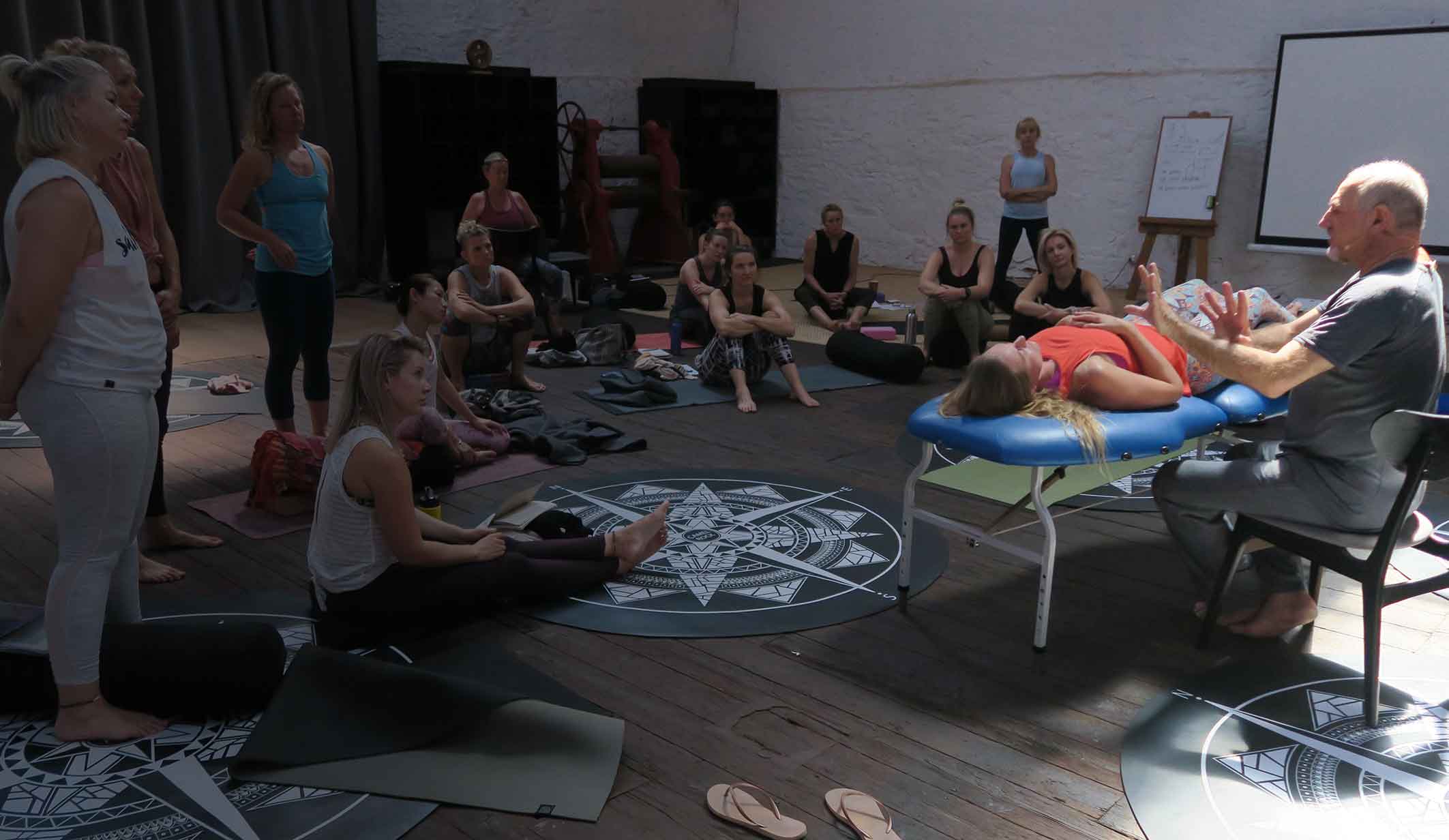
Leslie seated at a massage table demonstrating a technique for a roomful of students

Leslie Kaminoff is a best-selling author and yoga educator.

Category: Uncategorized

  • Is gender really an issue at SYTAR?

    In my opinion gender, per se, is not the real issue here. The type of genitalia a person possesses is about as relevant to their value as a presenter as whether they have an innie or an outie belly button. Many males have a distinctly “feminine” perspective, and vice versa, and this was in ample evidence in the SYTAR presentations.

    I think it’s important to not get caught up in the masculine vs. feminine argument either. It’s very easy to put these labels on differing perspectives, and tie those labels to whatever axe we feel needs grinding. It’s ultimately a polarizing view that takes us away from each other, and away from Yoga – which after all, is about integration and seeing beyond the obvious.

    Actual Yoga is neither masculine nor feminine, and I believe the only relevant distinction in this discussion is Yoga vs. non-yoga.

    Regardless of their gender, or “masculine/feminine” perspectives, if someone is willing to discard or minimize the essence of what makes Yoga unique, special and effective – i.e.: RELATEDNESS – they are (in my view) taking us outside the field of Yoga. If it were me choosing, a prospective presenter’s ideas on this issue would be the primary determining factor in the selection process.

    This, more than anything else, is what I found questionable about a few of the presenters at SYTAR. What are we to think of a teacher who’s focus is on what we should do as a profession to make ourselves acceptable or credible in the eyes of the rest of the world, and who utters not a word about honoring and protecting the very thing that makes our work unique: the student/educator relationship? I found this “relatedness” theme also largely missing from the research design and presentations, mostly because it was one of the variables that they had to “control” for in order to make the studies reproducible.

    I’ve always said that anyone who’s opinion really matters has long since been convinced of Yoga’s efficacy in a wide range of therapeutic applications (by anyone, I mean upwards of 15 million members of the general public in the USA). Who are we still trying to prove this to? Doctors? Hospitals? The government? Insurance companies? Some honest inquiry into the real motive behind these research studies could yield some enlightening answers.

    I’m not suggesting that we shouldn’t do research into the effectiveness of Yoga; I just think we can find ways of designing better studies that tell us something we don’t already know. For example, I’d love to see a study that INCLUDES the student/teacher relationship as a central element. Here’s a study: given identical sequences to teach, does an experienced teacher get better outcomes than a novice teacher? If anyone wants to do this study, I’d be happy to help, because I’d really like to know the results – even if they challenge my basic assumptions about teacher training.

    As always, please feel free to share what you think….

  • Responses to "Gender Politics" Post

    Here are three responses to the “Gender Politics” post from last month. They are from Janice Gates, Nischala Joy Devi, and Scott (he apparently doesn’t use a surname).

    Click the title link above, or “Read More!” below to see the responses.

    Janice Gates said…

    Greetings Megan and All,

    I am so glad this topic is being addressed here. I recently completed a book that was born from my own frustration around the underacknowledged contribution that women are making in the field of yoga (Yogini, the Power of Women in Yoga). As someone who has done extensive research on the role of women in the history of yoga as well as the role they are playing in the evolution of yoga today, I was acutely aware of how easy it is to default to our deepest conditioning – with the men in more prominent roles defining the field and discussing the future of the profession with the women in more ´supporting´roles. As Vice President of the board of IAYT, I regret that I had not insisted more vocally that women be more prominently represented at the symposium. The positive side of this is that the gender imbalance has highlighted some issues that I feel are now ripe for discussion. Additionally, the board and everyone involved in next years programming are wide awake to this issue (from my own input as well as that of many attending) and it is being addressed as we speak.

    Some questions I have been reflecting on that may inspire some collective self-inquiry:

    1. What is the role of lineage and empowerment from the teacher/guru in becoming a yoga teacher or yoga therapist?

    I find this question particularly relevant as the teachings of yoga we are most familiar with in the West today,while not gender specific themselves, have primarily been passed through male lineages for centuries and are now being spread – widely – through women. Most of these women come from an extremeley different culture and life experience than that out of which the yoga teachings arose. Bringing this topic forward for discussion could both acknowldge the value of, and simultaneously demystify, what may sometimes be held up as he ultimate teaching credential.

    2. What are the experiences, qualities, skills and expertise that women are bringing to the field of yoga therapy that have yet to be acknowledged or defined?

    At the symposium, Nischala Devi so beautifully pointed out that even if we have the highest standards for yoga therapists, and teachers have extensively studied the yoga texts, intuition and compassion are essential components in the student-teacher relationship. These qualities are not gender specific, yet they are often considered feminine, or soft, and not given equal weight in relation to intellectual knowledge.

    3. And, lastly, in this evolving field of yoga therapy – which was described several times by presenters as the process of becoming aware of negative patterns that no longer serve us and transforming them into more positive ways of being – how can we, as a community, men and women together, become free of the conditiong that no longer serves us and realize our collective potential as a profession?

    Peace,
    Janice Gates

    author of Yogini, The Power of Women in Yoga
    ———————–

    Nischala Joy Devi said…

    Dear Leslie, Sisters and Brothers in Yoga,

    Wow! What a spectacular wave this conference is making throughout the Yoga and Medical world. Thank you to the visionaries who organized and brought this to fruition and for the presenters who are carrying the concepts to the next level of understanding.

    So many wonderful and inspiring letters and comments are being given on how to carry Yoga therapy into the 21st century.

    I do however; want to address what is now being called the “Gender Balance”. It seems that a very vital and important issue is once again being shuffled into the broad bin of “Women needing to have their voices heard” or even feminism.

    The reason the Gender Balance is so tipped is because traditionally the women healing from a heart and intuitive perspective were honored as the healers. When the scientific right brained thinking emerged it was overshadowed.

    As we can see this issue is much greater than how many women presented at the conference, that imbalance was only the symptom. A great paradigm shift is happening in many phases of our lives and health care is calling out among them. Having trained and worked in Modern Medicine most of my adult life, when I embraced Yoga some 30 years ago I wove the two together in what seems like a healing balance.

    Modern medicine has it’s apparent strengths, and obvious weaknesses. It’s weakness is that it sees people as only bodies and often only parts of the body. It is allopathic (against disease) oriented. It does not look at or acknowledge that we are anything but bodies.

    Yoga therapy differs as it acknowledges that each individual houses the divine spirit and when it is given honor healing power emerges. Trying to bridge these very different concepts is a task that takes great skill. That skill comes from outside learning but more from our own inner practices.

    Having been a Yoga Therapist and researcher in the Lifestyle Heart Trial (Dean Ornish Program) our first trial demonstrated the efficacy of using Yoga as a modality for Reversing Heart Disease. This was proven to be dramatically effective. Nothing in modern medicine had the potency to reverse cardio-vascular disease. I was laughed at and teased for invoking “unscientific practices” to invoke love, intuition and compassion. In the end that is what patients reported that encouraged the “true healing”.

    Our second study the Multi Centered Lifestyle Heart Trial, was done in order to see if, we, the modality specialists, could train others to do this work with the same effects. It was also proven as the first trial. This is what we as, Yoga Teachers, are doing in training each other to guide patients to heal themselves.

    What became clear to me during the two trials was the difference between objective and subjective findings. Objective findings are delivered through concrete measurements and testing. Subjective findings are the ones that are reported by the individual as the initiation of the healing. Only measured by the individual perception.

    When we consider the panels and discussion for the next symposium and what to teach as Yoga therapy both the objective and subjective are necessary. The subjective part is what has been missing and is the essence of the paradigm shift. The heart and the head must be considered and honored; otherwise we are just folding the great and ancient tradition of Yoga into another arm of Allopathic Medicine.

    It is time to unite all parts of us, the spiritual, mental, emotion and physical through using all the tools we now have, whether ancient or modern, to bring balance.

    I am honored to be part of such a great shift and part of such a noble organization as IAYT.

    With you in joy, love and healing, Nischala Joy Devi

    —————————

    Scott said…

    Dear All,

    A great discussion here, and on such a wonderful topic.

    I cannot agree enough on the need for a return to the feminine aspects of Yoga, especially in Therapy. Having thankfully been gifted an adjustment in perspective of late, I can see what Megan and others are expressing here, to me we all seem to be expressing the same truth in different ways.

    I would say that we should be careful how to proceed in this matter though – it may be insntinctive to rush in and try to ch
    ange things to “the way they ought to be”, but this is simply a masculine approach to a masculine problem. In doing so you may entrench those who have not yet received the wisdom of the power of a more feminine approach, or at the very least shift your own actions from being sourced in feminine power back to the masculine approach i.e. you may become that which you dislike.

    I personally favour the Ghandi approach of “Be the change you want to see in the world.” Let the conference organisers have their speakers on their podiums – remembering, of course, not to judge those speakers themselves as they may have nothing to do with the preceived imbalance.

    Do your work, do it the way you know it should be done, the way your heart is telling you. Be kind and compassionate, and help people to remember how to heal. Let those who mistake intellect for Yoga work through their own path, and maybe, eventually, they will see the error of their ways (if in fact it even is an error, rather than simply a process) and your example will give them guidance to a better way. That’s what happened to me, and if I can make the shift please be assured it is possible for anyone to be influenced in this way 😉

    Love and light,

    Scott
    www.exploreyoga.co.uk

  • Yoga Therapy and Gender Politics? Megan McDonough and John Kepner Weigh In…

    The following exchange is taken from the comments page of my post “More SYTAR Reports Coming.” In it, Megan McDonough makes some excellent points – many of which I agree with – about the male/female dynamics apparent at the SYTAR event, and in the current atmosphere of the Yoga Therapy field.
    I forwarded her comments to John Kepner, Executive director of IAYT, who promptly responded with his own observations, and an invitation to address these issues at the next symposium.
    Here is the exchange. As always, I welcome any comments from you.

    1/31/2007 12:20 PM
    Megan McDonough said…

    Hi Leslie,

    I’m sorry I missed you at the SYTAR conference in LA. The conference began with the question: How COULD we define yoga therapy? The more telling question, from my perspective, is: How ARE we already defining yoga therapy?

    Actions speak louder than words. If we are to view the actions at the first yoga therapy conference as the basis for a definition, then we could easily come away with the mistaken impression that yoga therapy is a masculine modality, a conclusion drawn from the panels, the process and the platform.

    Firstly, the panels were predominately male. For years, corporations have made the argument that there were simply not enough females in the job pool for solid representation in leadership roles. All we had to do was observe the overwhelming presence of females in the audience to see that this is not the case for yoga therapy. Why, then, were the panel members mostly men?

    Secondly, the majority of workshops and perspectives at the conference looked at the process of yoga therapy as taking a masculine approach of “Let’s fix what’s wrong with the body.” Like the prescriptive approach rampant in our healthcare system, this approach ignores the wisdom and individuality of the patient and instead thrusts the yoga therapist into the role of “answer-man.” Missing in the discussions, for the most part, was the emotional component—how yoga therapists can (and do) play a vital role in the circular and sometimes messy journey of emotional healing. Western medicine’s limitation to a purely prescriptive approach is one of the reasons people seek out-of-the-box modalities like yoga therapy in the first place; let’s not model ourselves after a system to which we are attempting to offer an alternative.

    Lastly, the platform of the conference tended towards a straightforward lecture or discussion format, similar to that of a medical conference, with little movement or participant involvement.

    Explicit definitions of yoga therapy are helpful. Far more telling, however, are the implicit definitions revealed in the methods and mindset we are using to develop those explicit definitions. I, for one, would like to see the feminine better represented in the panels, the process, and the platform at future conferences.

    We need not follow in the footsteps of healthcare, business, or other yoga models when developing a definition or a conference format. Yoga therapy is a unique entity. We must forge a model all our own, one that is inclusive and honors the depth and range of yoga in both its masculine and feminine forms.

    In Yoga,

    Megan McDonough
    www.yogawithmegan.net

    1/31/2007 02:05 PM
    John Kepner said…

    Aloha

    I appreciated Megan’s comments. I was especially glad to meet her in person at the Symposium. Several years ago she won a special prize offered by YREC for the best Yoga essay of the year. You can see why.

    I have actually been working on a little article on the gender balance issue, so in the friendly spirit of this forum, I will offer this to e-sutra readers. Maybe I should title it… “Fools Rush In”

    Gender Balance and Symposium Faculty Selection Criteria
    “Lies, Damned Lies and Statistics” – John Kepner, Executive Director

    In a wonderfully positive atmosphere, gender imbalance was politely but pointedly pointed out to us several times. The participants were mostly female and the presenters were mostly male. So, let’s look at the statistics and (at least my own)faculty section criteria in general for IAYT’s first Symposium. We are not seeking to argue anything here. We are, however, always seeking better ways to serve our mission, our membership and the public, especially in the faculty selection for the next Symposium. We are mindful that today it is mostly women who are carrying forth the Yoga tradition.

    Statistics:

    Main Session Presenters
    Female: 22%
    Male 78%

    All Faculty
    Female 41%
    Male 59%
    (All Faculty consists of Main Session Presenters, Moderators, Practice Session Leaders and Workshop Leaders)

    Faculty Selection Criteria:

    The best faculty available to support the mission of IAYT and the Symposium on Yoga Therapy and Research. For this first symposium, all faculty were individually selected.

    A balance between Yoga researchers, healthcare practitioners that use or support Yoga in their practice, and especially many leading Yoga teachers and Yoga therapists representing most of the major traditions, lineages and methodologies with a history of contributions to Yoga therapy.

    A preference for IAYT members and contributors to IAYT publication

    A preference for faculty from Los Angeles and California to keep costs down for our first Symposium.

    Looking forward:

    A key issue, at least in my opinion, is the maintaining the appropriate balance of heart and mind, science and spirit in a Yoga symposium. But the title is indeed, “Yoga therapy and research.” Suggestions for new faculty, especially important emerging voices that support the mission of the Symposium and serve the participants are always appreciated. The working strategy for the next symposium, is “more depth, dialogue and integration” (and thus consequently, less breadth).

    Comment:

    The current IAYT Board of Directors (Veronica Zador, Janice Gates and Eleanor Criswell) is all female. The current Staff is 75% female (John Kepner, Kelly McGonigal, Amber Elliott and Jesse Gonzales)

  • National Yoga Day at The Breathing Project

    Please join us on Saturday, January 27 at the Breathing Project for a day of Free yoga classes! January 27, 2007 is National Yoga Day – when free yoga classes are offered to the general public to get more people interested in the benefits of yoga.

    We are offering 3 free workshops at The Breathing Project: Prenatal with Amanda Zapanta at 10:30 – 12; Sun Salutation Workshop from 2 – 4 pm with Melissa Elstein; and Restorative with Edya Kalev, 4:15 – 5:45 pm.

    Click on the image above to view or print a full-sized version of the flyer. Please help us to spread the word! We hope to see you Saturday, January 27!

  • More SYTAR reports coming…

    In case you were wondering, I do have more to say about the rest of the SYTAR event – but I’m especially interested in what you all have to say! If you were there, please send in your feedback.
    Also, my apologies to those e-Sutra members who couldn’t find our table for the lunch on Friday. My previous session ran late, I got held up a bit by questions, and we ended up in the corner of the larger of the dining rooms.

  • Friday at SYTAR

    After the invocation and greeting, John Kepner, IAYT’s executive director revealed that they were hoping that maybe 400 people would sign up for this event. They opened registration in May, and by July, a small trickle of registrations had turned into a torrent. There were 800 people packed into the largest ballroom at the LAX Hilton. Not bad, considering that the Yoga Journal Conference is happening simultaneously in San Francisco this weekend. The size and quality of the crowd was very impressive – especially when viewed from up on the dais (where I eventually sat to moderate the “YOGA AS AN EMERGING COMPLEMENTARY AND ALTERNATIVE MEDICINE (CAM) PROFESSION” panel.

    One of the most memorable elements of the morning session was the sight of my good friend Larry Payne sitting on the dais looking over the vast crowd with an expression of stunned joy on his face. He and Richard Miller started IAYT in 1989. I asked Richard if he ever, in his wildest dreams, imagined the possibility of such a huge response to their work. He said “it’s exactly what I hoped for.” I replied that it pays to have big dreams.

    My first opportunity to address the group came at the end of the “CAM” panel I was moderating with John Kepner. My main point, which was very well received, started with the question: “Does anybody else get a knot in their guts when the idea of regulation of Yoga Therapy is discussed?” After nearly everyone raised their hands, I pointed out that we should honor that feeling, and try to understand its source. I suggested that it may be because something we hold to be sacred – the student teacher relationship – is tangibly threatened by the third-party interference that regulation represents.

    I renewed my call for us to honor the principle of Ahimsa when it comes to our role as Yoga Therapists, obviously, to do no harm to our clients/students, but most importantly, to first do no harm to ourselves and our profession. Here, it bears repeating the 1993 statement I composed while serving as VP of Unity in Yoga:
    “We enthusiastically support the ongoing dialog addressing higher personal, professional and ethical standards for yoga teachers and therapists.”
    “We are in support of a process that results in the establishment of yoga as a respected personal and academic pursuit, and any certification or accreditation that may result.”
    “We are, however, opposed to the establishment of any entity that assumes the authority to license or regulate yoga teachers as professional practitioners and to enforce it’s standards on the yoga community.”
    I also made sure to point out that the current leadership of IAYT takes these issues very seriously, and would never knowingly do anything to violate that first principle of AHIMSA.
    Since then, I’ve had innumerable people coming up to me to thank me for my comments, which is very heartening.

  • Lecture notes from my 15-Minute breathing presentation

    There is an old story about how rabbi Hillel was asked to explain Judaism while standing on one foot. Hillel balanced on one foot and said: “Don’t do to others what you wouldn’t have them do to you. That is all the Torah; all the rest is commentary.”
    On Friday, I had an opportunity to present the essence of my life’s work in 15 minutes.
    Here’s my standing-on-one-foot version: “Breathing is the 3-dimensional shape change of the abdominal and thoracic cavities. The principal muscle of this shape change is the diaphragm, over which we have limited control- specifically its timing. Therefore, breath practice should focus on re-training the accessory muscles, which are defined as any muscle other than the diaphragm that assist or resist cavity shape change.”

    My brief talk was very well-received by the 800 Yoga Teachers/Therapists in attendance. They especially seemed to enjoy my demonstration of the dynamics of the abdominal and thoracic cavities that employs the use of a stacked water balloon and an accordion. Click the title link to this post to view a PDF of the complete lecture notes that were posted to the event’s website.

  • The SYTAR Main Session Course Companion

    Click the title link above to view PDF’s of most of the presenters’ notes and slideshows for their presentations.
    Also, I HIGHLY recommend that you download and use “Musculoskeletal Screening Guidelines for Yoga Therapists” from Matthew J. Taylor, PT, PhD, RYT. His was my favorite presentation of my fellow panelists from yesterday.

  • Arrival at SYTAR

    Just arrived in LAX for the SYTAR event, checked in, and have already seen several old friends and familiar faces.
    For those of you who are here, and wish to contribute, either send me an e-mail, or use the comments feature of this blog. Of course, this assumes you have some sort of e-mail or internet access (the business center of the Hilton, right across from the SYTAR registration desk on the second floor has internet access for a fee).
    It looks like we’ll have about 20 people for our lunch at 12:30 tomorrow (Friday). We’ll probably need a couple of tables in the dining area. IAYT Executive director John Kepner has said he’ll join us. I’ll have a report on this and much more tomorrow.
    Good night.

  • Blogging from SYTAR, and an Invitation

    The preparations for this weekend’s event are proceeding with much anticipation. I will be blogging my observations and impressions to e-Sutra in as close to real time as possible, starting on Thursday night. I invite any e-Sutra list members who will be in attendance to contact me if you want to contribute to the blog’s content during the event. I will arrange a simple method by which you can e-mail your impressions to me for possible posting to the blog.

    In addition, I would like to invite any e-Sutra list members to lunch at 12:30 on Friday. I’m not one of the designated “Private Luncheon with the Speakers” presenters, but that doesn’t mean we can’t commandeer a table at our complimentary luncheon. Let me know if you are interested, and I’ll make the arrangements.

    I’m eager to meet as many of you as I can while there!