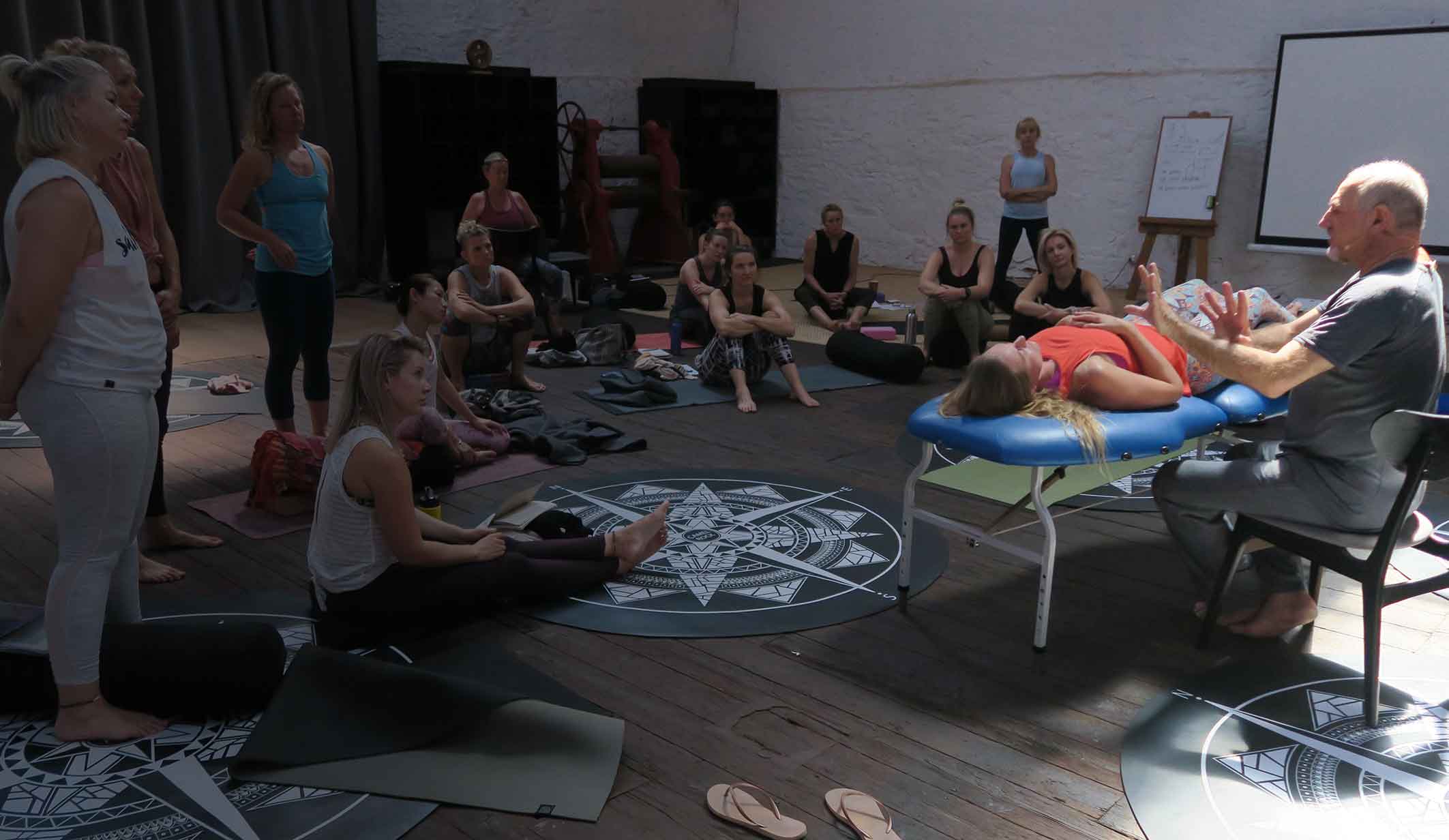
Leslie seated at a massage table demonstrating a technique for a roomful of students

Leslie Kaminoff is a best-selling author and yoga educator.

Category: Opinion

  • Yoga Alliance Approved, My Ass

    Another gem from my friend J. Brown of the Abhyasa Yoga Center

    Flipping through the catalog for a big name yoga and retreat center, I was shocked to notice that they advertised their yoga teacher training programs as “Yoga Alliance Approved.” Misrepresentations like this are the dirty little secret of the yoga industry. No one really wants to admit there is no accreditation for Yoga.
    Anyone who claims to be “approved,” “certified” or “licensed” by the YA is either grossly uninformed or disingenuous. The YA maintains a registry of yoga teachers and training programs. In filling out the paperwork and paying the fees, yoga teachers and training programs purport to follow a vague set of curriculum guidelines that are posted on the YA website and assume a service mark of RYT (Registered Yoga Teacher) or RYS (Registered Yoga School.)

    What no one ever seems to acknowledge or mention is that the YA provides no oversight whatsoever. No one checks to see if anyone is actually doing what they say. Everyone is on the “honor” system. Consequently, the registry amounts to a digital rubber stamp or paid advertising. Not to mention, the YA does not disclose what they do with the money they collect from the Yoga community.

    Even if everyone is being true to their word, referring to the YA guidelines as “standards” is quite a stretch. For example, being registered at the 200 hr level is said to have 20 hours of yoga philosophy. Generally, this entails a cursory reading of Patanjali’s Yoga Sutra’s and a written test, kind of like reading the chapter and answering the summary questions in my 9th grade social studies class…

    Read the rest here…

  • New York Times Dicks Around with Circ Stats

    The New York Times proclaimed the other day in a Global Update from Uganda:
    Male Circumcision May Help Protect Sexual Partners Against Cervical Cancer

    My friend Gil Hedley and I are in in complete agreement about not mutilating infant male genitalia, so I sent him the article, and he replied with a particularly (and characteristically) funny rant, which he has given me permission to share…

    (more…)

  • Helping Students with RSI: RSI Expert Deborah Quilter Comments on Paul Grilley’s Recent Article

    In this article for Yoga Journal’s “My Yoga Mentor,” Paul Grilley writes about his recommendations for students with “RSS – Repetitive Strain Syndrome.”
    After scanning through it, I had some anatomical red flags waving in my brain (this happens a lot when I read yoga articles), so I sent the link to a colleague of mine who teaches here at The Breathing Project, Deborah Quilter. Deborah is an expert on RSI (Repetitive Strain Injury), and is the creator of a website and a couple of books devoted to the topic.

    Click here to read Deborah’s detailed response to the Grilley article. Since writing the piece, Deborah has already heard from at least one person with RSI who has hurt themselves following Grilley’s advice. In Deborah’s own words: “I hope some of my students, or people with RSI who can still type, comment. It’s much stronger if it comes from them.”

    I e-mailed Deborah’s response to Paul Grilley last week, giving him an opportunity to respond, but I’ve heard nothing yet. Despite appearances, I don’t go out of my way to find fault with Paul Grilley’s ideas. I just have to listen to those red flags when they get raised.

    Dear Leslie,
    You asked my opinion of Paul Grilley’s article in My Yoga Mentor October 2005. Repetitive strain injury (RSI) is a vast topic. Misinformation about it abounds; indeed, very few doctors are knowledgeable in this area. Most people have no idea just how debilitating RSI can be, and all too often those who want to help unwittingly steer the injured in the wrong direction. My response follows, but obviously there is much crucial information I’ll have to leave out here. Omissions are covered in ample detail in my books and website,rsihelp.com .
    I am a big fan of Paul Grilley, and thought his piece on tension or compression, posted on e-Sutra January 4, 2005, had much to commend it. But as the author of two books on RSI, and having helped countless people cope with this disease over the past 15 years, my approach to teaching Yoga to injured people differs quite markedly from his. Yoga, if expertly modified for the student’s injury, can be enormously helpful for people with RSI; however, the wrong asana practice could make matters significantly worse. More on that later.

    First, a little background: RSI is a highly complex soft-tissue disease. It is not just one thing, such as carpal tunnel syndrome, as most people assume. Depending on how you count them, RSI comprises about two dozen separate diagnoses to the nerves, tendons and muscles of the upper extremity (from shoulder blade to fingertip), including the best-known (but not the most common) carpal tunnel syndrome, epicondylitis (tennis elbow), thoracic outlet syndrome, De Quervains’ disease, and several nerve entrapments. A new syndrome, “Blackberry Thumb,” was recently reported by the American Society of Hand Therapists. People usually have at least three separate diagnoses and often have as many as two dozen. Also, since each person presents with a unique – and changing – cluster of symptoms, and the severity of injury varies from person to person and day to day, across-the-board protocols do not work for every body.

    Unlike many other injuries, RSI is invisible. Without an astute awareness of telltale pain behavior, it is only through the student’s self-disclosure or difficulty in movement that the teacher would know someone has it. Otherwise, they look normal. This can lead teachers to greatly overestimate a student’s capacity.
    RSI can be devastating. Not only can it end careers, it can also make common daily activities such as driving, dressing or eating difficult or impossible. Simple things like signing a check, holding a coffee mug or pressing an elevator button can be extremely daunting.

    Because of the unforgiving nature of soft-tissue injuries, it’s extremely easy to re-injure yourself if you have RSI, and relapses can be worse than the initial injury. Therefore, I typically see students one-on-one to begin with so they have my undivided attention – and receive a practice tailored to their unique needs. First, I take a thorough health history so I have a general idea of which movements to avoid. We begin with relaxation, so the student can sense breath and learn to guide and be guided by it. I emphasize that the student is in charge, and say, “If something doesn’t feel right for any reason, stop. Don’t do anything that bothers you.” Once the student has established trust in his inner teacher, we can safely proceed to moving at a slow, comfortable pace. I demonstrate postures before we do them for the first time, and ask the student if he thinks that asana would bother him before we proceed. I also watch students’ facial expressions, quality of movement and breathing, and stop them immediately if there is any sign of struggle or strain.
    My approach also differs from Grilley’s in emphasis: his exercises focused on stretching. While this is very important, my program emphasizes strengthening as well. People often develop RSI because of weakness, particularly in the back muscles, so I design practices that bring balance to the muscles, strengthening and stretching them.

    Regarding the specifics of Grilley’s piece, I’ll respond point by point. Let’s begin with the dinner-plate analogy. In fact, most computer users do not position their arms as though holding a dinner plate. Rather, they rest their wrists on the edge of the desk because the shoulder muscles become extremely fatigued from holding the weight of the arm. Fatigue also leads to the forward head and slouched posture common among computer users. To compound the risk factors, the keyboard is often on the desk, rather than an appropriately lowered keyboard tray. This leads to more shoulder strain as the computer user constantly lifts her shoulders as she keys or reaches for the mouse. Wrist-resting leads to a multitude of possible problems: the compression of the median nerve at the wrist; and the dorsiflexion (upward bend) and ulnar deviation (sideways bend) of the wrist, both of which can strain the forearm tendons, muscles and nerves.
    Grilley correctly states that computer users need movement, but the single most important – and most difficult – step toward rehabilitating RSI is neither movement nor stillness per se, but ceasing to use the computer or stopping any other offending activity. Given that most people’s jobs involve computer use, this is a thorny and frightening dilemma.
    Grilley’s suggestions for movement at work may seem innocuous, but when you deal with RSI, you quickly learn that the simplest exercise or movement could be too much for someone.

    • Dropping your arms by your side can be very fatiguing to people with shoulder injuries or cause unpleasant tingling in people who have thoracic outlet syndrome. My suggestion: rest your forearms palms up on a big pillow or two placed on your lap – this rests the shoulders and relieves the forearms from the strain of pronation (the palms-down position).
    • Many people cannot stretch their arms overhead without difficulty; and any relief from symptoms would be fleeting at best if they have chronic pain.
    • Pushups, one of the exercises Grilley mentioned, are contraindicated for people with RSI because most cannot bear any weight through the wrist.
    My approach is to tell uninjured people that they need regular breaks from computing, at least one 5-10 minute break for every twenty minutes at the keyboard. Most authors of articles on RSI and ergonomics offer exercises you can do seated at your desk, but because sitting in and of itself is a prime risk factor for RSI, I urge people to do what the body was designed for – full-body movement. To that end, I encourage people to get up from their chairs and go for a walk to stimulate circulation, and rest their eyes by gazing in the distance, preferably out a window. For more on why breaks are so important, see http://rsihelp.com/breaks_important.shtml.

    Grilley was quite right to caution mindfulness with his suggested exercises, but, with the exception of the second exercise (gently dropping the head forward), I would not recommend any of his choices. His suggestions would be fine for experienced Yogis with ample range of motion and strength, but many people come to Yoga only after they are severely injured, and they may not have exercised for years. Most of his examples too extreme for such beginners, and could lead to more pain and injury.
    • In his first exercise, bending the head back would be very painful for people with limited range of motion or severe neck pain. Here’s one alternative choice: keeping your gaze on a fixed point straight ahead, make a slow figure eight with your nose in an easy range of motion, avoiding extreme upward movement of the head.
    • In the Eagle variation, few of my students with RSI would be capable of sitting on the floor with straight legs and resting their elbows on the floor or even a bolster without rounding – hence straining – their backs. Doing this pose on a hard surface such as a desk could be damaging to the ulnar nerve, which is already stretched to maximum length. (By the way, habitually leaning on your elbow on hard surfaces is one of the ways people develop ulnar nerve injuries.)
    • I strongly caution people with RSI to avoid the Broken Wing variation. While this pose might feel marvelous to an uninjured person, if someone has rotator cuff tendinitis, for instance, they cannot reach into a back hip pocket or unhook a bra without pain, much less place their hand between their shoulder blades – then rest their body weight on top of that! I’ve also had students who could barely bend their elbows because of pain. Placing the body weight on an injured forearm could likely set off an episode of pain or tingling.
    • As for the Peacock variation, because so few people with RSI are comfortable in Cat pose, this extra-strong forearm stretch would be entirely too much for most of them. A safer choice would be a simple Namaste, going only as far as is easy, or gently circling the wrists. Later, when the student has gained flexibility, I prefer a standing variation of the pose my teacher, Kevin Kortan, showed me: place your hands on the wall for support so the body weight is more easily controlled. In this position you can ease into the pose slowly and back off quickly if it’s too much.

    Given Paul Grilley’s statements about “freeing ourselves from the tyranny of ‘proper form’ and ‘perfect poses,’ I feel confident that he would not intentionally encourage someone with RSI to strain. I also applaud him for caring enough to bring this topic to light. RSI is the leading occupational disease in the United States – and people’s lives are devastated by it every day – but RSI prevention has received less and less government support since the Bush administration vetoed the Occupational Safety and Health Administration (OSHA) ergonomic standard. The leading cause of RSI is ignorance. No one who uses a computer should find out about RSI the hard way by becoming injured. And no one who comes to Yoga seeking help should be further injured in the attempt to heal.

    – Deborah Quilter

    Deborah Quilter is the author of The Repetitive Strain Injury Recovery Book (Walker, New York 1998) and what Amazon.com called the “bible” of RSI: Repetitive Strain Injury: A Computer User’s Guide (with Emil Pascarelli, M.D., Wiley, New York 1994). She has spoken internationally on RSI and appears in the media frequently. She earned her yoga teacher certification through Spanda®: the Yoga of Movement, and holds certifications in personal fitness training from Marymount Manhattan College and the American Council on Exercise. Ms. Quilter studies Evolutionary Yoga™ with its founder, Kevin Kortan. She is writing another series of books and articles about RSI, and will also be teaching other Yoga teachers her methods for helping students do asana without exacerbating existing injuries at Kripalu and other venues including the Breathing Project next year. For more information, visit her website, rsihelp.com.

  • Tension or Compression: The Fundamental Distinction

    This thread contains an essay that Paul Grilley wrote, at my request, for e-Sutra. The follow-up posts are from myself, senior teachers of The Breathing Project and others. This is still an open thread, and more comments are welcome, including a response from Paul.

    Tension or Compression: The Fundamental Distinction
    Paul Grilley
    September 20, 2004
    Ashland, Oregon

    Posted to e-Sutra January 4, 2005

    Architectural principles start from the premise that all structures, including our bodies, are a balance between stretching forces and crushing forces, or briefly “tension and compression”. The cables that stabilize telephone poles or lift elevators are being stretched, they are subject to tension. The telephone pole itself or the support columns holding up a building are being pressed, they are under compression. When we practice Yoga asana the fundamental distinction to make is this: “Are the physical restrictions I am feeling tension or compression?” Tension is due to the stretching of muscle or connective tissue but compression is determined by the shape of our bones.

    Skeletal differences
    The bulk of my work as an invited Yoga teacher is anatomical. A few years ago I walked into “The Bone Room” in Berkeley, California and purchased five human femur bones. It was the best investment I ever made. In nearly all my presentations I point out the dramatic differences between these bones. Besides the obvious size and length variations I point out how some bones are twisted 40 degrees backward or rotated 30 degrees upward. These differences might remain a mere curiosity but when these skeletal differences are coupled with the idea of compression it usually turns a student’s yoga world around. Because all of our bones are different, all of our joints compress at different angles of flexion and extension. Through our Yoga practice we can discover where we compress but our Yoga practice will not change where we compress.

    A brief outline of the ideas presented in an “Anatomy for Yoga Workshop” is as follows:

    1. When we practice asanas we move our joints.
    2. When we move our joints our bones pivot away from each other.
    3. Because the bones are moving apart tissues are stretched.
    4. At first our limits of motion are determined by how much we can stretch.
    5. But the ultimate limit to our range of motion is compression.
    6. Compression is due to the shape of our bones.

    Tensile Metaphors
    Virtually all the metaphors of present day Yoga instruction are tensile.
    “Relax” – relax the muscle tension, “Breath into it” – soften up the tissue, “Let go” – relax tension, “Make a space” – let the bones move apart. But limiting our conceptions to tensile metaphors is walking with one leg. For the vast majority of us who have practiced yoga for several years the restrictions we experience are compressive, not tensile. It is the inherent shape of our bones that determines what we can or cannot practice safely. And because each person’s bones are differently formed then what is beneficial for one person is destructive to another.

    Perfect Postures
    My goal in presenting compression as the ultimate limit to a range of motion is to free ourselves from the tyranny of “proper form” and “perfect pose”. Asana practice is supposed to be a mild therapeutic that allows us to influence the movement of prana and fluids through our bodies, but in the present environment there is a naive belief that if we all try hard enough we can “do all the poses”. This is wrong. More damaging then the physical strains caused by pushing to “perfect” a pose is the lingering feeling of inadequacy. Many instructors explicitly or implicitly teach that our inability to perform asanas “correctly” is a reflection of deeper emotional problems. Because of this many students place far, far too much emphasis on “perfecting poses”. Many students pursue this imagined perfection not out of any vain desire to look good but because they earnestly want to uncover whatever is “holding them back” in their spiritual life. Note that “holding back” is a tensile metaphor. Having no idea of compression they dimly imagine that their joints must be restricted by soft tissues that they should be able to “lengthen”, “soften”, or “relax” if they could just “let go” of their emotional baggage.

    Teach Skeletal Differences and Compression
    Compression is not a native conception to Yoga students. Even if a student senses a “natural limitation” in their movements they will not use the word “compression” to describe it. The closest they will come is “I don’t bend that way.” Time and again I have seen students unable to tilt his pelvis forward in a forward bending posture because the trochanter of their femur is compressed. When I ask them where they feel the restriction they are not sure what to say because they don’t feel a “stretch” in their groin or hamstrings. They are not in pain. Pushing on them doesn’t bother them much. They just “can’t do down”.
    Because of the nature of my work I am constantly asked by students what they can do to “improve” different poses. After a quick examination of their skeletal movements I can usually tell them there is nothing to “improve”, their asanas are fine as they are. I tell them that they don’t look like the pictures in the book because of the shape of their bones. People in my workshops usually accept this opinion with a huge sense of relief but this is because they have been introduced to the ideas of skeletal differences and compression. Without these two ideas Yoga students sometimes interpret any suggestion of limitation as “pessimistic”. But if it is possible to communicate to a student that it is the unique shape of her bones that is limiting her then she will start to let go of trying to make her poses “perfect” and begin to relax and enjoy her practice.
    I will end this brief introduction with two caveats. One, our mental and emotional life is reflected in the tissues of our bodies but this reflection is primarily in the soft tissues of the body. Two, asana practice influences the health of our bones but this is something different from their general contour. It is the general contour and proportion of our bones that determines our ranges of motion.

    =============================
    ============================

    Posted March 23, 2005

    (LK: Here, finally, are the responses to Paul Grilley’s article about tension and compression. Amy Matthews and Carl Horowitz are senior teachers here at the Breathing Project in New York. Sara Tirner is a New York yoga teacher who has graduated from our Yoga Anatomy program. Matt Huish is an accomplished yogi, teacher and scholar who I had the pleasure of meeting when I taught in Portland last year. His wife Nicole did the cadaver dissection with us last August. My comments are at the bottom of the post.))

    ==============================
    From: Amy Matthews
    Comments on Paul grilley article for e-Sutra “Tension or Compression: The Fundamental Distinction”

    Dear Leslie –

    Thanks for asking for my comments on Paul Grilley’s article. It was a pleasure to consider his ideas, and doing so helped me organize my own thinking on some of the issues he raised.

    I agree that one way to organize our perceptions in a yoga pose is between the sensation of “tension and compression”, as Paul Grilley points out. The sensation of compression is very different than the sensation of tension (or stretching), and is a rich area for exploration – especially for those who are more flexible. For a student to begin to refine their perceptions to distinguish between these two sensations is a starting point for further refining their experiences.

    Rather than having compression be the end point for the exploration of a pose, it can initiate another level of exploration – with consciousness, by changing our alignment we can also change the vector of compression, to flow along the line of force in the bone or to shear off at an angle and create stress at the joints.

    In my own teaching, as I’ve shifted my focus from encouraging students to seek the sensation of stretching in muscles to sensing the flow of weight or force through bones I have seen them come to a new understanding of the dynamic relationships between the parts of the body, and how those relationships are affected by breath, attention and intention.

    I absolutely support the idea that we should be freed from the “tyranny of “proper form” and “perfect pose”” . . . and I would say that part of finding that freedom is re-defining how we describe limits, and how we describe a perfect pose. Instead of saying that a perfect pose is not achievable, my hope is have students look at what they define as their limits, and see if they can change their understanding of what perfect pose is. With that idea, the understanding of perfection would integrate each individual’s context, and no two ‘perfect poses’ will look alike.

    To limit our understanding of the body’s potential movement to a question of flexibility is indeed a disservice to the students and the practice – we can explore the sensation of stretching in the muscles and connective tissue as Grilley points out, develop our sense of compression and lines of force in the bones . . . and we also have the ability to explore consciousness in asana in the nervous system or the endocrine system, in our fluids and tissues, in our senses and perceptions, our reflexive and developmental patterns . . . the possibilities are infinite.

    So instead of using compression as the ‘ultimate limit’, we can explore compression as another way of changing what we define as our limits. And rather than looking at flexibility as the ‘ultimate goal’, if consciousness and understanding of the relationships within our bodies is the ultimate goal there is no limit to the depth of our experience in asana.

    ====================================
    From: Carl Horowitz

    I think this is a nice submission by Paul Grilley and it was quite generous of him to take the time to write this piece for this forum. From my personal perspective, anything that will enable students to understand that they do not have to go any farther, when they have reached their limit, could have very useful applications.

    Here are a few simple examples of some ways in which bone on bone compression can occur diagramed in “Anatomy of Movement” by Blandine Calais-Germain on page 183 and 188.

    My feeling is that the following are some very insightful statements:

    “My goal in presenting compression as the ultimate limit to a range of motion is to free ourselves from the tyranny of “proper form” and “perfect pose”…More damaging then the physical strains caused by pushing to “perfect” a pose is the lingering feeling of inadequacy. Many instructors explicitly or implicitly teach that our inability to perform asanas “correctly” is a reflection of deeper emotional problems.”

    The kind of flawed thinking that Paul is trying to help uncover is well worth examining. And if this concept of compression being the “ultimate limit” to range of motion can help free people from this kind of deluded thinking, I am all for his use of the concept. Hopefully it can help people understand that they do not have to continue pushing themselves (note: the term pushing, as Mr. Grilley used it in the above quote, is a compression metaphor) :o) to go any farther.

    I also understand that in the context of this forum it is not possible to give a complete or exhaustive analysis of anything and I am sure Mr. Grilley understands that often a joint reaches end range of motion for reasons other than bone on bone compression and frequently has to do with the purpose and function of the joint and the way the joint capsule has formed for a person over his/her lifetime.

    I will use the joints in the fingers to give a simple example of what I am talking about. If you push your fingers (the distal and proximal interphalangeal joints and metacarpophalangeal joints) into extension (the opposite of making a fist) they will reach end range and it has absolutely nothing to do with bone on bone compression even though it may feel to some like compression. But it is still end range and going farther could cause serious damage to your fingers.

    Often end range of motion is end range of motion and there is no reason to try and change it regardless of why or how a person has gotten to end range. By practicing in a way that is right for you things that are supposed to change will change over time and things that should not be pushed against will change in ways that a practitioner might not consciously realize are necessary. So if your practice is about going farther and you start realizing that by practicing in this way you are actually becoming less open and are not able to go as far, it is an indication that your body is trying to tell you something and I would say that this would be well worth listening to.

    I would also say that looking at the body from the perspective of tension and compression in end range of motion could cause people to stay within a concept of farther being deeper and more “advanced”. However, farther often does not mean deeper and more advanced often has nothing to do with either farther or deeper. There are a limitless number of directions for one’s awareness to evolve and grow towards and I would say that more awareness ultimately might be a more useful equation for more advanced than further or deeper. Awareness of internal sound during practice, the flow of the breath inside the body, feeling the circulatory system and how it affects the fluidity of the muscular and skeletal systems, the effect of any technique on the energetic or emotional systems, the effect of practice on the intellectual system and the personality are just a few examples of a small number of different directions that more awareness could be directed. In reality the options are limitless.

    This being said, I feel fairly strongly that any information that will help people practice more safely and intelligently, whether anatomically accurate or not, can be useful and beneficial.

    Thank you, Paul for this thoughtful submission.

    Peace.

    upsidedowncarl@earthlink.net

    ==========================================
    From: Matt Huish

    Comments on Paul Grilley Yoga Anatomy Video

    I have finished watching the Paul Grilley anatomy video and have a few comments. Paul, both in the article and in the video, uses tension and compression as his “mantra” but ends up focusing almost exclusively on the nature of compression in yoga. Tension and the role of muscular/fascial limitation is sorely neglected. A student who was interested in learning about the complex topic of anatomy and how it relates to yoga would get a very one sided and limited view from this video.

    Let me make it clear that I do think that bony compression has its place in the limitation of the range of motion within asana. However I think that Paul completely overstates its place in the context of yoga practice. It was apparent even from just looking at many of the students that there was still tensile factors present, muscular/fascial limitation of the neck, arms, shoulders, etc. Even Paul himself demonstrating the pronation of the forearm obviously seemed limited by an overdeveloped muscle mass of the forearm. Taking these factors into consideration, some of the students would find a still greater range before encountering the bony compression. I have seen many students like these in the hundreds of students I have worked with and I have watched their range of motions increase vastly with healthy proper practice. To say that “these are the bodies they are born with” and leave it at that seems somewhat fatalistic and limiting to one’s practice.

    I was also a bit concerned with Paul’s assessment of the hyperflexible folks. He seemed to be saying that there is really no hyperflexibility and that it is ok to overbend in the elbow and shoulder region. The basic implication of this is that it is ok to keep stretching stretching stretching until you hit bony compression. This ignores the balance of strengthening in yoga. Too many folks today are already under the assumption that yoga is just about stretching the body. Muscular integrity comes about even more through a proper balancing act between opposing muscle groups and the act of strengthening areas that are weak. Hypermobile people oftentimes have incredible weakness in these same areas. Also, muscles acting across a joint that is angled beyond 180 degrees are going to have to work harder and run a greater risk of injury.

    Beyond these basic points I was also disappointed in the fact that there was not a very good introduction to the fundamental concepts of anatomy that would be useful to the yoga student. Some of the examples were very poor. For example, when he asked the students to raise the arms in flexion, it was obvious that the shoulder blade was involved in the mobile student even as he claimed it wasn’t. Another thing I found disturbing was the assessment that one of the students couldn’t squat due to bony compression in the ankle. Squatting ability is not just due to the angle of the ankle. There are other factors involved such as abdominal and shin strength. The example of “neck” bending in the dvd ignores the complex nature of that region with its many vertebrae, different ranges of motion through each of these joints (the neck is not one joint), and the muscular/fascial bindings on this area. Just looking at these students it was obvious that certain tensions were held in this region.

    One last point. I think that sometimes it is really the muscular/fascial bindings that cause the compression in the first place and it is these factors that need to be worked with. While compressive factors may have a say in a particular student, I have sure not seen it near as much as the tensile factors in the many students I have worked with.

    ==============================

    From: Sara Tirner

    I don’t fully understand what he means by compression. Is it when bone hits bone, no matter what we do, we can go no further? And by the shape of the bones and how they fit together, this may be significantly different for each individual? If that is true, than what he says seems to make sense. (We probably all experience this in one place or another in our bodies.) With me, it is at the location of the ankle. I am fairly convinced it is this relationship that prevents me from more deeply bending my knees and therefore limiting my ability to jump, never was a good jumper in ballet class! But self diagnosis can be grossly inaccurate! Perhaps just something that sounds like a credible excuse. However, this anatomical relationship also prevents me from taking the warrior 1 position as defined in the Iyengar tradition. If I try to do that position, the limitations in the ankle result in a nasty compression in the lower back, no place – else for it to go, it has to give somewhere! As a result, the Viniyoga alignment ((LK: shorter, wider base)) works so much better for me, try to tell the folks that think I’m wimping out! Instead, I was practicing ahimsa.

    I appreciate that he (Grilley) is trying to recognize differences in the individual and encourage them not to try to achieve some predetermined ideal, but is it really true that all limitations are based solely on the shape of the bone? I also am no anatomy expert. It would be great to get an MD that specializes in bone and soft tissue to comment. Perhaps an orthopedic type. ((LK: Actually, our own Carl Horowitz does a good job in his post, above.))

    ========================
    From: Leslie Kaminoff

    Paul Grilley makes a very important distinction in discussing the concepts of compression and tension in the context of recognizing anatomical differences. His advice to asana practitioners to ask themselves: “Are the physical restrictions I am feeling tension or compression?” is sound. Whether we are teachers or students, learning about the unique shape and proportions of individual skeletal systems is a very important step towards making the practice of asana safe and effective. For anyone who wants to go deeply into this material, I can recommend Paul’s video as a good introduction.

    However, even in the limited context of asana practice, I don’t consider “Tension or Compression” to be “The FUNDAMENTAL Distinction.” Paul’s phrasing of his topic is part of the problem, because it implies that the distinction to made is between tension AND compression, and if we can sort out which of the two are responsible for our physical sensations/restrictions, we will know what we’re dealing with.

    In reality (and gravity), we are ALWAYS dealing with a COMBINATION of tension and compression forces. What we experience at any given moment is a result of how and where we focus our attention. In fact a valid definition of asana practice is: “getting the tension and compression forces in our bodies into a state of balance.” When we are neither obsessed with tearing through our limits nor bashing into our boundaries, we can unlock the natural forces of intrinsic equilibrium that nature has built into these remarkable bodies. That many of us learn this lesson only after going too far in one or both of those directions is unfortunate. Paul’s teachings can be an important step towards greater understanding and less self-inflicted suffering.

    My point is, calling something like tension/compression *fundamental* to Yoga needs to be done in context. In fact, if you removed all reference to yoga or asana from Paul Grilley’s video, it could just as easily apply to stretching, gymnastics, dance or martial arts. This does not in any way invalidate the truth of what he’s saying, it just means that I think any discussion of asana needs to connect with the greater universal principles of Yoga, such as Sthirasukhamasanam (YS 2:46) and Tapasvadhyayaishvarapranidhanani kriyayogah (YS 2:1).

    In this context, I see Paul’s information as a valuable lesson in Ishvara Pranidhana: accepting with an attitude of surrender the things you cannot change or control — like the bony limitations of your skeletal system. Having accepted the reality of those boundaries, we are free to pursue change in the areas that are actually capable of changing (tapas). An introspective process of self-study (swadhyaya) allows us to distinguish one from the other.

    In the interest of full disclosure, I feel obliged to reveal that I am signing a contract to write a new book about Yoga Anatomy. Some of the points I have just briefly made involve key concepts that I will cover in the book, so I apologize if some of my comments seem a bit cryptic. For a full explanation of my view, you are of course encouraged buy the book when it comes out next year ; ).

  • ARE WE STILL BELITTLING YOGA?

    http://4.bp.blogspot.com/_F2FOvGoBFzE/S3hsq8IKLVI/AAAAAAAAAMc/Jo1MaSZw678/s320/yoga+devanagari.pngThis thread features a piece called ARE WE STILL BELITTLING YOGA? by Georg Feuerstein in which he proposes a campaign to push for the captialization of the word “Yoga.”

    My dissenting reply led to a lively discussion among list members.

    Originally posted 6/27/00

    From: Georg Feuerstein

    In response to a query from Leslie, I would like to tender the following comments (a version of which was published in a recent issue of Yoga World newsletter published by YREC):

    ARE WE STILL BELITTLING YOGA?

    For many years now, I have been writing Yoga instead of yoga. My reason for doing so is that comparable traditions such as Samkhya and Vedanta are written with an initial capital letter. Surely Yoga deserves no less.
    Most publications still use the lowercase yoga, which not only is inconsistent but also perhaps subtly suggests that yoga is not to be taken as seriously as the other traditions. Possibly this custom of spelling goes back to the popular confusion of Yoga with mere physical exercises. But Yoga is a spiritual tradition that should not be “belittled.”

    I am calling for a letter-writing campaign to the major Yoga publications and publishers, as well as the publishers of dictionaries and encyclopedias, to educate them and encourage them to appropriately honor the depth of Yoga by using uppercase Y.

    Leslie also wanted to know whether I thought there is ever an occasion for writing yoga? My answer is: only if we focus on the term itself or if it occurs in the context of a transliterated Sanskrit compound, such as yoga-anushasana (“exposition of Yoga”) or yoga-bhumi (“level of Yoga”).

    NAMAS TE,

    Georg Feuerstein

    ——————————–
    Leslie Responds:

    While I admire and respect Georg’s scholarship and commitment to his principles, I feel the need to present an alternative view on this issue.

    Although I completely understand the context of Georg’s desire to see Yoga capitalized, I fear that the result of his campaign would be an “us vs. them” climate in the yoga community, with the “capitalizers” viewing the “non-capitalizers” as disrespectful to India’s rich religious and cultural tradition. I believe that there is enough of this attitude in the yoga world already, and I also believe that there are better ways to determine someone’s level of respect for yoga than seeing whether or not they capitalize the word. How do they use the word?……..In what context do they place the concept of yoga?………What place does the practice hold in their lives?…..How do they treat other people who’s views may not agree with theirs? If one of the basic tenets of Yoga is tolerance, shouldn’t Yogis be able to tolerate a little “y” if the context calls for it?

    In my life, yoga does not hold the place of a religion, and my use of the word reflects that fact. For me, always capitalizing would be hypocritical. For those who do view yoga as a religion, of course it makes sense for them to write “Yoga” in a way that reflects their beliefs.

    What would we do if the Judeo-Christians insisted that we always capitalize the word “exodus” because it is one of the books of the Old Testament? The word exodus, like yoga, has come to have many different shades of meaning other than the original.

    I have not consistently capitalized the word yoga in these paragraphs, but does that mean I’ve belittled Yoga? Notice how much more written nuance I’m able to communicate by switching between “Yoga” and “yoga”. I’d have a lot less freedom of thought if I felt constrained by political/religious correctness to use only the uppercase “Yoga”.

    If we rigidly followed Georg’s advice, always capitalizing “yoga” could actually have the opposite of the intended effect; for example, the following sentence would read: “My friend, the aerobics instructor, decided to do a weekend Yoga certification.” Capitalizing the word in that sentence doesn’t do anything but belittle Yoga….it certainly doesn’t elevate the idea of a weekend training for aerobics instructors!

    In summary: lower-case does not always belittle, and upper-case does not always elevate….what matters is the context of the usage, and the intent of the writer.

    As always, I welcome comments.

    Leslie

    ========================
    7/1/00

    From: Georg Feuerstein

    Leslie’s remarks about my notice “Are We Still Belittling Yoga?” (submitted at his request) have magnified my thoughts beyond their original intent, perhaps in order to fuel discussion.

    That Leslie does not practice Yoga as a spiritual discipline (he calls it “religion”) is of course his prerogative. That authentic Yoga is exactly a spiritual tradition is also beyond dispute.

    Perhaps I may suggest–tongue-in-cheek–that we should continue to use “yoga” for all despiritualized (desacralized) pursuits that claim the name “yoga” and reserve “Yoga” for the kind of approach that coincides with what the originators of the yogic tradition had in mind. Ideally, I would like to see the word “yoga” or “Yoga” dropped from any approach that does not include the spiritual principles of the authentic yogic heritage.

    Leslie expressed his concern that my suggestion would cause a split in the contemporary Yoga movement. Surely, surely it is obvious to everyone by now that there already exists a huge gap between the camp of traditional Yoga and the gymnastic variety. Should we attempt to bridge it? Of course. The question is how? From my perspective–and this is what I have in fact been endeavoring to accomplish for the past thirty years–we create a bridge by getting the gymnastic Yoga camp to consider the deeper aspects of the yogic tradition.

    For what it’s worth, I tend to wholeheartedly agree with a recent statement by Swami Janakananda, who in a recent issue of the Dutch Yoga magazine Bindu, commented on “the current fashion to call gymnastics Yoga only because it sells better.” The title of his editorial reads “Call it something else! The yogis are turning in their graves.”

    Georg Feuerstein
    Yoga Research and Education Center

    ———————————–
    Leslie responds:

    Yes, I have enlarged the topic in order to fuel discussion about a more fundamental issue: how we react to versions of yoga with which we disagree.

    For the sake of clarity, I’ll complete Georg’s incomplete syllogism: “That Leslie does not practice Yoga as a spiritual discipline (he calls it “religion”) is of course his prerogative. That authentic Yoga is exactly a spiritual tradition is also beyond dispute.” The only possible conclusion is: “Therefore, Leslie does not practice authentic Yoga.”

    In order to imply this conclusion, Georg must equivocate between “spiritual discipline” and “religion.” They are not the same thing. It is possible to practice yoga as a spiritual discipline, and not as a religion.

    As to the question of whether my yoga is authentic or not; that is between me and reality. What anyone else has to say about it is, with due respect, irrelevant. I’d go further by saying that what anyone has to say about anyone else’s spiritual practice is irrelevant. In fact, anything I could say about my own spiritual practice is equally irrelevant if I can’t back it up with appropriate action. What kind of action? Let’s let Georg Feuerstein translate what Patanjali has to say about it:

    (Y.S. I.33) “The projection of friendliness, compassion, gladness and equanimity towards objects–[be they] joyful, sorrowful, meritorious or demeritorious–[bring about] the pacification of consciousness.”

    I also like Desikachar’s rendering of the same sutra:

    “In daily life we see people around us who are happier than we are, and people who are less happy. Some may be doing praiseworthy things and others causing problems. Whatever may be our usual attitude towards such people and their actions, if we can be pleased with others who are happier than ourselves, compassionate towards those who are unhappy, joyful with those doing praiseworthy things and remain undisturbed by the errors of others, our minds will be very tranquil.”

    My impulse to judge the authenticity of other people’s practice is the outcome of my human tendency to be attached to what I think I know — what has worked for me. I have found it useful, though, to ask myself how well my yoga has really been working if I keep finding fault with other people’s practices.

    Authentic experience in yoga is not limited to those who view themselves as practitioners of an authentic Vedic heritage. How about a novice student in a health club who feels her lower back release for the very first time? Does it matter that she’s taking a yoga class from an aerobics teacher who’s had just a weekend of training? Does it matter that she or her teacher are unaware that yoga can be Yoga? If her health-club class was called something other than “yoga,” how could she eventually discover the link between her first experiences and the larger tradition?

    Everyone has to start somewhere. I say, the more, the merrier! If that means that some long-dead yogis are spinning in their graves, let them — most of them were cremated anyway — so I’m taking a long, deep breath, and letting a few of their molecules rattle around in my trachea.

    Leslie

    ———————————-
    From: Eve Grzybowski

    > In summary: lower-case does not always belittle, and upper-case does not
    > always elevate….what matters is the context of the usage, and the intent of
    > the writer.

    Re: Should yoga be Yoga….

    I’m with you on this one, Leslie.

    Yoga has been in my life now more years than it hasn’t; and, even from the
    time of the beginner’s yoga course I did in 1971, I knew I wanted yoga to be
    a part of my life.

    Yoga ebbs and flows through my life every day because, over time, I’ve woven
    it in in so many ways: doing pranayama, thinking about issues of morality,
    self-study, asana practice, teaching, understanding my mind, relating to
    myself and others.

    I’m still learning about aspects of yoga and practicing those aspects that
    resonate with me. I have huge respect for yoga’s long and vast tradition.

    However, for me it’s the everyday-ness of yoga that makes it meaningful. A
    little thing like thinking of yoga as only upper case would make it seem a
    little too special, a little remote and unattainable, and maybe even not my
    yoga.

    Still, I’m all for choice.

    Cheers,
    Eve Grzybowski

    ===================
    7/3/00

    From: David Frawley

    I prefer to capitalize Yoga, though I have discovered that the common usage is in the lower case. I don’t know how consistent my books have been, but Georg has a good point.

    Yoga is a system of philosophy, religion and spirituality like Samkhya and Vedanta, which are invariably capitalized. We have been belittling Yoga. Even to call Yoga not a religion can be belittling it.

    Religion, like Yoga, means to unite. The concern of Yoga like that of religion is union with Divinity or gaining of immortality. Yoga is not a dogma or a church like most religion that we know, but it is a spiritual system worthy of respect.

    ———————————-
    From: Zo Newell

    If the discussion about yoga and Yoga were being carried on in Devanagari
    script, we wouldn’t have to worry about upper case and lower case….I’ll
    no doubt regret getting into this but, as a Harvard-educated theologian
    and the childhood disciple of a pretty traditional teacher, who finds
    herself teaching asana under the supervision of aerobics departments, I
    think about these things. Also, I serve as adjunct faculty to the
    Southern Institute of Yoga Instructors’ teacher training program, and
    it’s my role to break it tactfully to the students that there is more to
    the field than physical culture.

    I think I’ve solved the yoga/Yoga issue in my own mind by using “asana”
    whenever possible, rather than “yoga”, since what’s being taught in
    health clubs and Y’s throughout the country tends to be an eighth of the
    discipline at best. Capital-Y Yoga is one of the six philosophical
    systems of India. If we capitalize Samkhya and Vedanta, it follows that
    we capitalize Yoga. This does not amount to deifying it. Yoga is not a
    religion, it’s a philosophy which includes the spiritual dimension. I
    would define religion as being about God, and philosophy as being about
    getting out of suffering. It’s true that Patanjali – like Bill W. of AA –
    holds that our efforts are more fruitful when they are supported by
    faith in a higher power, but he doesn’t presume to dictate what that
    ought to be.

    I’m in agreement with Georg Feuerstein in hoping to bridge the gap
    between the asana-only or “gymnast” folks and the traditional/ holistic
    party by introducing them to the deeper aspects of Yoga. I find that
    when I do this in a sensitive and non-threatening way, students almost
    always respond positively, even here in the “Buckle on the Bible Belt”.
    (We just had a huge Billy Graham crusade here in town, y’all; in fact, to
    illustrate just how popular Yoga has become, he preached against it as
    part of his publicity campaign.)

    I’d like to quote R.S. Mishra’s take on YS I:33: “By cultivating
    feelings of friendship and fellowship toward those who are happy, by
    great compassion and love toward those who are unhappy and suffering, by
    joy and entertainment toward those who are meritorious and virtuous, by
    neutrality and indifference toward those who are demeritorious and
    evil-natured, a yogin should attain undisturbed peace and happiness of
    mindstuff, chittam.” I guess if people find joy in small-y yoga, the
    most it’s appropriate for me to do is offer to share my Yoga toys, and if
    they don’t want to play, let it alone.

    Namaste, Zo Newell

    ————————————

    From: Gilli Harouvi  (Ashtanga Yoga-The Israeli Center)

    Well friends, Being born a Jew, I have a simple offer: in Hebrew there are NO
    capital letters. end of story. convert to jUdAiSm, you infidels!! and by the way,
    which other languages do the same?
    ((LK: How about Sanskrit?))
    and seriously- (as I usually get told off regarding my tendency to teach stand-up
    Yoga)-  Writing “Yoga ” seems good and appropriate, as I love it so much. I usually use
    UPPER CASE when I write in english, And George Feuerstein is right in my opinion
    about writing it like that, as Yoga is an equal member of the “six classical
    systems club”.
    And on the other hand…. (of course! I’m a jew, and a Libra)- was
    it not Patanjali that wrote: (1-39) “Or (restriction is achieved) through meditative absorption as desired.” Was Patanjali a jew in disguise?

    Thanks to all our teachers, thank you Georg for the translation, thank you leslie
    for the e-project.

    NAMASTE, GILLI.

    ((LK: How come Georg gets a capital “G’, and I get stuck with a small “l”???? ))
    —————–
    From: Baxter Williams

    Hi Leslie,
    I am with Georg 100% on this one. Those who treat Yoga
    as less than the full & complete darshana that it is
    should take pause when they consider their
    relationship with it. I think a more apt analogy is
    Judaism or Islam. Would one ever not capitalize these
    words? I think not.

    Way to go Georg.
    Regards & Namaste’,
    Baxter

    ———————
    From: Leslie Kaminoff

    I want to make it clear that I agree that it is entirely proper to capitalize “Yoga” when it is being referred to as one of the six classical systems of Indian philosophy, or in a religious, mystical or Hindu context.

    My point was that it is too rigid to have a blanket rule to capitalize the word under all circumstances, regardless of the context of usage.

    Other than that, the Yoga/Religion issue becomes one of semantic usage, and there are arguments on both sides for viewing the terms synonymously, or as distinctly different.
    ===========================
    7/5/00

    From: Al Bingham

    I am loving the discussion of this thread and don’t want to do anything to get in
    the way of it. But in the back of my mind I seem to recall hearing about a story
    of the yogis whose job it was to go around and get all of the other swamis on the
    same page teaching-wise. They come across some guy on a remote island and correct
    the way he is doing asana or pranayama or some such thing. Their job “finished
    here”, these folks hop on their boat and row off. A few miles later the guy they
    were correcting, having run on the water after them, finally catches up to them
    and says “Wait! Was that yoga with a capital or a lower case ‘y’ that you were
    just teaching me?”

    All due respect,
    Hari om,
    Al Bingham

    ——————–
    From: Georg Feuerstein

    I appreciate all the thoughtful responses to my remarks about “belittling Yoga.” I wholeheartedly agree that we should keep all doors open so that everyone can discover and benefit from Yoga at whatever level. This also has been my teaching practice. I particularly like the idea of speaking of asanas rather than yoga (with lower case initial).

    Namas te,

    Georg Feuerstein
    AUM TAT SAT