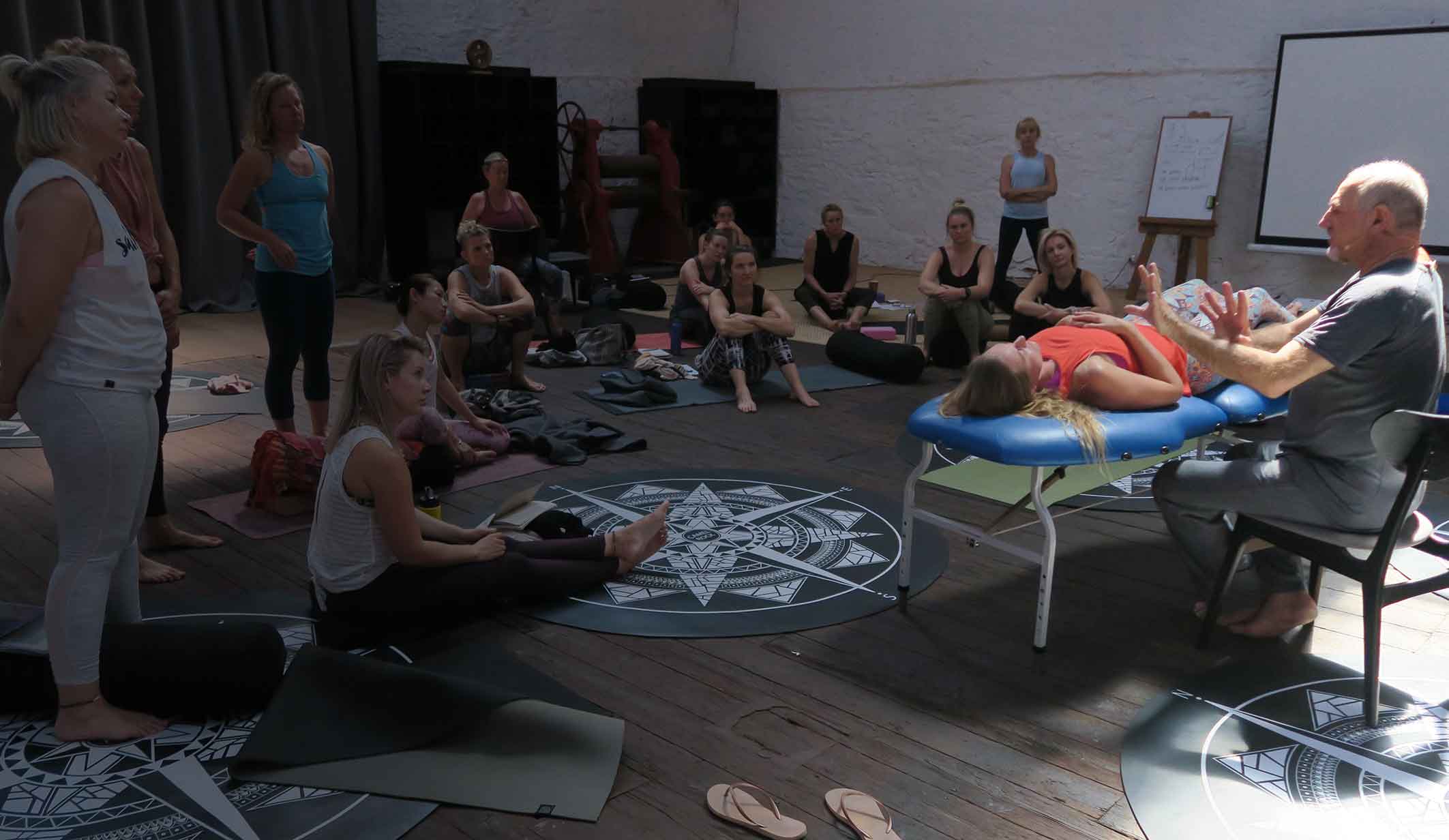
Leslie seated at a massage table demonstrating a technique for a roomful of students

Leslie Kaminoff is a best-selling author and yoga educator.

Category: Opinion

  • Did Yoga really start as a sex cult?

    In this video follow-up to my previous post “William Broad is at it again at the NY Times,” you can hear me tell Mr. Broad that every time he opens his mouth, he loses another piece of whatever credibility he may have had as an authority on Yoga.

    In the end, I just tell him to shut his mouth until such time as he’s willing to do a modicum of valid research into the actual history of Yoga practice – which did NOT begin with the Tantric sex cults of Medieval India. He actually contradicts himself in the space of two sentences in his interview with Stephen Colbert, when he first asserts that Yoga is 4 to 5 thousand years old, then follows up with “…real yoga started out in a sex cult..”

    Someone with as big a platform as William J. Broad has an equally big responsibility to speak accurately about this subject.  In this, he has repeatedly and utterly failed.

  • William Broad is at it again in the NY Times

    This time, Mr. Broad is riding the coattails of the John Friend “scandal;” and sharing his expertise about how Yoga’s origins have always been steeped in sexuality.

    It’s astounding how this guy thinks that doing sun salutations since the 70’s and book research for a few years makes him an authoritative scholar regarding the history of Yoga.  He can’t even keep the science in his book straight, and that’s supposed to be his field.

    Yoga Fans Sexual Flames and, Predictably, Plenty of Scandal – NYTimes.com.

  • Reaction to the Anusara situation and the idea of the Guru

    I wouldn’t be much of a yoga blogger if I didn’t mention the events of the past 2 weeks concerning the Anusara community.  In an attempt to contribute something constructive, I recorded this on Wednesday evening after class.

  • A lively discussion on Amazon

    I stayed up until 4AM on Feb. 7th to insure that mine was the first Amazon review of William J. Broad’s “The Science of Yoga.” My review is listed as “the most helpful critical review” and as of this writing 237 of 264 people found it helpful. It has also generated 47 comments by Amazon users.  It makes for some interesting reading.

  • Should Yoga be covered by your Insurance?

    Anyone who’s been following me for a while already knows the answer to this question, but you should watch the video anyway.  This discussion is sure to be heating up again, now that yoga has been proven to be life-threatening, and its teachers so horribly under-regulated.

  • yogijbrown: Is Your Yoga Safe?

    Another great piece from my friend J. Brown’s blog.  He’s given me permission to re-publish on e-Sutra anything I think my readers will enjoy, and I’m sure this qualifies.

    ————————————-

    From J. Brown:

    Infrequent visitors to the yoga blogosphere may not be aware of the recent kerfuffle surrounding a NY Times article about how yoga will hurt you, but there also has been some mainstream media coverage on the safety of yoga.

    While the article seems to have broken a few glass jaws in the broader yoga community, practitioners with a therapeutic orientation have been sounding alarms about questionable practice for years and getting nothing but flak in return. Those with the courage to take a stand and level public criticism of overly aggressive and guitar-hero-like approaches are usually written off as haters who are just jealous of the cool kids with their feet on their heads.

    I’m not going to address the article directly. This has been done well enough already by voices more qualified than mine (I recommend watching Leslie Kaminoff’s three-part video response.) But I am interested in people questioning what they are doing and whether or not it is safe, even if it is a byproduct of a sensationalistic and irresponsible ploy to sell books.

    Unfortunately, the subsequent conversation has largely been dominated by a reach for easy answers that avoid deeper issues. More often than not, injuries in yoga are being attributed to a lack of proper alignment or understanding of anatomy. It is said either that practitioners are not doing the poses in a technically correct way or that their teachers are not educated enough about anatomy to instruct students how to do the poses in a technically correct way.

    When it comes to alignment, I find it curious to notice teachers who are are usually quite rigid in their instruction are now bending over backwards to explain how they respond to the needs of students. Specifically, I was reading an excerpt from a new book, written by a senior teacher in a classical tradition, who was considering the instruction to “straighten your leg.”

    Without referring to any particular poses, the author asserts that the instruction is a “very coarse truth [that] new students need to hear” and that the way to accommodate different capabilities is to offer different “levels of truth” in the form of more detailed directives (i.e. lift the quadriceps, resist with the calf muscle, root the three corners of the feet, etc.) The suggestion is that different students need different details as they develop the fully realized truth behind “straighten your leg.”

    The problem is that finding different ways of articulating the same arbitrary configuration is not an example of how to adapt to the needs of students and certainly will not make the practice any safer for the large majority of people who benefit from bending their knees. The concept of “technically correct” is open to interpretation and much of what is considered proper alignment in the classical forms is contraindicated for huge portions of the population. Thus, it is possible to have perfect alignment and still hurt yourself.

    For those who are inclined to rely on science, I have written a full length article for Yoga Therapy Today magazine entitled: Does Studying Anatomy Make Yoga Safer? In the piece, I ask several prominent anatomy for yoga teachers to weigh in on the role of studying anatomy and science in making yoga safe. What I think most people might find surprising is that even the experts in the field do not agree that anatomy is the key to ensuring safety in yoga.

    As Neil Pearson, clinical assistant professor at the University of British Columbia and the chair of the Pain Science Division of the Canadian Physiotherapy Association, put it: “In the end, it is not Western scientific knowledge of the human body that will make Yoga safer. Changing the students approach to the discipline of yoga and the practice of asana will create the greatest shift.”

    Instead of looking to alignment and anatomy as a panacea for what ails the yoga profession, perhaps we would do better to foster a different mentality around the physical work of yoga practice that minimizes any potential risks and encourages smarter choices.

    Most of the professionals I have spoken to agree that the key to safe yoga boils down to the sensitivity and adaptability of the instructor, his or her capacity for dialogue with and responsiveness to a student, and the humble confidence of knowing what you know and what you don’t know.

  • Video Review of "The Science of Yoga: The Risks and the Rewards," by William J. Broad and a defense of my friend Larry Payne

    In this video review, I accuse William J. Broad of launching an ad hominem attack on my friend Larry Payne.  Realizing this may need further explanation, I offer the following:

    “Ad Hominem” literally means “against the man.” It is the name of an often-employed logical fallacy that seeks to refute a person’s ideas by discrediting their character.  For example, “Mr. Smith is known to be a drunkard, therefore his views on the economy should be dismissed.”

    As I mentioned in the video, as a longtime friend of Larry Payne and teacher of the anatomy section of his LMU course each year in Los Angeles, I am hardly a neutral observer regarding Larry. This does not reduce my ability to offer objective criticism of Broad’s tactics in this part of his book.

    On page 154 of “The Science of Yoga,” Broad lays the cornerstone of his attack: “If the origins of the modern field [yoga therapy] can be traced to a single person, it would be Larry Payne.”  Here, Broad is preparing a case of guilt by association in which he will try to discredit the entire field of “modern yoga therapy” by assaulting the character of the person he is identifying as its key founder. He will go on to portray Larry as an opportunistic huckster who, unlike Loren Fishman, M.D., one of Broad’s heroes, took what he considers an easy path to credibility by obtaining a Ph.D. from a questionable school. Broad goes on to point out some commonly-held physiological errors that ended up in Larry’s book “Yoga for Dummies” as a way of further discrediting him.

    Broad’s clear goal in the chapter in question (chapter five for those following along) is to cast aspersions on the organization Larry helped to found, the International Association of Yoga Therapists (IAYT), by drawing a parallel between what he perceives as Larry’s lack of a valid credential and the certificate one obtains upon joining IAYT. Broad observes that the IAYT membership certificate resembles a professional accreditation, but “a quick read shows that the document is in fact quite meaningless…The phony credential does an injustice to the talented yoga therapists who have labored for years and decades to develop their healing expertise and have helped countless people.”

    This is a classic example of an ad hominem attack, setting up guilt by association. Forget the fact that Larry Payne is also one of the “talented yoga therapists who have labored for years and decades to develop their healing expertise and have helped countless people.”  Forget the fact that IAYT has never represented their membership certificate as anything other than what it clearly states on its face.  Forget the fact that never – to my knowledge – has any yoga therapist, whether a member of IAYT or not, expressed outrage over misrepresentation via a “phony credential.” Forget the fact that there is a real, live human being named Larry Payne at the other end of this attack who has been walking around for the past week feeling like he’s been simultaneously kicked in the gut and stabbed in the back by the writer to whom he granted – in good faith – full access and lengthy interviews.

    William J. Broad makes a strong case for accurately representing oneself in the professional sphere.  Did he do that when he approached my friend Larry for the purpose of writing an authoritative book about the field in which he has faithfully labored for four decades?  I’m sure Larry Payne, Ph.D. welcomed Mr. Broad with the same open heart he offers to everyone he encounters.  He deserves far better than what he got in “The Science of Yoga.”


  • Egg On My Neck, part 2 of My 2 Cents about ‘How Yoga Can Wreck Your Body’

    Last week’s video got quite a lot of attention on YouTube – over 12,500 views as of this writing.  This week’s follow-up includes an apology to William J. Broad, the author of the NYT article and the book “The Science of Yoga”, which was sent to me by the publishers this week.

    In last week’s video, I had taken Broad to task for under-reporting the “normal” range of motion of the cervical spine in axial rotation as 50º. In fact, that is the same number I give in the 2nd edition of Yoga Anatomy! Oops. Egg on my “neck”.

    In retrospect, I believe I used outdated numbers in the book and I’m in the process of researching how to revise that page (34). Here’s one of the research articles I’m referencing that gives a good overview of just how variable these range of motion (ROM) measurements can be. For example, compare the lowest ROM—for a male in his nineties—at 26º. The greatest ROM was a teenage female with a whopping 94º! So, what’s normal?

    I’m about halfway through Broad’s book now, and I’m pleased to report that it’s a great read. I will have a full review when I’m done but even at this point I can safely say I’m going to recommend every serious student of yoga read it.


  • My 2 Cents about "How Yoga Can Wreck Your Body"

    As I say at the end of this video response to the New York Times article, “How Yoga Can Wreck Your Body,” I’m too lazy, too dyslexic and too slow a typist to write out my opinion. Instead I was able to tape this piece at the end of my Yoga Anatomy class last Wednesday night.  In it, I reference my friend Eddie Stern’s marvelous blog piece “How the NYT Can Wreck Yoga,” with great comments by Marshall Hagins, P.T. and Rick Bartz, D.C.  I highly recommend reading it.

    I’ll probably have more to say once the book is released next month and I’ve had a chance to read it. As always, your comments are welcome.

  • Who is John Galt? RTFN.

    As I write this, I am wearing an article of Lululemon clothing I purchased 8 years ago. Did I spend twice what I pay for other brands? Yes. But, Lulu’s product has lasted 4 times as long. Maybe reading Atlas Shrugged helped Chip Wilson make boxer briefs this good. If so, I thank both him and Ayn Rand from the bottom of my well-ventilated nutsack.

    It has been quite the spectacle the past few weeks, observing the widespread reaction to Wilson’s decision to put four provocative words on Lululemon’s ubiquitous shopping bags. So far, I have not seen a single article, comment or quote referencing Ayn Rand, Atlas Shrugged or Objectivism that reflects even a rudimentary understanding of the fundamental ideas that they represent.

    Aside from being a satisfied Lulu customer, I’ve been following this story with keen interest because of two facts: I’m both a yoga educator, and a publicly declared Objectivist of long standing. If I were to evaluate these two facts on the basis of the general response to the “Galt” kerfuffle, I’d have to judge them to be incompatible. Fortunately, I do not make judgements based on public opinion.

    I have read Atlas Shrugged five times, Fountainhead four times, and all of Ayn Rand’s non-fiction. As far as her more formal work on philosophy is concerned, I have had the privilege of personally studying with two of the top Objectivist scholars in the world. I have been contemplating and applying Rand’s ideas in every area of my life and career for four decades, and I’m well aware of the hard work it’s taken to forge a consistent world view in which the principles of Yoga are compatible with those of Objectivism. It wasn’t easy, but I did it, and I owe whatever success I’ve had in my life to the effort I put in.

    If you have made a similar effort to forge a consistent philosophy for yourself and have something RATIONAL to say about this issue, I’d love to hear from you.

    However, if you wish to comment about “Who is John Galt,” I’ll give you the same advice issued by frustrated tech support when they are repeatedly assaulted with stupid questions that have already been answered by the people who have taken the trouble to write the operating instructions: “RTFM – Read The Fucking Manual.”

    What I’m suggesting is that there is a very well-written manual for addressing all the injustices that both the Occupy Movement and the Tea Party are protesting. It is called “Atlas Shrugged.” So, before you bitch and moan about how society isn’t working for you, I suggest you “RTFN – Read The F-ing Novel.”

    Then, we’ll talk.