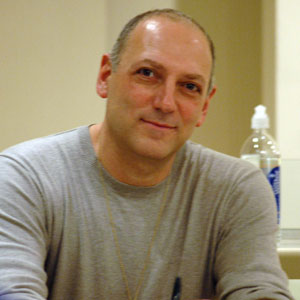
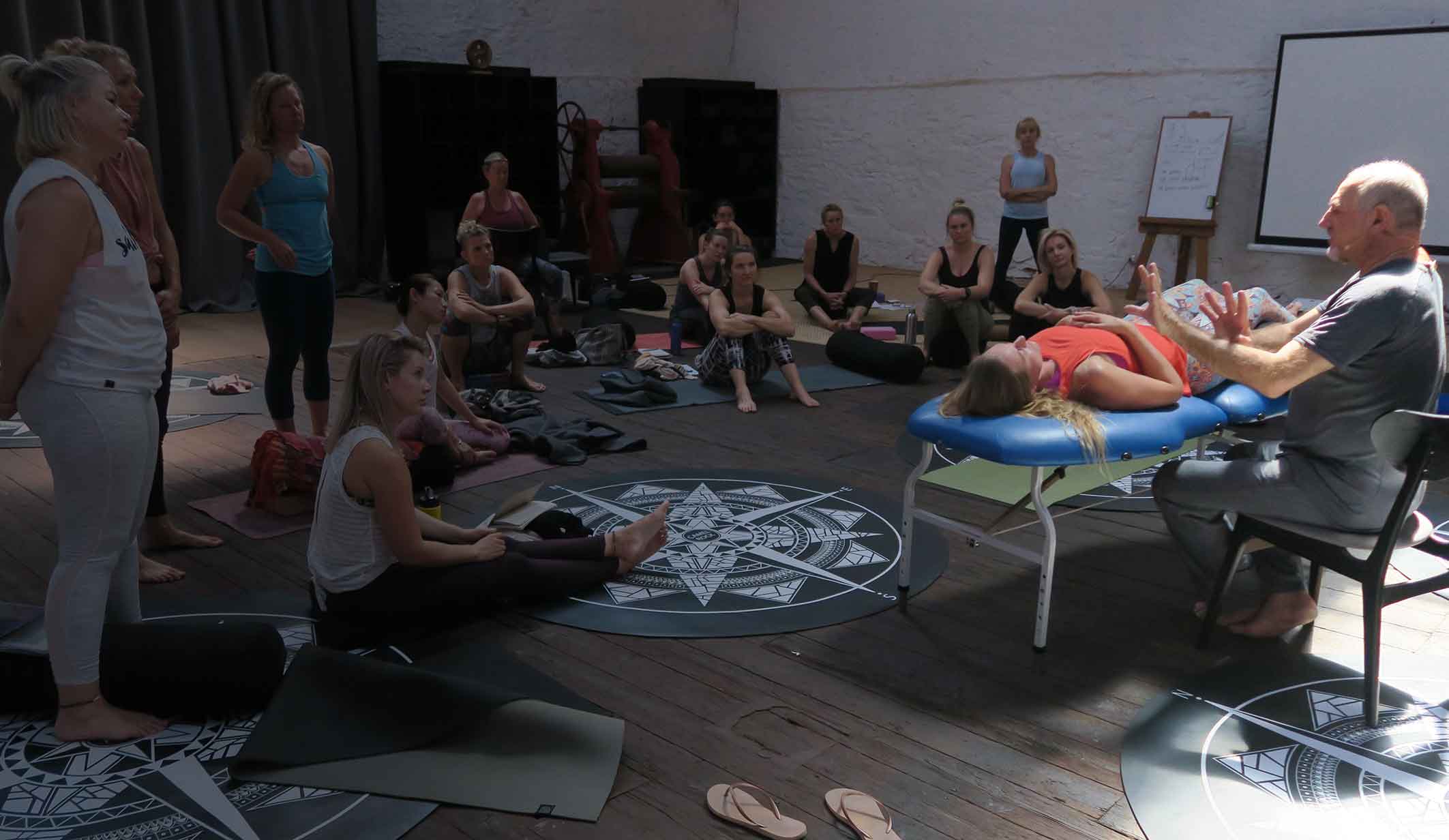
Leslie seated at a massage table demonstrating a technique for a roomful of students

Leslie Kaminoff is a best-selling author and yoga educator.

Category: News

  • In Memoriam: Georg Feuerstein

    I was shocked to see this item being reported by Yoga Journal today.  Georg was only 65.

    From Yoga Journal: “Yoga scholar Georg Feuerstein died Saturday at the age of 65….Feuerstein was one of the most highly regarded scholars on Hinduism in the West. He authored more than 45 books about yoga including The Yoga Tradition: Its History, Literature, Philosophy, and Practice (2001), The Deeper Dimension of Yoga: Theory and Practice (2003), The Shambhala Guide to Yoga (1996), and The Shambhala Encyclopedia of Yoga (1997).”

    In the early days of e-Sutra I had the pleasure of exchanging ideas with Georg, most notably in the classic thread from June, 2000: “Are We Still Belittling Yoga?”

    He left us way too soon, and his scholarship and commitment will be sorely missed.  Please feel free to use comments to add any personal recollections or thoughts.

  • Did Yoga really start as a sex cult?

    In this video follow-up to my previous post “William Broad is at it again at the NY Times,” you can hear me tell Mr. Broad that every time he opens his mouth, he loses another piece of whatever credibility he may have had as an authority on Yoga.

    In the end, I just tell him to shut his mouth until such time as he’s willing to do a modicum of valid research into the actual history of Yoga practice – which did NOT begin with the Tantric sex cults of Medieval India. He actually contradicts himself in the space of two sentences in his interview with Stephen Colbert, when he first asserts that Yoga is 4 to 5 thousand years old, then follows up with “…real yoga started out in a sex cult..”

    Someone with as big a platform as William J. Broad has an equally big responsibility to speak accurately about this subject.  In this, he has repeatedly and utterly failed.

  • William Broad is at it again in the NY Times

    This time, Mr. Broad is riding the coattails of the John Friend “scandal;” and sharing his expertise about how Yoga’s origins have always been steeped in sexuality.

    It’s astounding how this guy thinks that doing sun salutations since the 70’s and book research for a few years makes him an authoritative scholar regarding the history of Yoga.  He can’t even keep the science in his book straight, and that’s supposed to be his field.

    Yoga Fans Sexual Flames and, Predictably, Plenty of Scandal – NYTimes.com.

  • Should Yoga be covered by your Insurance?

    Anyone who’s been following me for a while already knows the answer to this question, but you should watch the video anyway.  This discussion is sure to be heating up again, now that yoga has been proven to be life-threatening, and its teachers so horribly under-regulated.

  • Video Review of "The Science of Yoga: The Risks and the Rewards," by William J. Broad and a defense of my friend Larry Payne

    In this video review, I accuse William J. Broad of launching an ad hominem attack on my friend Larry Payne.  Realizing this may need further explanation, I offer the following:

    “Ad Hominem” literally means “against the man.” It is the name of an often-employed logical fallacy that seeks to refute a person’s ideas by discrediting their character.  For example, “Mr. Smith is known to be a drunkard, therefore his views on the economy should be dismissed.”

    As I mentioned in the video, as a longtime friend of Larry Payne and teacher of the anatomy section of his LMU course each year in Los Angeles, I am hardly a neutral observer regarding Larry. This does not reduce my ability to offer objective criticism of Broad’s tactics in this part of his book.

    On page 154 of “The Science of Yoga,” Broad lays the cornerstone of his attack: “If the origins of the modern field [yoga therapy] can be traced to a single person, it would be Larry Payne.”  Here, Broad is preparing a case of guilt by association in which he will try to discredit the entire field of “modern yoga therapy” by assaulting the character of the person he is identifying as its key founder. He will go on to portray Larry as an opportunistic huckster who, unlike Loren Fishman, M.D., one of Broad’s heroes, took what he considers an easy path to credibility by obtaining a Ph.D. from a questionable school. Broad goes on to point out some commonly-held physiological errors that ended up in Larry’s book “Yoga for Dummies” as a way of further discrediting him.

    Broad’s clear goal in the chapter in question (chapter five for those following along) is to cast aspersions on the organization Larry helped to found, the International Association of Yoga Therapists (IAYT), by drawing a parallel between what he perceives as Larry’s lack of a valid credential and the certificate one obtains upon joining IAYT. Broad observes that the IAYT membership certificate resembles a professional accreditation, but “a quick read shows that the document is in fact quite meaningless…The phony credential does an injustice to the talented yoga therapists who have labored for years and decades to develop their healing expertise and have helped countless people.”

    This is a classic example of an ad hominem attack, setting up guilt by association. Forget the fact that Larry Payne is also one of the “talented yoga therapists who have labored for years and decades to develop their healing expertise and have helped countless people.”  Forget the fact that IAYT has never represented their membership certificate as anything other than what it clearly states on its face.  Forget the fact that never – to my knowledge – has any yoga therapist, whether a member of IAYT or not, expressed outrage over misrepresentation via a “phony credential.” Forget the fact that there is a real, live human being named Larry Payne at the other end of this attack who has been walking around for the past week feeling like he’s been simultaneously kicked in the gut and stabbed in the back by the writer to whom he granted – in good faith – full access and lengthy interviews.

    William J. Broad makes a strong case for accurately representing oneself in the professional sphere.  Did he do that when he approached my friend Larry for the purpose of writing an authoritative book about the field in which he has faithfully labored for four decades?  I’m sure Larry Payne, Ph.D. welcomed Mr. Broad with the same open heart he offers to everyone he encounters.  He deserves far better than what he got in “The Science of Yoga.”


  • Egg On My Neck, part 2 of My 2 Cents about ‘How Yoga Can Wreck Your Body’

    Last week’s video got quite a lot of attention on YouTube – over 12,500 views as of this writing.  This week’s follow-up includes an apology to William J. Broad, the author of the NYT article and the book “The Science of Yoga”, which was sent to me by the publishers this week.

    In last week’s video, I had taken Broad to task for under-reporting the “normal” range of motion of the cervical spine in axial rotation as 50º. In fact, that is the same number I give in the 2nd edition of Yoga Anatomy! Oops. Egg on my “neck”.

    In retrospect, I believe I used outdated numbers in the book and I’m in the process of researching how to revise that page (34). Here’s one of the research articles I’m referencing that gives a good overview of just how variable these range of motion (ROM) measurements can be. For example, compare the lowest ROM—for a male in his nineties—at 26º. The greatest ROM was a teenage female with a whopping 94º! So, what’s normal?

    I’m about halfway through Broad’s book now, and I’m pleased to report that it’s a great read. I will have a full review when I’m done but even at this point I can safely say I’m going to recommend every serious student of yoga read it.


  • My 2 Cents about "How Yoga Can Wreck Your Body"

    As I say at the end of this video response to the New York Times article, “How Yoga Can Wreck Your Body,” I’m too lazy, too dyslexic and too slow a typist to write out my opinion. Instead I was able to tape this piece at the end of my Yoga Anatomy class last Wednesday night.  In it, I reference my friend Eddie Stern’s marvelous blog piece “How the NYT Can Wreck Yoga,” with great comments by Marshall Hagins, P.T. and Rick Bartz, D.C.  I highly recommend reading it.

    I’ll probably have more to say once the book is released next month and I’ve had a chance to read it. As always, your comments are welcome.

  • Who is John Galt? RTFN.

    As I write this, I am wearing an article of Lululemon clothing I purchased 8 years ago. Did I spend twice what I pay for other brands? Yes. But, Lulu’s product has lasted 4 times as long. Maybe reading Atlas Shrugged helped Chip Wilson make boxer briefs this good. If so, I thank both him and Ayn Rand from the bottom of my well-ventilated nutsack.

    It has been quite the spectacle the past few weeks, observing the widespread reaction to Wilson’s decision to put four provocative words on Lululemon’s ubiquitous shopping bags. So far, I have not seen a single article, comment or quote referencing Ayn Rand, Atlas Shrugged or Objectivism that reflects even a rudimentary understanding of the fundamental ideas that they represent.

    Aside from being a satisfied Lulu customer, I’ve been following this story with keen interest because of two facts: I’m both a yoga educator, and a publicly declared Objectivist of long standing. If I were to evaluate these two facts on the basis of the general response to the “Galt” kerfuffle, I’d have to judge them to be incompatible. Fortunately, I do not make judgements based on public opinion.

    I have read Atlas Shrugged five times, Fountainhead four times, and all of Ayn Rand’s non-fiction. As far as her more formal work on philosophy is concerned, I have had the privilege of personally studying with two of the top Objectivist scholars in the world. I have been contemplating and applying Rand’s ideas in every area of my life and career for four decades, and I’m well aware of the hard work it’s taken to forge a consistent world view in which the principles of Yoga are compatible with those of Objectivism. It wasn’t easy, but I did it, and I owe whatever success I’ve had in my life to the effort I put in.

    If you have made a similar effort to forge a consistent philosophy for yourself and have something RATIONAL to say about this issue, I’d love to hear from you.

    However, if you wish to comment about “Who is John Galt,” I’ll give you the same advice issued by frustrated tech support when they are repeatedly assaulted with stupid questions that have already been answered by the people who have taken the trouble to write the operating instructions: “RTFM – Read The Fucking Manual.”

    What I’m suggesting is that there is a very well-written manual for addressing all the injustices that both the Occupy Movement and the Tea Party are protesting. It is called “Atlas Shrugged.” So, before you bitch and moan about how society isn’t working for you, I suggest you “RTFN – Read The F-ing Novel.”

    Then, we’ll talk.

  • An “Advanced” Practice

    Reflections on the inaugural class of Leslie Kaminoff’s “Yoga Anatomy – Practices” at The Breathing Project, NYC.  October 5, 2011

    by Edya Kalev
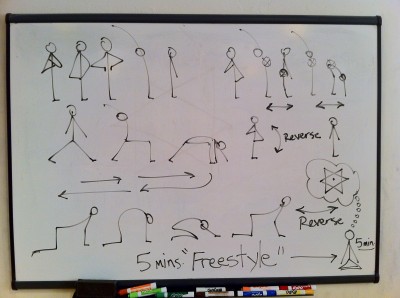
    In a sold-out asana class full of professional yoga teachers, one might expect that the practice would include splits, scorpions and other poses deemed impossible by the vast majority of lay practitioners.  Not so in the first day of Leslie Kaminoff’s brand-new Yoga Anatomy: Practices course at The Breathing Project.

    Standing, breathing, and concentrating awareness; these were the surprisingly complex challenges given to the class.  Starting out, we sensed the movement of the breath with hands on belly and abdomen. Then we focused on the top hand as we inhaled, and the bottom as we exhaled.  Taking that into movement, we floated into a forward bend from a lunge position. Maddeningly, Leslie provided no specific instruction as to how to breathe, just where to focus the attention as we moved.

    After settling into a comfortable pattern of movement, focus and breath, Leslie of course swapped the area of focus.  Now we were to shift attention to the belly region on the inhale and the chest region on the exhale.  Many experienced momentary confusion as we arched into cow and rounded our spine into cat…why did this familiar movement feel so different?  Could changing the focus of our breathing really change everything?

    At the end of our brain-scrambling sequence, just when we were looking forward to a predictable winding down, Leslie proposed “freestyle counterposing,”  encouraging students to figure out what they needed to feel complete in the practice and do it on their own.  Yet another diversion from the expected, honoring the unique individual over the “routine.”

    During the last 5 minutes, the class meditated on a figure of overlapping triangles with a center point.  Leslie asked us to sit with our “associations, insights, and connections between the visual image and the practice,” just as he had to 25 years ago in the presence of his teacher, the great TKV Desikachar.  He then shared with us his private journal and drawings from that lesson, showing how broke the symbol apart into two separate triangles and reconstructed it again.

    Back in that room, Leslie found meaning in the separate parts of the symbol before making it whole again, as one would examine the two distinct parts of the breath, then flow with the full breath.  An apt parallel to both what his teacher incited in him, and what he has begun to stir in us.  With Desikachar’s lesson in mind, Leslie had created an Advanced Practice without advanced poses, for yoga teacher and yoga student alike.

  • The Return of e-Sutra!

    Well, it’s been a while.

    e-Sutra is coming out of its longest period of inactivity since I started it in 1997 as a mailing list being run from my AOL account.

    A lot has been happening, almost of it good – some of it really great.  As part of a major re-design and integration of my online enterprises, I’ve partnered with web genius extraordinaire Lydia Mann to migrate all my sites (including this blog) to WordPress.  This migration was made all the more urgent by an epic failure on the part of Blogger that irretrievably destroyed the original esutra.blogspot.com.  Fortunately, I’ve archived every post ever sent out, and I’ll gradually re-post the most important ones in the near future.

    I have also invited a few guest bloggers to contribute pieces to e-Sutra, the first being my good friend Edya Kalev, who is participating in my brand-new “Yoga Anatomy – Practices” course at The Breathing Project.  About twice a month, Edya will write about her personal experiences and share her insights as we work our way through this exciting new material.

    In the category of really great, this week saw the arrival of the brand-new second edition of “Yoga Anatomy,” featuring expanded chapters on breathing and the spine, two new chapters on the skeletal and muscular systems, plus more illustrations, variations, indexes and better organization of information.  Overall, my co-author Amy Matthews and myself are very pleased with the result, and we know you will be, too.

    It’s great to be back, and I’m looking forward to hearing from you.  As always, comments are welcome.