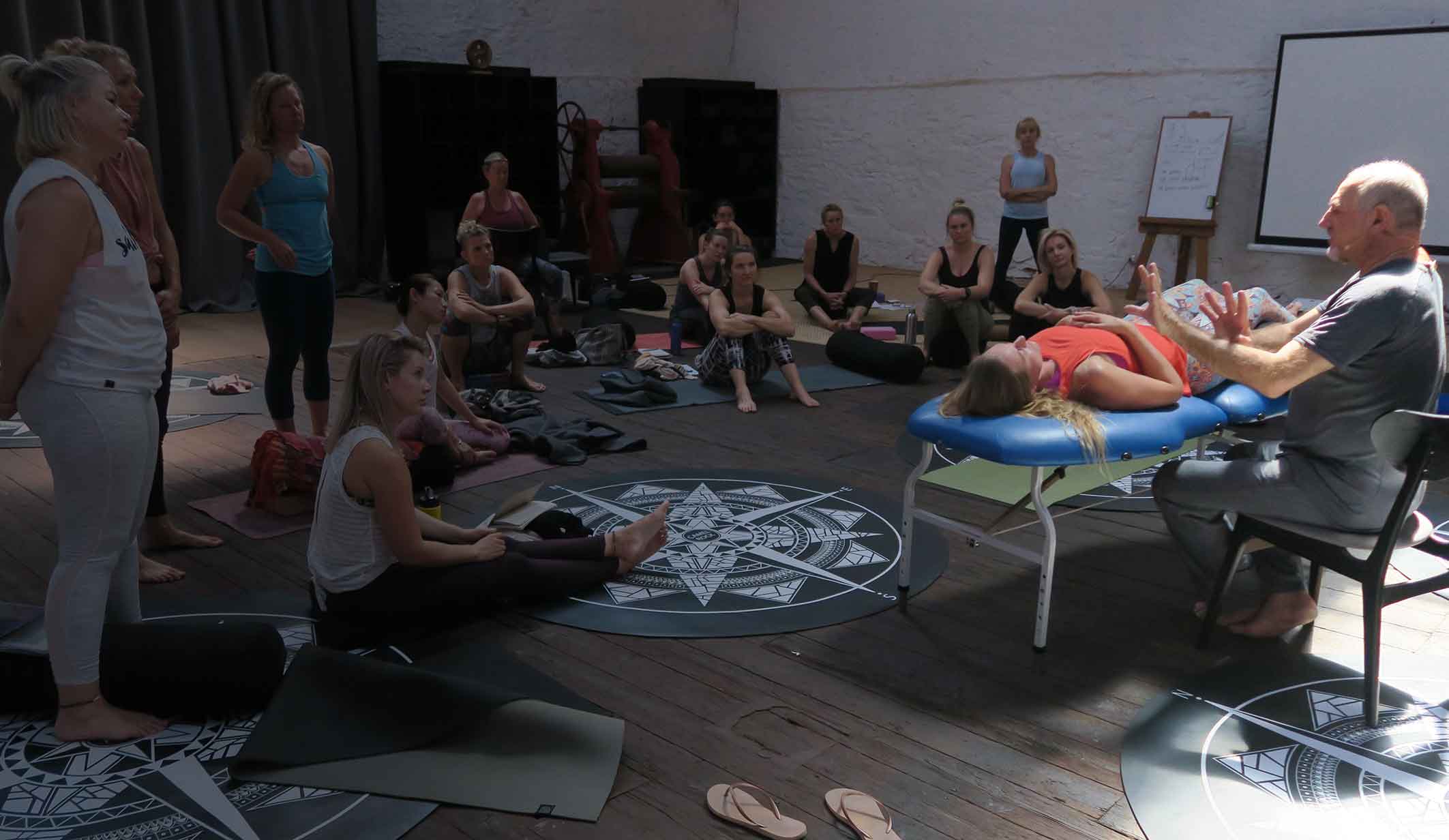
Leslie seated at a massage table demonstrating a technique for a roomful of students

Leslie Kaminoff is a best-selling author and yoga educator.

Category: Health

  • Yoga Therapy Summit in the Black Hills of South Dakota – Sept. 13-15

    YT Summit
    I am very excited and honored to be presenting alongside my esteemed colleagues and fellow students of the Krishnamacharya/Desikachar lineage at this unprecedented event.
    I hope you can join us for this one-of-a-kind experience in this beautiful setting.
    Check out the Facebook page.

    For the occasion, I’ve created a brand-new presentation entitled: The Knot of Brahma – Emotional Suppression as the Source of Common Pain Syndromes.

    Here is the description of the topic:
    The ancient model of prana/apana samayogah as a definition of pranayama offers a simple, yet powerful model for how we can uncover and resolve the internal obstructions that result from a lifetime of managing our emotional “spaces.”
    These ideas are especially important for Yoga Educators because there is mounting evidence that the most common pain syndromes suffered by vast numbers of people have their origins in the mind-body/psyche-soma mechanisms of emotional suppression.
    In this wide-ranging lecture/demo, Leslie Kaminoff will review some of the latest research that supports this view, and he will relate it to the uniquely integrated teachings of breath-centered yoga practice within the tradition of T. Krishnamacharya.
    For educators dedicated to working more deeply and effectively, these insights will be invaluable in the pursuit of reducing the “bad space” of dukha and increasing the “good space” of sukha.

  • Is Breathing an Asana?


    It’s always fun when Amy drops in on one of my advanced studies classes. This time, it was in response to the provocative question “is breathing an asana? It sparked a very interesting exchange. Enjoy!

  • Should Yoga be covered by your Insurance?

    Anyone who’s been following me for a while already knows the answer to this question, but you should watch the video anyway.  This discussion is sure to be heating up again, now that yoga has been proven to be life-threatening, and its teachers so horribly under-regulated.

  • yogijbrown: Is Your Yoga Safe?

    Another great piece from my friend J. Brown’s blog.  He’s given me permission to re-publish on e-Sutra anything I think my readers will enjoy, and I’m sure this qualifies.

    ————————————-

    From J. Brown:

    Infrequent visitors to the yoga blogosphere may not be aware of the recent kerfuffle surrounding a NY Times article about how yoga will hurt you, but there also has been some mainstream media coverage on the safety of yoga.

    While the article seems to have broken a few glass jaws in the broader yoga community, practitioners with a therapeutic orientation have been sounding alarms about questionable practice for years and getting nothing but flak in return. Those with the courage to take a stand and level public criticism of overly aggressive and guitar-hero-like approaches are usually written off as haters who are just jealous of the cool kids with their feet on their heads.

    I’m not going to address the article directly. This has been done well enough already by voices more qualified than mine (I recommend watching Leslie Kaminoff’s three-part video response.) But I am interested in people questioning what they are doing and whether or not it is safe, even if it is a byproduct of a sensationalistic and irresponsible ploy to sell books.

    Unfortunately, the subsequent conversation has largely been dominated by a reach for easy answers that avoid deeper issues. More often than not, injuries in yoga are being attributed to a lack of proper alignment or understanding of anatomy. It is said either that practitioners are not doing the poses in a technically correct way or that their teachers are not educated enough about anatomy to instruct students how to do the poses in a technically correct way.

    When it comes to alignment, I find it curious to notice teachers who are are usually quite rigid in their instruction are now bending over backwards to explain how they respond to the needs of students. Specifically, I was reading an excerpt from a new book, written by a senior teacher in a classical tradition, who was considering the instruction to “straighten your leg.”

    Without referring to any particular poses, the author asserts that the instruction is a “very coarse truth [that] new students need to hear” and that the way to accommodate different capabilities is to offer different “levels of truth” in the form of more detailed directives (i.e. lift the quadriceps, resist with the calf muscle, root the three corners of the feet, etc.) The suggestion is that different students need different details as they develop the fully realized truth behind “straighten your leg.”

    The problem is that finding different ways of articulating the same arbitrary configuration is not an example of how to adapt to the needs of students and certainly will not make the practice any safer for the large majority of people who benefit from bending their knees. The concept of “technically correct” is open to interpretation and much of what is considered proper alignment in the classical forms is contraindicated for huge portions of the population. Thus, it is possible to have perfect alignment and still hurt yourself.

    For those who are inclined to rely on science, I have written a full length article for Yoga Therapy Today magazine entitled: Does Studying Anatomy Make Yoga Safer? In the piece, I ask several prominent anatomy for yoga teachers to weigh in on the role of studying anatomy and science in making yoga safe. What I think most people might find surprising is that even the experts in the field do not agree that anatomy is the key to ensuring safety in yoga.

    As Neil Pearson, clinical assistant professor at the University of British Columbia and the chair of the Pain Science Division of the Canadian Physiotherapy Association, put it: “In the end, it is not Western scientific knowledge of the human body that will make Yoga safer. Changing the students approach to the discipline of yoga and the practice of asana will create the greatest shift.”

    Instead of looking to alignment and anatomy as a panacea for what ails the yoga profession, perhaps we would do better to foster a different mentality around the physical work of yoga practice that minimizes any potential risks and encourages smarter choices.

    Most of the professionals I have spoken to agree that the key to safe yoga boils down to the sensitivity and adaptability of the instructor, his or her capacity for dialogue with and responsiveness to a student, and the humble confidence of knowing what you know and what you don’t know.

  • Video Review of "The Science of Yoga: The Risks and the Rewards," by William J. Broad and a defense of my friend Larry Payne

    In this video review, I accuse William J. Broad of launching an ad hominem attack on my friend Larry Payne.  Realizing this may need further explanation, I offer the following:

    “Ad Hominem” literally means “against the man.” It is the name of an often-employed logical fallacy that seeks to refute a person’s ideas by discrediting their character.  For example, “Mr. Smith is known to be a drunkard, therefore his views on the economy should be dismissed.”

    As I mentioned in the video, as a longtime friend of Larry Payne and teacher of the anatomy section of his LMU course each year in Los Angeles, I am hardly a neutral observer regarding Larry. This does not reduce my ability to offer objective criticism of Broad’s tactics in this part of his book.

    On page 154 of “The Science of Yoga,” Broad lays the cornerstone of his attack: “If the origins of the modern field [yoga therapy] can be traced to a single person, it would be Larry Payne.”  Here, Broad is preparing a case of guilt by association in which he will try to discredit the entire field of “modern yoga therapy” by assaulting the character of the person he is identifying as its key founder. He will go on to portray Larry as an opportunistic huckster who, unlike Loren Fishman, M.D., one of Broad’s heroes, took what he considers an easy path to credibility by obtaining a Ph.D. from a questionable school. Broad goes on to point out some commonly-held physiological errors that ended up in Larry’s book “Yoga for Dummies” as a way of further discrediting him.

    Broad’s clear goal in the chapter in question (chapter five for those following along) is to cast aspersions on the organization Larry helped to found, the International Association of Yoga Therapists (IAYT), by drawing a parallel between what he perceives as Larry’s lack of a valid credential and the certificate one obtains upon joining IAYT. Broad observes that the IAYT membership certificate resembles a professional accreditation, but “a quick read shows that the document is in fact quite meaningless…The phony credential does an injustice to the talented yoga therapists who have labored for years and decades to develop their healing expertise and have helped countless people.”

    This is a classic example of an ad hominem attack, setting up guilt by association. Forget the fact that Larry Payne is also one of the “talented yoga therapists who have labored for years and decades to develop their healing expertise and have helped countless people.”  Forget the fact that IAYT has never represented their membership certificate as anything other than what it clearly states on its face.  Forget the fact that never – to my knowledge – has any yoga therapist, whether a member of IAYT or not, expressed outrage over misrepresentation via a “phony credential.” Forget the fact that there is a real, live human being named Larry Payne at the other end of this attack who has been walking around for the past week feeling like he’s been simultaneously kicked in the gut and stabbed in the back by the writer to whom he granted – in good faith – full access and lengthy interviews.

    William J. Broad makes a strong case for accurately representing oneself in the professional sphere.  Did he do that when he approached my friend Larry for the purpose of writing an authoritative book about the field in which he has faithfully labored for four decades?  I’m sure Larry Payne, Ph.D. welcomed Mr. Broad with the same open heart he offers to everyone he encounters.  He deserves far better than what he got in “The Science of Yoga.”


  • Egg On My Neck, part 2 of My 2 Cents about ‘How Yoga Can Wreck Your Body’

    Last week’s video got quite a lot of attention on YouTube – over 12,500 views as of this writing.  This week’s follow-up includes an apology to William J. Broad, the author of the NYT article and the book “The Science of Yoga”, which was sent to me by the publishers this week.

    In last week’s video, I had taken Broad to task for under-reporting the “normal” range of motion of the cervical spine in axial rotation as 50º. In fact, that is the same number I give in the 2nd edition of Yoga Anatomy! Oops. Egg on my “neck”.

    In retrospect, I believe I used outdated numbers in the book and I’m in the process of researching how to revise that page (34). Here’s one of the research articles I’m referencing that gives a good overview of just how variable these range of motion (ROM) measurements can be. For example, compare the lowest ROM—for a male in his nineties—at 26º. The greatest ROM was a teenage female with a whopping 94º! So, what’s normal?

    I’m about halfway through Broad’s book now, and I’m pleased to report that it’s a great read. I will have a full review when I’m done but even at this point I can safely say I’m going to recommend every serious student of yoga read it.


  • New York Times Dicks Around with Circ Stats

    The New York Times proclaimed the other day in a Global Update from Uganda:
    Male Circumcision May Help Protect Sexual Partners Against Cervical Cancer

    My friend Gil Hedley and I are in in complete agreement about not mutilating infant male genitalia, so I sent him the article, and he replied with a particularly (and characteristically) funny rant, which he has given me permission to share…

    (more…)

  • Indian guru Sai Baba ‘close to death’

    HYDERABAD, India (AFP) – Doctors treating Indian spiritual leader Sai Baba, one of the country’s most famous gurus, said on Thursday his health was deteriorating fast as devotees massed to pray for his recovery.
    (more…)

  • Orthotic Shoe Inserts May Work, but It’s Not Clear Why – NYTimes.com

    About time. We’ve been telling the truth about orthotics for years.

    Money quote: “As for ‘corrective’ orthotics…they do not correct so much as lead to a reduction in muscle strength.” (more…)

  • Helping Students with RSI: RSI Expert Deborah Quilter Comments on Paul Grilley’s Recent Article

    In this article for Yoga Journal’s “My Yoga Mentor,” Paul Grilley writes about his recommendations for students with “RSS – Repetitive Strain Syndrome.”
    After scanning through it, I had some anatomical red flags waving in my brain (this happens a lot when I read yoga articles), so I sent the link to a colleague of mine who teaches here at The Breathing Project, Deborah Quilter. Deborah is an expert on RSI (Repetitive Strain Injury), and is the creator of a website and a couple of books devoted to the topic.

    Click here to read Deborah’s detailed response to the Grilley article. Since writing the piece, Deborah has already heard from at least one person with RSI who has hurt themselves following Grilley’s advice. In Deborah’s own words: “I hope some of my students, or people with RSI who can still type, comment. It’s much stronger if it comes from them.”

    I e-mailed Deborah’s response to Paul Grilley last week, giving him an opportunity to respond, but I’ve heard nothing yet. Despite appearances, I don’t go out of my way to find fault with Paul Grilley’s ideas. I just have to listen to those red flags when they get raised.

    Dear Leslie,
    You asked my opinion of Paul Grilley’s article in My Yoga Mentor October 2005. Repetitive strain injury (RSI) is a vast topic. Misinformation about it abounds; indeed, very few doctors are knowledgeable in this area. Most people have no idea just how debilitating RSI can be, and all too often those who want to help unwittingly steer the injured in the wrong direction. My response follows, but obviously there is much crucial information I’ll have to leave out here. Omissions are covered in ample detail in my books and website,rsihelp.com .
    I am a big fan of Paul Grilley, and thought his piece on tension or compression, posted on e-Sutra January 4, 2005, had much to commend it. But as the author of two books on RSI, and having helped countless people cope with this disease over the past 15 years, my approach to teaching Yoga to injured people differs quite markedly from his. Yoga, if expertly modified for the student’s injury, can be enormously helpful for people with RSI; however, the wrong asana practice could make matters significantly worse. More on that later.

    First, a little background: RSI is a highly complex soft-tissue disease. It is not just one thing, such as carpal tunnel syndrome, as most people assume. Depending on how you count them, RSI comprises about two dozen separate diagnoses to the nerves, tendons and muscles of the upper extremity (from shoulder blade to fingertip), including the best-known (but not the most common) carpal tunnel syndrome, epicondylitis (tennis elbow), thoracic outlet syndrome, De Quervains’ disease, and several nerve entrapments. A new syndrome, “Blackberry Thumb,” was recently reported by the American Society of Hand Therapists. People usually have at least three separate diagnoses and often have as many as two dozen. Also, since each person presents with a unique – and changing – cluster of symptoms, and the severity of injury varies from person to person and day to day, across-the-board protocols do not work for every body.

    Unlike many other injuries, RSI is invisible. Without an astute awareness of telltale pain behavior, it is only through the student’s self-disclosure or difficulty in movement that the teacher would know someone has it. Otherwise, they look normal. This can lead teachers to greatly overestimate a student’s capacity.
    RSI can be devastating. Not only can it end careers, it can also make common daily activities such as driving, dressing or eating difficult or impossible. Simple things like signing a check, holding a coffee mug or pressing an elevator button can be extremely daunting.

    Because of the unforgiving nature of soft-tissue injuries, it’s extremely easy to re-injure yourself if you have RSI, and relapses can be worse than the initial injury. Therefore, I typically see students one-on-one to begin with so they have my undivided attention – and receive a practice tailored to their unique needs. First, I take a thorough health history so I have a general idea of which movements to avoid. We begin with relaxation, so the student can sense breath and learn to guide and be guided by it. I emphasize that the student is in charge, and say, “If something doesn’t feel right for any reason, stop. Don’t do anything that bothers you.” Once the student has established trust in his inner teacher, we can safely proceed to moving at a slow, comfortable pace. I demonstrate postures before we do them for the first time, and ask the student if he thinks that asana would bother him before we proceed. I also watch students’ facial expressions, quality of movement and breathing, and stop them immediately if there is any sign of struggle or strain.
    My approach also differs from Grilley’s in emphasis: his exercises focused on stretching. While this is very important, my program emphasizes strengthening as well. People often develop RSI because of weakness, particularly in the back muscles, so I design practices that bring balance to the muscles, strengthening and stretching them.

    Regarding the specifics of Grilley’s piece, I’ll respond point by point. Let’s begin with the dinner-plate analogy. In fact, most computer users do not position their arms as though holding a dinner plate. Rather, they rest their wrists on the edge of the desk because the shoulder muscles become extremely fatigued from holding the weight of the arm. Fatigue also leads to the forward head and slouched posture common among computer users. To compound the risk factors, the keyboard is often on the desk, rather than an appropriately lowered keyboard tray. This leads to more shoulder strain as the computer user constantly lifts her shoulders as she keys or reaches for the mouse. Wrist-resting leads to a multitude of possible problems: the compression of the median nerve at the wrist; and the dorsiflexion (upward bend) and ulnar deviation (sideways bend) of the wrist, both of which can strain the forearm tendons, muscles and nerves.
    Grilley correctly states that computer users need movement, but the single most important – and most difficult – step toward rehabilitating RSI is neither movement nor stillness per se, but ceasing to use the computer or stopping any other offending activity. Given that most people’s jobs involve computer use, this is a thorny and frightening dilemma.
    Grilley’s suggestions for movement at work may seem innocuous, but when you deal with RSI, you quickly learn that the simplest exercise or movement could be too much for someone.

    • Dropping your arms by your side can be very fatiguing to people with shoulder injuries or cause unpleasant tingling in people who have thoracic outlet syndrome. My suggestion: rest your forearms palms up on a big pillow or two placed on your lap – this rests the shoulders and relieves the forearms from the strain of pronation (the palms-down position).
    • Many people cannot stretch their arms overhead without difficulty; and any relief from symptoms would be fleeting at best if they have chronic pain.
    • Pushups, one of the exercises Grilley mentioned, are contraindicated for people with RSI because most cannot bear any weight through the wrist.
    My approach is to tell uninjured people that they need regular breaks from computing, at least one 5-10 minute break for every twenty minutes at the keyboard. Most authors of articles on RSI and ergonomics offer exercises you can do seated at your desk, but because sitting in and of itself is a prime risk factor for RSI, I urge people to do what the body was designed for – full-body movement. To that end, I encourage people to get up from their chairs and go for a walk to stimulate circulation, and rest their eyes by gazing in the distance, preferably out a window. For more on why breaks are so important, see http://rsihelp.com/breaks_important.shtml.

    Grilley was quite right to caution mindfulness with his suggested exercises, but, with the exception of the second exercise (gently dropping the head forward), I would not recommend any of his choices. His suggestions would be fine for experienced Yogis with ample range of motion and strength, but many people come to Yoga only after they are severely injured, and they may not have exercised for years. Most of his examples too extreme for such beginners, and could lead to more pain and injury.
    • In his first exercise, bending the head back would be very painful for people with limited range of motion or severe neck pain. Here’s one alternative choice: keeping your gaze on a fixed point straight ahead, make a slow figure eight with your nose in an easy range of motion, avoiding extreme upward movement of the head.
    • In the Eagle variation, few of my students with RSI would be capable of sitting on the floor with straight legs and resting their elbows on the floor or even a bolster without rounding – hence straining – their backs. Doing this pose on a hard surface such as a desk could be damaging to the ulnar nerve, which is already stretched to maximum length. (By the way, habitually leaning on your elbow on hard surfaces is one of the ways people develop ulnar nerve injuries.)
    • I strongly caution people with RSI to avoid the Broken Wing variation. While this pose might feel marvelous to an uninjured person, if someone has rotator cuff tendinitis, for instance, they cannot reach into a back hip pocket or unhook a bra without pain, much less place their hand between their shoulder blades – then rest their body weight on top of that! I’ve also had students who could barely bend their elbows because of pain. Placing the body weight on an injured forearm could likely set off an episode of pain or tingling.
    • As for the Peacock variation, because so few people with RSI are comfortable in Cat pose, this extra-strong forearm stretch would be entirely too much for most of them. A safer choice would be a simple Namaste, going only as far as is easy, or gently circling the wrists. Later, when the student has gained flexibility, I prefer a standing variation of the pose my teacher, Kevin Kortan, showed me: place your hands on the wall for support so the body weight is more easily controlled. In this position you can ease into the pose slowly and back off quickly if it’s too much.

    Given Paul Grilley’s statements about “freeing ourselves from the tyranny of ‘proper form’ and ‘perfect poses,’ I feel confident that he would not intentionally encourage someone with RSI to strain. I also applaud him for caring enough to bring this topic to light. RSI is the leading occupational disease in the United States – and people’s lives are devastated by it every day – but RSI prevention has received less and less government support since the Bush administration vetoed the Occupational Safety and Health Administration (OSHA) ergonomic standard. The leading cause of RSI is ignorance. No one who uses a computer should find out about RSI the hard way by becoming injured. And no one who comes to Yoga seeking help should be further injured in the attempt to heal.

    – Deborah Quilter

    Deborah Quilter is the author of The Repetitive Strain Injury Recovery Book (Walker, New York 1998) and what Amazon.com called the “bible” of RSI: Repetitive Strain Injury: A Computer User’s Guide (with Emil Pascarelli, M.D., Wiley, New York 1994). She has spoken internationally on RSI and appears in the media frequently. She earned her yoga teacher certification through Spanda®: the Yoga of Movement, and holds certifications in personal fitness training from Marymount Manhattan College and the American Council on Exercise. Ms. Quilter studies Evolutionary Yoga™ with its founder, Kevin Kortan. She is writing another series of books and articles about RSI, and will also be teaching other Yoga teachers her methods for helping students do asana without exacerbating existing injuries at Kripalu and other venues including the Breathing Project next year. For more information, visit her website, rsihelp.com.