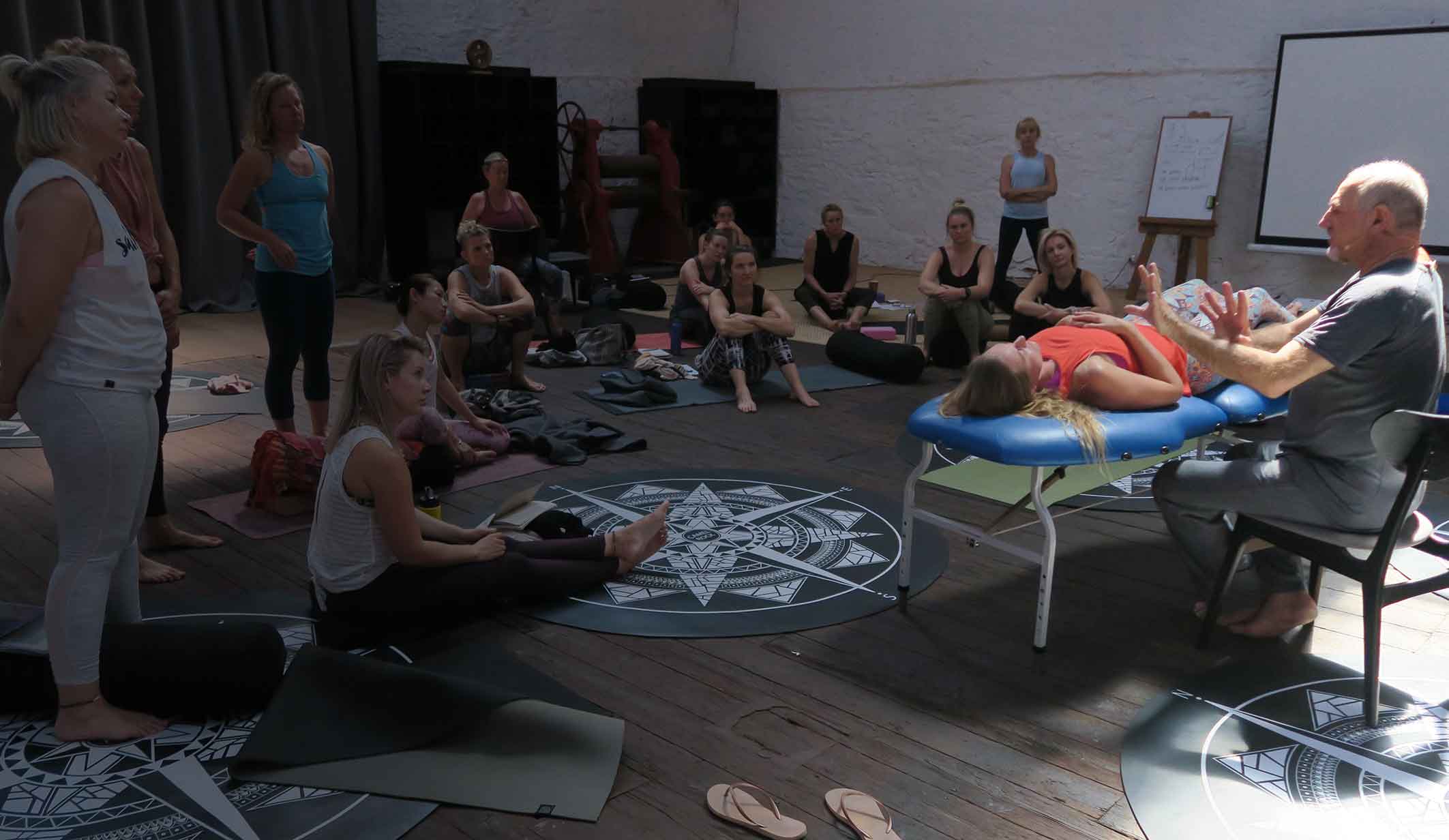
Leslie seated at a massage table demonstrating a technique for a roomful of students

Leslie Kaminoff is a best-selling author and yoga educator.

Category: Blogroll

  • The Art of the Answer-Sutra (+ commentary), part 3

    Here’s another exchange from my Instagram Stories Q&A, plus a bit more exposition:

    Q: Would you instruct to use the breath to lengthen the spine?  Is this possible?

    A: I generally do not give this cue unless the nature of the pose specifically calls for axial extension, which reduces all three of the major curves of the spine. And yes, any spinal action involves many of the major respiratory muscles.

    “Lengthen the spine” is a very common cue given in yoga class that is strongly associated with safety and proper alignment. I believe that – for the most part – when a yoga teacher gives that cue, their intent is to keep the spine in neutral meaning: “don’t collapse into flexion or over-arch into extension.”  In fact, a neutral spine can be relaxed without being collapsed, and is a component of many asanas, including: Sirsasana, Chaturanga Dandasana, Adho Mukha Svanasana.

    Anatomically it is not possible to lengthen your spine. The action of axial extension, in which all three curves of the spine are flattened and stabilized, can make you a bit taller – temporarily.  It is not a state you can live in forever, and you wouldn’t want to. It would be exhausting, and likely adversely effect digestion (acid reflux, anyone?).

    Axial extension is present to various degrees in a number of asanas such as Tadasana, Virabhadrasana III, Dandasana, Malasana/Upavasasana and Mahamudra, as well as any pranayama in which strong bandhas are engaged. In fact, the muscular action that creates axial extension is, by definition, the action of the bandhas:

    • Mula Bandha flattens the lumbar curve;
    • Uddiyana Bandha flattens the thoracic curve; and,
    • Jalandhara Bandha flattens the cervical curve.

    All these actions both reduce the ability of the spine to articulate and reduce the freedom of respiratory shape-change. In other words, the result is spinal and breath stability (sthira). As I said before, this is not something you want to hold all the time.

    Bottom line: unless I’m teaching one of the practices in which axial extension is specifically called for I do not refer to “lengthening the spine.”  You can find more detailed information about spinal actions in many of the major asanas in our book Yoga Anatomy.

  • The Art of the Answer-Sutra (+ commentary), part 2

    How do you know when your body is anatomically not built for a certain pose (and when to accept this)?Here’s another from my Instagram Stories Q&A, plus a bit more exposition:

    Q: How do you know when you’re (sic) body is anatomically not built for a certain pose (and when to accept this)?
    A: This is a key question that involves a deep practice of swadhyaya (self-inquiry), and it never has any final solution, because as our body ages, the answers will constantly change.

    My expanded commentary: Some questions cut right to the heart of yoga, and this is one of them. The second chapter (Sadhana Pada) of Patanjali’s Yoga Sutra offers a brilliant, succinct three-part definition of yoga practice (Kriya Yoga). Two of those parts (tapas and isvara pranidhana) are referenced in this question and the third (swadhyaya) is in my answer.

    The practice of poses (asana) can be seen as a kind of tapas. Although the term tapas is usually translated as “austerity,” a more useful view derives from its primary meaning of “warmth” or “heat.” My teacher T.K.V. Desikachar described the heat of tapas as a fire which removes impurities. Asana practice accomplishes this by working our physical body and breath against the grain of our embedded habits (samskaras). The assumption behind this idea is that we are working with something that actually is changeable – like how we breathe or hold tension in certain muscles – and this is how our bodies adapt to the practice. By contrast, we sometimes discover that some poses are made difficult (if not impossible) by some aspect of our body that is not going to change – like the proportional relationship of our arm-to-torso length, or the orientation of our hip joints – and this is when we must adapt the practice to our bodies.

    Through practice and self-reflection (swadhyaya) we can discover some things about ourselves that are not subject to change – that’s when acceptance of that reality needs to become our focus. This is isvara pranidhana, a surrender to that which is not changeable or within our control.  Or, as Desikachar put it: “…in the final analysis, we are not the masters of everything we do.” (from Heart of Yoga)

    To re-state what I said in my original answer, everything about our embodied existence is subject to some kind of change, so we must always maintain a self-reflective attitude that allows us to constantly re-evaluate what we are working to change, and what we need to stop trying to change.  Surrender is itself an act of will.

    Another well-known formulation of this principle is Reinhold Niebuhr’s Serenity Prayer which seeks to find “the strength to change the things we can, the serenity to accept the things we cannot change, and the wisdom to know the difference.”

    Stay tuned for more Q&A sutras with commentary, and if you have yoga anatomy questions please ask them on Instagram, or email me.

  • The Art of the Answer-Sutra (+ commentary), part 1

    Q: Is there any way to teach people not just do the pose but feel the pose?Some of you reading this may have been on my e-Sutra email-based discussion list since 1997, when it was run through my AOL account (an inelegant solution, but all there was at the time). Those early long-form threads tackled important issues at a critical time in the yoga community, but the reach was inherently limited.
    By far the vast majority of you are more recent members of my online community via web blog, Facebook, Twitter, or Instagram and may never have had exposure to long-form online writing. That type of inquiry-based exchange remains my comfort zone – evident to all who take workshops with me, as I insist on interaction and will ask questions of my students if they don’t speak up themselves!

    Newer social media opportunities, such as Instagram Stories, have simultaneously opened up a much broader reach while requiring ever-briefer sutra-like* answers. I am constantly trying to improve my ability to deliver meaningful information is as few words as possible, but often know there’s more I’d like to say. By way of illustration, here’s a question from Iness Lagios (_yoginess__) from a recent Instagram Story, and my brief answer, plus some commentary:

    Q: Is there a way to teach people not just to do the pose, but to feel the pose?
    A: Yes. It involves engaging students in an inquiry – but first, we have to stop telling them what they should be feeling, and inviting them to see what they notice.

    My expanded commentary: Iness’ excellent question touches on what is essential for anyone practicing or teaching yoga. The key to safety and effectiveness in asana practice depends on an ability to tune into your inner experience of the pose – not just mimicking a teacher, other students, or an idealized image of what the pose looks like, or what you’ve been told it should feel like.

    My current thinking on this is encapsulated by the following teaching methodology: “Try this, now try that…now, see what you notice.” I propose that teachers should always have at least two different ways of teaching a single practice. By offering options in close succession students are encouraged to notice what difference they feel, if any, putting focus on their own embodied experience.

    Invariably, some students will have trouble noticing any difference between the options, and it’s easy for them to feel left out or to assume they “did it wrong.” That’s why I always leave a lot of space in my classroom for not knowing. In fact, I honor confusion as a necessary starting point for any meaningful inquiry, as long as it is recognized. I’m pretty certain that for at least the last decade of workshops I’ve always quoted my teacher T.K.V. Desikachar on this point: “The recognition of confusion is itself a form of clarity.” This is the point from which an asana practice can become yoga, not just physical exercise.

    Stay tuned for more Q&A sutras with commentary, and if you have yoga anatomy questions please ask them on Instagram, or email me.

    * My teacher T.K.V. Desikachar’s father, T. Krishnamacharya, described a sutra as being inspiration for the teacher rather than instruction for the student. When I refer to something as “sutra-like” I mean to offer some direction with room for exploration and development, not a hard-and-fast rule.

  • I was asked “What is your favorite quote?”

    You know those Facebook quizzes…the ones that ask a bunch of questions and then deliver what is supposed to be some insightful truth about you, which you’re then supposed to post for all the world to see? I hate those. If you invite me to take one (or to play Candy Crush) I will unfriend you.

    That’s why I was surprised at how deeply I responded to a series of philosophical questions posed by the folks at Triyoga in London, where I’ll be teaching at the end of June. As it happens, the key question they asked me was “What is your favourite quote?” I instantly knew the answer.

    Even before I was attracted to yoga in my late teens, I had been very curious about fundamental world views. My readings at the time tended toward the mystical as well as the philosophical. As part of my yoga training with the Sivananda organization, I got a big dose of Vedanta and Yoga philosophy, which I continued to study for many years.  In spite of the fact that I ended up teaching the basic tenets of Yoga/Vedanta, I developed deep misgivings about what I saw as the disembodied nature of the teachings. Years later, I stumbled on a quote in the book Philosophy: Who Needs It, by Ayn Rand:

    Humans are beings of self-made soul.

    That one devastating statement shattered any remnants of the mystical thinking I had inherited from my days at the ashram. It awakened me to the fact that the fundamental essence of my being is my own creation, and it belongs to me, and no one else. In other words, my soul is not on temporary loan from god or some great undifferentiated cloud of consciousness. Through the accumulation of the countless free-will choices I’ve made ever since I’ve existed, I have created the kind of person I have become.

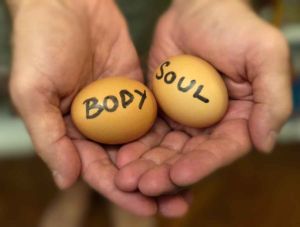
    I came to realize that mystical teachings get it backwards when they insist that existence emerges from consciousness. Rather, consciousness can only exist as an emergent attribute of a physical entity. This is a fundamental point of divergence between my view and that of most other yoga teachers. The issue has been called the primacy of existence vs. the primacy of consciousness. The primacy of consciousness view allows for the separability of body and soul. My yoga is grounded in the indivisibility of body and soul – the primacy of existence.

    The dualistic roots of yoga philosophy can easily reinforce disembodied thinking by reducing a person to two fundamentally incompatible elements: Purusha (consciousness) and Prakriti (physical nature). This is reminiscent of another Ayn Rand quote from her book Atlas Shrugged when she wrote that proponents of the soul-body dichotomy “…have taught man that he is a hopeless misfit made of two elements, both symbols of death. A body without a soul is a corpse, a soul without a body is a ghost.” Similarly, Samkhya (the darshanic partner of Yoga) famously describes a human as a lame man who can see (Purusha) being carried around by a blind man who can walk (Prakriti). By asserting the indivisibility of body and soul, I reject both models.  Humans are not the ghost of a consciousness somehow being carried around by a dead lump of matter.

    I’m grateful that the questions sent me by Triyoga for their blog post created an opportunity to consider these and other issues. I’ll be offering a special 90 minute donation-based program while in London: Free Will and The Nature of the Soul: A Philosophical Inquiry with Leslie Kaminoff with all profits going to a favorite charity of mine, The Africa Yoga Project. This will be on Facebook Live too, so we hope to see you there!

  • Return to OZ

    Lydia and I are preparing for a month of travel and teaching, in fact it’s our biggest teaching tour to date! We are really looking forward to the upcoming tour, which takes us to:

    We work hard on these teaching tours, but we always schedule a couple days on each side of the workshops to enjoy the host city. We’ve heard Sorrento is beautiful and while I’m teaching there I’ll turn 60 years old (on March 13). Word on the street is there may be some celebrating going on, so come out to the workshop on March 14th to help cheer me into my 7th decade! I believe there’s still room in some of the workshops, so if you or someone you know is down under, please come out and say hello.

    All this planning got me feeling nostalgic about my first visit to New Zealand and Australia in 1983 so I dug out some old photos. At the time, I was living in Los Angeles with my partner Lynda Huey where we worked at Dr. Leroy Perry’s International Sportsmedicine Institute.  Lynda was the athletic director and, although I was teaching yoga flexibility to the athletes, my main job was to administer a new form of electro-therapy that was getting great results with pain and soft tissue injuries.  The instruments I specialized in, the Electro-Acuscope and Myopulse, were in great demand around the world at the training areas of track meets so, eased by the fact that Lynda and I were also working part-time as travel agents, it created a perfect opportunity to travel.

    August of 1983 found us in Helsinki, Finland for the first-ever world championships of Track and Field. Towards the end of 1983, we were invited by Australian Olympic swimming legend Murray Rose to present our rehab work at a Sports Medicine event at Sydney’s Town Hall. After a stop to visit some friends in Auckland, we arrived in Sydney and were taken on a whirlwind tour of the city by Murray and his friends.

    In this photo, I am posing for an AP photographer with Evelyn Ashford, who at the time was the world’s fastest woman. Evelyn had sustained a hamstring injury in an early heat of the 100 meter dash, and I was treating her with the equipment.  She recovered well enough to make the U.S. team and win a gold medal the 1984 L.A. Olympics in spite of a slight re-injury at the team trials (for which I also treated her). As part the promotion for the Sydney event, I was invited to a T.V. interview on “Good Morning Australia.

    This photo shows me on set preparing the equipment for my segment.  I am wearing my best (and only) suit for the occasion. I was apparently still wearing that outfit when we visited a game preserve outside Sydney.  There, I met kangaroos for the first time. Once the film was developed back in L.A. , I also noticed for the very first time that I was – at the tender age of 25 – going bald on the top of my head. I was shocked and devastated, but I’ve gotten over it.

    The rest of our trip was terrific.  We traveled to Canberra to tour the brand new Australian Institute of Sport, and the headed up the Gold Coast to visit with some friends in Nambour before continuing up to check out the facilities at the University of Queensland in Brisbane. Finally, we went all the way north to Cairns, where we had a memorable scuba dive off the Barrier Reef. Lynda and I actually returned to Sydney in 1984 for a return visit that was more of a pleasure trip.
  • 2015 – It’s been a helluva year…

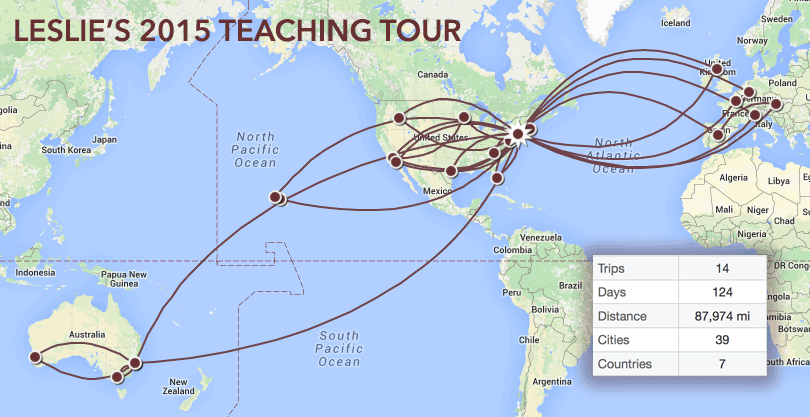
    This map shows where I traveled in 2015
    Lower numbers in the chart are as of December 12, and don’t reflect the days or mileage for our return trip to New York on December 15. The 39 cities on the chart are inflated since they count every time we returned home to New York. The actual number of cities we visited is 26.

    Tonight in Paris, after finishing my last day of travel teaching for 2015, Lydia and I exhaled deeply and decided to map all our teaching travel for the year just ending.  Seeing it all in one image fills me with many emotions.

    First and foremost, I feel gratitude for the fact that I can do what I do. When I took my first asana class at the New York Sivananda Center 1978, I could not have imagined how profoundly my life would be transformed. I wasn’t alone.  Over the last four decades so many others have been touched by Yoga, the world has turned into a place where someone like me – who is profoundly unemployable in any other field – can travel the globe sharing these teachings with the sincere, dedicated groups of lifelong learners we call Yoga Educators.

    So – in tribute to this amazing year of teaching, travel, learning, and connecting – I am going to give a shout out to all the folks who made it possible for me to spend 127 days of 2015 journeying more than 90,000 miles* to 26 cities, seven countries, and meet close to 5,000 students in my classes and workshops. It has truly been an honor and privilege to spend time with the amazing students they gathered in their diverse spaces around the world:

    • Los Angeles, California – Larry Payne and his YogaRx Therapy training at LMU
    • Winter Haven, Florida – Kerry Wilson at Inside Out Fitness
    • Austin, Texas – Laura Forsyth and Lori McDougall at Yoga Yoga
    • McCall, Idaho– Debra Murphy at Shanti Yoga Studio
    • Sydney, Melbourne, Freehold, Australia – Michael de Manincor and Lisa Grauaug of Yoga Institute of Australia
    • New York, New York – Renee LaRose, Alden Conant and the entire team at YJLive! Conferences
    • Washington, D.C. – Rexx Samuell and his team at Buddha B. Yoga Studio
    • Lambertville, New Jersey – Sue Elkind, Denise Orloff and Caroline Joan Peixoto at Dig Yoga
    • Monroe, New York – Nicole Lewitan at Ananda Ashram
    • Glasgow, Scotland – Mark Russell of Kridaka Yoga
    • Minneapolis, Minnesota – Sarah Jane Wroblewski at the Yoga Center of Minneapolis (special shout-out to her wife Kim Bartmann for making us so welcome at a number of her retaurants)
    • New York, New York – Everyone at the Breathing Project and all the amazing students who showed up for my “Transformation Through Touch” summer immersion
    • Honolulu, Hawaii – Rich Girolami of Silk Bridge
    • Madrid, Spain –  Blanca San Roman of Dhara Yoga
    • Vienna, Austria – Florian Reitlinger and Brigit Pöltl at the Yoga Zentrum Mödling
    • Asheville, North Carolina – Stephanie Keach and Julia Albertson, Asheville Yoga Center
    • Milano, Italy – Giulia Borioli of the Milano Yoga Festival, and my translator Vittoria Frua
    • Encinitas, California – Monique Lonner of Soul of Yoga
    • Cologne, Germany – Sonia Bach and her team at the yogaloft Cologne
    • Paris, France – Alia M’Hamdi Bolt of AliaOM Yoga

    We’re almost finished nailing down an equally exciting teaching schedule for 2016.  As soon as dates are confirmed, they will appear on my Calendar Page. I will be starting off the year with my first-ever appearance at the San Francisco YJLive! event and would love to see you there!

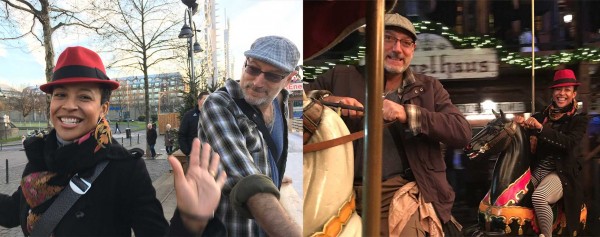
    Finally, Lydia and I would like to send a special thank you to my agent, Ava Taylor and her amazing team at YAMA Talent. Ava is an amazing partner, a great friend and a true trailblazer in the field of professional management for yoga talent and event production. She also showed us a great time in Cologne, Germany (photo evidence below).

    The fabulous Ava Taylor showing us a good time in Cologne.

    * Lower numbers in the chart are as of December 12, and don’t reflect the days or mileage for our return trip to New York on December 15. The 39 cities on the chart are inflated since they count every time we returned home to New York. The actual number of cities we visited is 26.

  • Yoga Therapy and Gender Politics? Megan McDonough and John Kepner Weigh In…

    The following exchange is taken from the comments page of my post “More SYTAR Reports Coming.” In it, Megan McDonough makes some excellent points – many of which I agree with – about the male/female dynamics apparent at the SYTAR event, and in the current atmosphere of the Yoga Therapy field.
    I forwarded her comments to John Kepner, Executive director of IAYT, who promptly responded with his own observations, and an invitation to address these issues at the next symposium.
    Here is the exchange. As always, I welcome any comments from you.

    1/31/2007 12:20 PM
    Megan McDonough said…

    Hi Leslie,

    I’m sorry I missed you at the SYTAR conference in LA. The conference began with the question: How COULD we define yoga therapy? The more telling question, from my perspective, is: How ARE we already defining yoga therapy?

    Actions speak louder than words. If we are to view the actions at the first yoga therapy conference as the basis for a definition, then we could easily come away with the mistaken impression that yoga therapy is a masculine modality, a conclusion drawn from the panels, the process and the platform.

    Firstly, the panels were predominately male. For years, corporations have made the argument that there were simply not enough females in the job pool for solid representation in leadership roles. All we had to do was observe the overwhelming presence of females in the audience to see that this is not the case for yoga therapy. Why, then, were the panel members mostly men?

    Secondly, the majority of workshops and perspectives at the conference looked at the process of yoga therapy as taking a masculine approach of “Let’s fix what’s wrong with the body.” Like the prescriptive approach rampant in our healthcare system, this approach ignores the wisdom and individuality of the patient and instead thrusts the yoga therapist into the role of “answer-man.” Missing in the discussions, for the most part, was the emotional component—how yoga therapists can (and do) play a vital role in the circular and sometimes messy journey of emotional healing. Western medicine’s limitation to a purely prescriptive approach is one of the reasons people seek out-of-the-box modalities like yoga therapy in the first place; let’s not model ourselves after a system to which we are attempting to offer an alternative.

    Lastly, the platform of the conference tended towards a straightforward lecture or discussion format, similar to that of a medical conference, with little movement or participant involvement.

    Explicit definitions of yoga therapy are helpful. Far more telling, however, are the implicit definitions revealed in the methods and mindset we are using to develop those explicit definitions. I, for one, would like to see the feminine better represented in the panels, the process, and the platform at future conferences.

    We need not follow in the footsteps of healthcare, business, or other yoga models when developing a definition or a conference format. Yoga therapy is a unique entity. We must forge a model all our own, one that is inclusive and honors the depth and range of yoga in both its masculine and feminine forms.

    In Yoga,

    Megan McDonough
    www.yogawithmegan.net

    1/31/2007 02:05 PM
    John Kepner said…

    Aloha

    I appreciated Megan’s comments. I was especially glad to meet her in person at the Symposium. Several years ago she won a special prize offered by YREC for the best Yoga essay of the year. You can see why.

    I have actually been working on a little article on the gender balance issue, so in the friendly spirit of this forum, I will offer this to e-sutra readers. Maybe I should title it… “Fools Rush In”

    Gender Balance and Symposium Faculty Selection Criteria
    “Lies, Damned Lies and Statistics” – John Kepner, Executive Director

    In a wonderfully positive atmosphere, gender imbalance was politely but pointedly pointed out to us several times. The participants were mostly female and the presenters were mostly male. So, let’s look at the statistics and (at least my own)faculty section criteria in general for IAYT’s first Symposium. We are not seeking to argue anything here. We are, however, always seeking better ways to serve our mission, our membership and the public, especially in the faculty selection for the next Symposium. We are mindful that today it is mostly women who are carrying forth the Yoga tradition.

    Statistics:

    Main Session Presenters
    Female: 22%
    Male 78%

    All Faculty
    Female 41%
    Male 59%
    (All Faculty consists of Main Session Presenters, Moderators, Practice Session Leaders and Workshop Leaders)

    Faculty Selection Criteria:

    The best faculty available to support the mission of IAYT and the Symposium on Yoga Therapy and Research. For this first symposium, all faculty were individually selected.

    A balance between Yoga researchers, healthcare practitioners that use or support Yoga in their practice, and especially many leading Yoga teachers and Yoga therapists representing most of the major traditions, lineages and methodologies with a history of contributions to Yoga therapy.

    A preference for IAYT members and contributors to IAYT publication

    A preference for faculty from Los Angeles and California to keep costs down for our first Symposium.

    Looking forward:

    A key issue, at least in my opinion, is the maintaining the appropriate balance of heart and mind, science and spirit in a Yoga symposium. But the title is indeed, “Yoga therapy and research.” Suggestions for new faculty, especially important emerging voices that support the mission of the Symposium and serve the participants are always appreciated. The working strategy for the next symposium, is “more depth, dialogue and integration” (and thus consequently, less breadth).

    Comment:

    The current IAYT Board of Directors (Veronica Zador, Janice Gates and Eleanor Criswell) is all female. The current Staff is 75% female (John Kepner, Kelly McGonigal, Amber Elliott and Jesse Gonzales)