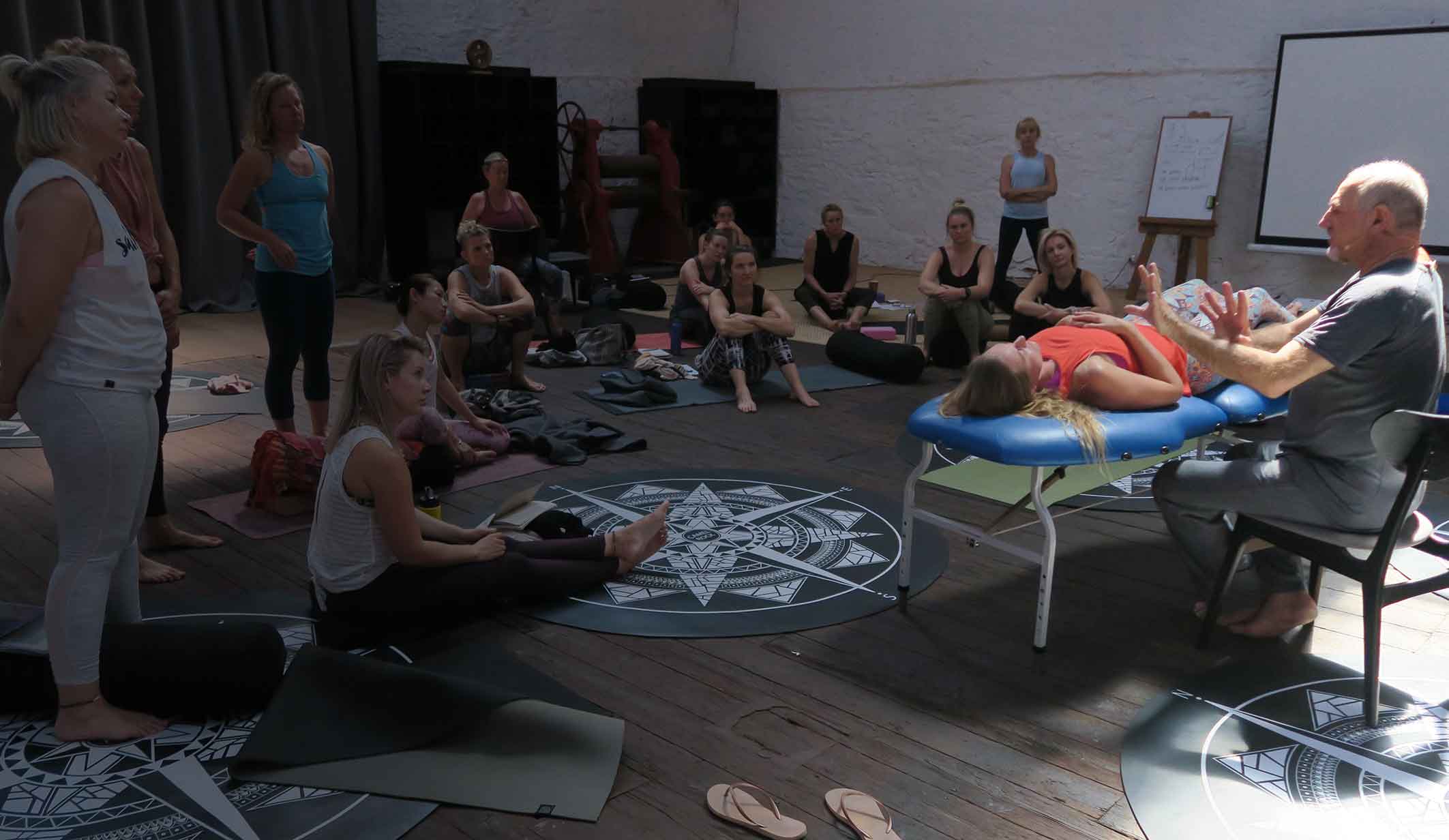
Leslie seated at a massage table demonstrating a technique for a roomful of students

Leslie Kaminoff is a best-selling author and yoga educator.

Author: yatb

  • Egg On My Neck, part 2 of My 2 Cents about ‘How Yoga Can Wreck Your Body’

    Last week’s video got quite a lot of attention on YouTube – over 12,500 views as of this writing.  This week’s follow-up includes an apology to William J. Broad, the author of the NYT article and the book “The Science of Yoga”, which was sent to me by the publishers this week.

    In last week’s video, I had taken Broad to task for under-reporting the “normal” range of motion of the cervical spine in axial rotation as 50º. In fact, that is the same number I give in the 2nd edition of Yoga Anatomy! Oops. Egg on my “neck”.

    In retrospect, I believe I used outdated numbers in the book and I’m in the process of researching how to revise that page (34). Here’s one of the research articles I’m referencing that gives a good overview of just how variable these range of motion (ROM) measurements can be. For example, compare the lowest ROM—for a male in his nineties—at 26º. The greatest ROM was a teenage female with a whopping 94º! So, what’s normal?

    I’m about halfway through Broad’s book now, and I’m pleased to report that it’s a great read. I will have a full review when I’m done but even at this point I can safely say I’m going to recommend every serious student of yoga read it.


  • My 2 Cents about "How Yoga Can Wreck Your Body"

    As I say at the end of this video response to the New York Times article, “How Yoga Can Wreck Your Body,” I’m too lazy, too dyslexic and too slow a typist to write out my opinion. Instead I was able to tape this piece at the end of my Yoga Anatomy class last Wednesday night.  In it, I reference my friend Eddie Stern’s marvelous blog piece “How the NYT Can Wreck Yoga,” with great comments by Marshall Hagins, P.T. and Rick Bartz, D.C.  I highly recommend reading it.

    I’ll probably have more to say once the book is released next month and I’ve had a chance to read it. As always, your comments are welcome.

  • Who is John Galt? RTFN.

    As I write this, I am wearing an article of Lululemon clothing I purchased 8 years ago. Did I spend twice what I pay for other brands? Yes. But, Lulu’s product has lasted 4 times as long. Maybe reading Atlas Shrugged helped Chip Wilson make boxer briefs this good. If so, I thank both him and Ayn Rand from the bottom of my well-ventilated nutsack.

    It has been quite the spectacle the past few weeks, observing the widespread reaction to Wilson’s decision to put four provocative words on Lululemon’s ubiquitous shopping bags. So far, I have not seen a single article, comment or quote referencing Ayn Rand, Atlas Shrugged or Objectivism that reflects even a rudimentary understanding of the fundamental ideas that they represent.

    Aside from being a satisfied Lulu customer, I’ve been following this story with keen interest because of two facts: I’m both a yoga educator, and a publicly declared Objectivist of long standing. If I were to evaluate these two facts on the basis of the general response to the “Galt” kerfuffle, I’d have to judge them to be incompatible. Fortunately, I do not make judgements based on public opinion.

    I have read Atlas Shrugged five times, Fountainhead four times, and all of Ayn Rand’s non-fiction. As far as her more formal work on philosophy is concerned, I have had the privilege of personally studying with two of the top Objectivist scholars in the world. I have been contemplating and applying Rand’s ideas in every area of my life and career for four decades, and I’m well aware of the hard work it’s taken to forge a consistent world view in which the principles of Yoga are compatible with those of Objectivism. It wasn’t easy, but I did it, and I owe whatever success I’ve had in my life to the effort I put in.

    If you have made a similar effort to forge a consistent philosophy for yourself and have something RATIONAL to say about this issue, I’d love to hear from you.

    However, if you wish to comment about “Who is John Galt,” I’ll give you the same advice issued by frustrated tech support when they are repeatedly assaulted with stupid questions that have already been answered by the people who have taken the trouble to write the operating instructions: “RTFM – Read The Fucking Manual.”

    What I’m suggesting is that there is a very well-written manual for addressing all the injustices that both the Occupy Movement and the Tea Party are protesting. It is called “Atlas Shrugged.” So, before you bitch and moan about how society isn’t working for you, I suggest you “RTFN – Read The F-ing Novel.”

    Then, we’ll talk.

  • Yoga Alliance Approved, My Ass

    Another gem from my friend J. Brown of the Abhyasa Yoga Center

    Flipping through the catalog for a big name yoga and retreat center, I was shocked to notice that they advertised their yoga teacher training programs as “Yoga Alliance Approved.” Misrepresentations like this are the dirty little secret of the yoga industry. No one really wants to admit there is no accreditation for Yoga.
    Anyone who claims to be “approved,” “certified” or “licensed” by the YA is either grossly uninformed or disingenuous. The YA maintains a registry of yoga teachers and training programs. In filling out the paperwork and paying the fees, yoga teachers and training programs purport to follow a vague set of curriculum guidelines that are posted on the YA website and assume a service mark of RYT (Registered Yoga Teacher) or RYS (Registered Yoga School.)

    What no one ever seems to acknowledge or mention is that the YA provides no oversight whatsoever. No one checks to see if anyone is actually doing what they say. Everyone is on the “honor” system. Consequently, the registry amounts to a digital rubber stamp or paid advertising. Not to mention, the YA does not disclose what they do with the money they collect from the Yoga community.

    Even if everyone is being true to their word, referring to the YA guidelines as “standards” is quite a stretch. For example, being registered at the 200 hr level is said to have 20 hours of yoga philosophy. Generally, this entails a cursory reading of Patanjali’s Yoga Sutra’s and a written test, kind of like reading the chapter and answering the summary questions in my 9th grade social studies class…

    Read the rest here…

  • Small Cell, Big Questions, by Edya Kalev

    You thought you were breathing in Trikonasana, but that was only with your lungs.  When you tap into cellular breathing, as we did in the second session of The Breathing Project’s Yoga Anatomy: Practices course, then a whole new arena of sensation – and potential frustration – opens to you.

    Taught by Amy Matthews, an expert in not just anatomy but in the “embodiment” of all the body’s systems, this asana class invited the cells in your hands and feet to breathe, just as much as the lung tissue.  How can we access these seemingly unconscious cells?

    Amy began with a review of basic cell anatomy, providing visuals for the complex processes happening deep within us at every moment.  On the most basic level, every cell must inhale nourishment from it’s surroundings, and exhale waste. It is dependent on its environment to supply that nourishment and carry that waste away, so it can continue to burn energy while not becoming toxic.

    The cell wall is the semi-permeable barrier that can either allow or reject incoming matter (proteins, lipids, carbohydrates) much like the bouncers at a popular nightclub.  The place between the velvet ropes where decisions get made is the place where we, as yoga students/embodiment novices, got to explore.  What do we let in?  What gets to sit and wait on the edge?  What do we let go of?  What identity do we create in the process?

    With images of cellular respiration in mind, we could think about the more subtle sensations in our toes, imagining that those cells were participating in our down dog as much as our spine or sit bones.  Crossing those velvet ropes into a new inner universe, we might even stop “thinking” about the cells, and be able to listen to them.  Indeed, several students found that they had altered states of consciousness while moving and breathing into all their cells.

    However, some of us felt confused or disoriented, daunted by the sheer number of cells (trillions?) we could listen to.  Lest we thought that we were unsuccessful in the practice if we couldn’t hear them speak, Amy reassured us that everyone was “100% successful” in cellular breathing.  There was no wrong way to breathe;  our cells are doing it all the time or we would not be alive.

    Yet, “along with no wrong way, there is also no right way, and that can be terrifying,” Amy pointed out.  As professional teachers used to instructing our classes how to do a pose, this was a huge philosophical shift.  Can we find another way to teach asana, one that encourages exploration rather than imitation?

    These are the big questions posed by our smallest units.  Let’s take a moment and listen to what they have to say…

  • An “Advanced” Practice

    Reflections on the inaugural class of Leslie Kaminoff’s “Yoga Anatomy – Practices” at The Breathing Project, NYC.  October 5, 2011

    by Edya Kalev

    In a sold-out asana class full of professional yoga teachers, one might expect that the practice would include splits, scorpions and other poses deemed impossible by the vast majority of lay practitioners.  Not so in the first day of Leslie Kaminoff’s brand-new Yoga Anatomy: Practices course at The Breathing Project.

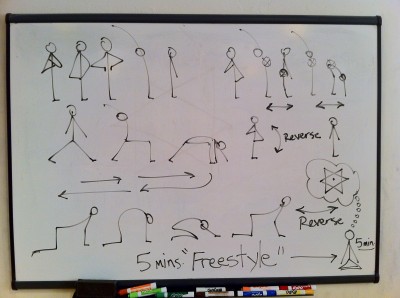
    Standing, breathing, and concentrating awareness; these were the surprisingly complex challenges given to the class.  Starting out, we sensed the movement of the breath with hands on belly and abdomen. Then we focused on the top hand as we inhaled, and the bottom as we exhaled.  Taking that into movement, we floated into a forward bend from a lunge position. Maddeningly, Leslie provided no specific instruction as to how to breathe, just where to focus the attention as we moved.

    After settling into a comfortable pattern of movement, focus and breath, Leslie of course swapped the area of focus.  Now we were to shift attention to the belly region on the inhale and the chest region on the exhale.  Many experienced momentary confusion as we arched into cow and rounded our spine into cat…why did this familiar movement feel so different?  Could changing the focus of our breathing really change everything?

    At the end of our brain-scrambling sequence, just when we were looking forward to a predictable winding down, Leslie proposed “freestyle counterposing,”  encouraging students to figure out what they needed to feel complete in the practice and do it on their own.  Yet another diversion from the expected, honoring the unique individual over the “routine.”

    During the last 5 minutes, the class meditated on a figure of overlapping triangles with a center point.  Leslie asked us to sit with our “associations, insights, and connections between the visual image and the practice,” just as he had to 25 years ago in the presence of his teacher, the great TKV Desikachar.  He then shared with us his private journal and drawings from that lesson, showing how broke the symbol apart into two separate triangles and reconstructed it again.

    Back in that room, Leslie found meaning in the separate parts of the symbol before making it whole again, as one would examine the two distinct parts of the breath, then flow with the full breath.  An apt parallel to both what his teacher incited in him, and what he has begun to stir in us.  With Desikachar’s lesson in mind, Leslie had created an Advanced Practice without advanced poses, for yoga teacher and yoga student alike.

  • The Return of e-Sutra!

    Well, it’s been a while.

    e-Sutra is coming out of its longest period of inactivity since I started it in 1997 as a mailing list being run from my AOL account.

    A lot has been happening, almost of it good – some of it really great.  As part of a major re-design and integration of my online enterprises, I’ve partnered with web genius extraordinaire Lydia Mann to migrate all my sites (including this blog) to WordPress.  This migration was made all the more urgent by an epic failure on the part of Blogger that irretrievably destroyed the original esutra.blogspot.com.  Fortunately, I’ve archived every post ever sent out, and I’ll gradually re-post the most important ones in the near future.

    I have also invited a few guest bloggers to contribute pieces to e-Sutra, the first being my good friend Edya Kalev, who is participating in my brand-new “Yoga Anatomy – Practices” course at The Breathing Project.  About twice a month, Edya will write about her personal experiences and share her insights as we work our way through this exciting new material.

    In the category of really great, this week saw the arrival of the brand-new second edition of “Yoga Anatomy,” featuring expanded chapters on breathing and the spine, two new chapters on the skeletal and muscular systems, plus more illustrations, variations, indexes and better organization of information.  Overall, my co-author Amy Matthews and myself are very pleased with the result, and we know you will be, too.

    It’s great to be back, and I’m looking forward to hearing from you.  As always, comments are welcome.

  • Work and Play in Colorado

    I’m at the 16th annual Yoga Journal Conference at the beautiful YMCA of the Rockies in Estes Park, Colorado.

    As I’ve had to explain many times to curious attendees, I’m not here as a presenter.  This has become an annual vacation for me, and a chance to re-connect with old friends, and to make new ones.This year, it is also a working vacation… (more…)

  • New York Times Dicks Around with Circ Stats

    The New York Times proclaimed the other day in a Global Update from Uganda:
    Male Circumcision May Help Protect Sexual Partners Against Cervical Cancer

    My friend Gil Hedley and I are in in complete agreement about not mutilating infant male genitalia, so I sent him the article, and he replied with a particularly (and characteristically) funny rant, which he has given me permission to share…

    (more…)

  • Indian guru Sai Baba ‘close to death’

    HYDERABAD, India (AFP) – Doctors treating Indian spiritual leader Sai Baba, one of the country’s most famous gurus, said on Thursday his health was deteriorating fast as devotees massed to pray for his recovery.
    (more…)