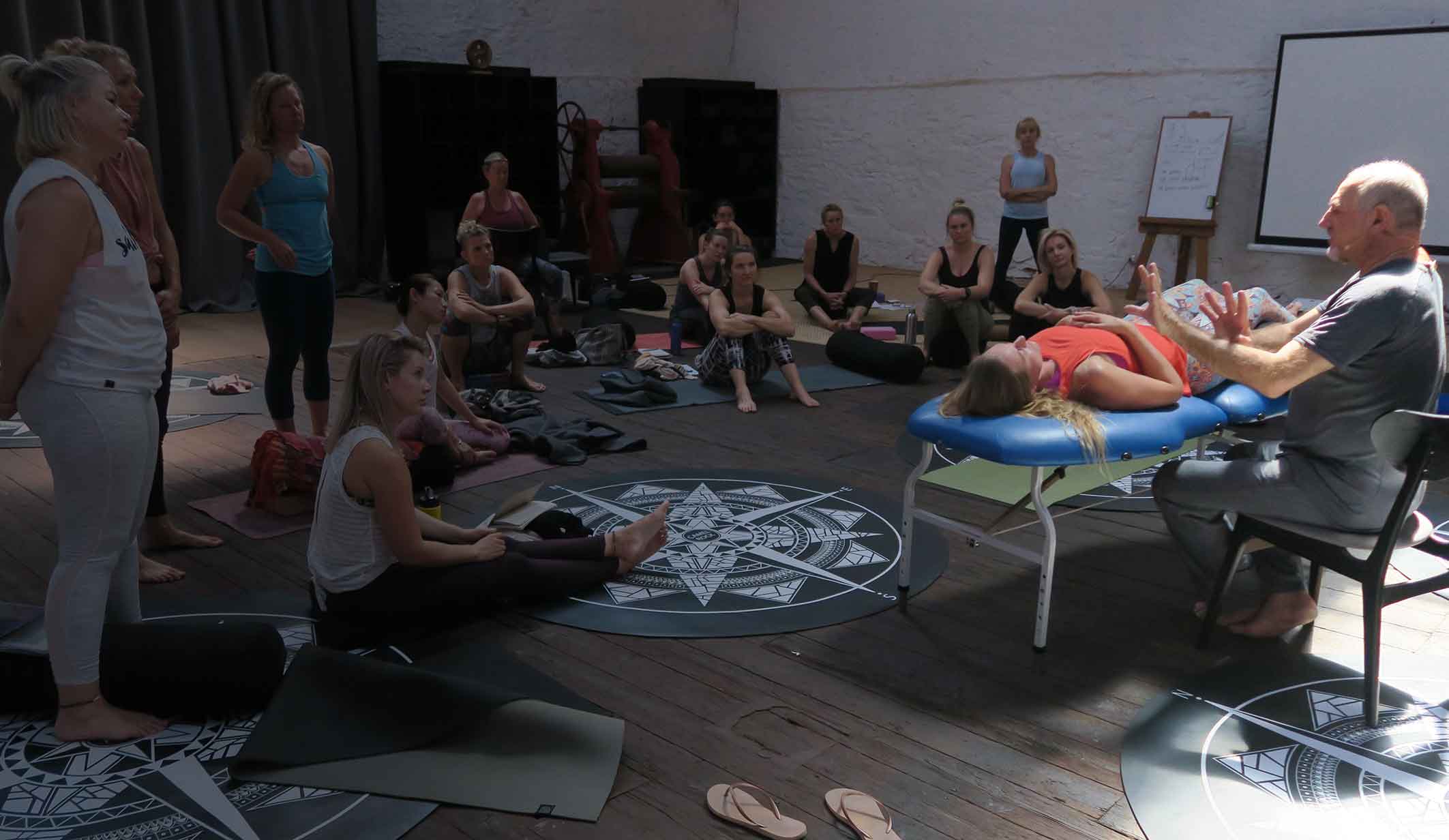
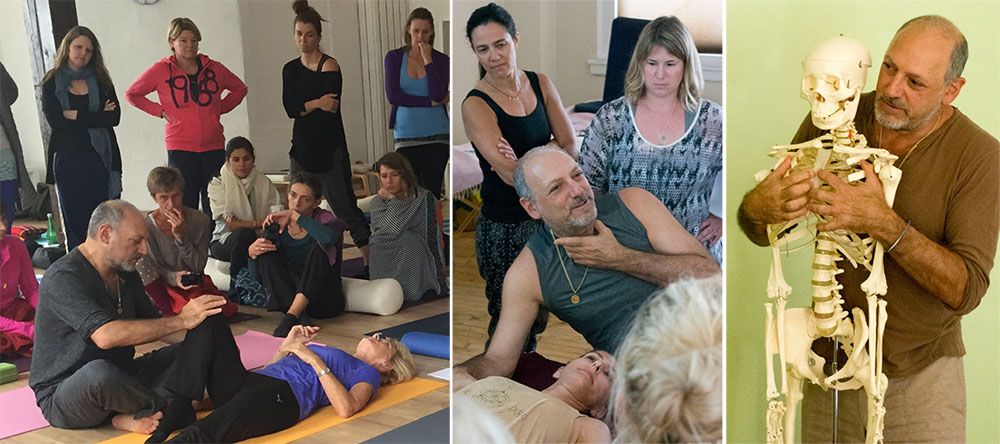
Leslie seated at a massage table demonstrating a technique for a roomful of students

Leslie Kaminoff is a best-selling author and yoga educator.

Author: lkaminoff

  • My Friend Ti.

    I want you to know about a friend of mine. Her full name is Terecita Mahoney Blair, but everyone calls her Ti (sounds like “Tee”).  August 8 is her birthday and I sincerely hope it marks the start of a wonderful next year.

    Ti is one of my (s)heroes. Life has dealt her some pretty tough cards yet she consistently inspires with dedication, determination and a relentlessly positive, honest outlook.

    I don’t know too much about her early life, but in 2009 Ti got hit by a bus. Her spine was badly broken, and she needed 5 surgeries in the years that followed. Turns out, the hardware that was implanted did not do what it was supposed to and she has been struggling with a host of bizarre and awful symptoms, often being dismissed by orthopedists and other medical professionals. It’s a wonder she was vertical at all, once she learned that nothing more than scar tissue and muscle spasms were keeping her vertebra together (photos below of the faulty and replacement hardware).

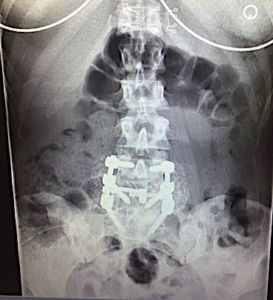
    photo of spinal hardware
    Bad spinal hardware, that never should have been put into anyone’s body, and never permitted spinal fusion to take place.
    Ti wrote about her new spinal hardware: “Bottom screws into sacrum, L5 and L4. You can’t see them, but new Titanium plated cages were inserted. Bone should grow within the vertebrae and on the outsides of all the hardware, making for a solid fusion.”

    I met Ti five years ago this month in Los Angeles, when I taught a workshop at Black Dog Yoga, where she was working as their Teacher Training Administrator. Ti was familiar with me through my online courses, which Black Dog had been using as part of their teacher training. You never know who’s going to walk into one of your classes. All educators need to remember that. Ti was just four years post-surgical, and I could have asked a million questions of her, but if I thought I could keep her *safe* during my workshop, I would have been sorely mistaken. All we can do is set up reasonable experiments for our students to try on their “rectangular laboratories” (aka yoga mats), and encourage them to notice what they are experiencing.

    Ti at her temporary work station (laptop on her bright pink walker) answering questions from students in my online Yoga Anatomy course.

    Ti was a careful and wise student, applying the anatomy and asana practice I was presenting, and referencing what she found in her own body. As she wrote in a recent Facebook post: “Leslie Kaminoff’s Yoga Anatomy (is) the foundation of how I teach and understand pain, relationship and balance.” As an educator, I couldn’t possibly hope for a better student.

    When Ti and her husband moved to Denver, it was a natural fit for her to connect with the creator of our online courses Kelsey Kaufman, who lives in Fort Collins, CO. Ti eventually became our anatomy homework coach for the online courses. I am touched and honored to know that her work with us has been a lifeline when she’s been so laid up with physical pain, she’s had to take a break from pretty much everything else.

    I travel around the world teaching yoga for a living – mostly to other yoga teachers, and I feel privileged when I meet people like Ti, whose primary focus is on doing whatever good they can for populations they care most about.  For Ti it’s seniors and first responders, two groups that often get lost in the cracks of our society.  For others, it’s trauma survivors, prison populations, people in recovery, teens at risk…the list is endless. This commitment to using the tools of Yoga to better the world is a never-ending source of inspiration.

    video link Last year, we were thrilled when she was voted the 2017 Silver Sneakers 2017 Instructor of the Year. Please watch this video celebrating Ti’s award and bear in mind that – unbeknownst to her – her spine was being inadequately held together by ill-conceived hardware all the time she was jumping around and leading these classes! Ti’s commitment to frequently invisible populations, in this case older folks needing to get or stay moving, catapulted her along and her life-experience made her a sympathetic example for these elders experiencing their own physical challenges.

    What really makes Ti a hero to me is that through all the pain of recovery as well as her internal demons, she not only maintains a positive attitude but keeps focus on what really matters to her: other people who are struggling. The way she walks through the world reminds me of my teacher, T.K.V. Desikachar’s, admonition that “yoga is relationship.”

    Reconnecting with Ti in Los Angeles a number of years after she showed up in one of my workshops, and just as she was joining my online courses as homework coach.

    There is a great deal of talk about corruption of yoga, and commercialization, and the need for third-party reimbursement and licensing and blah blah blah blah. But Ti is an example of true yoga in action. She has made it her life’s work to seek out and serve communities in need, people who might not otherwise know about coordinating breath and mind and movement in a way to enrich and embody their day-to-day experience. She works one-on-one with veterans and first responders recovering from traumatic injuries, and has forged remarkable relationships with many of them.

    She has been brutally honest about the pain and despair that lurks behind her smiling face and started a Facebook project to help her through this really tough post-surgical period. She is using the medium to raise awareness for many of the causes she supports, by wearing a different “Ti-shirt” every day emblazoned with their logos. Here are a few of the organizations she supports:

    The 2018 Colorado 9/11 Memorial Stair Climb honors and remembers fallen firefighters.  Ti has promised (with her surgeon’s permission) to climb at least one stair on 9/11.  She has set a goal of raising $1,111.00 by then, and I am certain she’ll do it simply because it is something she has set her mind to. I just donated $108.00 and hope you will too, if you can spare it.

    Safe Call Now: A no-cost confidential crisis referral service for public safety agency employees all first responders and their families nationwide.

    Emergency Responder Trauma Counselors (ERTC) provides specialized counseling for emergency services personnel and their family members, related to their work and home life and the variety of stressors in which affect them. Including but not limited to PTSD, anxiety, addiction, depression and grief.

    ResponderStrong: Emergency responders working with the National Mental Health Innovation Center to improve mental wellness among Colorado responders and their families. .

    Officer Involved Project: Officer Involved is a thoughtful documentary that examines officers who have been involved in deadly force incidents during their tour of duty.

    I am proud beyond measure to know Ti and others like her, who constitute the vast majority of the yoga teaching universe.  I’m similarly proud to offer what I can in the way of teaching to the online community we’ve built over the years – a community that now spans 45 countries and over 4,000 students – many of whom are lucky enough to have Ti as their homework coach. On the occasion of Ti Mahoney Blair’s birthday, I recommit to keeping my yoga real and staying connected to those around me. I hope you are inspired, as I have been, by her life and work.

    Happy birthday, Ti!

  • Celebrating Desikachar: Share Your Story!

    In the process of promoting our upcoming event at Kripalu, “Celebrating Desikachar: A Life in Yoga, A Legacy of Learning,” we have heard from many people who are unable to attend, but who nevertheless felt moved to share their personal stories about how deeply they’ve been affected by his teachings.

    We have found a way to include these voices at our event – we are inviting anyone, from anywhere in the world, to send in a short paragraph about how their lives have been touched by the life and teachings of Desikachar.  We will print out your message and hang it on a wall of remembrance at our event.  After the event, we will post these messages to a Facebook group page for the world to see.

    It’s super simple to contribute – just send an email to: T.K.V.Tribute@gmail.com

  • I was asked “What is your favorite quote?”

    You know those Facebook quizzes…the ones that ask a bunch of questions and then deliver what is supposed to be some insightful truth about you, which you’re then supposed to post for all the world to see? I hate those. If you invite me to take one (or to play Candy Crush) I will unfriend you.
    That’s why I was surprised at how deeply I responded to a series of philosophical questions posed by the folks at Triyoga in London, where I’ll be teaching at the end of June. As it happens, the key question they asked me was “What is your favourite quote?” I instantly knew the answer.

    Even before I was attracted to yoga in my late teens, I had been very curious about fundamental world views. My readings at the time tended toward the mystical as well as the philosophical. As part of my yoga training with the Sivananda organization, I got a big dose of Vedanta and Yoga philosophy, which I continued to study for many years.  In spite of the fact that I ended up teaching the basic tenets of Yoga/Vedanta, I developed deep misgivings about what I saw as the disembodied nature of the teachings. Years later, I stumbled on a quote in the book Philosophy: Who Needs It, by Ayn Rand:

    Humans are beings of self-made soul.

    That one devastating statement shattered any remnants of the mystical thinking I had inherited from my days at the ashram. It awakened me to the fact that the fundamental essence of my being is my own creation, and it belongs to me, and no one else. In other words, my soul is not on temporary loan from god or some great undifferentiated cloud of consciousness. Through the accumulation of the countless free-will choices I’ve made ever since I’ve existed, I have created the kind of person I have become.

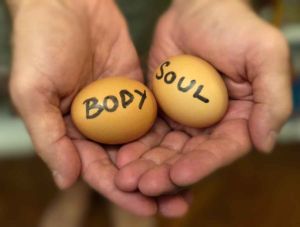
    I came to realize that mystical teachings get it backwards when they insist that existence emerges from consciousness. Rather, consciousness can only exist as an emergent attribute of a physical entity. This is a fundamental point of divergence between my view and that of most other yoga teachers. The issue has been called the primacy of existence vs. the primacy of consciousness. The primacy of consciousness view allows for the separability of body and soul. My yoga is grounded in the indivisibility of body and soul – the primacy of existence.

    The dualistic roots of yoga philosophy can easily reinforce disembodied thinking by reducing a person to two fundamentally incompatible elements: Purusha (consciousness) and Prakriti (physical nature). This is reminiscent of another Ayn Rand quote from her book Atlas Shrugged when she wrote that proponents of the soul-body dichotomy “…have taught man that he is a hopeless misfit made of two elements, both symbols of death. A body without a soul is a corpse, a soul without a body is a ghost.” Similarly, Samkhya (the darshanic partner of Yoga) famously describes a human as a lame man who can see (Purusha) being carried around by a blind man who can walk (Prakriti). By asserting the indivisibility of body and soul, I reject both models.  Humans are not the ghost of a consciousness somehow being carried around by a dead lump of matter.

    I’m grateful that the questions sent me by Triyoga for their blog post created an opportunity to consider these and other issues. I’ll be offering a special 90 minute donation-based program while in London: Free Will and The Nature of the Soul: A Philosophical Inquiry with Leslie Kaminoff with all profits going to a favorite charity of mine, The Africa Yoga Project. This will be on Facebook Live too, so we hope to see you there!

  • Relationship: it’s the key to what I do

    Just finishing a month of teaching in Australia, I’ve had innumerable opportunities to practice a principle my teacher T.K.V. Desikachar often emphasized: “Yoga is relationship.”  One of our Brisbane hosts is the witty and fierce president of Yoga Australia, Leanne Davis. I was intrigued to learn her community is small enough that they all know each other. With only around 100 teaching programs in the whole country, Yoga Australia is able to provide support, check-ins and coaching in a really personal manner. It’s not a model that could directly scale in the U.S., but it’s worth noting that the only valid way to deal with ethics and scope of practice issues lies in the context of the community in which teachers operate. Studios, peers, colleagues – as well as the students –  always need to be in direct relationship to teachers, and feel empowered to give them feedback. We all need to be answerable to someone, but that someone should be part of our immediate community.
    I have been thinking about the role of coaching and personal connection in relation to the specialized work I do. It will be a big part of my upcoming 5-day (30-hour) immersion “Breath Education: Coaching Better Breathing,” August 20-24, 2018, under the aegis of my educational nonprofit, The Breathing Project, Inc. With an intimate group, I look forward to covering the anatomical and practical underpinnings of breath coaching, as well as how to nurture supportive relationships for therapeutic breath work with individuals and groups.

    Having just turned 60, I can confidently say that every good thing I’ve achieved in my life, every positive effect I’ve wrought, has been based on a willingness to be related. Whenever I shied away from relationship by generalizing or depersonalizing, I have failed. I am committed to remembering this for my next 60 years.

  • A Post-Iyengar Reimagining of Alignment in Asana

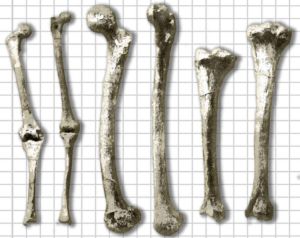
    For the last several years I’ve been pondering the derivation and evolution of the term “alignment” as it relates to yoga asana. My interest correlates directly to the increasing number of repetitive strain injuries my private clients, many of them long-term practitioners, have been presenting with. It is no longer a secret how many teachers have had to undergo hip repair and replacement surgery as a result of their asana practice.

    Historically, the conversation about yoga alignment, at least in the United States, can be traced back to 1956 when  BKS Iyengar first visited Ann Arbor, Michigan to deliver several lecture-demonstrations. Ten years later, Iyengar released his perennial classic “Light on Yoga,” a work that was clearly influenced by his original teacher, T. Krishnamacharya’s “Yoga Makaranda,” which was published in 1934 . Ironically, by the mid-sixties Krishnamacharya himself was no longer hewing to the prescriptive rules he had laid out in the Makaranda. In fact, Krishnamacharya’s mature teaching methodology represented an almost complete reversal of his rigid alignment directives when he declared: “the very essence of yoga is that it must be adapted to the individual, not the other way around.”

    For the past 62 years in America, one system of asana training – Iyengar’s – has held a virtual monopoly on the conversation about what constitutes correct alignment in asana. In my view, the time is ripe for questioning the assumption that Iyengar’s idealized, geometrical alignment directives are the ultimate goal in yoga asana. If there are no straight lines in the body, why are we always trying to “square our pelvis,” or  “place our feet in parallel?”

    What is needed is an anatomically-informed definition of alignment from which healthy asana cueing language can be derived.

    The ultimate context for asana practice is the unique person who is practicing. It is only an individual’s singular body that can be in alignment – not the asana. To speak about yoga poses as if they had some intrinsically correct alignment is, in my opinion, an error. To sum this up as a principle:
                           “Asanas don’t have alignment – people have alignment.”

  • Return to OZ

    Lydia and I are preparing for a month of travel and teaching, in fact it’s our biggest teaching tour to date! We are really looking forward to the upcoming tour, which takes us to:

    We work hard on these teaching tours, but we always schedule a couple days on each side of the workshops to enjoy the host city. We’ve heard Sorrento is beautiful and while I’m teaching there I’ll turn 60 years old (on March 13). Word on the street is there may be some celebrating going on, so come out to the workshop on March 14th to help cheer me into my 7th decade! I believe there’s still room in some of the workshops, so if you or someone you know is down under, please come out and say hello.

    All this planning got me feeling nostalgic about my first visit to New Zealand and Australia in 1983 so I dug out some old photos. At the time, I was living in Los Angeles with my partner Lynda Huey where we worked at Dr. Leroy Perry’s International Sportsmedicine Institute.  Lynda was the athletic director and, although I was teaching yoga flexibility to the athletes, my main job was to administer a new form of electro-therapy that was getting great results with pain and soft tissue injuries.  The instruments I specialized in, the Electro-Acuscope and Myopulse, were in great demand around the world at the training areas of track meets so, eased by the fact that Lynda and I were also working part-time as travel agents, it created a perfect opportunity to travel.

    August of 1983 found us in Helsinki, Finland for the first-ever world championships of Track and Field. Towards the end of 1983, we were invited by Australian Olympic swimming legend Murray Rose to present our rehab work at a Sports Medicine event at Sydney’s Town Hall. After a stop to visit some friends in Auckland, we arrived in Sydney and were taken on a whirlwind tour of the city by Murray and his friends.

    In this photo, I am posing for an AP photographer with Evelyn Ashford, who at the time was the world’s fastest woman. Evelyn had sustained a hamstring injury in an early heat of the 100 meter dash, and I was treating her with the equipment.  She recovered well enough to make the U.S. team and win a gold medal the 1984 L.A. Olympics in spite of a slight re-injury at the team trials (for which I also treated her). As part the promotion for the Sydney event, I was invited to a T.V. interview on “Good Morning Australia.

    This photo shows me on set preparing the equipment for my segment.  I am wearing my best (and only) suit for the occasion. I was apparently still wearing that outfit when we visited a game preserve outside Sydney.  There, I met kangaroos for the first time. Once the film was developed back in L.A. , I also noticed for the very first time that I was – at the tender age of 25 – going bald on the top of my head. I was shocked and devastated, but I’ve gotten over it.

    The rest of our trip was terrific.  We traveled to Canberra to tour the brand new Australian Institute of Sport, and the headed up the Gold Coast to visit with some friends in Nambour before continuing up to check out the facilities at the University of Queensland in Brisbane. Finally, we went all the way north to Cairns, where we had a memorable scuba dive off the Barrier Reef. Lynda and I actually returned to Sydney in 1984 for a return visit that was more of a pleasure trip.
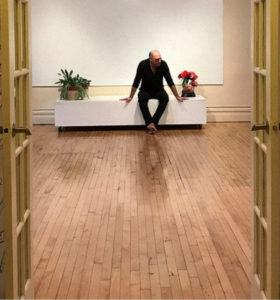
  • A Space for Memories

    This photo was taken on July 15th as I sat alone in the empty studio following the Breathing Project’s closing party. In the nearly two years leading up to this moment, I was asked innumerable times what I was feeling.  My stock reply was “everything,” and that pretty much sums up what you can see in this picture.

    I didn’t get too visibly emotional about the closing when other people were around, but at times like this, when I sat alone in that room, memories and feelings would often flood through me.  As it happens, I remember quite clearly what was on my mind at the moment my partner Lydia Mann snapped the photo.  I was thinking of my boys, and how this room was such a special place for most of their childhood.

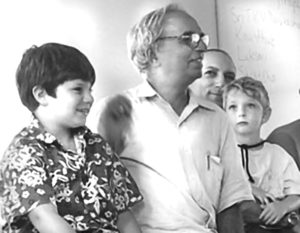
    I was remembering how, in the summer of 2003, my teacher Desikachar’s family joined my family, friends and colleagues for a small ceremony to help inaugurate our new studio.  Taken on that day,  this photo shows me and my teacher and my middle and youngest sons, Jai (8) and Sasha (3).  Afterwards at Vatan, our favorite Indian restaurant, Desikachar mischievously offered $20.00 to Jai if he would eat one of the hot chili peppers on the table.  Jai was game to try it, but I intervened.
    Back then I was splitting my time between New York City and Great Barrington, MA, and the boys would always enjoy their occasional weekend visits to NY, when they would camp out on the floor of the big room and watch movies I would project – cinema-sized – on the wall.  There were many times when our basket of Gertie Balls would cause a spontaneous game of dodgeball to break out.
    I also recalled how my oldest son Shaun would eventually become a work-study student in the 2014-2015 version of my Yoga Anatomy course – the sessions that were recorded for my online Principles course.

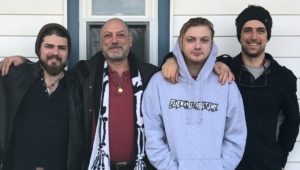
    Today, Desikachar is no longer with us, Shaun is 27, Jai is 22, Sasha (who wishes to be called Alex) just turned 18, I will be 60 in March and Amy Matthews’ Babies Project is creating a whole new generation of memories in that space.

    Happy New Year.  I hope 2018 creates memories that are as precious to you as the ones I’ve shared.

  • Hacking DST*

    Melted Metal Clock
    It must be a sign I’m getting old that I’m so inordinately tickled when I can extract a tiny favor from the space-time continuum.

    While teaching in England 2 weeks ago, we observed *Daylight Savings Time on the Sunday morning of my workshop by luxuriating in an extra hour of much needed sleep.  Since the USA observes DST a week later than the U.K., I got to sleep in again last Sunday. Though two hours of extra sleep in the space of one week may not seem like a big deal, it thrills me beyond measure that I won’t have to give back one of those hours next spring – I get to keep it for the rest of my life.

    Time, of course, always wins in the end –  but in my case it will have to wait an extra hour.

  • The Most Important Aspect of Therapeutic Yoga

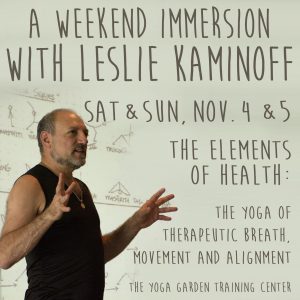
    I am looking forward to an upcoming event in the Philadelphia area – a return visit with our friends at The Yoga Garden in Narberth on the weekend of November 4 & 5.

    The topic for the weekend is one my favorites – “The Yoga of Therapeutic Breath, Movement and Alignment.” While prepping the workshop I came across some relevant writing I did, a chapter proposal for a handbook aimed at medical professionals. I hope it sparks your interest in continuing the discussion and, if you’re anywhere near Philadelphia, please come join us…there’s still some room in the workshop.

    From “Yoga Therapy — The Art of the Individual”

    When applying yoga in a therapeutic context, it is vitally important to remember that we do not treat conditions – we educate people.

    Our students are likely to have already seen several professionals whose job it is to focus on their problems. By contrast, the yoga educator’s focus should be on what’s still going right with a person, not on what has gone wrong — and there are always far more things still working in a person’s body than have stopped working. Even on the sickest, most pain-filled day of a person’s life, there are untold billions of unimpeded, cellular life processes happening within them. This is the biological basis of the concept of prana. As long as there’s prana, there can be improvement — not necessarily curing or fixing — but healing — what my teacher Desikachar referred to as “the relationship to their illness.”

    In any discussion about the place of therapeutic yoga in health care delivery, I assert that the principle expressed above is the most important to remember.  As long as we stay grounded in the perspective of what’s still going right, our scope of practice is profound and simple: if the person in front of us can breathe, move, and focus, even minimally, they can bring their breath, body and mind into a more integrated state and they can do yoga.

  • Podcast: “Even Yoga Masters Break Down Sometimes”

    OK, let me say right at the top that I did not choose the title of the podcast I did with the good folks at Curable Health.  I cringe whenever the word “master” gets thrown at a human, most especially if that human happens to be me.

    The best definition of “master” I’ve ever heard is: “A master is someone who is capable of creating another master.” This simple concept emphasizes the fact that mastery is a process that is never completed – that it involves passing knowledge freely from one generation to the next.  In other words, the word master is an ever-evolving verb for what a teacher does, not a fixed noun for what or who a teacher is.

    That aside, I am really quite pleased with how this interview came out.  Through the well-informed questioning of Laura Seago, I got to tell some very personal stories, some of which regular readers of this blog will have heard in a different context. From her description of the interview:

    “So what happened when he lost his breath for six months? When he lost control of his body? When he lost touch with his emotions? Join us as Leslie recounts his deeply personal journey to “mastery,” and shares what he’s learned about life, yoga, and the power of breath.”

    Have a listen to the podcast, and let me know what you think.  Also, check out the great app Curable has built for people suffering from chronic pain.  It’s based on the work of the recently deceased Dr. John Sarno, and I think it can help a lot of people.  For many years, I’ve been recommending Sarno’s books, but now, I have the option of sending them to Curable to have a more direct, interactive experience of his groundbreaking work.

    Lastly, if you’re anywhere near these showings of the wonderful documentary “All the Rage: Saved by Sarno,” rush out and see it.  It opens in L.A. tomorrow (August 11, 2017).